
Delegating Without Losing Quality of Care
Most physicians didn't struggle to learn delegation because they lacked confidence in their staff — they struggled because their entire training taught them the opposite lesson. In residency, the person who caught the missed detail, who double-checked the dose, who stayed to make sure the patient was actually okay, was you. That instinct kept patients safe for years, and it doesn't just switch off the day you open your own practice and suddenly need other people to carry real clinical weight. The good news is that safe delegation isn't a personality trait some doctors have and others don't — it's a system. Practices that hand off tasks without any drop in quality aren't staffed by braver physicians; they're staffed by physicians who built specific, written, testable structures around who can do what, when, and what happens the moment something falls outside that line. This article walks through exactly what those structures look like, so delegation stops feeling like a leap of faith and starts feeling like something you designed on purpose.

Figure 1. A written scope-of-practice document, not a verbal understanding, is what turns delegation into a repeatable, auditable system rather than a guess.
Why Delegation Feels Like a Risk to Your License, Not Just Your Time
Ask most physicians why they still room their own patients, draw their own labs, or personally call every abnormal result, and the honest answer usually isn't "I don't trust my staff." It's closer to a quieter, more specific fear: if something goes wrong on a task I handed off, I'm the one who signed the chart, I'm the one the board calls, and "my medical assistant was supposed to catch that" has never once worked as a defense. That fear is rational — physicians carry legal and ethical accountability for care given under their license in a way that doesn't map cleanly onto how delegation works in most other industries, where a manager who hands off a task simply isn't personally liable if it's done wrong.
The mistake isn't the caution itself — it's treating that caution as a reason to avoid delegating rather than a reason to build delegation properly. A restaurant kitchen doesn't let every line cook freelance the recipe from memory; it runs on standardized prep lists precisely because the head chef's name is the one on the door if a dish goes out wrong. Delegation done well doesn't remove your accountability — it's still your name on the chart — but it does let you extend your judgment through people and protocols you've deliberately trained and verified, rather than trying to physically be in three exam rooms at once. The rest of this article is about building exactly that kind of extension: not blind trust, and not doing everything yourself, but a specific, written, testable middle path.
There's also a version of this fear that has nothing to do with legal exposure and everything to do with identity. Many physicians chose this career in part because being the one who catches the detail, who personally makes sure nothing slips, is part of how they think of themselves as a good doctor. Handing that specific task to someone else can feel, quietly, like handing off a piece of what makes you good at your job — even when, rationally, the physician knows their actual clinical value lies in judgment calls no one else on the team is trained to make, not in personally taking every blood pressure reading. Naming that emotional undercurrent explicitly is often what allows a physician to actually let go of a task they've been unconsciously holding onto for reasons that were never really about patient safety in the first place.
The Scope-of-Practice Ladder: What Can Actually Be Delegated
The first mistake most practices make isn't delegating too much — it's delegating without ever writing down where the line actually is. "Use your judgment" is not a policy; it's an invitation for two different staff members to draw that line in two different places, usually discovered only after one of them draws it wrong. A useful way to think about this is as a ladder with three distinct rungs, each with a fundamentally different level of clinical judgment required, and each requiring a different kind of oversight before a task belongs on it.
The bottom rung is fully protocol-driven tasks: vitals, standard immunizations, basic wound care, point-of-care testing performed exactly as written. These carry low clinical judgment requirements because the "if this, then that" logic has already been decided by you in advance, not improvised in the room. The middle rung is tasks that require pattern recognition within a bounded scope — a medical assistant trained to recognize the specific red-flag vital signs that mean "get the physician now" during rooming, for example, is still not making a diagnosis, but they are exercising judgment about when their own competence ends. The top rung is anything requiring differential diagnosis, treatment decisions, or interpreting an ambiguous finding — and that rung, by definition, never leaves your hands, no matter how experienced your staff becomes. The point of naming these three rungs explicitly, in writing, is that it turns a vague anxiety ("can I trust them with this?") into a concrete, answerable question: which rung does this specific task sit on, and does this specific staff member have documented competency for that rung?
Where Most Practices Actually Get This Wrong
In practice, the failure point is rarely a staff member acting recklessly outside their training — it's usually a task that was never formally assigned to a rung at all, so it drifted upward informally over time. A medical assistant who's been with you five years starts fielding a slightly more clinical phone question here, a slightly more judgment-based triage call there, each individually reasonable in the moment, none of it ever written down or formally authorized. Eighteen months later, that person is functionally operating on the middle or even top rung of the ladder with no documented training, no competency check, and no protocol behind them — not because anyone decided that on purpose, but because nobody decided anything on purpose. The fix isn't distrust of tenured staff; it's the discipline of re-formalizing what's already happening, in writing, so tenure and trust get backed by an actual paper trail instead of just accumulated comfort.
A useful exercise, worth doing once a year even in a well-run practice, is simply asking every staff member to list, honestly, the things they currently handle that were never formally assigned to them. Most physicians are surprised by what surfaces — not because staff are overstepping maliciously, but because informal delegation happens constantly in a busy practice, one small favor and one reasonable-sounding exception at a time, and nobody is tracking the cumulative total. This exercise isn't about pulling responsibilities back; in most cases the right move is simply to formalize what's already working well, write the protocol that should have existed from the start, and verify competency on a task that, in practice, someone has already been safely performing for months.
Standing Orders and Protocols: The Safety Net Underneath Every Delegated Task

Figure 2. Direct observation paired with a signed competency checklist is what converts a one-time demonstration into a documented, reusable authorization.
A standing order is simply a pre-written, physician-signed instruction that authorizes a specific staff member to perform a specific action under specific conditions, without needing to ask you in real time for that particular instance. Instead of a medical assistant needing to interrupt you mid-visit to confirm "can I give the flu shot," the standing order has already answered that question in advance, for every patient who meets the criteria written into it — while also specifying exactly which situations fall outside it and require pulling you in immediately. This is the single most underused tool in small and mid-sized practices, not because physicians don't believe in it, but because writing the first one feels like a big, formal undertaking rather than something you can build incrementally, one task at a time, starting with whatever you currently interrupt your day for most often.
A well-written standing order has three parts, and skipping any one of them is where the safety net develops a hole. First, the exact criteria for who qualifies — age ranges, contraindications, specific vital sign thresholds, whatever narrows the population to genuinely low-judgment cases. Second, the exact action authorized, described specifically enough that two different staff members would perform it identically. Third, and most frequently missing, explicit escalation criteria: the specific signs that mean "this patient does not meet the standing order after all, stop, and get the physician." That third piece is what actually protects quality, because it's not really a document about what staff can do — it's a document about the exact moment staff must stop and hand a decision back to you.
Building Your First Standing Order Library, One Task at a Time
The practices that end up with a genuinely useful set of standing orders rarely wrote them all at once. They started with whichever single task interrupted the physician's day most often — often something as simple as a flu shot, a basic medication refill within defined parameters, or a specific point-of-care test — wrote one clear, three-part protocol for it, trained the team, ran it for a few weeks, and then moved to the next task. Trying to build a comprehensive protocol binder in one sitting is exactly the kind of project that feels so large it never actually gets started; picking one recurring interruption per month and formalizing it is a pace almost any practice can sustain, and after a year, that's twelve real protocols in place that weren't there before, each one immediately reducing a specific daily interruption.
Want your staff spending less time chasing down lab results and more time on the patient-facing work only they can do? LabsFive turns every report into a document your team can act on immediately — see it for yourself.
Create My Free AccountVerifying Competency Before You Hand Over a Task
Training someone once and delegating forever is where a lot of well-intentioned delegation quietly breaks down. A single demonstration tells you someone can perform a task while you're standing right there watching — it tells you almost nothing about whether they'll perform it correctly, consistently, six weeks later, on a busy Friday afternoon, with nobody checking. Competency verification is the deliberate, repeatable step that closes that gap, and it doesn't need to be elaborate to be real: direct observation with a signed-off checklist the first several times, a brief return-demonstration at set intervals afterward, and a low-friction way for the staff member themselves to flag "I'm not confident on this one" without it feeling like an admission of failure.
That last piece matters more than most practices give it credit for. If the only paths available to a staff member are "perform the task with total confidence" or "admit incompetence," most people will quietly choose the first option even when they shouldn't, simply because the second one feels professionally risky. A practice culture where "I want a second check on this one" is treated as good judgment rather than a weakness is one of the cheapest, most effective quality safeguards available — cheaper than any software, any additional staff hire, any policy binder — because it turns your entire team into people actively watching for the edge of their own competence instead of people quietly hoping they're within it.
Documenting Competency So It Survives Staff Turnover
The other reason a written competency record matters is less about the day it's created and more about the day, months or years later, when something goes wrong and you need to reconstruct exactly what that staff member was authorized to do and how their competency on that specific task was verified. Without a signed checklist with a date on it, you're left relying on memory — yours and theirs — which is a genuinely difficult position to be in during a complaint, an audit, or a malpractice inquiry. A simple, dated, signed competency log per employee, per task, is not bureaucratic overhead; it's the single piece of paper that turns "I trusted them" into something a licensing board, an insurer, or an attorney can actually verify.
Communication Systems That Prevent the Silent Handoff Failure

Figure 3. A visible, physical escalation reference at the point of contact gives staff a clear, low-pressure way to recognize when a call belongs with the physician.
Most delegation failures that actually reach a patient don't happen because a staff member did the wrong thing — they happen because information that should have moved from one person to another simply didn't, and nobody noticed the gap until it mattered. A patient mentions something concerning to the front desk while scheduling, and that detail never makes it into the chart or to you, because there was no structured, expected place for it to go. This is why healthcare handoff communication has become its own formal discipline, with structured formats like SBAR — Situation, Background, Assessment, Recommendation — designed specifically to make sure a handoff between two people transfers the same critical information every time, rather than whatever each person happens to remember to mention.
You don't need hospital-grade infrastructure to borrow the underlying principle. What matters for a small practice is simply this: every task you delegate should come with an equally clear, equally deliberate path for information to travel back to you, not just permission for the task to happen. A rooming protocol that tells a medical assistant what to check is only half the system; the other half is a specific, always-used method — a flagged note in the chart, a standardized verbal handoff before you enter the room, a physical color-coded card on the door — for surfacing anything unusual they noticed along the way. Delegation without a return channel isn't really delegation; it's just information loss with a plausible cover story.
A brief, real-world version of this in action: a medical assistant rooms a patient scheduled for a routine follow-up, and while checking vitals, notices the patient mention, almost in passing, a new symptom that has nothing to do with the visit's stated reason. Without a structured handoff habit, that comment might get mentioned to the physician only if the MA happens to remember, in whatever order feels natural, sometime during a rushed thirty-second exchange at the door. With a structured habit — even something as simple as a standing rule that any comment outside the visit's stated reason gets a specific flag in the chart before the physician enters — that detail reliably makes it into the room instead of depending on memory and timing. The system doesn't need to be elaborate to work; it needs to be the same, every single time, regardless of how busy the day is.
This same principle extends past the exam room. Front desk staff fielding a scheduling call, a billing question, or a prescription refill request are also, constantly, small handoff points where a detail worth a physician's attention can either get captured or quietly disappear. A patient who mentions feeling "just not right lately" while rescheduling an unrelated appointment is easy to miss if there's no expected place for that comment to land — but with a simple standing habit of flagging anything that sounds even slightly clinical for physician review, regardless of which staff member happens to take the call, that detail has a real chance of reaching you instead of getting lost in the routine business of running a front desk.
Monitoring Quality After the Task Has Been Handed Off
Writing a good protocol and verifying initial competency both happen before a task is delegated. The piece most practices skip is what happens afterward — the ongoing check that confirms the system is still working months later, not just on day one when everyone was paying extra-close attention. Without this step, quality erosion doesn't announce itself; it happens gradually, through small shortcuts that each individually seem harmless, until the actual practice on the floor has quietly drifted away from the protocol on paper.

Figure 4. A scheduled, recurring chart-review habit — not a one-time policy rollout — is what actually catches quality drift before a pattern becomes a problem.
A workable version of this doesn't require new software or a compliance department. It's a small, recurring habit: a random sample of delegated encounters reviewed every week or two, specifically checking whether the protocol was followed and whether escalation criteria were respected, not just whether the outcome happened to be fine. Outcomes are a misleading signal on their own, because a shortcut can go unnoticed for a long time before it happens to land on the one patient where it mattered — reviewing the process, not just the result, is what catches the drift while it's still small and easy to correct with a conversation rather than an incident report.
This audit habit also does something less obvious but equally valuable: it gives you a running, current picture of exactly how good your delegation systems actually are, instead of a picture frozen at the moment you first trained someone. Competence isn't static — a staff member can get better at a task over time, or, just as easily, can drift from the original protocol without realizing it, especially if their volume of a given task has grown quickly. A brief, regular review is what lets you catch either direction of change early enough to act on it.
What to Actually Track, Beyond a Gut Feeling
A useful audit doesn't need to measure everything — a small number of consistent, specific metrics tracked over time beats a large, vague checklist reviewed once and forgotten. Worth tracking for most delegated tasks: how often the documented escalation criteria were actually followed when a borderline case came up, how often a delegated note required a substantive correction rather than a routine co-signature, and how staff themselves rate their own confidence on a task at each check-in, since a dip in self-reported confidence often precedes a documentation problem by weeks. None of these require special software — a simple shared log, reviewed for ten minutes every couple of weeks, is enough to turn quality monitoring from a vague intention into an actual habit with a paper trail behind it.
The Graduated Autonomy Model
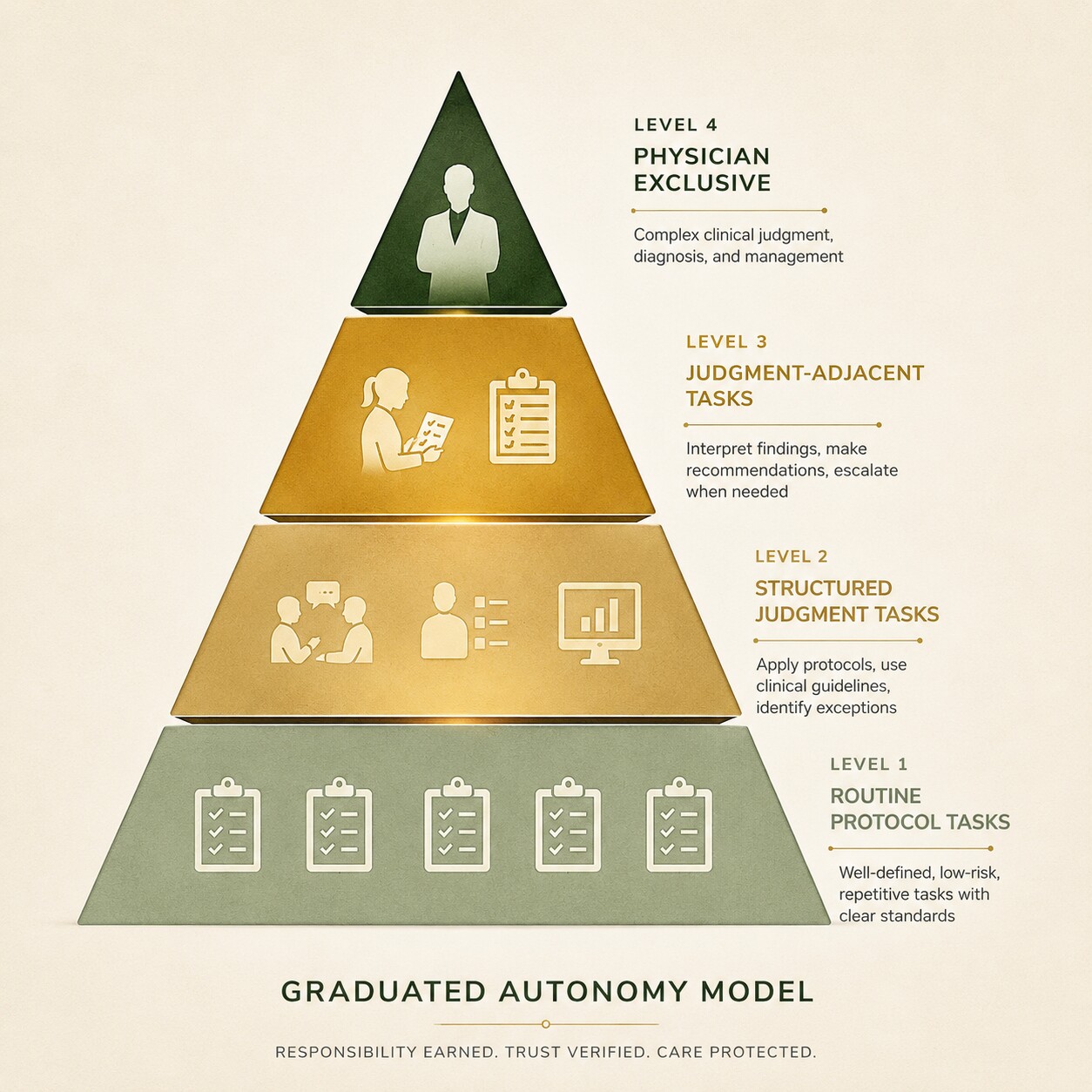
Figure 5. Autonomy that expands in small, verified steps up this tier structure protects quality far better than a single, all-at-once handoff of responsibility.
One of the most effective mental models for scaling delegation over time is one you already use constantly in a completely different context: how you supervised residents. Nobody hands a first-year resident an unsupervised complex case on day one, and nobody keeps a fourth-year resident permanently shadowed on tasks they mastered two years earlier. Responsibility expands in deliberate, verified steps, with autonomy earned through demonstrated competence rather than granted all at once out of convenience or tenure. Applying that exact same logic to your staff — rather than a binary "trusted" or "not trusted" — is what lets delegation grow safely over years instead of stalling permanently at whatever level felt comfortable the first month someone was hired.
In practice, this means each task on your scope-of-practice ladder should have its own visible progression: direct supervision, then supervision available but not present in the room, then fully independent within the written protocol, then — for your most experienced staff, on your lowest-risk tasks only — a level of informal judgment you're comfortable extending because years of audited performance have actually earned it. The mistake to avoid is skipping stages because someone seems ready, or freezing someone permanently at an early stage because change feels risky. Both failure modes come from the same root cause: treating autonomy as a feeling instead of something demonstrated and documented, one verified stage at a time.
It's worth being explicit with staff about which stage they're currently at on each task, rather than leaving it as something only the physician tracks silently. A medical assistant who knows they're one verified step away from working a task fully independently has a concrete, motivating target — and just as importantly, they know exactly what "not yet ready" means for them specifically, rather than experiencing a vague, unexplained ceiling on their responsibility. This transparency also protects the practice: if a staff member's actual behavior on the floor ever needs to be compared against what they were authorized to do, a documented stage on a documented ladder is a far stronger record than an informal, unwritten sense of how much everyone trusted them.
Common Failure Points Worth Naming Directly
A handful of specific mistakes account for most delegation problems that actually surface in practices, and naming them plainly makes them much easier to catch in your own operation. The first is delegating a task without ever delegating the authority to say no to a patient who's pushing for something outside the protocol — a medical assistant who technically knows the rule but has never been explicitly told "it's fine to hold your ground here, I will always back you up" will, under enough social pressure, eventually bend it. The second is a protocol that exists on paper but was never actually trained against realistic edge cases, only the clean textbook scenario, leaving staff genuinely unprepared the first time a real patient doesn't fit the pattern.
The third, and probably the most common, is treating delegation as a one-time event — a training day, a policy memo — rather than an ongoing system that needs the audit habit described above to stay accurate over time. And the fourth is a subtler cultural failure: a practice where mistakes are met with blame rather than a calm review of what part of the system let the mistake happen. That last one matters enormously, because a team that's afraid to report a near-miss will simply stop reporting them, which doesn't make your delegation system safer — it just makes its failures invisible to you until one of them reaches a patient.
A fifth, quieter failure point is delegating a task to whichever staff member happens to be available in the moment, rather than to whoever has actually been trained and verified on it. This tends to happen during short-staffed stretches, when a physician under time pressure reasonably assumes "someone competent enough is probably nearby" rather than checking who is specifically authorized. It's an understandable shortcut in the moment, but it's also exactly how a well-designed delegation system quietly stops matching reality — the protocol still says one thing, while the floor, under pressure, has started doing another. Naming this pattern explicitly, and having an agreed-upon fallback for short-staffed days (even if that fallback is simply "the physician absorbs the task that day rather than assigning it to someone unverified"), closes a gap that otherwise tends to open precisely on the days a practice can least afford a mistake.
What Safe Delegation Actually Buys You

Figure 6. A brief, structured verbal handoff before every visit is what closes the information gap that written protocols alone can't fully cover.
The reason this entire investment is worth making isn't abstract efficiency — it's what it actually frees you to do with the time it returns. Every task that moves safely off your plate through a verified protocol is time that goes somewhere: a longer conversation with a patient who needs one, an on-time schedule instead of a chronically backed-up one, or simply an end to the day that doesn't run two hours past when the last patient left. Physicians who build real delegation systems consistently report being able to see more patients without each visit feeling rushed, because the tasks that didn't require their specific judgment stopped competing for their specific attention.
There's also a retention argument that's easy to overlook. Capable staff who are trained, trusted, and given real, well-defined responsibility tend to stay considerably longer than staff who are kept permanently at arm's length from anything meaningful — being treated as capable of growth is, for most people, a significant part of what makes a job worth staying in. A practice that never delegates anything real isn't just leaving physician time on the table; it's also quietly training its best people to look for that growth somewhere else.
Finally, there's a quality argument that runs in the opposite direction from what most physicians initially assume. A physician stretched across every task in a visit — rooming, documentation, patient education, the clinical decision itself — has less attention available for the one part of the visit that actually requires a physician's training: the differential diagnosis and the treatment decision. Removing the lower-judgment tasks from that workload through a verified delegation system doesn't just save time in the abstract; it protects the mental bandwidth available for the highest-stakes moments of the visit, which is arguably the opposite of a quality tradeoff — it's a quality upgrade, achieved by making sure your attention is spent where your training actually adds the most value.
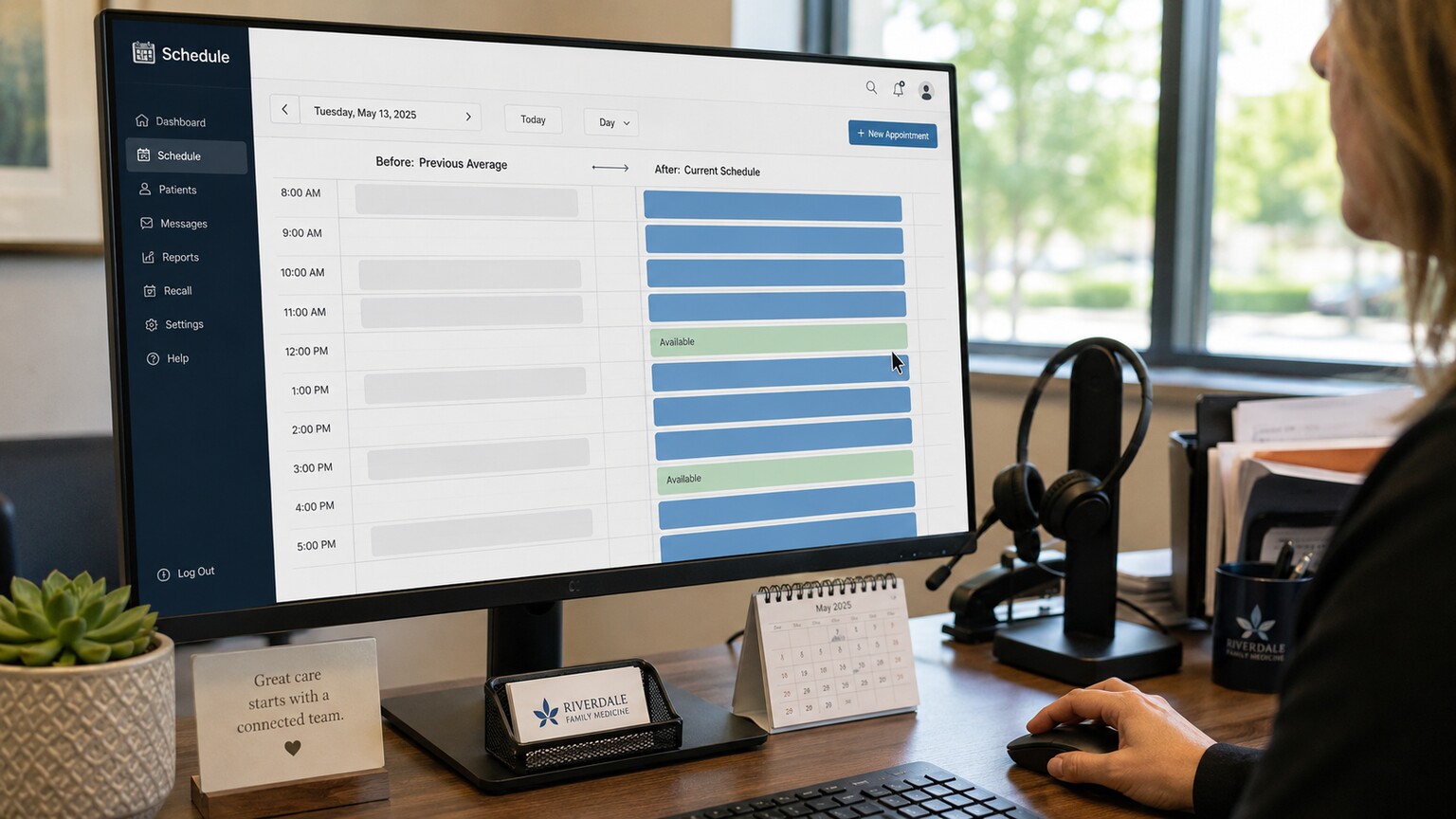
Figure 7. The visible payoff of a working delegation system shows up directly in schedule capacity — more appointment slots without a longer physician workday.
Frequently Asked Questions
How do I know if a task is actually safe to delegate?
Ask whether the task requires interpreting ambiguous or conflicting information to decide what happens next. If the answer is genuinely no — the steps and the decision criteria can be fully written down in advance — it likely belongs on the lower two rungs of the scope-of-practice ladder. If judgment about an unclear situation is required, it stays with you, regardless of how routine the task otherwise seems.
How often should competency actually be re-verified?
There's no universal number, but a reasonable default is a brief re-check at defined intervals — for example, a supervised return-demonstration every six to twelve months for lower-risk tasks, more frequently for anything higher-stakes or infrequently performed. The chart-audit habit described above should also be treated as an ongoing, lightweight form of continuous verification between those formal check-ins.
What if a staff member resists having their competency formally documented?
This is usually a sign the practice culture around documentation feels punitive rather than protective, and it's worth addressing directly rather than pushing the paperwork through anyway. Framing the record as protection for both the staff member and the practice — evidence they were properly trained and cleared, not a mark against them — usually resolves the resistance once it's clear the goal is a shared paper trail, not a performance trap.
Does building all of this take away from time actually spent seeing patients?
There's a real upfront cost — writing the first protocols and running the first competency checks takes hours you don't have to spare. But that cost is paid once per task, while the time saved from no longer personally handling that task, or re-explaining it verbally each time, repeats every single day afterward. Most practices that build this system report it paying for itself within the first few months.
Is delegation different in a solo practice with just one or two staff members?
The core principles are identical, just at a smaller scale — a two-person team still benefits from a written protocol and a documented competency check, arguably more so, since there's no larger team to catch an informal gap. The main difference is speed: a solo practice can usually build and adjust these systems faster, simply because there are fewer people to train and align on any given change.
What's the single best place to start if none of this exists yet in my practice?
Start with the one task that interrupts your day most often and already feels routine and low-risk in your gut — that instinct is usually correct, and it's the fastest way to get a real, working example in place. Write its three-part standing order, train and verify one staff member on it, run it for a few weeks, and only then move to the next task. A single working protocol teaches your team, and you, more about how to build the next one than any amount of planning in the abstract.
Conclusion
Delegation stops feeling risky the moment it stops being a leap of faith and starts being a system you built on purpose — a clear ladder of what belongs to whom, a written protocol underneath every handoff, a real competency check before autonomy is granted, a return channel for information to travel back to you, and a recurring habit of checking that the system is still working the way it was designed. None of that removes your responsibility for the care given under your license, and it isn't supposed to. What it does is let you extend your own judgment through people you've deliberately trained and verified, so your best clinical instincts reach every patient who needs them, not just the ones you personally have time to see yourself.
None of this needs to happen all at once, and trying to build it all at once is usually why it never gets built at all. Pick one task, write one protocol, verify one person, and let the system grow one deliberate step at a time — the same graduated, evidence-based approach you'd trust for a resident is exactly the approach that will hold up for your team.
Ready to Offer a More Complete Standard of Care?
Join the physicians using LabsFive to turn every lab result into a clear, professional, patient-ready report — start with free credits, no commitment.
Create My Free AccountThis article is for general informational purposes only and does not constitute legal, compliance, or employment advice. Consult qualified counsel regarding scope-of-practice regulations in your state.