
Why a High CA 19-9 Reading Alone Never Proves Pancreatic Cancer
A high number is a fact. "I have pancreatic cancer" is a conclusion. The gap between those two things is exactly what this article is about — not a rundown of which organs can push CA 19-9 upward (our companion piece on the specific benign causes covers that ground in mechanistic detail), but the actual reasoning a doctor walks through before they'll let a single elevated result move them from "worth investigating" to "diagnostic." That reasoning rests on statistics, not intuition: how often an elevated result in a given clinical setting turns out to be cancer versus something else entirely, and why a test built primarily to monitor disease that's already confirmed was never designed to hand down a verdict on its own.
Curious what your own lab results are really telling you? Upload them and get a complete, plain-language breakdown in under 15 minutes.
Analyze My ResultsWhat CA 19-9 Actually Measures, and Why It's an Imperfect Cancer Test
Most labs set the upper limit of normal for CA 19-9 at 37 U/mL, though the exact cutoff can shift slightly depending on which assay a particular lab uses. Above that line, doctors describe the result as "elevated" — a word that simply means the number is outside the statistical range, not that it has already been interpreted as anything specific. In people who already have symptoms suggestive of pancreatic cancer, CA 19-9 correctly identifies roughly 79% to 81% of true cases (its sensitivity) and correctly rules out roughly 82% to 90% of people who don't have it (its specificity) at that 37 U/mL threshold. Those numbers sound reasonably strong until you consider what they mean in practice: a meaningful share of people without cancer will still test positive, and a meaningful share of people who do have early-stage cancer will still test negative — CA 19-9 is elevated in only around 40% of Stage I pancreatic cancers, since small, early tumors often haven't grown enough to shed much of the antigen yet.
It helps to see what that actually looks like with real numbers rather than percentages alone. Pancreatic cancer is genuinely rare in the general population — even generous estimates put it at well under 1% of people at any given time. Picture a hypothetical group of 10,000 people with no symptoms, run through CA 19-9 with no other context: roughly 10 to 15 of them might actually have early pancreatic cancer, and at 80% sensitivity, the test would correctly flag maybe 8 to 12 of those. But at 90% specificity, out of the roughly 9,985 people who don't have cancer, about 998 of them would still test positive anyway. That means the large majority of "elevated" results in this scenario belong to people without cancer, not because the test is broken, but because the disease itself is so uncommon relative to how often benign causes trigger the same signal. This exact math is the reason doctors reserve the test for people who already have symptoms, risk factors, or a suspicious finding — using it in a population where cancer is genuinely likely changes those odds dramatically in the test's favor.
It Isn't Just Cancer That Sheds This Protein
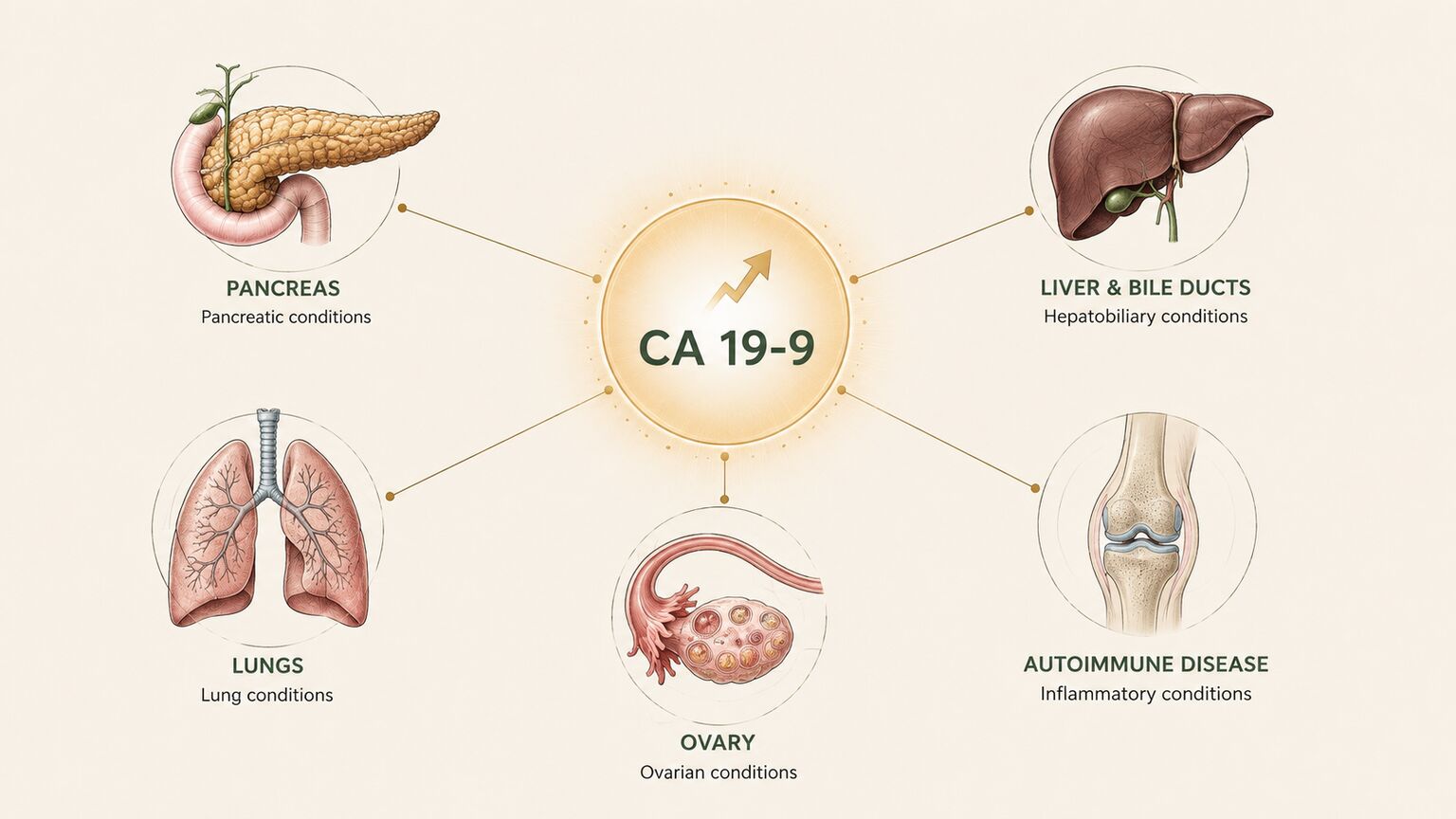
Because CA 19-9 is produced by ordinary, healthy tissue turnover in several organs, almost anything that irritates or obstructs those organs can push the number up. For a full breakdown of exactly how each one does it, see our companion article on the specific mechanisms behind benign CA 19-9 elevation — in short, documented benign causes include:
- Gallstones and bile duct stones (choledocholithiasis) — a stone blocking the bile duct is one of the most common benign triggers of a dramatically elevated result.
- Acute or chronic pancreatitis — inflammation of the pancreas itself, independent of any tumor.
- Cholangitis — infection or inflammation of the bile duct system.
- Cholestasis and jaundice from any cause — anything that slows or blocks the normal flow of bile.
- Acute hepatitis and chronic liver disease, including cirrhosis — a liver working under strain clears CA 19-9 from the bloodstream less efficiently.
- Diabetes mellitus — a well-documented, if less intuitive, cause of mild-to-moderate elevation.
- Interstitial lung disease — CA 19-9 is also expressed in lung tissue.
- Autoimmune and collagen vascular diseases, and thyroiditis — general inflammatory and autoimmune activity can raise it.
- Gynecological conditions — endometriosis and certain benign ovarian cysts, including mucinous cystadenomas and dermoid cysts (teratomas), have all been documented to elevate CA 19-9 in the complete absence of any malignancy.
The mechanism behind several of these entries is worth understanding rather than just memorizing, because it explains why the list is so much longer than most people expect. Diabetes and autoimmune conditions don't obstruct anything physically, but ongoing inflammation and altered handling of glycoproteins throughout the body appear to nudge CA 19-9 production upward even in tissue nowhere near a tumor. Endometriosis and mucinous ovarian cysts work through a more direct route: research using tissue staining has shown that the glandular cells lining these benign growths bind strongly to CA 19-9 antibodies, meaning the cyst tissue itself is actively producing the antigen, the same way pancreatic or bile duct tissue would, just for entirely non-cancerous reasons. In one specific case, a large benign ovarian dermoid cyst was even flagged as a possible sign of ovarian torsion specifically because of how sharply it had driven CA 19-9 upward — a reminder that this marker responds to inflamed or mechanically stressed tissue in general, not to malignancy specifically.
None of this means an elevated result should be dismissed — it means the number, by itself, is a starting question rather than a finished answer.
Why Jaundice and Liver Problems Specifically Push This Number Up
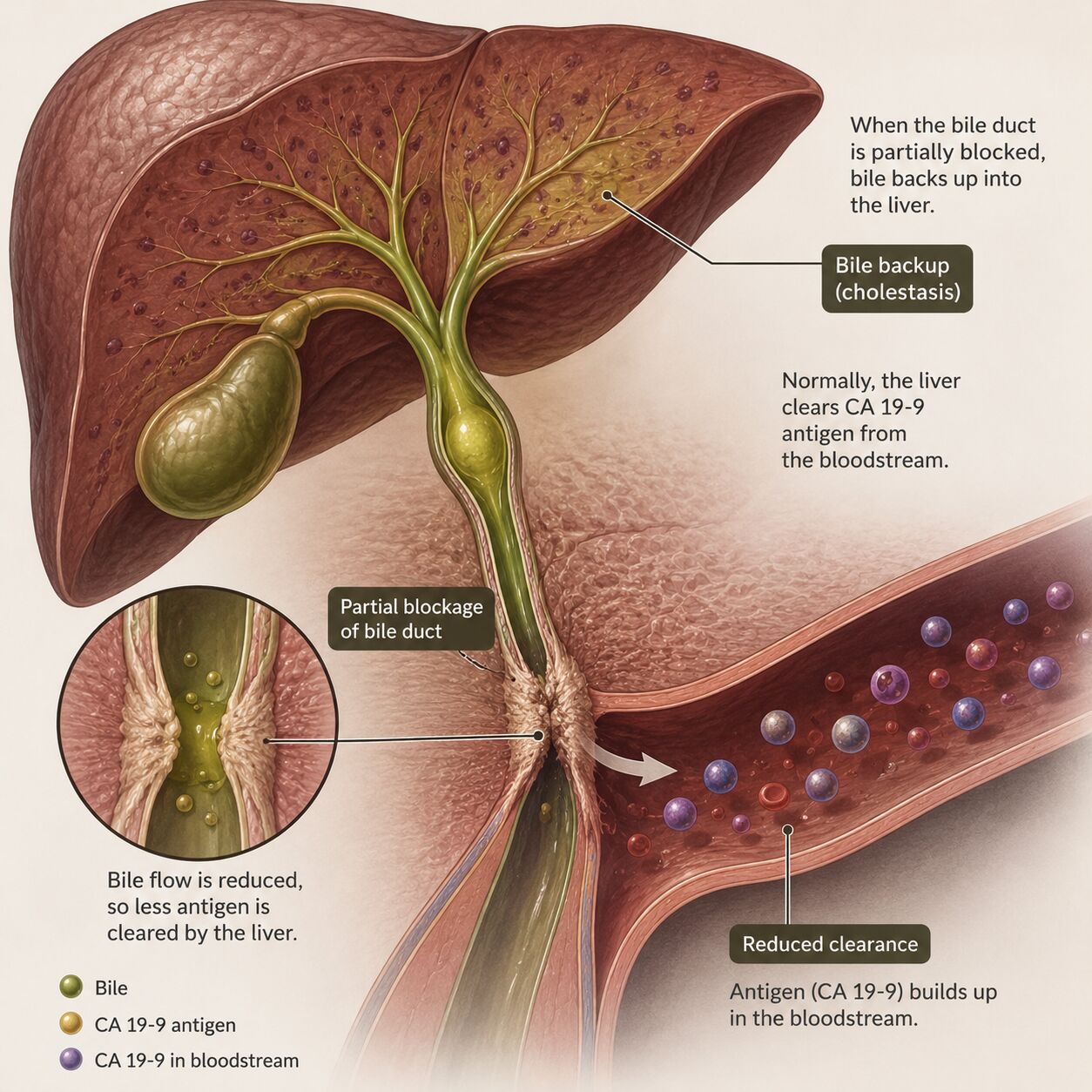
Cholestasis and jaundice deserve their own explanation, because they're among the most common benign drivers of a genuinely high number, sometimes dramatically so. Under normal conditions, the liver plays a quiet but essential role in clearing CA 19-9 out of the bloodstream. When bile flow is blocked or slowed — whether by a gallstone, a stricture, or inflammation — that clearance process breaks down, and the antigen accumulates in the blood the same way other substances the liver normally filters out will build up during jaundice. On top of that, liver cells under this kind of strain appear to degrade the antigen less efficiently even before it's cleared. Bilirubin, the pigment responsible for the yellowing of jaundice, tends to rise and fall in step with CA 19-9 in exactly these situations, which is one of the clues doctors use to recognize when an elevated result is being driven by cholestasis rather than a tumor.
In practice, this is part of why a full liver panel is usually drawn alongside CA 19-9 rather than the marker being ordered in isolation. If bilirubin and alkaline phosphatase are also elevated on the same blood draw, that pattern points more strongly toward a bile-flow problem than a tumor, and some clinicians will wait to see whether CA 19-9 falls once the obstruction is treated — with a gallstone removed or a bile duct stent placed, for example — before drawing any further conclusions. A CA 19-9 that drops back toward normal once bile flow is restored is a strong argument that cholestasis, not cancer, was driving the original number.
"But My Number Was Really High" — Why That Still Isn't Automatic Proof
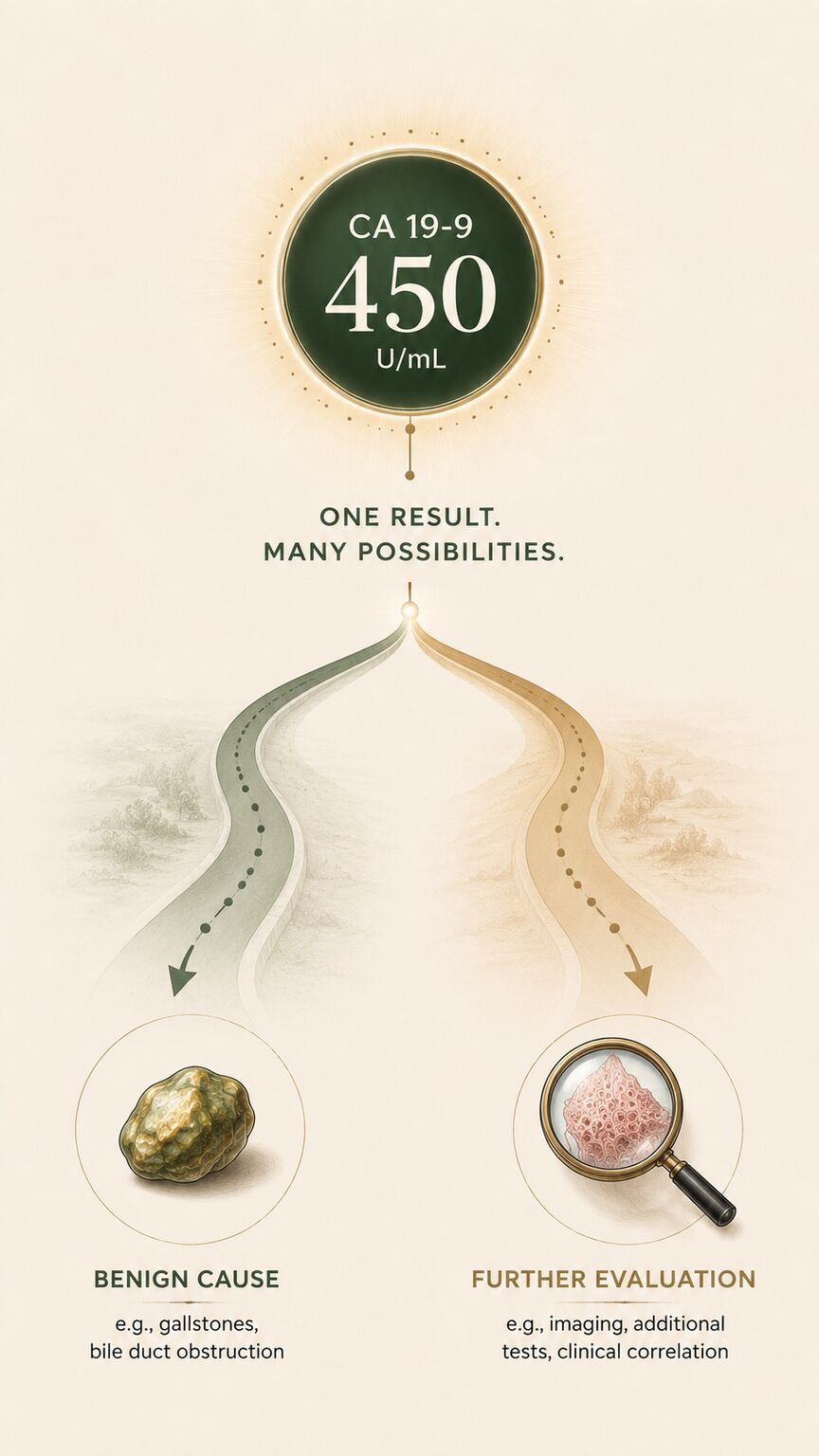
It's a fair instinct to assume that a dramatically high number must mean something serious, and there's real truth in it: research shows that once CA 19-9 climbs above 1,000 U/mL, its specificity for pancreatic cancer rises to about 99.8%, meaning a result that high is far more likely to reflect a real, significant problem than a borderline one just over 37 U/mL. But "far more likely" isn't the same as "certain," and documented case reports exist of benign conditions — common bile duct stones, acute cholangitis, acute pancreatitis, poorly controlled diabetes, and cirrhosis among them — pushing CA 19-9 above 1,000 U/mL with no cancer present at all. At that same very high cutoff, sensitivity for cancer actually drops to around 41%, since many real, confirmed pancreatic cancers — especially smaller or earlier ones — never climb anywhere near that level in the first place. Put simply: an extremely high number raises the stakes of the conversation, but it still has to be interpreted alongside imaging and clinical context rather than read as a verdict on its own.
Curious what your own lab results are really telling you? Upload them and get a complete, plain-language breakdown in under 15 minutes.
Analyze My ResultsWhy This Was Never Designed to Be a Screening Test
Given everything above, medical guidelines are explicit that CA 19-9 should never be used to screen the general, symptom-free population for pancreatic cancer. The reasoning is a straightforward numbers problem: pancreatic cancer is relatively rare, so even a test with reasonably good specificity will still generate far more false alarms than true detections when it's applied broadly to people who have no symptoms and no elevated risk. Run this test on a large, healthy population, and the vast majority of the "positive" results that come back will belong to people with one of the benign conditions listed earlier — not cancer — while still missing a meaningful share of the early cancers that are actually present. That tradeoff is exactly why CA 19-9 is reserved for people who already have symptoms, imaging findings, or a known diagnosis it can help monitor, rather than offered as a general checkup add-on.
This is also why you'll rarely see CA 19-9 included on a routine annual bloodwork panel the way cholesterol or glucose often are. Where it earns its place is in a narrower, more deliberate set of situations: monitoring someone already diagnosed with pancreatic or biliary cancer to see whether treatment is working, helping distinguish a suspicious pancreatic mass from a benign one when combined with imaging, or investigating a specific, unexplained symptom pattern a doctor is actively trying to solve. Used that way, in a population where the odds of cancer are already meaningfully higher than the general public, the same test performs far better than it would as a blind, population-wide screen.
How Doctors Actually Use This Number: Trend, Not a Single Reading
In real clinical practice, a single CA 19-9 result is treated as one data point, not a final answer. Current oncology guidance calls for retesting roughly every 3 to 6 months during active monitoring, precisely because the direction a number moves over time carries far more information than where it sits on any one given day. A steadily declining trend after treatment typically signals a good response; a number that holds steady or climbs again after initially dropping is a more concerning pattern, and one that often shows up before it becomes visible on a CT or MRI scan. CA 19-9 is also frequently interpreted alongside CEA, another tumor marker sometimes used for digestive-system cancers, and always alongside imaging and the person's actual clinical picture — symptoms, exam findings, and history — rather than as a standalone number floating in isolation.
Research into this marker hasn't stood still either. Newer approaches under active study combine CA 19-9 with other emerging signals — circulating tumor DNA shed into the blood, exosomal markers released by tumor cells, and broader metabolite or protein signatures — in an effort to build a more accurate picture than any single marker can offer alone. None of that changes how CA 19-9 is used today, but it's part of why a mildly abnormal, isolated result on a single draw is treated so differently from a rising trend confirmed across several tests and supported by imaging: the field itself is moving toward triangulating multiple signals rather than leaning harder on any one of them.
The Small Group Who Can't Produce This Marker at All
It's worth knowing that this cuts both ways: roughly 5% to 10% of people are genetically unable to produce CA 19-9 in the first place, a trait tied to what's known as Lewis-negative blood group status. For that group, the marker can stay low or undetectable even in the presence of real, advanced disease, which is a very different situation from the benign-elevation causes covered above — one is a signal that's misleadingly loud, the other is a signal that never sounds at all. Neither situation reflects a flaw in the person; both simply reflect the biological reality that CA 19-9 depends on machinery some bodies build differently than others. If your family history or clinical picture raises this question, our related article on who can't naturally produce CA 19-9 covers that scenario in depth.
What to Ask Your Doctor If Your CA 19-9 Came Back High

A short, specific list of questions tends to get you further than a long, anxious one. It's worth asking directly whether anything else in your history — gallstones, liver disease, diabetes, a recent infection — could plausibly explain the number on its own. Ask whether a repeat test is planned, and on what timeline, since a second value gives your doctor something to compare against rather than a single isolated point. Ask whether imaging is being ordered alongside the blood work, since CA 19-9 is never meant to stand alone in this kind of workup. And if the number is only mildly elevated with no other red flags, it's entirely reasonable to ask plainly what would need to change before this becomes something to actively worry about, versus something to simply monitor.
It's also worth asking about your bilirubin and liver function results from the same blood draw, if they were checked, since a simultaneously elevated bilirubin is one of the clearer signs that cholestasis, rather than a tumor, is the more likely explanation. And if you're a woman with a known ovarian cyst or a history of endometriosis, mentioning that directly is worthwhile even if your doctor doesn't ask — it's exactly the kind of detail that can reframe how an elevated result should be read.
When an Elevated CA 19-9 Does Warrant a Closer Look
None of this is meant to suggest an elevated result should be waved away. A few patterns genuinely do raise the level of concern and typically prompt further workup: a result that keeps climbing across repeat tests rather than settling or falling, a very high number with no clear benign explanation on history or basic bloodwork, and — most importantly — an elevated CA 19-9 that lines up with a suspicious finding on a CT or MRI scan. New or worsening symptoms alongside the number matter too: unexplained weight loss, persistent abdominal or back pain, or new-onset jaundice without an obvious gallstone or infection behind it all shift the picture meaningfully, even at a moderately elevated result. It's the combination of the number, the trend, the imaging, and the symptom picture together that carries real diagnostic weight, which is exactly why a thorough doctor will always look at all four before drawing a conclusion from any one of them alone.
Frequently Asked Questions
What CA 19-9 level is considered normal?
Most labs use an upper limit of 37 U/mL, though the exact cutoff can vary slightly by lab and testing method. A result above that line is flagged as elevated, which prompts further evaluation rather than an automatic diagnosis.
Can gallstones alone cause a very high CA 19-9 result?
Yes. Bile duct stones and the cholestasis they cause are among the most well-documented benign causes of a dramatically elevated CA 19-9, sometimes well above 1,000 U/mL, with no cancer present.
If my CA 19-9 is over 1,000 U/mL, does that mean I have cancer?
Not automatically, though it does meaningfully raise the level of concern. Levels that high are highly specific for cancer, but documented benign cases — including bile duct stones, pancreatitis, and cirrhosis — have reached that range too. Imaging and clinical context are needed to tell the difference.
Why isn't CA 19-9 used to screen everyone for pancreatic cancer?
Because pancreatic cancer is relatively uncommon and CA 19-9 isn't specific enough on its own, screening the general population would produce far more false alarms than real detections, while still missing many early-stage cancers. It's used for people with symptoms or a known diagnosis, not as a general checkup test.
How often should CA 19-9 be retested if it comes back elevated?
Current oncology guidance generally calls for retesting roughly every 3 to 6 months during active monitoring, since the trend over multiple tests is far more informative than any single result on its own.
Can endometriosis or an ovarian cyst really cause an elevated CA 19-9?
Yes. Tissue studies have shown that the cells lining endometriotic and certain mucinous ovarian cysts actively produce CA 19-9 themselves, entirely independent of any malignancy. It's a well-documented, if lesser-known, benign cause worth mentioning to your doctor if it applies to you.
Conclusion
An elevated CA 19-9 is a genuine signal worth taking seriously, but it's a signal with a long list of possible senders — gallstones, pancreatitis, liver disease, diabetes, autoimmune conditions, and several gynecological conditions among them — not a direct readout of cancer. Even very high numbers have documented benign explanations, and even some real, confirmed cancers never push the number high at all. The number only becomes genuinely useful once it's read together with your history, a repeat test to establish a trend, and imaging where appropriate — which is exactly the kind of full-picture interpretation worth asking your doctor for directly, rather than searching a single number in isolation and assuming the worst before that fuller picture exists.
Still Not Sure What Your Results Mean?
Upload your labs and get a complete, visual, plain-language interpretation of every biomarker — delivered to your inbox in under 15 minutes.
Get My ReportThis article is for educational purposes only and does not constitute medical advice. Always consult your healthcare provider regarding your specific lab results.