
Understanding How CA 19-9 Is Used to Monitor Treatment
Once pancreatic cancer has actually been diagnosed, CA 19-9 stops functioning the way it does earlier in the process. It's no longer a single number being checked for a red flag — it becomes a running measurement, drawn again and again over months or years, watched for direction rather than read in isolation. That shift in purpose changes almost everything about how the number should be interpreted, and it's a distinction that often gets lost between the diagnosis conversation and the treatment plan that follows it. Here's exactly how oncology teams actually use this marker at each stage — before treatment starts, during chemotherapy, immediately after surgery, and for years afterward — and what the changing number is really telling them at each point.
It helps to name this shift explicitly, because it's easy to carry the wrong mental model forward from earlier testing. Before a diagnosis, the central question about CA 19-9 is essentially "is this number a problem?" After a diagnosis, that question has already been answered by biopsy and imaging, and CA 19-9's job changes entirely — from raising a question to tracking an answer that's already known and confirmed. Everything that follows in this article is built on that distinction.
Step One: Establishing a Baseline Before Treatment Starts
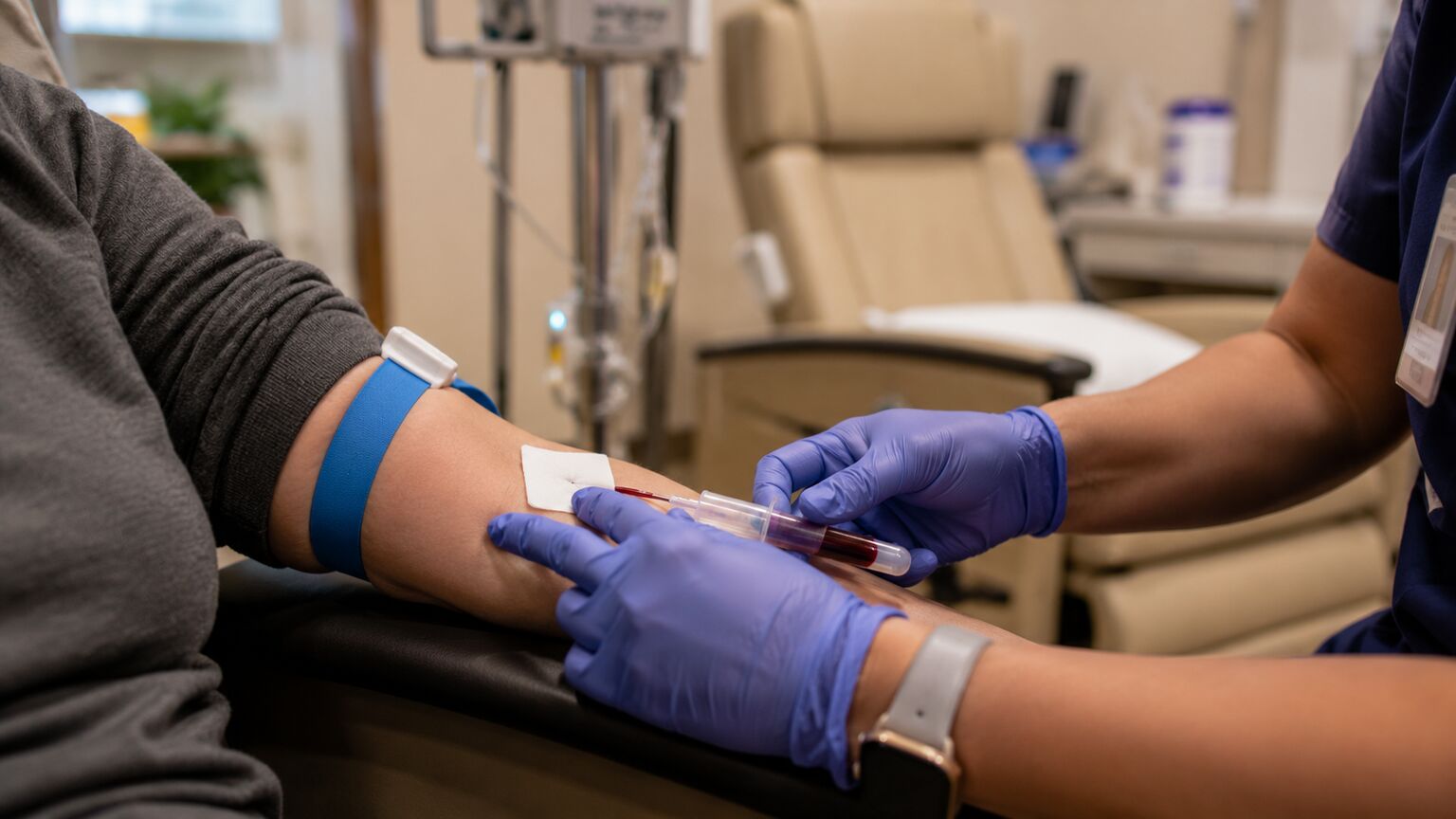
Before any treatment decision is finalized, oncology teams draw a CA 19-9 level and record it as the baseline — the number everything afterward gets compared against. This single early step is what makes every later measurement meaningful; without it, a future result is just another isolated number with nothing to be judged against. If a person happens to be one of the roughly 5% to 10% of people who are Lewis-negative and simply can't produce CA 19-9 at all, that becomes clear at this stage too, since their baseline will already read low or undetectable regardless of tumor burden — a distinction covered in more depth in our related article on who can't naturally produce CA 19-9. For that smaller group, the team simply knows from day one that CA 19-9 won't be a useful tool for them going forward, and leans more heavily on imaging instead.
The baseline number itself also carries some independent prognostic information, separate from anything that comes later. A very high starting value before treatment has begun generally correlates with a larger overall tumor burden, and some research groups use the baseline number, alongside imaging, to help estimate how extensive the disease is likely to be even before treatment starts working one way or the other. That's part of why this first draw is treated as more than a formality — it's the anchor point for a story that will be told entirely in comparison to it, for however long that story runs.
Watching the Number During Chemotherapy
For patients receiving chemotherapy, radiation, or targeted therapy for locally advanced or metastatic disease, CA 19-9 is typically rechecked every 1 to 3 months throughout active treatment, with some protocols spacing it closer to every 4 to 8 weeks. The logic is straightforward: a tumor that's shrinking under effective treatment generally produces less CA 19-9, so a falling number across these repeat draws is a genuinely encouraging sign, even before it shows up clearly on a scan. Research following patients on frontline chemotherapy for metastatic pancreatic cancer found that those whose CA 19-9 dropped by more than 20% from their baseline within the first 8 weeks of treatment had significantly better median survival than those whose levels rose or fell by less than that amount — a difference substantial enough that this specific threshold has become a genuinely useful early signal oncologists watch for.
What matters here isn't just whether the number is higher or lower than last time, but how quickly and how consistently it's moving — a concept researchers sometimes describe as CA 19-9 "velocity." Two patients could both show a falling number at the three-month mark, but one whose level has been dropping steadily draw after draw tells a more reassuring story than one whose number fell once and then plateaued or bounced back up. This is part of why oncologists rarely react strongly to any single data point during active treatment, and instead wait to see the shape of the whole curve as more draws accumulate.
What a Falling Number Really Means (and What It Doesn't)
A meaningful drop in CA 19-9 during treatment has also been linked to something very concrete: a better chance of the tumor becoming eligible for complete surgical removal, known as an R0 resection, in patients whose cancer wasn't initially operable. That's a genuinely important piece of information, since surgery remains the treatment most closely tied to long-term survival for pancreatic cancer. But a falling number is still a marker of probability, not a guarantee, and it isn't read on its own — a declining CA 19-9 alongside a scan showing the tumor is actually shrinking is a much stronger combined signal than either one by itself. This is also precisely why the 2025 NCCN guidelines are explicit that any rise in CA 19-9 during treatment should be confirmed radiologically before it's treated as evidence of tumor progression, since a temporary bump can come from something entirely unrelated to the cancer itself, like a brief bile duct blockage or an infection.
This works in the other direction too, and it's worth knowing so a stable or slightly rising number doesn't feel like an automatic setback. Some effective treatments cause enough tissue breakdown in the tumor itself that CA 19-9 can bump up briefly right after a new therapy starts, before settling into a genuine downward trend over the following cycles. Oncologists are generally aware of this pattern and won't necessarily change course based on one early uptick — it's part of why the full sequence of measurements matters more than any single point plotted along the way.
Curious what your own lab results are really telling you? Upload them and get a complete, plain-language breakdown in under 15 minutes.
Analyze My ResultsAfter Surgery: Why the First 4 to 6 Weeks Matter So Much
CA 19-9 clears from the bloodstream fairly quickly on its own — its half-life is only around 14 hours — which is exactly why the timing of the first postoperative measurement matters so much. Checking it too early, while the body is still processing tissue disruption from the surgery itself, can produce a misleadingly high number that has nothing to do with how much tumor was actually left behind. Because of this, the standard practice is to wait roughly 4 to 6 weeks after surgery before drawing that first postoperative level, giving the body enough time to settle so the number actually reflects what surgery accomplished. That single measurement carries real weight: research has found that patients with a postoperative CA 19-9 under 37 U/mL had a 49% three-year survival rate, compared to 38% for those under 200 U/mL, and close to 0% in that study for those above 500 U/mL — a striking illustration of how much information sits inside that one carefully timed number.
It's worth sitting with why that pattern exists rather than just the numbers themselves. A pancreatic tumor is rarely removed with mathematical precision down to the last cell — microscopic disease can remain even after a surgeon achieves what looks, to the naked eye, like a complete resection. A postoperative CA 19-9 that stays elevated is one of the few tools available for detecting that residual disease before it's large enough to see on any scan, which is exactly why this single blood draw, timed correctly, gets treated with so much clinical weight in the weeks immediately following surgery.
Why Normalization Within 6 Months Is Such a Big Deal
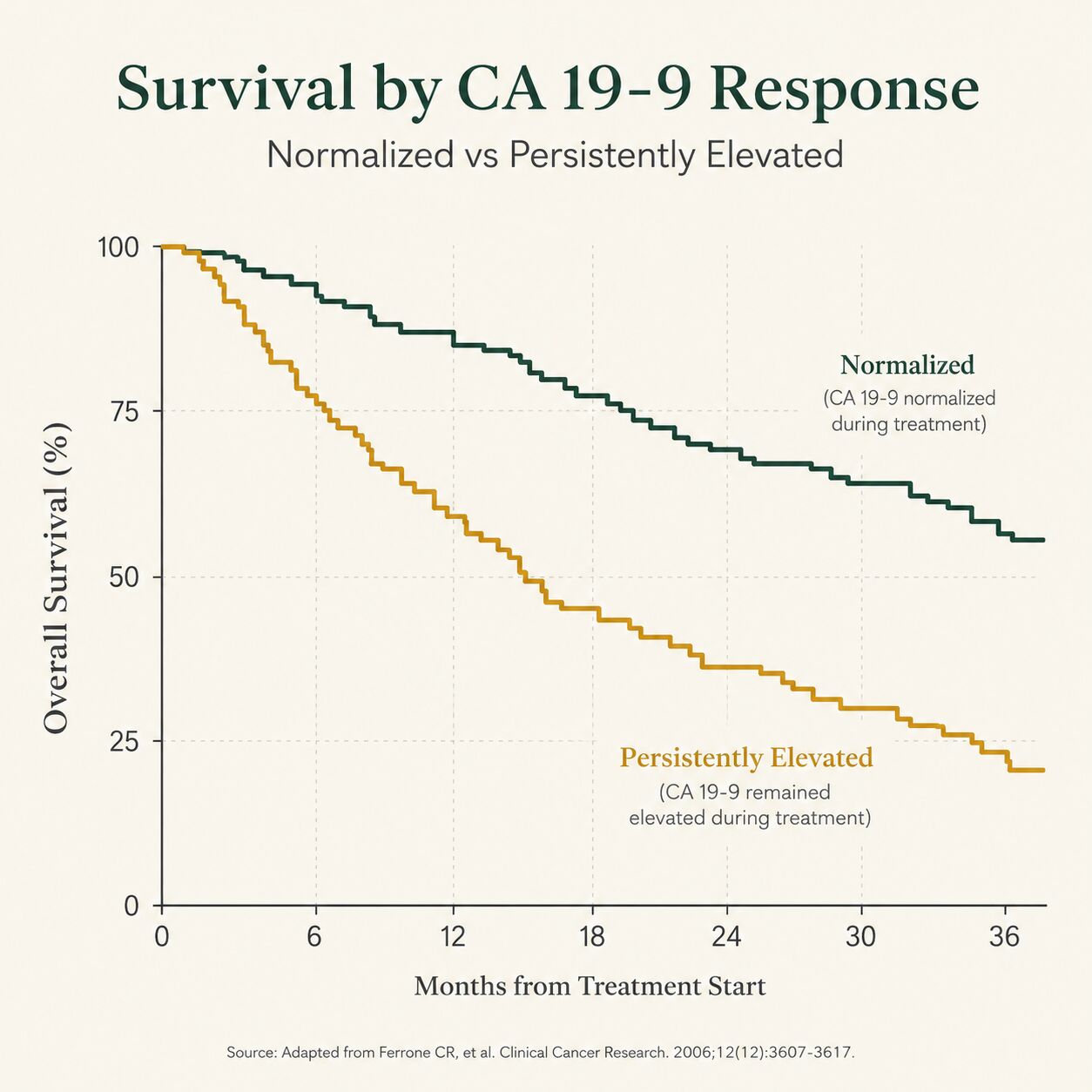
The postoperative story doesn't end with a single measurement, though. Whether CA 19-9 actually returns to the normal range within the first six months after surgery turns out to be one of the strongest prognostic signals available at this stage. Patients whose levels normalized within that window had a median survival of roughly 29.9 months, compared to about 14.8 months for those whose levels stayed elevated — and research has gone as far as describing a failure to normalize within six months as carrying a prognostic weight roughly comparable to already having metastatic disease. That's a sobering comparison, but it's also exactly why this specific checkpoint gets so much attention from oncology teams: it's one of the clearest single data points available for understanding how surgery actually went at a biological level, beyond what the operating surgeon could see with their own eyes in the room.
For patients and families, this means the six-month mark after surgery is worth treating as a genuine milestone in its own right, not just another routine follow-up visit on the calendar. It's a natural point to ask directly where the numbers stand and what they mean for the plan going forward, rather than waiting for that information to come up unprompted.
Long-Term Surveillance: Catching a Recurrence Before It Shows Up on a Scan
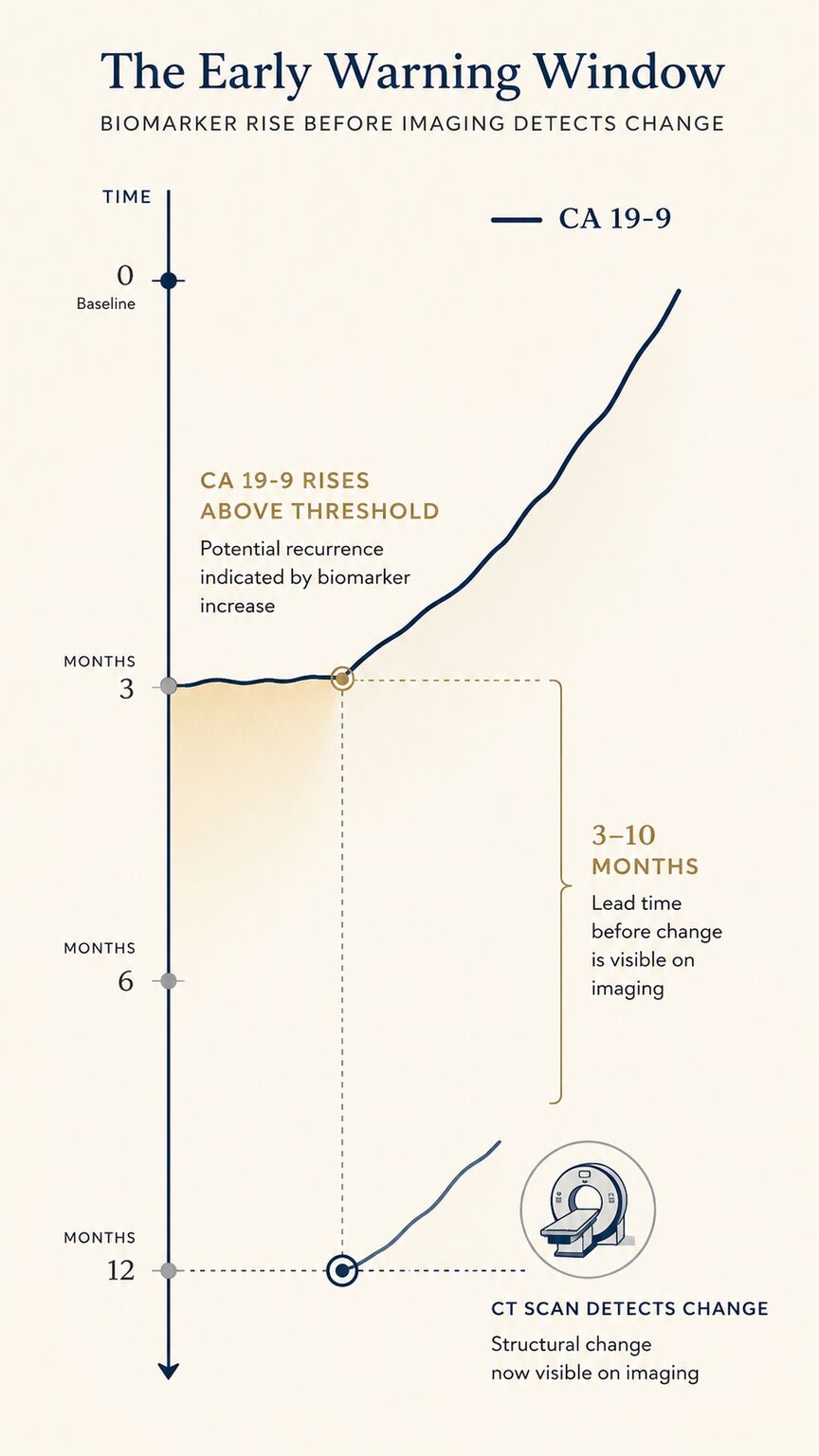
Once active treatment ends and a patient moves into long-term surveillance, CA 19-9 continues to earn its place in the follow-up schedule, typically checked every 1 to 3 months and coordinated alongside CT scans usually spaced every 3 to 6 months. What makes this phase particularly valuable is timing: research tracking recurrence has found that a rising CA 19-9 can precede radiological evidence of recurrence on imaging by roughly 3 to 10 months, depending on the study, and that around 88% of patients who do experience a recurrence show a clear CA 19-9 elevation as part of that picture. The most well-validated signal used in this setting is a 2.6-fold relative increase from a patient's own first postoperative value — a threshold specific enough that it functions less like a vague warning sign and more like a genuine early-detection tool, often surfacing a problem months before it becomes visible on a scan.
Using a relative threshold tied to each patient's own postoperative number, rather than a single fixed cutoff applied to everyone, matters because "normal" already looks different from one patient to the next at this stage. Someone whose CA 19-9 normalized to 8 U/mL after surgery and someone whose level settled at a still-normal 30 U/mL are both considered to have a good postoperative result, but a rise to 60 U/mL means something very different for each of them proportionally. Anchoring the warning threshold to each person's own baseline, rather than to the general population's reference range, is what makes this kind of surveillance genuinely personalized rather than a one-size-fits-all cutoff.
Why a Rising Number Still Needs a Scan to Confirm It
Even with all of that predictive power, a rising CA 19-9 during surveillance is never treated as proof of recurrence on its own. The 2025 NCCN guidelines are direct about this: an elevated result can still reflect biliary obstruction, infection such as cholangitis, or inflammation entirely unrelated to cancer, even in a patient with a history of pancreatic cancer. This isn't a flaw specific to survivorship monitoring — it's the same underlying limitation that applies to CA 19-9 at every stage, simply carrying higher stakes once a person already has a cancer history layered on top of it. In practice, this means a rising number during surveillance functions as the trigger for a confirmatory scan, not as a diagnosis delivered over the phone. It's genuinely useful precisely because it prompts that closer look early, not because the number is ever meant to stand entirely on its own.
This is also why a single elevated draw during surveillance doesn't typically trigger an immediate scan on its own, either — many centers will repeat the blood test first, since a value driven by something transient like a mild, self-resolving infection often settles back down on a second draw within a few weeks. A number that's confirmed elevated on a repeat test, or one that keeps climbing across two or more consecutive draws, is what actually escalates the workup toward imaging. This two-step approach helps avoid sending someone for an unnecessary scan, and the anxiety that comes with it, over what turns out to be a single noisy data point.
The Built-In Limitation: Not Everyone's Cancer Can Be Tracked This Way
It's worth returning to the Lewis-negative point raised earlier, because it matters just as much during monitoring as it does at diagnosis. For patients who can't produce CA 19-9 at all, none of the surveillance strategies described above apply in the same way — a flat, low number carries no reassurance for this group, since it was never capable of moving in the first place. Oncology teams typically identify this pattern early, either through direct testing or simply by noticing that CA 19-9 stayed near-zero despite clear imaging evidence of active disease, and shift the entire monitoring plan toward imaging and other available markers instead of leaning on a tool that was never going to work for that particular patient.
A related, less common scenario is a tumor that initially produces CA 19-9 normally but stops doing so over time as it changes biologically, sometimes as a result of treatment itself. This is one of the reasons oncologists don't rely on CA 19-9 as the sole surveillance tool even for patients whose Lewis status is normal and whose baseline levels were clearly elevated at diagnosis — imaging remains part of the plan throughout, precisely because no single marker, however useful, is assumed to stay perfectly reliable for the entire course of a person's care.
What to Ask Your Oncology Team About Your Own Monitoring Plan
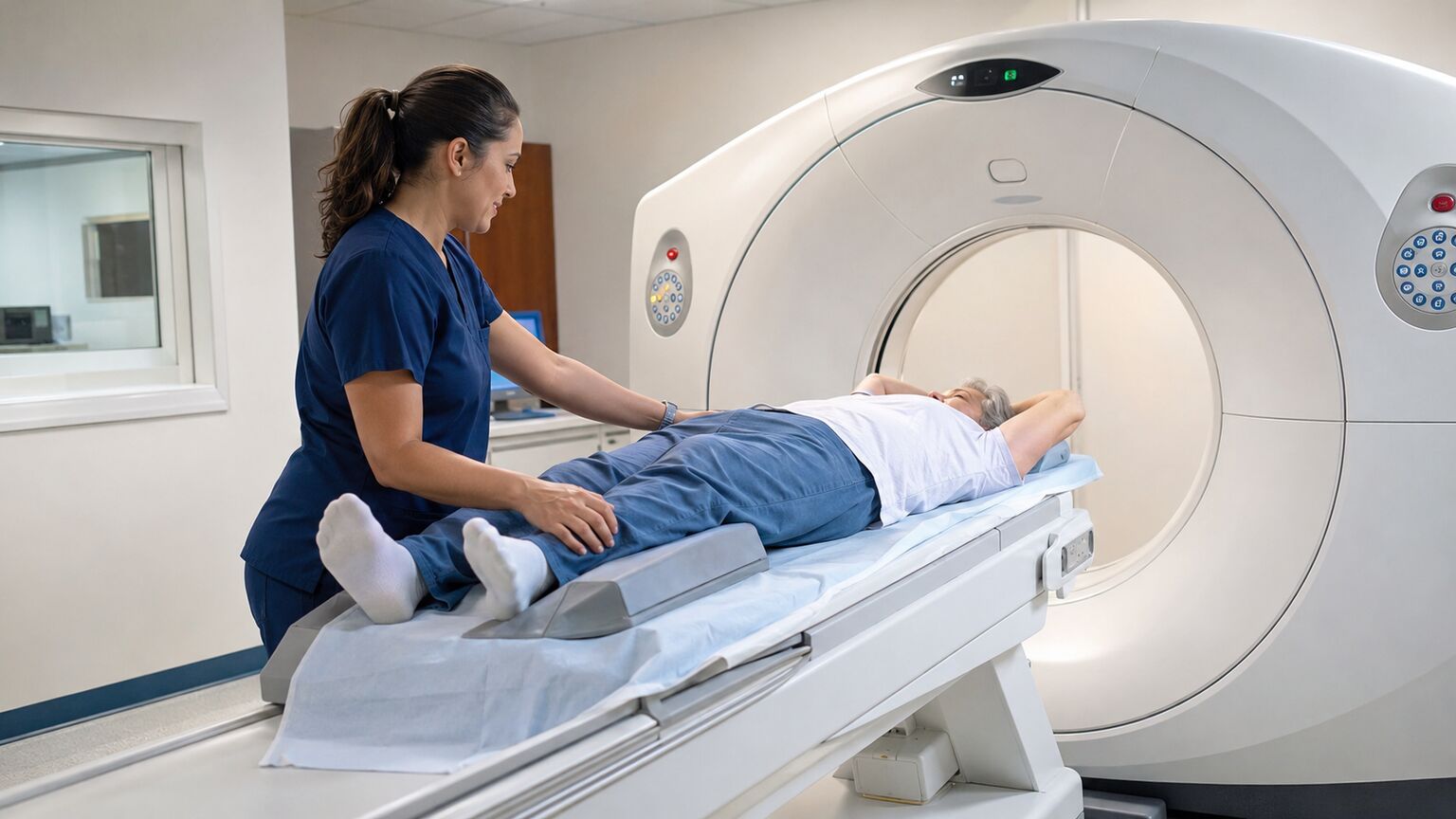
Since monitoring protocols vary somewhat between institutions and individual cases, it's worth asking your own oncology team a few direct questions rather than assuming a generic schedule applies. Ask what your own baseline number was and what specific value or percentage change they'll consider meaningful for you personally, since that threshold isn't identical for every patient. Ask how often CA 19-9 will be checked relative to your scans, and whether the two are timed together or independently. And if a future result does come back higher, ask plainly what the next step will be — a repeat test, an earlier scan, or something else — so a rising number never arrives as a surprise with no clear plan already in place behind it.
It's also reasonable to ask for your own numbers in writing over time, rather than hearing them read aloud once during a visit and then trying to remember them later. Many patient portals will show a simple table or graph of past lab values, and having that history in front of you — rather than reconstructed from memory between appointments — makes it much easier to follow the trend your care team is actually watching, and to ask sharper, more specific questions the next time a new result comes in.
Frequently Asked Questions
How often is CA 19-9 checked during chemotherapy?
Most protocols recheck CA 19-9 every 1 to 3 months during active treatment, sometimes every 4 to 8 weeks depending on the institution, timed to track how the tumor is responding over the course of therapy.
Why is CA 19-9 checked 4 to 6 weeks after surgery instead of right away?
CA 19-9 has a short half-life of about 14 hours, but checking it too soon after surgery can produce a misleadingly high reading caused by the surgery itself rather than remaining tumor. Waiting 4 to 6 weeks lets the body settle so the result actually reflects the surgical outcome.
Does a rising CA 19-9 during surveillance always mean the cancer has come back?
No. It can also reflect a benign issue like biliary obstruction or infection, which is why current guidelines require radiological confirmation before a rising number is treated as evidence of recurrence.
How much sooner can CA 19-9 detect a recurrence compared to a CT scan?
Research suggests a rising CA 19-9 can precede visible recurrence on imaging by roughly 3 to 10 months, which is why it's used as an early trigger for closer scanning rather than a replacement for imaging.
What does it mean if my CA 19-9 doesn't return to normal after surgery?
Failure to normalize within about 6 months of surgery is associated with meaningfully lower survival in research studies and is generally treated as a signal that warrants closer monitoring going forward.
Is one high CA 19-9 result during surveillance an emergency?
Generally no. Many centers repeat the test first, since a single elevated value can reflect something temporary and unrelated to cancer. It's a confirmed rise across repeat draws, or a rise paired with a suspicious imaging finding, that typically prompts urgent action.
Conclusion
Once treatment begins, CA 19-9 changes jobs — from a single number being screened for a red flag, to a running measurement whose real value comes from the pattern it forms over months and years. A falling number during chemotherapy, a normalized level within six months of surgery, and a stable trend through years of surveillance are each genuinely meaningful signals, and so is a number that starts climbing again. None of them are ever meant to be read alone, and every rising result still deserves a scan, and often a repeat draw, before it's treated as an answer. Understanding that distinction is exactly what turns an anxiety-inducing number on a portal into a tool you and your care team can actually use together, draw after draw, for as long as your monitoring plan calls for it.
Still Not Sure What Your Results Mean?
Upload your labs and get a complete, visual, plain-language interpretation of every biomarker — delivered to your inbox in under 15 minutes.
Get My ReportThis article is for educational purposes only and does not constitute medical advice. Always consult your healthcare provider regarding your specific lab results.