
Which Cancers Is CA 19-9 Actually Used to Track?
Ask five different sources what CA 19-9 monitors and you'll likely get five overlapping but slightly different answers, because the honest answer isn't a single disease — it's a map with one clearly marked capital city and several smaller outposts of varying reliability. This article is that map, not a walkthrough of how the number gets used once a specific cancer is already being tracked (our companion article covers that workflow in depth). Instead, this is about scope: which cancers does CA 19-9 have a genuine, regulator-endorsed job monitoring, which ones does it play a real but secondary role in, and which situations was it simply never built to handle at all? Knowing where your own diagnosis lands on that map changes how much weight a single result should carry.
A Brief History: How a Colon Cancer Discovery Became the Pancreatic Cancer Standard
There's a genuinely surprising origin story behind this marker that helps explain some of its quirks. CA 19-9 wasn't discovered by researchers looking for a pancreatic cancer test at all. In 1979, immunologist Hilary Koprowski and colleagues generated a mouse monoclonal antibody, labeled 1116-NS-19-9, while studying a colorectal cancer cell line — the "19-9" in the name simply refers to its position in a numbered series of antibody clones from that research, not anything specific to the pancreas. Two years later, in 1981, the same research group described a related antigen circulating in the blood serum of colon cancer patients, and follow-up work by Magnani, Nilsson, Brockhaus, and colleagues identified exactly what that antigen was at a molecular level: a mucin glycoprotein carrying what's called the sialylated Lewis-a epitope — the same Lewis blood-group chemistry responsible for the roughly 5% to 10% of people who can't produce this marker at all, as covered in our related article on Lewis-negative status. A practical radioimmunoassay to actually measure it in a standard blood draw followed in 1983, developed by Del Villano and colleagues.
As researchers tested this new marker across different cancer types through the early 1980s, an unexpected pattern emerged: despite being discovered in colon cancer research, it turned out to be shed in far larger quantities by pancreatic tumors than by colorectal ones, where CEA was already well established and remained the better-performing marker. That accident of biology — a colon-cancer-derived antibody turning out to be a much better pancreatic cancer marker than a colorectal one — is essentially why CA 19-9 ended up filling the specific role it holds today, and why the hierarchy described throughout the rest of this article (pancreatic first, colorectal a distant fourth) looks the way it does more than four decades later.

The One Regulatory Fact That Explains Almost Everything
There's a single piece of regulatory history that clears up more confusion about CA 19-9 than almost anything else: the CA 19-9 radioimmunoassay received FDA marketing clearance specifically for monitoring pancreatic cancer — not for diagnosing it, and not for screening for it. Those three words, monitoring, diagnosis, and screening, describe genuinely different jobs, and CA 19-9 was only ever cleared for one of them. Monitoring means tracking a known, already-confirmed cancer over time to see how it's responding to treatment or whether it's coming back. Diagnosis means using a test to help determine, for the first time, whether cancer is actually present in someone with symptoms or suspicious findings. Screening means testing people with no symptoms at all, hoping to catch a disease early before it announces itself.
CA 19-9 fails as a screening tool for a very specific, quantifiable reason: its positive predictive value in a general, symptom-free population is estimated at somewhere between 0.5% and 0.9%. In plain terms, if you tested a large group of healthy people with no symptoms and no risk factors, only about 1 in every 110 to 200 people who tested "positive" would actually turn out to have pancreatic cancer — the overwhelming majority of positive results would be false alarms driven by the benign conditions covered in our related article on why an elevated CA 19-9 doesn't always mean cancer. Diagnosis is a separate, related limitation: even in people who already have symptoms, CA 19-9 alone isn't accurate enough to confirm or rule out cancer without imaging and, ultimately, tissue biopsy. Monitoring is where it earns its keep, because in that context you already know a cancer is present — the test's job shrinks down to something much more tractable: is this specific, already-identified tumor getting bigger, smaller, or staying the same.
It's worth sitting with why that distinction makes such a mathematical difference. In a monitoring context, the "population" being tested is no longer everyone off the street — it's narrowed down to people who already have a confirmed cancer diagnosis, which changes the underlying math entirely. A test doesn't need anywhere near the same level of standalone accuracy to be genuinely useful once the question shifts from "does this person have cancer at all" to "is this specific, already-confirmed cancer changing." That's the core reason the same test can be simultaneously unsuitable for one job and genuinely valuable for another, without any contradiction.
Its Primary, Best-Established Use: Monitoring Known Pancreatic Cancer
Pancreatic cancer is where CA 19-9 is used most, trusted most, and has the deepest body of supporting research behind it — it remains, to date, the only tumor marker with FDA clearance for this purpose in this disease. Once someone has a confirmed pancreatic cancer diagnosis, CA 19-9 gets folded into essentially every stage of their care: an initial baseline before treatment starts, repeat measurements during chemotherapy to judge how well the tumor is responding, a carefully timed postoperative check after surgery, and ongoing surveillance testing for years afterward to catch any sign of recurrence as early as possible. Research examining recurrence specifically has found that an elevated CA 19-9 identifies true recurrence within two years of pancreatectomy with roughly 83% sensitivity and 87% specificity — solid performance for a single blood test operating in a population where the disease is already known to be a real possibility, a very different statistical environment than screening the general public.
Our related articles on exactly how this monitoring schedule works and on who can't produce this marker at all go much deeper into the specifics of this primary use case. What's worth understanding here, at the level of the whole picture, is simply that pancreatic cancer monitoring is the foundation everything else about this test is built on — every other use described below is, to varying degrees, borrowed from lessons learned in this one disease.
CA 19-9 also plays a role earlier than most people expect, at the staging and surgical-planning stage rather than only afterward. Alongside CT or MRI imaging, a very high baseline number can raise concern about disease that has already spread beyond what a scan alone can confirm, prompting a more cautious approach before committing to a major operation. It isn't used as the deciding factor on its own — imaging and, when needed, diagnostic laparoscopy carry more weight in that specific decision — but a markedly elevated baseline is one more piece of evidence a surgical team weighs when deciding whether upfront surgery, or chemotherapy first to shrink the tumor before attempting resection, is the safer path for a given patient.
Its Second Major Use: Biliary Tract Cancers
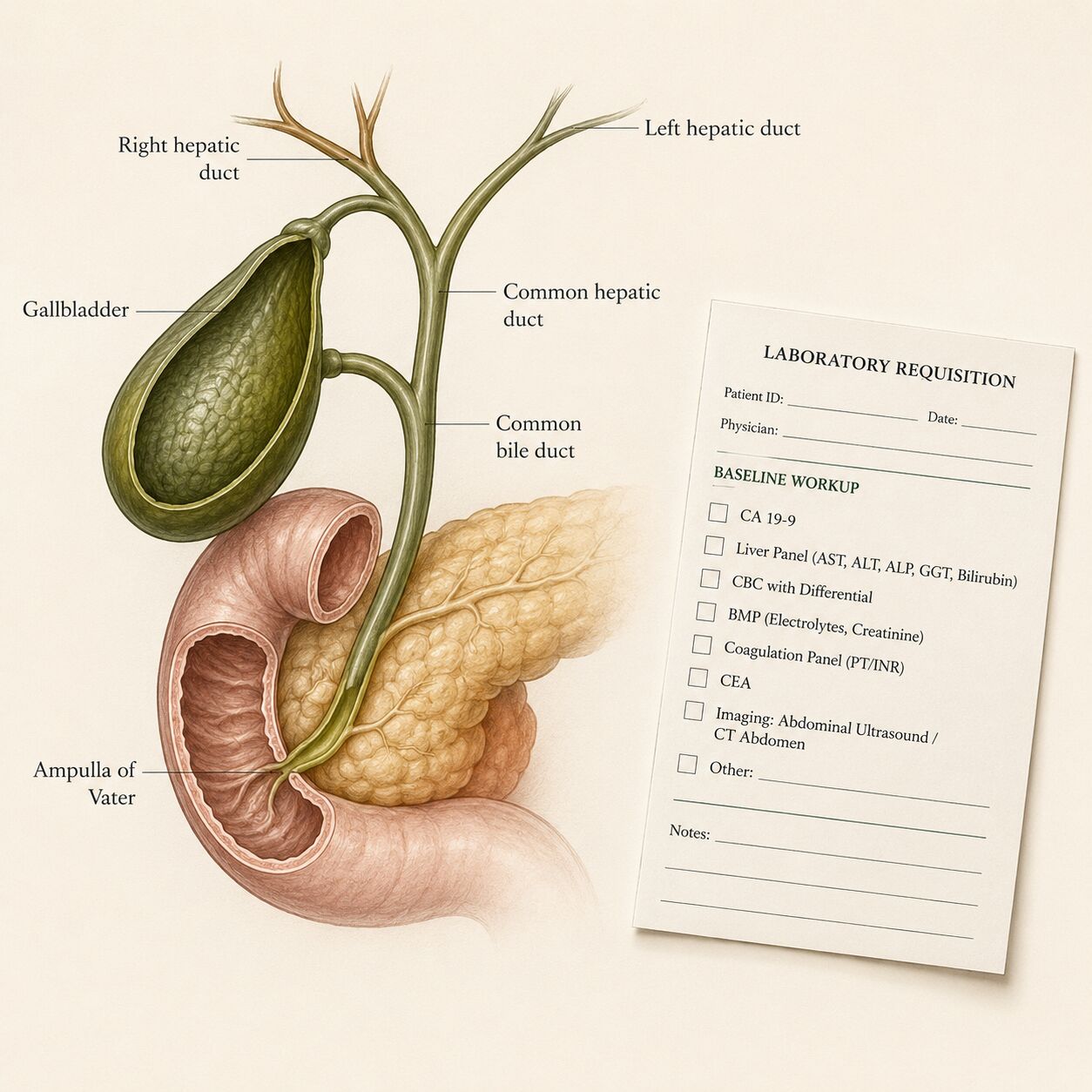
Cholangiocarcinoma (bile duct cancer) and gallbladder cancer are the next tier down, and current NCCN clinical practice guidelines give CA 19-9 a real, defined role here too — though a more limited one than in pancreatic cancer. It's recommended as part of the baseline workup when a suspicious mass or unexplained jaundice shows up on imaging, again after initial hepatobiliary surgery, and as an optional component of the annual surveillance schedule afterward, alongside MRI or MRCP imaging as the primary tool. Reported sensitivity and specificity for detecting cholangiocarcinoma with CA 19-9 are broadly similar to what's seen in pancreatic cancer, which is part of why it earned a place in these guidelines in the first place.
There's an important technical wrinkle specific to this category, though: because bile duct and gallbladder cancers frequently cause jaundice and cholestasis on their own — and, as covered in our companion piece on how bile duct blockages raise CA 19-9 without cancer, cholestasis independently inflates the number — guidelines suggest waiting until an acute cholangitis episode has resolved before drawing a meaningful CA 19-9, and applying an adjusted cutoff of around 300 U/mL rather than the standard 37 U/mL in patients with ongoing cholestasis. Guidelines are also explicit that CA 19-9 should not be used as a standalone diagnostic test for gallbladder cancer specifically, precisely because jaundice from unrelated causes muddies the number so often in this anatomical area.
Beyond surveillance, CA 19-9 has also shown some value in biliary tract cancer as a supporting factor when a care team is weighing whether a tumor is realistically resectable — similar in spirit to its emerging staging role in pancreatic cancer described above. A markedly elevated level alongside imaging findings suggesting a technically difficult resection can tip a multidisciplinary team toward a more cautious surgical plan, or toward starting with chemotherapy first. As with every other use covered in this article, it functions here as one input among several rather than a deciding vote cast on its own.
A Supporting Role in Gastric Cancer
In gastric (stomach) cancer, CA 19-9 isn't the lead marker — that role typically goes to CEA and, in some protocols, CA 72-4 — but it earns a real supporting spot precisely because of how it complements those other markers rather than competing with them. Research comparing single-marker and combined-marker testing in gastric cancer follow-up found that pairing CEA with CA 19-9 raised overall sensitivity for detecting disease from roughly 59% with either marker alone up to as high as 94% when both are checked together. That's a substantial jump, and it illustrates a theme that runs through this entire topic: CA 19-9 is frequently most useful not as a solo act, but as one input feeding into a broader combined picture alongside other markers and imaging.
CA 242, the CA 19-9-related marker mentioned in more detail below, is sometimes recommended in combination with CEA for gastric cancer as well, though CA 19-9 remains the more commonly used of the two in routine practice. Research specifically on cancers at the esophagogastric junction — the boundary where the esophagus meets the stomach — has also found CA 19-9 to carry independent prognostic value, with higher levels correlating with more advanced disease and poorer outcomes, reinforcing that its usefulness in this cancer type, while secondary to CEA, is genuine rather than incidental.
A Backup Role in Colorectal Cancer, Behind CEA
Colorectal cancer follow-up leans overwhelmingly on CEA as the primary tumor marker, and that hierarchy is well established rather than a close call — CEA alone is generally considered adequate for routine colorectal cancer monitoring. CA 19-9's role here is narrower and more of a fallback: it's brought in mainly for the smaller subset of patients whose tumors don't produce meaningful amounts of CEA, where relying on CEA alone would leave a monitoring blind spot. In those specific CEA-negative cases, adding CA 19-9 to the panel gives the care team a second signal to watch where the primary one isn't available. For the majority of colorectal cancer patients whose tumors do produce CEA normally, CA 19-9 typically doesn't add much beyond what CEA already provides on its own.
To put CEA's own performance in context, since it's the standard CA 19-9 gets compared against in this specific cancer: serial CEA testing during colorectal cancer follow-up has been shown to detect recurrence with roughly 80% sensitivity and 70% specificity, and can provide a lead time of around five months before recurrence would otherwise become apparent through other means. That's a meaningfully shorter early-warning window than the multi-month lead time CA 19-9 provides in pancreatic cancer surveillance, which is part of why the two markers occupy such different tiers of importance in their respective cancers rather than being interchangeable tools. Some research has also noted a correlation between body mass index and both CEA and CA 19-9 levels in colorectal cancer patients, a reminder that even well-established markers can be nudged by factors that have nothing to do with tumor activity itself.
Where It Shows Up Outside These Core Cancers
Beyond these four cancer types, CA 19-9 turns up in the medical literature in a scattering of other, less central contexts. It's sometimes checked as part of the workup for suspected ovarian tumors, particularly mucinous ovarian cancers and certain benign mimics like endometriosis, though CA-125 remains the dominant marker in gynecologic oncology and CA 19-9 plays a distinctly secondary role there — a distinction covered in more depth in our article on benign causes of an elevated CA 19-9, which discusses exactly this gynecologic overlap. It occasionally appears in research settings exploring lung and other cancers, generally without enough consistent evidence to support routine clinical use outside of a study.
The throughline across all of these peripheral uses is the same: CA 19-9 is a carbohydrate antigen expressed by certain types of glandular, mucin-producing tissue wherever it occurs in the body, so any tumor built from that kind of tissue can, in principle, produce it — but "can, in principle" is a much lower bar than the kind of validated, guideline-backed evidence that exists for pancreatic, biliary, gastric, and colorectal cancer specifically. If you encounter CA 19-9 mentioned in the context of a cancer type not covered in this article, it's worth treating that as a signal to ask your specific care team directly how established that particular use is, rather than assuming it carries the same weight of evidence behind it that it does in pancreatic cancer.
Curious what your own lab results are really telling you? Upload them and get a complete, plain-language breakdown in under 15 minutes.
Analyze My ResultsHow CA 19-9 Compares to Other Tumor Markers
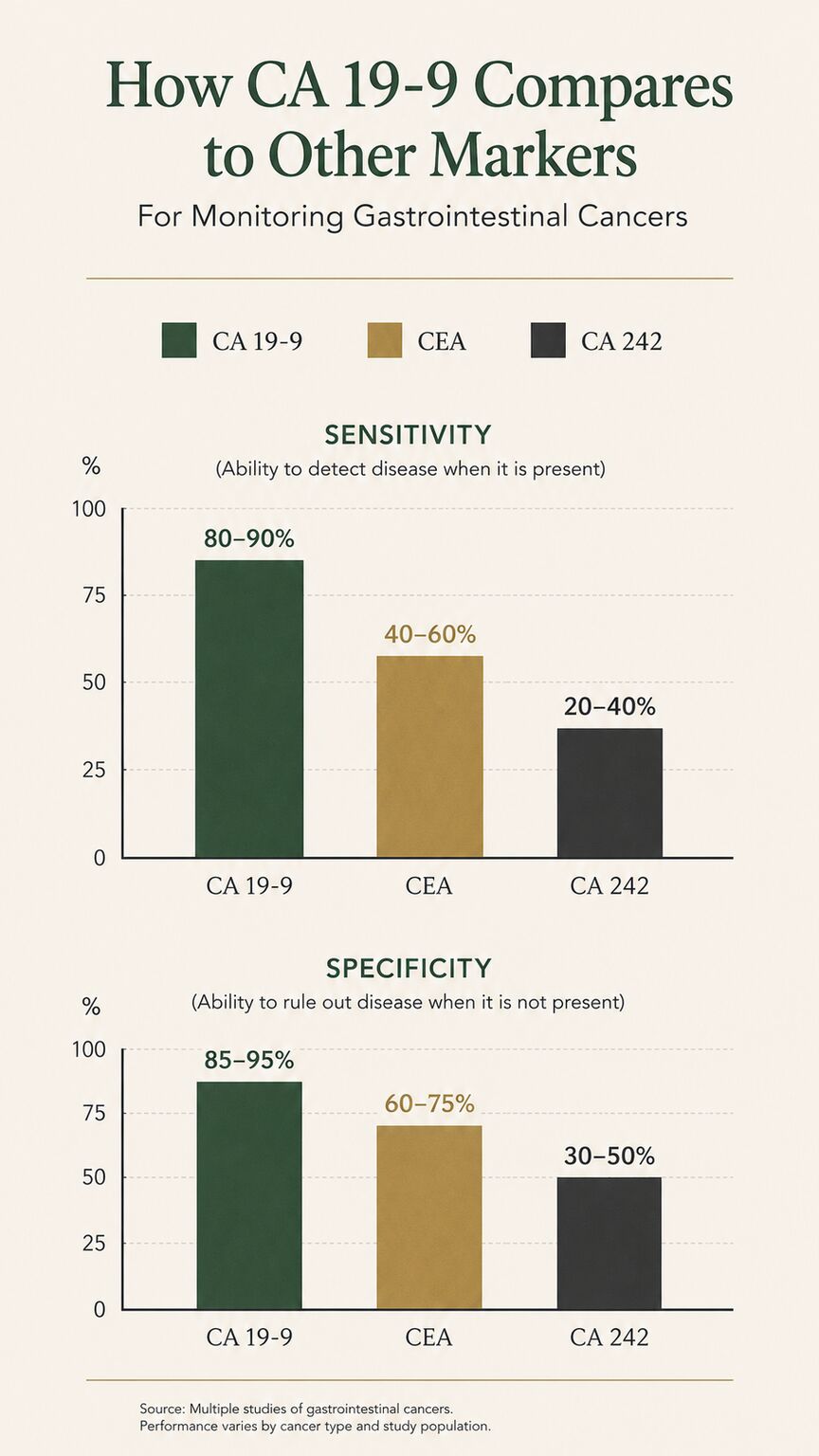
CA 19-9 isn't the only carbohydrate antigen or glycoprotein marker used in this space, and it's worth knowing how the alternatives stack up. CA 242, a related carbohydrate marker, has shown somewhat better specificity than CA 19-9 in pancreatic cancer — meaning fewer false positives from benign disease — but at the cost of lower overall sensitivity, particularly in early-stage disease, and it never achieved the same level of validation or guideline endorsement that would justify replacing CA 19-9 in routine practice. DUPAN-2 is another carbohydrate antigen sometimes studied alongside CA 19-9 in pancreatic cancer, occasionally combined with it to modestly improve diagnostic accuracy in specific research settings, though it hasn't displaced CA 19-9 as the standard either. CEA, as covered above, is the dominant marker in colorectal cancer and a strong complementary marker in gastric cancer, but performs less consistently as a standalone tool in pancreatic and biliary disease compared to CA 19-9. CA 125 remains the reference marker for ovarian cancer specifically, with CA 19-9 playing only a minor supporting role there.
The practical takeaway from all of this comparison work is that no single marker has emerged as a clear universal replacement for CA 19-9 in the cancers where it's already established. Despite decades of research into alternatives, CA 19-9 has kept its position mainly because the newer candidates trade one limitation for another — better specificity but worse sensitivity, or vice versa — rather than offering a decisive improvement across the board.
Newer, non-carbohydrate approaches are also being actively studied as potential future additions rather than outright replacements. Circulating tumor DNA, exosomal markers shed by tumor cells, and broader multi-protein or metabolite signatures are all areas of active research aimed at building a more complete picture than any single glycoprotein marker can offer alone. None of these have displaced CA 19-9 in routine clinical guidelines as of this writing, but they represent the direction the field is generally moving in: toward combining several different types of biological signal rather than searching for one perfect marker to replace the others outright.
What CA 19-9 Is Not Typically Used to Monitor
It's just as useful to be explicit about the negative space here. CA 19-9 is not recommended or validated as a general population screening test for any cancer, including pancreatic cancer, in people without symptoms or known elevated risk. It's not used as a standalone diagnostic test anywhere in current guidelines — every guideline that recommends it pairs that recommendation with imaging, biopsy, or both. It's not the primary marker for colorectal cancer, ovarian cancer, breast cancer, prostate cancer, or the majority of other solid tumors, even though isolated case reports exist of it being incidentally elevated in a wide range of unrelated conditions. And it's not a reliable tool for the roughly 5% to 10% of people who are Lewis-negative and simply cannot produce it at all, regardless of what cancer they may or may not have.
It's also worth naming a subtler point: CA 19-9 isn't typically used to monitor cancer in people who've never had an elevated or informative baseline in the first place. If someone's CA 19-9 was already normal at diagnosis, for reasons unrelated to Lewis status, tracking it going forward generally doesn't add much, since there was never a meaningful signal to watch return or persist. In that specific scenario, a care team will usually rely more heavily on imaging and other available markers from the start, rather than continuing to draw a test that already demonstrated it wasn't going to be informative for that particular patient's tumor.
Why Doctors Rarely Order It Alone

Pulling the threads above together, a consistent pattern emerges: in essentially every context where CA 19-9 is genuinely useful, it's deployed as part of a combination — with CEA in gastric cancer, with imaging in biliary tract cancer surveillance, with a patient's own baseline and clinical picture in pancreatic cancer monitoring. This isn't a weakness unique to CA 19-9; it reflects how tumor markers function across oncology generally. A single glycoprotein circulating in the blood can only carry so much information on its own, and combining it with other markers, imaging, and clinical context consistently outperforms any single test used in isolation.
This is also why results are so often reviewed by more than one specialist together rather than a single physician reading a number in isolation. A radiologist, a medical oncologist, and sometimes a surgeon may all weigh in on the same combined picture before a plan is finalized, precisely because each brings a different piece of context the others don't have. Understanding this helps explain why your doctor might order what looks like an unusually long panel of tests rather than just the one marker you might expect, and why a full answer sometimes takes a coordinated team rather than a single quick read of one result.
What to Ask If Your Doctor Orders CA 19-9 for a Non-Pancreatic Cancer
If you have a gastric, colorectal, biliary, or other non-pancreatic cancer and CA 19-9 shows up on your lab order, it's a reasonable and specific thing to ask about rather than simply assuming it's routine. Ask your oncology team what specific role it's playing for your particular cancer — is it the lead marker, a supporting one alongside CEA, or something being tracked mainly because it happened to be elevated at diagnosis. Ask what your own baseline number was, since that's the reference point every future result will be judged against. And ask what a rising or falling number would actually change about your treatment plan, since a marker that's being monitored purely out of thoroughness, with no real bearing on decisions, is worth understanding differently than one your care team is actively using to guide what happens next.
It's also fair to ask how confident your specific care team is in this particular marker for your particular tumor type, since, as this article has laid out, that confidence genuinely varies by cancer. A straightforward "we're watching this closely because it's been reliable for your type of tumor" is a very different answer than "we're checking it because it's sometimes useful here, though CEA is really our main marker" — and knowing which of those two situations you're actually in changes how much attention a single fluctuating number deserves between visits.
Frequently Asked Questions
Is CA 19-9 approved by the FDA for diagnosing pancreatic cancer?
No. It's FDA-cleared specifically for monitoring already-diagnosed pancreatic cancer, not for diagnosing it or screening for it in people without a known cancer. Its low positive predictive value in the general population makes it unsuitable for either of those other purposes.
Which cancer is CA 19-9 most closely associated with?
Pancreatic cancer. It remains the only tumor marker with FDA clearance for monitoring this specific disease, and it has the largest, most established body of supporting research of any cancer it's used in.
Is CA 19-9 useful for colorectal cancer monitoring?
Only in a secondary, backup capacity. CEA is the primary and generally sufficient marker for colorectal cancer follow-up; CA 19-9 is mainly added for the smaller group of patients whose tumors don't produce meaningful CEA on their own.
Why is CA 19-9 sometimes checked in gallbladder or bile duct cancer?
Current guidelines recommend it as part of baseline workup and optional annual surveillance for biliary tract cancers, though it's explicitly not recommended as a standalone diagnostic test, since jaundice from unrelated causes frequently elevates it in this same anatomical area.
Is there a better tumor marker than CA 19-9 for pancreatic cancer?
No single alternative has replaced it in routine practice. Markers like CA 242 and DUPAN-2 have been studied as alternatives or additions, but each trades sensitivity for specificity or vice versa rather than offering a clear overall improvement.
Should I be concerned if CA 19-9 is ordered for a cancer type it's not typically used for?
Not automatically, but it's worth asking your care team directly what role it's playing in your specific case. It may be a secondary marker adding useful information alongside a primary one, rather than being used as the main tool guiding your treatment decisions.
Was CA 19-9 originally discovered for pancreatic cancer?
No. It was first identified in 1979 during colorectal cancer research using a monoclonal antibody, and only later found to perform far better as a marker for pancreatic cancer than for the colon cancer it was originally studied in.
Does CA 19-9 help decide whether a tumor can be surgically removed?
It can play a supporting role in that decision, alongside imaging, in both pancreatic and biliary tract cancers. A markedly elevated baseline can prompt a more cautious surgical approach, but it's never used as the sole factor in deciding whether surgery is appropriate.
Conclusion
CA 19-9 has one clear, FDA-recognized home base — monitoring known, already-diagnosed pancreatic cancer — and a set of secondary roles in biliary tract, gastric, and colorectal cancers that range from genuinely useful to distinctly supportive, always alongside other markers and imaging rather than standing alone. It was never built, tested, or approved to screen healthy people or diagnose cancer on its own, in any of these diseases, and its origin story — a colon cancer discovery that turned out to work far better somewhere else entirely — is a useful reminder that a test's value is defined by evidence in a specific context, not by its name or its history. Knowing which category your own situation falls into is what turns a single unfamiliar test name on a lab order into something you can actually ask an informed, specific question about.
Still Not Sure What Your Results Mean?
Upload your labs and get a complete, visual, plain-language interpretation of every biomarker — delivered to your inbox in under 15 minutes.
Get My ReportThis article is for educational purposes only and does not constitute medical advice. Always consult your healthcare provider regarding your specific lab results.