
Smoking Can Significantly Raise Your CEA Levels
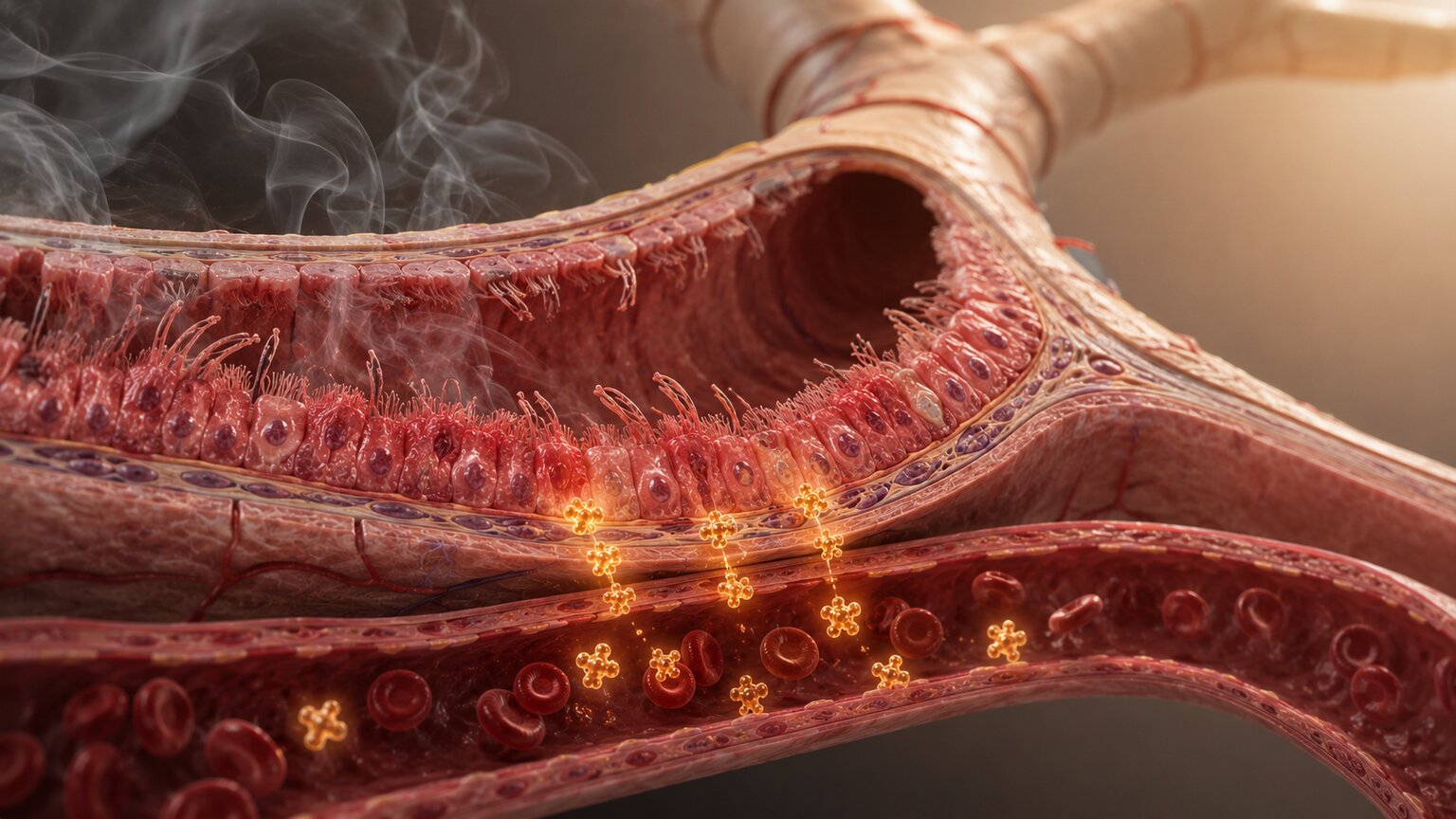
If you smoke and your CEA came back elevated, there's a good chance your cigarettes are the reason — not a hidden tumor. This isn't a vague correlation researchers noticed and shrugged at. Scientists have traced the actual biological chain of events: cigarette smoke lands directly on the tissue lining your airways, switches on the genes that produce CEA inside those cells, and the antigen then leaks from your lungs into your bloodstream in measurably higher amounts. One study found current cigarette smokers averaging more than four times the CEA level of nonsmokers. That's not a rounding error or a statistical fluke — it's one of the most consistent, well-documented, non-cancer causes of an elevated CEA in the entire medical literature, understood well enough that most labs quietly build a higher "normal" ceiling into their reference range specifically for smokers.
This article walks through exactly how much smoking raises CEA, what's actually happening inside your lungs to cause it, how it compares across cigarettes, hookah, and heated tobacco products, and — maybe most usefully — what happens to your number if you quit.
What Counts as "High" Already Depends on Whether You Smoke
Most labs quote a normal CEA of roughly 0 to 3 ng/mL for someone who has never smoked. But because the effect of smoking on this particular number is so well established, many labs build a separate, higher ceiling into their reference range for smokers — often up to about 5 ng/mL. That difference isn't a courtesy or a rounding adjustment; it's an acknowledgment, built directly into the test's interpretation, that a smoker's baseline genuinely sits higher than a nonsmoker's before any disease enters the picture at all. If your lab report doesn't ask whether you smoke, or if a doctor reviewing your number doesn't know, that's the single most important missing piece of context for correctly reading an elevated result.
You'll also notice the exact cutoff isn't perfectly consistent from one lab or clinical source to the next — some set the smoker ceiling at 5 ng/mL, while others describe a normal range for smokers stretching all the way up to 10 ng/mL. That spread isn't a sign that anyone is getting it wrong; it reflects genuine variation in which populations a given lab drew its reference data from, how heavily those smokers in the reference group actually smoked, and which specific assay technology the lab uses to run the test. What matters practically is less about memorizing one universal number and more about asking your own lab or doctor which specific reference range they applied to your result, and whether it already accounts for your smoking status at all.
The Actual Numbers: How Much Higher Are We Talking About?
The gap isn't subtle, and it's been measured repeatedly across different populations and decades. One of the earliest studies to formally document the effect, looking at 276 healthy volunteers, found a mean CEA of 2.7 ng/mL in smokers compared with 1.9 ng/mL in nonsmokers — a real difference, though a modest one. More recent research focusing specifically on cigarette smokers found a considerably larger gap: a mean CEA of 9.19 ng/mL among smokers versus 2.15 ng/mL in nonsmokers, more than a fourfold difference. A separate large study of over 1,300 people found the effect was concentrated mainly in men — 3.11 ng/mL in male smokers versus 2.14 ng/mL in male nonsmokers — while women in that particular dataset showed no statistically significant difference between smokers and nonsmokers at all, a sex-based pattern researchers haven't fully explained.
A 2025 study comparing 750 men — 250 conventional cigarette smokers, 250 heated tobacco product users, and 250 people who had quit entirely — adds a useful middle data point: median CEA was 2.4 ng/mL in cigarette smokers, 2.0 ng/mL in heated tobacco users, and 1.6 ng/mL in quitters, with each group meaningfully different from the next. That kind of clean, stepwise gradient across three different exposure levels is exactly the pattern you'd expect if the substance itself, not some unrelated factor, is what's actually driving the number.
It's worth pausing on why these studies don't all report the exact same multiple, since that variation itself is informative rather than confusing. Some of it comes down to how heavily the "smokers" in each study actually smoked — a group made up mostly of light, occasional smokers will naturally show a smaller gap than a group made up mostly of pack-a-day smokers, even though both groups are technically labeled the same way. Some of it comes down to differences in the specific lab assay used to measure CEA, since different testing platforms can calibrate slightly differently against the same blood sample. And some of it likely reflects genuine differences between the populations studied — age, overall health, how long people had been smoking, and how recently they'd last had a cigarette before the blood draw. None of that undermines the core finding; if anything, seeing the same general pattern hold up across so many differently designed studies, run by different research teams, in different countries, over multiple decades, is exactly the kind of consistency that makes researchers confident the relationship is real rather than a fluke of any one particular dataset.
Curious what your own lab results are really telling you? Upload them and get a complete, plain-language breakdown in under 15 minutes.
Analyze My ResultsWhy Cigarette Smoke Raises CEA — The Actual Mechanism

This is the part most explanations of "smoking raises CEA" skip entirely, and it's worth understanding because it's genuinely well-mapped biology, not a mysterious correlation. The cells lining your bronchial tubes and the tiny air sacs deep in your lungs — the bronchial and alveolar epithelium — normally carry a family of related proteins called CEA-related cell adhesion molecules, or CEACAMs, on their surface. Laboratory experiments have shown that cigarette smoke extract directly changes how actively the genes for these CEACAM proteins get switched on inside bronchial cells. In one study, researchers exposed lung cell cultures to smoke-treated fluid and watched CEA's own genetic blueprint, its messenger RNA, become measurably more active in response — direct, observable proof that smoke itself is flipping the switch, not merely correlating with it.
The tissue-level evidence backs this up in a striking way: non-cancerous lung tissue taken from smokers has been measured containing roughly 38 nanograms of CEA per milligram of protein, compared to only about 11 nanograms per milligram in tissue from nonsmokers — nearly three and a half times as much, sitting right there in otherwise healthy lung tissue, with no tumor anywhere in sight. Researchers have also identified what this locally produced CEA appears to be doing: purified CEA acts as a chemoattractant specifically for neutrophils, a type of white blood cell that rushes toward inflamed or irritated tissue, though it doesn't have the same pull on a different immune cell type called monocytes. In plain terms, smoke-irritated lung tissue starts pumping out extra CEA, and that CEA helps summon immune cells into the airways as part of the body's ongoing, chronic response to being irritated day after day, cigarette after cigarette. Elevated CEA has similarly been measured directly in bronchoalveolar lavage fluid — fluid collected by rinsing the airways during certain lung procedures — in smokers compared to nonsmokers, which is the most direct evidence available that this antigen is being produced locally in the lungs before it ever reaches a blood draw.
CEA doesn't act alone in this process, either. It belongs to a small family of closely related molecules — CEACAM1, CEACAM5, and CEACAM6 among them — and research has found these related proteins are among the most consistently and intensely present on the surface of bronchial and alveolar cells of anyone's airway, smoker or not, which is exactly why they're positioned to respond so directly when smoke irritates that tissue. There's a second, somewhat unexpected layer to this same family of molecules worth knowing: certain respiratory bacteria, including strains of Haemophilus influenzae and Moraxella catarrhalis that commonly cause chest infections, have evolved the ability to specifically latch onto CEACAM proteins on airway cells as a way of gaining a foothold on the mucosal surface, and CEACAM1 binding in particular appears to dampen part of the immune system's normal alarm response once that happens. Put together, this offers a plausible biological thread connecting two things smokers already know are linked from everyday experience — a chronically irritated airway lining and a greater susceptibility to respiratory infections — through the same family of molecules responsible for the CEA elevation this article is about.
What About Secondhand Smoke?
It's a completely reasonable question, and worth answering honestly rather than guessing: no published research was found specifically measuring CEA levels in people regularly exposed to secondhand smoke as a distinct category, separate from active smokers and nonsmokers with no exposure at all. Given that the mechanism driving this entire effect lives in the airway tissue itself reacting to inhaled smoke, it's biologically plausible that meaningful, repeated secondhand exposure could produce some effect, even if a smaller one than direct smoking — but that's an inference from the mechanism, not something this specific question has actually been tested and confirmed for. If you live with a smoker and are curious whether your own CEA reflects that exposure, that's a fair thing to raise with a doctor, with the honest caveat that the research hasn't caught up to that specific question yet.
Dose Matters: More Cigarettes, Higher CEA

This isn't an on-or-off effect where any amount of smoking produces the same bump. Research has found CEA rises in a genuinely dose-dependent way, climbing in step with how many cigarettes a person smokes per day, with the highest levels documented in people smoking more than 31 cigarettes daily — well over a pack. The relationship is also duration-dependent, meaning the number of years someone has smoked matters on top of daily intensity, and the effect is consistently described as more pronounced in current smokers than in former smokers, which fits neatly with everything the mechanism above would predict: more ongoing irritation to bronchial tissue means more ongoing CEA production, and stopping that irritation is what eventually lets the number settle back down.
Not All Smoking Is Equal: Cigarettes, Hookah, and Heated Tobacco

A common assumption is that hookah, or waterpipe smoking, is a gentler alternative to cigarettes because the smoke passes through water first. When it comes to CEA, the research tells a more layered story. One early comparison of 122 cigarette smokers, 14 hookah smokers, and 36 nonsmoker controls found hookah smokers averaging 7.16 ng/mL — clearly elevated above the nonsmoker average of 2.15 ng/mL, though still lower than the 9.19 ng/mL seen in cigarette smokers in that same study. A separate study focused specifically on people who smoked hookah exclusively found that, averaged across everyone, hookah smokers as a group weren't significantly different from nonsmokers — but breaking that group down by how much they actually smoked told a very different story: light hookah smokers averaged just 1.06 ng/mL, medium smokers 2.52 ng/mL, and heavy smokers 5.11 ng/mL, with heavy hookah smokers landing significantly above nonsmoking controls. The takeaway is that hookah smoking isn't automatically "safe" from a CEA standpoint — the effect simply depends heavily on how much and how often someone actually smokes it.
Part of why "light" and "heavy" hookah use can produce such different results comes down to how differently a single hookah session compares to a single cigarette. A typical cigarette is smoked in a few minutes; a typical hookah session commonly stretches on for the better part of an hour or more, involving many more individual puffs and a considerably larger total volume of smoke drawn into the lungs over that session than a single cigarette ever delivers. That's part of the reason "heavy" hookah use can rival or exceed cigarette-level exposure even though it's technically a different product — the water passing the smoke through cools and moistens it, but it was never shown to meaningfully filter out the chemical exposure driving the CEA effect covered throughout this article.
Heated tobacco products — devices that heat rather than burn tobacco, often marketed as a reduced-harm alternative to cigarettes — occupy a middle position in the data. In the 750-person study mentioned earlier, heated tobacco users showed a median CEA of 2.0 ng/mL, meaningfully lower than the 2.4 ng/mL seen in conventional cigarette smokers, but still higher than the 1.6 ng/mL seen in people who had quit tobacco entirely. As for vaping and e-cigarettes specifically, it's worth being straightforward about a genuine gap in the research: no published study was found directly measuring CEA levels in e-cigarette users as its own category. That's not the same as evidence of safety — it simply means this particular question hasn't been formally studied yet, and anyone using e-cigarettes shouldn't assume the CEA story is settled one way or the other.
What Happens When You Quit
The genuinely encouraging part of this entire story is how reversible it is, at least in large part. Early research found that within roughly three months of quitting smoking completely, elevated CEA levels typically decline back down into the normal, nonsmoker reference range. A more detailed, longer-running study followed this even further: among people who quit smoking after being found to have an elevated CEA above 5.0 ng/mL, their levels had dropped back within the normal reference range by the one-year mark. But when researchers checked back in at three years, those same ex-smokers still had CEA levels running somewhat higher than people who had never smoked at all — a small but persistent gap that hadn't fully closed even after three full years of not smoking.
That lingering gap wasn't an isolated finding, either — it showed up alongside a very similar pattern in lung function testing. The same study measured FEV1, a standard breathing test that captures how much air a person can forcefully exhale in one second, and found no meaningful improvement in that number for quitters compared to people who kept smoking over the same three-year window; both groups remained below never-smokers throughout. Put together, the honest picture is this: quitting delivers a real, fairly fast improvement in CEA that gets most of the way back to normal within about a year, but a smaller residual effect — echoing the same slow-healing pattern seen in lung function itself — can still be measurable years later. That's not a reason to see quitting as pointless; it's a reason to see it as a genuine biological reset that simply isn't instantaneous.
There's a reasonably intuitive explanation for why the recovery isn't instant or total. Years of smoke exposure don't just irritate airway tissue in the moment — they gradually remodel it, leaving behind structural changes in the bronchial lining, some degree of permanent scarring in the smallest airways, and a population of immune cells that has spent years primed to respond to constant irritation. Removing the cigarette removes the ongoing trigger, which is why the sharpest part of the improvement happens fairly quickly, but it doesn't instantly undo years of accumulated tissue-level change, which is why a smaller, slower-fading signal can still show up on a blood test years down the line. That timeline is worth keeping in mind if you've recently quit and are watching your own numbers: steady improvement is the expected pattern, not an overnight return to a never-smoker's baseline.
Why This Matters If You're Being Monitored for Cancer
For anyone using CEA as part of ongoing cancer surveillance — most commonly after colorectal cancer treatment, where doctors track the number over time to watch for recurrence — smoking status is a genuinely important piece of context that shouldn't get lost between visits. A smoker's baseline CEA sitting at, say, 4 or 5 ng/mL isn't automatically a red flag the way the same number would be in someone who has never touched a cigarette; it may simply reflect their smoking, exactly as the data throughout this article would predict. What actually matters for cancer surveillance in a smoker is less about any single number and more about the trend holding steady or climbing over repeat tests, especially if it climbs beyond what their smoking history alone would reasonably explain.
Consider two people with the exact same CEA result of 6 ng/mL after colorectal cancer treatment. One has smoked a pack a day for twenty years and hasn't changed that habit; the other has never smoked at all. For the lifelong nonsmoker, that number sits meaningfully above what their baseline should be and reasonably prompts a closer look. For the smoker, that same 6 ng/mL may be sitting almost exactly where their smoking history alone would predict it to land, and the more informative question becomes whether it's been climbing, holding steady, or actually falling across their last several tests — not whether the raw number happens to exceed a nonsmoker-calibrated cutoff. Two identical numbers, two very different levels of concern, entirely because of one piece of history that has nothing to do with cancer itself. If you're a smoker having your CEA tracked for any reason, make sure your doctor knows your smoking history in detail — how much, for how long, and whether you've quit — since that context measurably changes how any given number should be read.
Could My CEA Actually Reflect Lung Damage, Not Just "Being a Smoker"?
It's worth being precise about what an elevated CEA in a smoker is, and isn't, telling you. It isn't a direct measurement of cancer risk, and it isn't proof that damage has occurred — it's best understood as a marker of ongoing irritation and inflammation in lung tissue that smoke is actively causing, day after day, exactly the mechanism described earlier in this article. Some newer research has gone further, finding that CEA itself may play an active biological role inside tumors once they exist — one recent study describes CEA as potentiating the progression of non-small cell lung cancer through a specific cellular signaling pathway — which raises the interesting, still-developing question of whether CEA is purely a bystander marker of irritation or an active participant in the disease process itself. That question genuinely isn't settled yet, and this article won't overstate what a single elevated number in a smoker means beyond what the evidence actually shows: it reflects real, measurable irritation in your airways, which is itself a legitimate reason to talk to a doctor about your lung health and your smoking, entirely apart from any question about cancer.
It's a useful mental shift to make: rather than treating a smoking-related CEA elevation purely as a number to explain away, it's worth treating it as one more piece of feedback your body is giving you about the ongoing cost of smoking, alongside things like shortness of breath, a persistent cough, or reduced stamina that many smokers notice gradually enough to stop consciously registering them. The blood test simply happens to be putting a number on a process that's already underway either way.
What to Tell Your Doctor If You Smoke and Your CEA Is High
Being specific and upfront tends to get you a far more useful conversation than a general one. Tell your doctor plainly how many cigarettes you smoke per day and roughly how many years you've smoked, since both intensity and duration genuinely change how much CEA elevation is expected from smoking alone. Mention if you've recently cut back or quit, and when, since the timeline of decline covered above means a very recent quit date is a different situation from someone who quit years ago. If you also use hookah, heated tobacco products, or vape, mention that too, even though the research on some of these is still incomplete. And if your CEA is being tracked over time for any reason, ask specifically whether your result is being interpreted against a smoker-adjusted reference range, or against the standard nonsmoker cutoff — that single detail can be the difference between a number that looks concerning and one that looks exactly like what your smoking history would predict.
Frequently Asked Questions
How much can smoking actually raise CEA?
Studies have found mean CEA levels anywhere from about 1.4 to over 4 times higher in smokers compared to nonsmokers, depending on the study and how heavily someone smokes, with the highest levels seen in people smoking more than 31 cigarettes a day.
Why does smoking raise CEA in the first place?
Cigarette smoke directly increases CEA gene activity in the cells lining your airways. Non-cancerous lung tissue from smokers has been measured with nearly 3.5 times more CEA than tissue from nonsmokers, and this locally produced CEA appears to help draw immune cells into irritated lung tissue.
Is hookah smoking safer than cigarettes when it comes to CEA?
Not necessarily. While average CEA in hookah smokers tends to run lower than in cigarette smokers, heavy hookah smoking has been shown to significantly raise CEA above nonsmoker levels, similar in principle to cigarette smoking's dose-dependent effect.
Does vaping raise CEA?
This hasn't been directly studied yet in published research specifically measuring CEA in e-cigarette users, so there isn't clear data either way. That absence of data shouldn't be read as evidence of safety.
How long after quitting smoking does CEA return to normal?
Levels typically fall back within the normal reference range within about three months to a year of quitting. However, longer studies have found a small, lingering elevation compared to never-smokers that can persist even three years after quitting.
Should smokers use a different normal range for CEA?
Many labs already do, often treating up to about 5 ng/mL as normal for smokers compared to roughly 3 ng/mL for nonsmokers. It's worth confirming with your doctor which reference range was used to flag your specific result.
If I smoke and my CEA is elevated, could it still be cancer?
Yes, smoking as an explanation doesn't rule out other causes. The key is magnitude and trend — a level consistent with what smoking alone typically produces, that holds steady over repeat tests, is far less concerning than one that keeps climbing or is disproportionately high for your smoking history.
Does secondhand smoke exposure raise CEA too?
This hasn't been directly studied as its own category, so there's no confirmed data. Since the effect in active smokers comes from airway tissue reacting to inhaled smoke, meaningful secondhand exposure could plausibly have some effect, but that's an inference from the mechanism rather than a tested finding.
Conclusion
Smoking's effect on CEA isn't a loose statistical association — it's a documented biological chain running from cigarette smoke, to genetic activation inside your own airway cells, to measurably more CEA circulating in your blood, with the size of the effect tracking almost exactly how much and how long you've smoked. It's also one of the more genuinely hopeful causes on the list of things that can elevate this marker, because quitting produces a real, mostly-complete reversal within about a year, even if a small echo can linger longer. If you smoke and your CEA came back elevated, that context belongs at the center of the conversation with your doctor — not as an excuse to ignore the number, but as the single most useful piece of information for reading it correctly, and as one more concrete, measurable reason to consider putting the cigarettes down for good.
Still Not Sure What Your Results Mean?
Upload your labs and get a complete, visual, plain-language interpretation of every biomarker — delivered to your inbox in under 15 minutes.
Get My ReportThis article is for educational purposes only and does not constitute medical advice. Always consult your healthcare provider regarding your specific lab results.