
Understanding PSA Velocity and Why It Matters
If you've had more than one PSA (prostate-specific antigen) blood test, your doctor isn't just looking at the newest number — they're looking at how fast that number changed between tests. That rate of change has a name: PSA velocity. It's the difference between "your PSA is 3.5" and "your PSA went from 1.2 to 3.5 in eighteen months." Two men can land on the exact same final number and be in completely different risk categories, because one got there slowly over a decade of normal aging and the other got there in a year and a half. PSA velocity is the tool doctors use to tell those two stories apart, and understanding how it's calculated — and where it falls short — can help you make sense of why your doctor ordered a repeat test instead of jumping straight to a biopsy, or why they're not worried about a number that sounds high to you.
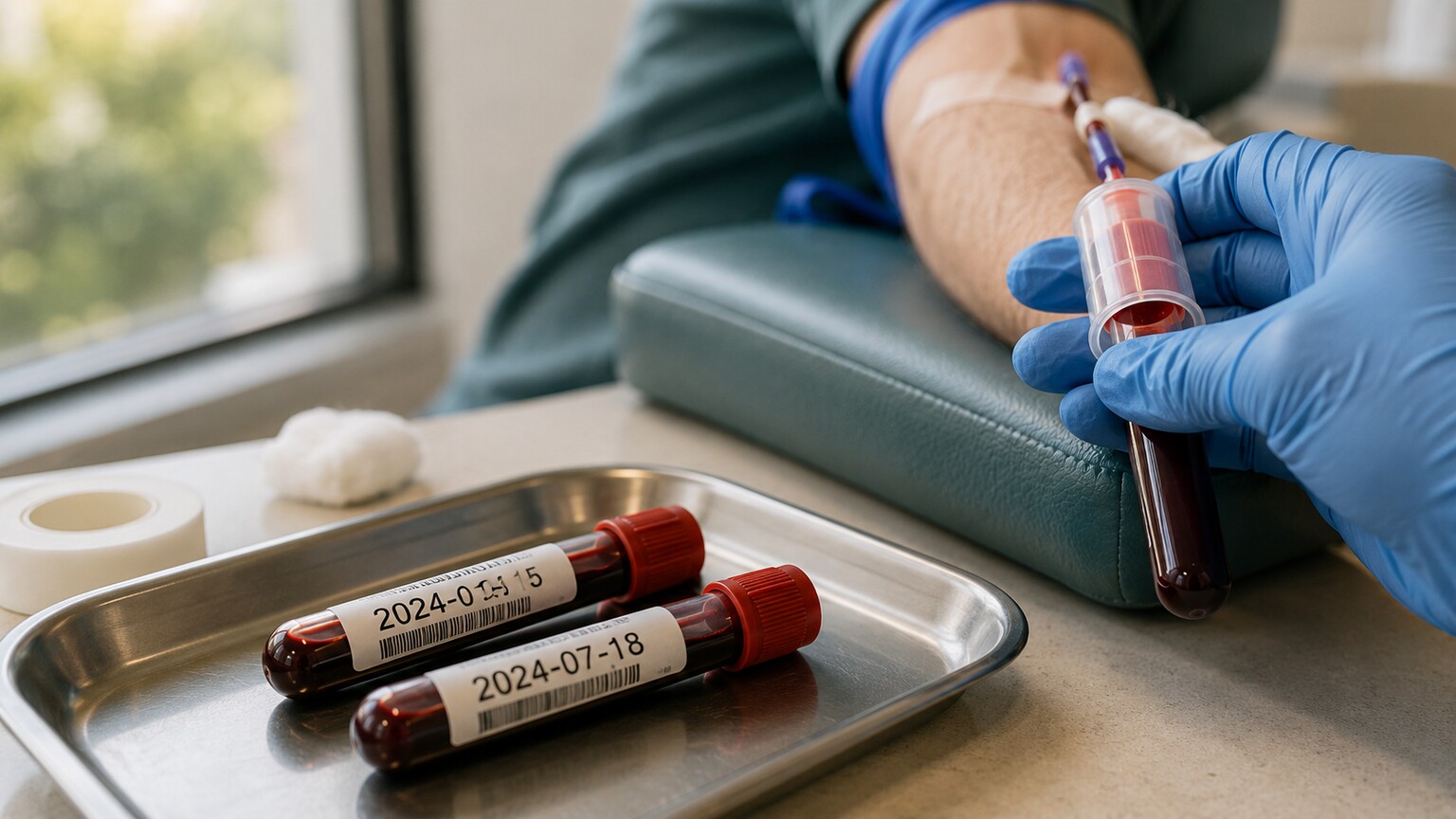
Figure 1. PSA velocity can only be calculated from two or more blood draws spaced months apart — a single test can never produce a rate.
What Exactly Is PSA Velocity?
PSA velocity is simply the rate at which your PSA level rises over time, usually expressed in nanograms per milliliter per year (ng/mL/year). It requires at least two — ideally three — separate blood draws taken months apart, because a single number, no matter how high or low, can never tell you a rate. Think of it the way a speedometer works compared to an odometer. The odometer tells you a static total: how many miles the car has traveled. The speedometer tells you how fast that total is currently increasing. A PSA test by itself is an odometer reading — a snapshot. PSA velocity turns two or three of those snapshots into a speedometer reading, giving your doctor a sense of momentum rather than just position.
This distinction matters clinically because the prostate gland, the walnut-sized organ that sits below the bladder and produces PSA as part of normal semen, doesn't stay static as men age. It's completely normal for PSA to drift upward gradually over the decades, largely because the gland itself tends to enlarge with age — a process called benign prostatic hyperplasia, or BPH, which has nothing to do with cancer. A slow, steady climb of a few tenths of a point per year in a man in his sixties is often just this ordinary enlargement doing exactly what's expected of it. A steep, sudden jump — the same total increase compressed into a much shorter window — raises a different kind of question, because rapid changes are more often associated with a biological process that's actively accelerating, which is one of the hallmarks doctors look for when they're worried about prostate cancer specifically.
It helps to picture PSA itself before picturing its velocity. PSA is a protein enzyme, produced almost exclusively by cells lining the prostate gland, whose actual biological job has nothing to do with cancer screening at all — its normal role is to liquefy semen after ejaculation, thinning it out so sperm can move more freely. Under normal circumstances, the overwhelming majority of the PSA a prostate cell produces stays contained within the gland's internal duct system and is released into semen, not into the bloodstream. Only a small, fairly consistent fraction leaks past the normal architecture of the gland into nearby blood vessels, which is what a standard PSA blood test is actually measuring. Anything that disrupts that normal architecture — whether it's benign glandular growth stretching and thinning the tissue, inflammation breaking down cellular barriers, or a tumor invading through tissue planes it doesn't belong in — tends to let more PSA leak into the bloodstream than usual. Velocity, in that light, isn't measuring the prostate directly; it's measuring how quickly the barrier between the gland and the bloodstream is changing over time.
How Doctors Calculate Your PSA Velocity
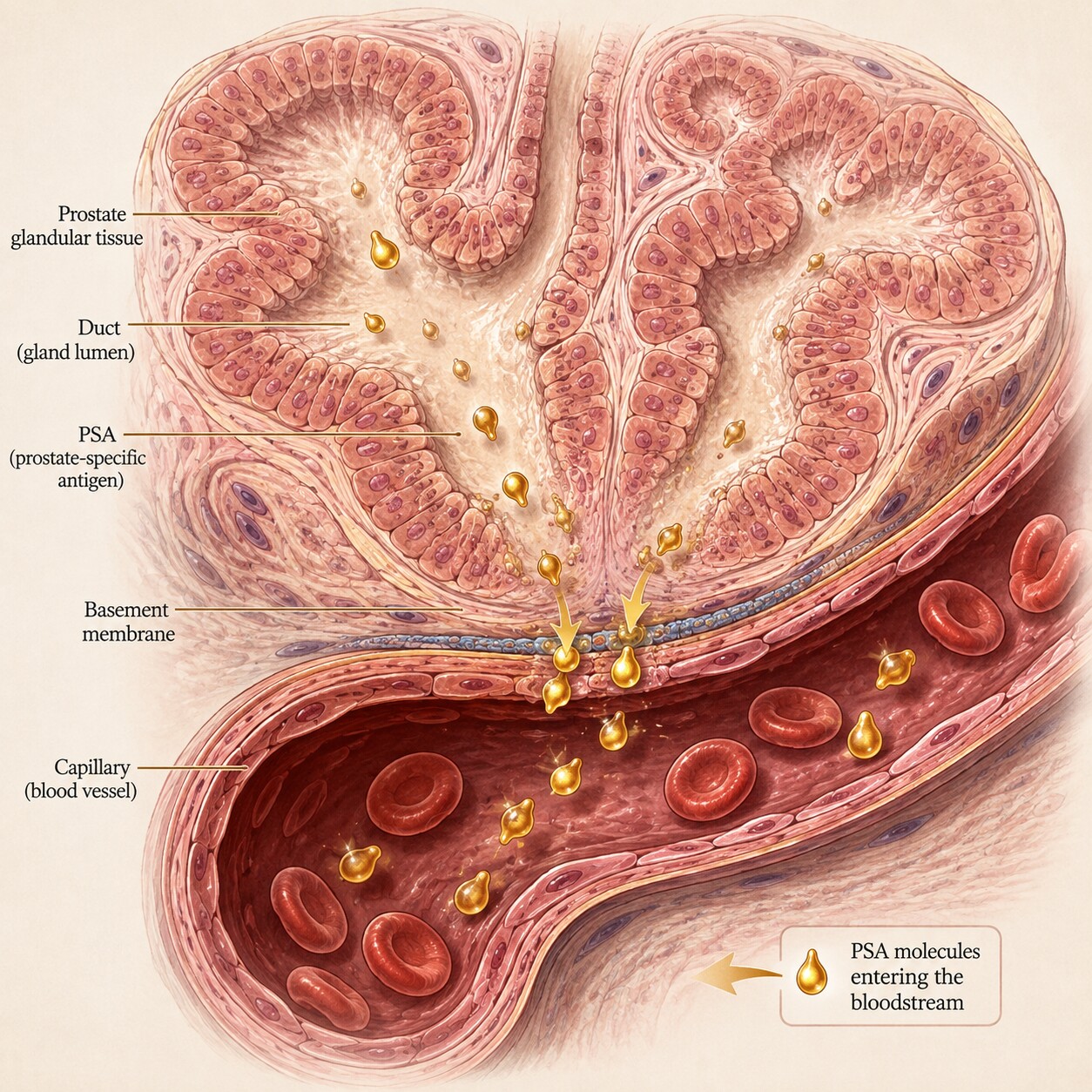
Figure 2. PSA leaks into the bloodstream from prostate tissue at a rate that reflects both gland size and any active disruption of normal tissue architecture.
The math behind PSA velocity is straightforward once you have the raw numbers: you take the difference between two PSA readings and divide it by the time, in years, that passed between the draws. If your PSA was 1.5 ng/mL two years ago and it's 2.5 ng/mL today, your PSA velocity over that stretch is (2.5 − 1.5) ÷ 2, or 0.5 ng/mL per year. Most guidelines that use velocity as a factor recommend basing the calculation on at least three measurements spread over a minimum of eighteen months, because a two-point calculation is far more vulnerable to being thrown off by lab-to-lab variability, timing quirks, or a single fluke reading. Three points let a real trend separate itself from noise.
That noise is not a small consideration. PSA is a notoriously "jumpy" biomarker — it can shift meaningfully from one week to the next based on factors that have nothing to do with the prostate's underlying health, including recent ejaculation, a bicycle ride, a digital rectal exam performed shortly before the blood draw, or even which specific lab and assay platform processed the sample. This is why clinicians who rely on PSA velocity insist on consistency: same lab, same assay method, similar conditions before each draw, and enough time between tests that a single noisy result can't masquerade as a genuine trend. A velocity calculated from three consistent draws over two years tells a much more reliable story than one calculated from two draws that happened to be run at different labs three months apart.
There's also a subtler statistical trap worth understanding: because PSA naturally bounces around by a small amount from test to test even when nothing about your prostate has changed, a velocity calculated from only two closely spaced draws can be pulled sharply upward or downward purely by chance, in the same way flipping a coin twice can easily produce two heads in a row without the coin being unfair. Researchers call this kind of natural, meaningless fluctuation "biological variability," and studies measuring it in healthy men have found that a single PSA value can vary by roughly 15 to 20 percent between two draws taken just weeks apart, with no change whatsoever in the underlying prostate. A velocity calculation built on three or more points, spread across a longer window, dilutes the influence of any one noisy measurement and makes the resulting trend line far more trustworthy — which is exactly why the standard recommendation leans so heavily on multiple data points rather than treating any two consecutive numbers as proof of a real pattern.
Already have a PSA number from a recent test, but not sure if it's actually good or bad for you? Just plug it in and see instantly.
🧮 Try the Free CalculatorWhat Counts as a Concerning PSA Velocity?
There's no single universal cutoff, and the threshold that gets applied depends heavily on your starting PSA range and your age, but a commonly cited benchmark in the urology literature is a rise of more than 0.35 ng/mL per year for men whose PSA is already under 4.0 ng/mL, and a rise of more than 0.75 ng/mL per year for men whose PSA sits somewhere in the 4.0 to 10.0 ng/mL range. These numbers aren't arbitrary — they come from research that tracked large groups of men over years and looked backward at which velocity patterns were more often associated with prostate cancer being found on biopsy versus which patterns tracked with benign gland growth. A velocity above these thresholds doesn't mean cancer is present; it means the trend is unusual enough that it changes the odds enough to warrant a closer look, the same way a fever alone doesn't diagnose an infection but does change what a doctor investigates next.
It's worth sitting with what these thresholds actually represent in real terms. A rise from 1.0 to 1.3 ng/mL over a year — a velocity of 0.3 — sits right at the edge of the lower threshold and, on its own, would rarely trigger alarm, especially in a man in his fifties or sixties where some gradual increase is expected. A rise from 3.0 to 4.6 ng/mL over that same single year — a velocity of 1.6 — is a much steeper climb relative to where the number started, and would typically prompt a more immediate conversation about repeat testing, a physical exam, or additional bloodwork like a free PSA percentage. The absolute numbers matter, but so does the shape of the climb: gradual and proportional versus sudden and disproportionate.
Age also changes how a given velocity should be read, because the "expected" background rate of PSA rise isn't the same at every stage of life. A healthy prostate in a man in his forties, largely untouched by benign enlargement, typically shows only a very small, slow upward drift year to year. By a man's sixties and seventies, some degree of BPH is close to universal, and a modest baseline velocity — even one that would look concerning in a much younger man — is often simply the expected signature of an aging gland. This is part of why doctors weigh velocity alongside age-specific PSA reference ranges rather than applying one flat number to every man regardless of age: the same 0.4 ng/mL/year climb might be unremarkable at seventy-two and worth a closer look at forty-eight.

Figure 3. Benign prostatic hyperplasia gradually enlarges the gland with age, which is the single most common non-cancer reason PSA — and PSA velocity — rises over time.
Non-Cancer Reasons PSA Can Rise Quickly

Figure 4. Comparing dated reports side by side, rather than reading a single result in isolation, is how a real PSA trend becomes visible to a patient.
A fast-rising PSA is not, by itself, a cancer diagnosis, and a large share of the men who see an alarming-looking velocity end up having a completely benign explanation once the full picture is examined. Benign prostatic hyperplasia is the biggest one: as the gland enlarges, it simply contains more PSA-producing tissue, and larger glands mechanically leak more PSA into the bloodstream regardless of whether any of that tissue is cancerous. A urinary tract infection or prostatitis — inflammation of the prostate itself, often from a bacterial infection — can also drive PSA up sharply and quickly, sometimes into a range that looks identical to what a rapidly growing tumor might produce, which is exactly why doctors often treat a suspected infection first and recheck PSA a few weeks later before considering anything more invasive.
Recent sexual activity, a long bike ride, a prostate biopsy or catheter placement in the preceding weeks, and even a fairly vigorous digital rectal exam performed right before the blood draw can all cause a temporary PSA spike large enough to distort a velocity calculation if the timing lines up badly. This is part of why a single suspicious-looking rise is rarely acted on immediately — the standard next step is almost always a repeat test under cleaner conditions (no ejaculation for 48 hours, no recent infection, same lab) rather than an immediate referral for biopsy. A true, sustained velocity concern is one that holds up across a repeat, carefully-timed test, not one that appears once and can be explained away by an obvious recent event.
Certain medications can also move PSA in the opposite direction and complicate how a velocity trend is interpreted. Drugs used to treat BPH symptoms, such as finasteride and dutasteride, work by shrinking the prostate gland, and they typically cut PSA roughly in half within about six to twelve months of starting treatment — which means a man on one of these medications needs his baseline PSA mathematically adjusted before any velocity calculation means anything at all. If a doctor isn't aware a patient recently started one of these drugs, a PSA that simply returns to its true, un-suppressed trajectory after the medication's effect levels off can look like an alarming rise when it's actually just the number reverting to where it always would have been. This is one of the most common reasons a mismatch shows up between a patient's own worry about a "rising" PSA and their doctor's much calmer read of the same numbers — the doctor is accounting for a medication effect the patient may not realize is relevant.
PSA Velocity vs. PSA Doubling Time
PSA velocity has a close cousin that gets used in a different clinical context: PSA doubling time, usually abbreviated PSADT. Where velocity measures the absolute rate of rise in ng/mL per year, doubling time measures how long it takes for the current PSA value to double, expressed in months. Doubling time is calculated using a slightly different mathematical approach — it typically uses the natural logarithm of the ratio between two PSA values divided by the time between them — and it's most commonly used after a man has already been treated for prostate cancer, when doctors are watching for a rising PSA that might signal the cancer has returned. A short doubling time, say six months or less, after treatment is a much more urgent finding than a doubling time of two or three years, because it suggests whatever tissue is producing PSA is growing rapidly.
The two tools serve overlapping but distinct purposes: velocity is more often discussed in the context of a man who has never been treated, as part of the initial decision about whether to biopsy or simply monitor; doubling time is more often discussed after treatment, as part of monitoring for recurrence. Both share the same core limitation — both are only as reliable as the consistency of the testing behind them, and both can be thrown off by the same benign factors (infection, recent ejaculation, lab variability) that complicate a single PSA reading.
The reason doubling time uses a logarithmic formula rather than the simple subtraction behind velocity comes down to how biological growth tends to actually behave. A population of cells that's genuinely proliferating doesn't usually add a fixed number of new cells every month — it tends to grow proportionally, the way compound interest accrues on a savings account, where the amount added each period scales with how much is already there. A tumor producing PSA at a steadily doubling rate will add far more PSA in absolute terms during its fourth doubling than during its first, even though the percentage increase per interval stays constant. Linear velocity, calculated as simple ng/mL per year, can make a genuinely exponential process look deceptively slow in its early stages and alarmingly fast later on, purely as an artifact of the math rather than any real acceleration in the underlying biology. Doubling time corrects for this by measuring the process in the units it actually grows in — proportional intervals — which is part of why it's the preferred tool specifically in the post-treatment setting, where distinguishing a slow-growing recurrence from a fast-growing one has direct treatment implications.
Why PSA Velocity Fell Out of Favor With Some Guideline Groups
If you've read that PSA velocity used to be a bigger deal in screening guidelines than it is today, that's accurate. For a period, several major urology and cancer organizations recommended factoring velocity into the decision about whether to biopsy a man with a borderline PSA. More recent research, however, found that once you already know a man's actual PSA level, his age, and his free PSA percentage, adding velocity into the equation didn't meaningfully improve the ability to predict which men actually had cancer on biopsy — it mostly just added more false alarms, prompting biopsies in men who turned out not to have cancer, without catching meaningfully more of the men who did. Because of this, groups including the American Urological Association have moved away from recommending PSA velocity as a standalone trigger for biopsy in most contemporary guidelines.
That doesn't mean velocity has become useless information — it still gets discussed, still gets calculated, and many urologists still find it clinically informative as one data point among several, particularly when a rise is dramatic and can't be explained by anything else. But it has shifted from being treated as an independent decision-making tool to being treated as supporting context that sits alongside the total PSA number, the free PSA percentage, prostate size on imaging, family history, and a digital rectal exam — a piece of the picture, not the whole picture on its own.
Where PSA Velocity Fits Into the Broader Screening Debate

Figure 5. A concerning velocity is discussed alongside total PSA, free PSA percentage, and exam findings rather than acted on in isolation.
PSA velocity's shifting role can't really be separated from a bigger, longer-running debate about PSA screening itself. For years, routine PSA testing in all men over fifty was widely encouraged, on the logic that catching prostate cancer earlier is always better. Then, in 2012, the U.S. Preventive Services Task Force — an independent panel that reviews screening evidence and issues national recommendations — went as far as recommending against routine PSA screening entirely, largely because trial data showed that widespread screening was catching a large number of slow-growing cancers that would likely never have caused harm in a man's lifetime, while exposing many men to the real physical and psychological costs of unnecessary biopsies and overtreatment. That recommendation proved controversial, and in 2018 the Task Force revised its position to a more nuanced one: for men aged 55 to 69, the decision to screen should be individualized, made jointly between a man and his doctor after weighing his own risk factors, values, and tolerance for the downstream uncertainty screening can create.
PSA velocity sits right in the middle of that tension. On one hand, tracking a trend over time — rather than reacting to any single elevated number — is exactly the kind of more thoughtful, less reactive approach the field has been moving toward, since it avoids rushing a man into a biopsy off one noisy result. On the other hand, the research showing velocity doesn't meaningfully improve cancer detection once other factors are already known is part of the same broader recognition that more testing and more data points don't automatically translate into better outcomes — sometimes they just add more anxiety and more procedures without changing what actually gets found. Understanding this context can help explain why your own doctor's approach to a rising PSA might differ somewhat from what you read about online or hear from a friend with a different provider; there's genuine, evolving disagreement within urology about exactly how much weight velocity should carry, even though nearly everyone agrees it shouldn't be ignored entirely.
What Happens After a Concerning Velocity Result

Figure 6. A confirmed rapid rise in PSA often leads to a targeted prostate MRI before any decision about biopsy is made.
If your PSA has risen faster than expected between two tests, the first move is almost never a biopsy — it's a repeat, carefully timed test to confirm the trend is real and not the product of a recent infection, sexual activity, or lab inconsistency. If the second test confirms the rise, your doctor will typically look at your free PSA percentage next: this measures what portion of your total PSA is circulating "free" in the blood versus bound to other proteins, and a lower free PSA percentage is more often associated with cancer, while a higher percentage leans toward benign enlargement. A digital rectal exam checks for any irregular firmness or nodules on the gland's surface that could be felt by hand. Depending on those results, the next step is often a prostate MRI, a non-invasive imaging scan that can flag suspicious areas within the gland and help decide whether a biopsy is actually warranted, and if so, where within the gland to target it — a meaningful improvement over the older approach of biopsying somewhat blindly across the whole gland.
It's worth emphasizing that a fast-rising PSA, even one that crosses a recognized velocity threshold, still leads to a cancer diagnosis in only a minority of cases once the full workup is complete. The purpose of velocity as a screening signal isn't to predict cancer with certainty — nothing about PSA does that — it's to help decide who genuinely needs a closer look versus who can reasonably be monitored with another routine test in six months or a year.
If a biopsy does end up being recommended, it's worth knowing that modern practice has moved substantially away from the older "blind" approach of taking a dozen or so tissue samples spread evenly across the gland regardless of where anything actually looked suspicious. When a prostate MRI has already flagged a specific region of concern, many urology practices now use MRI-ultrasound fusion biopsy, a technique that overlays the earlier MRI images onto real-time ultrasound during the procedure so the physician can direct the needle specifically toward the flagged area rather than sampling more broadly. This targeted approach has been shown in research to catch more clinically significant cancers while sometimes reducing the number of samples needed, which is part of why the MRI step has become such a central part of the modern pathway between a concerning PSA trend and any decision about biopsy.
How to Make Your Own PSA Trend More Reliable
Because so much of PSA velocity's accuracy depends on consistency between tests, there are a few practical things within your control that make the resulting trend more trustworthy. Try to use the same lab for repeat testing whenever possible, since different assay platforms can read the same blood sample slightly differently, introducing a false step in the trend that has nothing to do with your actual biology. Avoid ejaculation for 48 hours before a draw, avoid vigorous cycling in the day or two prior, and if you've had a urinary tract infection, prostatitis, or a digital rectal exam recently, mention it to whoever orders your test — postponing a draw by a few weeks after any of these events produces a far more meaningful number than rushing to test on the original schedule despite an obvious confound sitting in the way.
Keeping your own simple log of test dates and results — even just jotting the date and number down after each test — makes it much easier to spot a real trend yourself and to have a more informed conversation at your next appointment, rather than relying on memory or scattered paperwork from different visits. A simple spreadsheet or even a note on your phone with the date and value from each test, kept over years rather than just the most recent visit, can end up being more useful in a real conversation with a new specialist than trying to reconstruct the history from memory or from records scattered across two or three different health systems.
It also helps to ask your lab or provider's office, when you schedule a repeat test, whether the result will come from the same assay platform as your previous draws. Two of the most widely used PSA assay systems on the market have historically calibrated their results slightly differently from one another, and while most labs have converged on a standardized reference calibration in recent years, older records or results pulled from a different health system entirely can still carry a small systematic offset. If you've ever switched insurance plans, moved to a new city, or changed primary care providers between PSA tests, it's worth explicitly asking whether your new lab uses the same calibration standard as your old one, or at minimum flagging the switch to whoever is reviewing your trend, so a calibration difference doesn't get mistaken for a real biological change.
Family History and Other Risk Factors That Shift the Threshold
The velocity thresholds discussed earlier are population-level benchmarks, not fixed rules that apply identically to every man, and doctors typically adjust how much weight they give a given trend based on individual risk factors sitting alongside it. A man with a father or brother diagnosed with prostate cancer, particularly if that relative was diagnosed before age sixty-five, carries a meaningfully higher baseline risk, and a moderate velocity in that context may prompt a more cautious response than the same velocity would in a man with no family history at all. Race is another factor increasingly recognized in risk stratification: Black men in the United States face both a higher lifetime incidence of prostate cancer and a tendency toward more aggressive disease when it does occur, and several major urology organizations now recommend earlier and more frequent screening conversations for Black men as a result, which changes how a given velocity gets interpreted within that broader risk context.
Genetic factors add another layer for a smaller subset of men. Inherited mutations in genes such as BRCA2 — more commonly discussed in the context of breast and ovarian cancer risk — are also associated with a higher risk of aggressive prostate cancer in men who carry them, and men with a known BRCA2 mutation or a strong family history suggestive of hereditary cancer syndromes are often screened more intensively and followed more closely for velocity changes than the general population. None of this means a rising trend in a lower-risk man should be dismissed, or that a rising trend in a higher-risk man automatically means cancer — it simply means the same rate of change carries a different weight depending on the fuller clinical picture it sits inside.
Frequently Asked Questions
Can PSA velocity be calculated from just two tests?
Technically yes, but most guidelines that use velocity recommend at least three measurements spread over a minimum of eighteen months for a reliable result. A two-point calculation is far more vulnerable to being skewed by a single noisy or poorly timed reading, since there's no third data point to confirm the direction of the trend, and a doctor seeing only two numbers will typically want a third before treating the trend as established.
Is a rising PSA velocity always a sign of prostate cancer?
No. Benign prostatic hyperplasia, urinary tract infections, prostatitis, recent ejaculation, cycling, and lab-to-lab variability can all produce a rise that looks concerning on paper. Most men who show an elevated velocity end up having a benign explanation once the full workup — repeat testing, free PSA percentage, exam, and sometimes imaging — is complete.
Why did my doctor stop mentioning PSA velocity even though I know my PSA has gone up?
Several major guideline groups, including the American Urological Association, have moved away from using velocity alone as a trigger for biopsy after research found it added false alarms without meaningfully improving cancer detection once total PSA, age, and free PSA percentage were already known. Your doctor may still track it informally as supporting context rather than a standalone decision point.
What's the difference between PSA velocity and PSA doubling time?
Velocity measures the absolute rate of rise in nanograms per milliliter per year and is most often discussed before any prostate cancer treatment has occurred. Doubling time measures how long it takes the current PSA value to double and is most often used after treatment to monitor for a possible recurrence.
Should I ask for my PSA velocity to be calculated at every checkup?
It's a reasonable question to bring up if you've had two or more PSA tests, particularly if your absolute number has moved at all between them. Many providers will do this calculation informally without necessarily stating the exact velocity figure out loud, but asking directly — and asking what it would take to see the calculation from your own records — is a fair way to get a clearer, more concrete picture of your own trend rather than hearing only "your PSA is fine" or "your PSA is a little high" without the underlying trajectory.
Conclusion
PSA velocity exists because a single number can't tell you whether your prostate's PSA output has been climbing gradually for a decade or accelerating over the past year, and those two situations warrant genuinely different levels of concern. Understanding how it's calculated — from at least two or three consistently-timed blood draws — and what commonly drives it up outside of cancer can turn a frightening-looking jump on a lab report into a much more grounded conversation with your doctor about what to check next. It also helps to understand where velocity sits in the current medical conversation: no longer treated as a standalone trigger for biopsy the way it once was, but still a genuinely useful piece of context when it's read alongside your age, your family history, your total PSA, and your free PSA percentage rather than in isolation.
Whether your own trend turns out to reflect normal age-related gland growth, a resolved infection, a medication effect, or something that genuinely needs a closer look, the path forward almost always starts with the same next step: a repeat test done under clean, consistent conditions, not a leap to the most alarming possible explanation. Bringing your own record of past results to that conversation, asking directly about the trend rather than just the newest number, and understanding the difference between a number that's simply present and a number that's actively accelerating puts you in a far better position to make sense of whatever your doctor recommends next.
Still Not Sure What Your Results Mean?
Upload your labs and get a complete, visual, plain-language interpretation of every biomarker — delivered to your inbox in under 15 minutes.
Get My ReportThis article is for educational purposes only and does not constitute medical advice. Always consult your healthcare provider regarding your specific lab results.