
Understanding the Difference Between Total and Free PSA
If your total PSA came back somewhere in the fuzzy middle — not clearly normal, not clearly alarming — there's a good chance a second, less familiar number showed up on the same report: free PSA, sometimes expressed as a percentage. That isn't a clerical duplicate. PSA, short for prostate-specific antigen, doesn't travel through your blood in just one form. Some of it floats freely on its own, and some of it travels locked onto another protein, like a passenger buckled into a seatbelt. The ratio between those two forms — your "percent free PSA" — carries information the total number alone can't provide. A lower percentage of free PSA has, across decades of research, been associated with a higher relative likelihood that an elevated total PSA is being driven by prostate cancer rather than a benign, non-cancerous cause such as an enlarged prostate. It isn't a yes-or-no verdict by itself, but for men whose total PSA sits in what doctors call the diagnostic "gray zone," it can meaningfully shift the conversation about whether a biopsy makes sense now, or whether watching and retesting later is the more reasonable path.
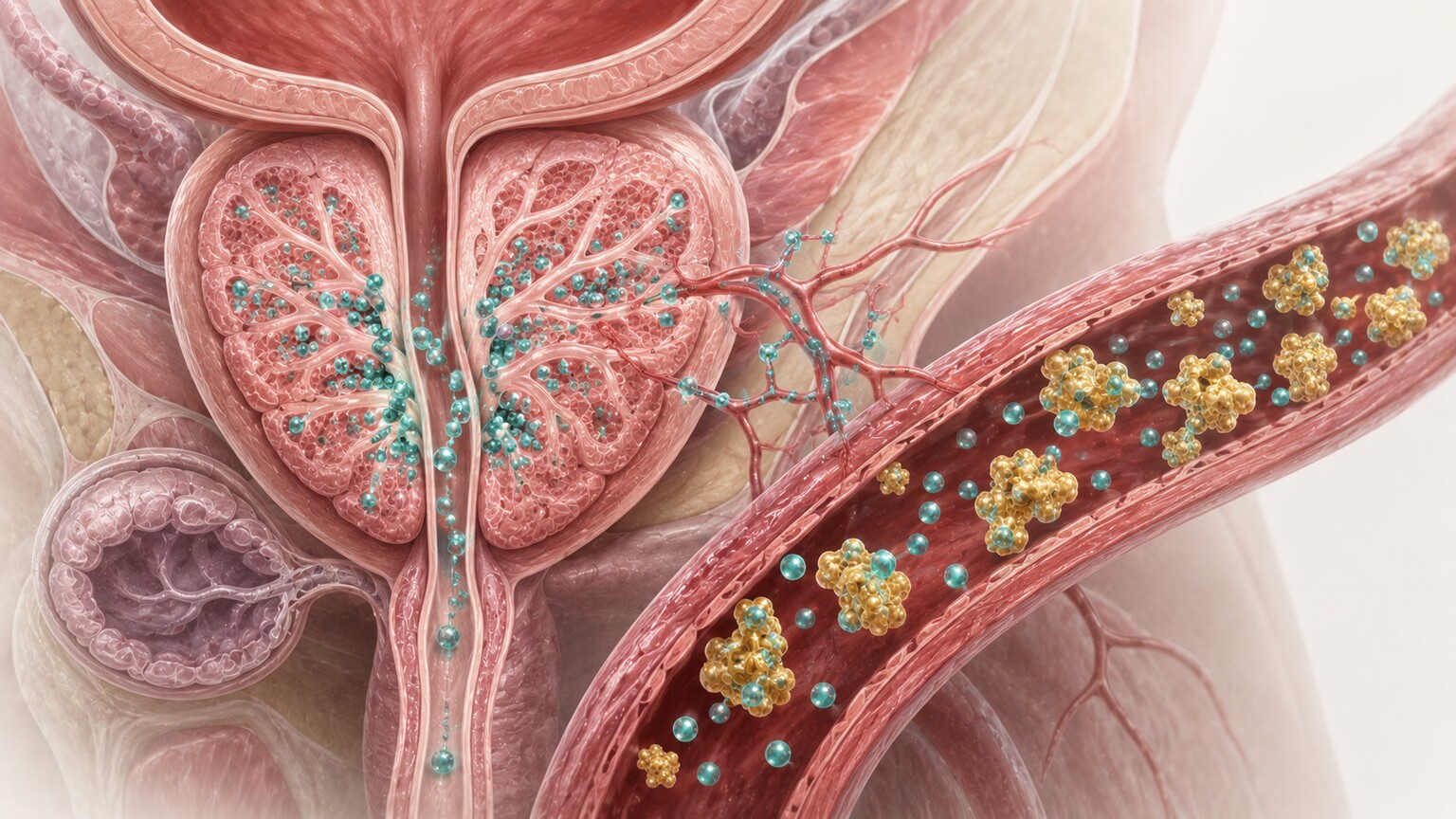
Figure 1. PSA is produced by prostate gland cells and enters the bloodstream either as a free molecule or bound to the carrier protein alpha-1-antichymotrypsin.
Already have a PSA number from a recent test, but not sure if it's actually good or bad for you? Just plug it in and see instantly.
🧮 Try the Free CalculatorWhat Is PSA, and Why Does Your Body Make Two Different Versions of It?
PSA is a protein — more specifically, an enzyme, meaning it doesn't just sit there passively, it actively performs a chemical job — made almost exclusively by cells inside the prostate gland, a walnut-sized gland that sits just below the bladder in men and wraps around part of the urethra, the tube that carries both urine and semen out of the body. The gene that instructs cells to build PSA is called KLK3, and it belongs to a family of enzymes called kallikreins, which is why older medical literature sometimes refers to PSA by its family nickname, human kallikrein 3.
Under normal circumstances, PSA has a very specific day job. Right after ejaculation, semen briefly turns into a loose gel, thick enough to keep sperm somewhat contained near the site of deposit rather than dispersing immediately. PSA is the enzyme responsible for breaking that gel back down into a thinner, more liquid consistency within about twenty minutes, a process it accomplishes by cutting apart two large structural proteins called semenogelins. Because this entire process happens almost entirely within the reproductive tract, the vast majority of the PSA your body manufactures never needs to enter your bloodstream at all — it's made, does its job locally, and stays largely contained.
But "almost entirely contained" isn't the same as "entirely contained." A small, steady trickle of PSA leaks out of the prostate and into the surrounding tissue and blood vessels even in a completely healthy gland. That trickle is what a PSA blood test actually detects — the test is really measuring the small overflow of a substance whose main job happens somewhere a blood draw can't reach directly. Anything that disrupts the prostate's normal internal architecture — benign swelling, inflammation, or cancerous tissue growth — tends to make that overflow larger, which is the entire reason a rising PSA number gets a doctor's attention in the first place.
PSA testing itself has a relatively short history. The protein was first identified and characterized in the 1970s, and by the mid-1980s it had been developed into a practical blood test. The U.S. Food and Drug Administration approved it in 1986, but only for a narrow purpose: monitoring men already diagnosed with prostate cancer to see whether treatment was working. It wasn't until 1994 that the FDA expanded that approval to include screening — using PSA to help flag prostate cancer in men who hadn't yet been diagnosed with anything. Free PSA testing came later still, becoming widely available in the late 1990s specifically to address a problem total PSA alone couldn't solve: too many men were being sent for biopsies that, it would later turn out, found no cancer at all.
It's also worth understanding why PSA is described as "prostate-specific" rather than "prostate-cancer-specific," because that distinction is really the whole reason free PSA testing exists in the first place. PSA is specific to the organ, not to the disease — it tells you something is happening inside the prostate, but on its own it can't tell you whether that something is cancer, benign overgrowth, inflammation, or simply the normal effect of aging tissue producing slightly more leakage than it used to. Other members of the kallikrein family, like human kallikrein 2 (hK2), are closely related to PSA and are sometimes studied in research settings for similar reasons, though PSA itself remains by far the most established and widely used marker in routine clinical practice. Keeping this "organ-specific, not disease-specific" distinction in mind makes it much easier to understand why doctors reach for additional tools, like the free PSA percentage, rather than treating one blood number as a final answer.
How PSA Splits Into "Free" and "Bound" Forms Once It Reaches Your Blood
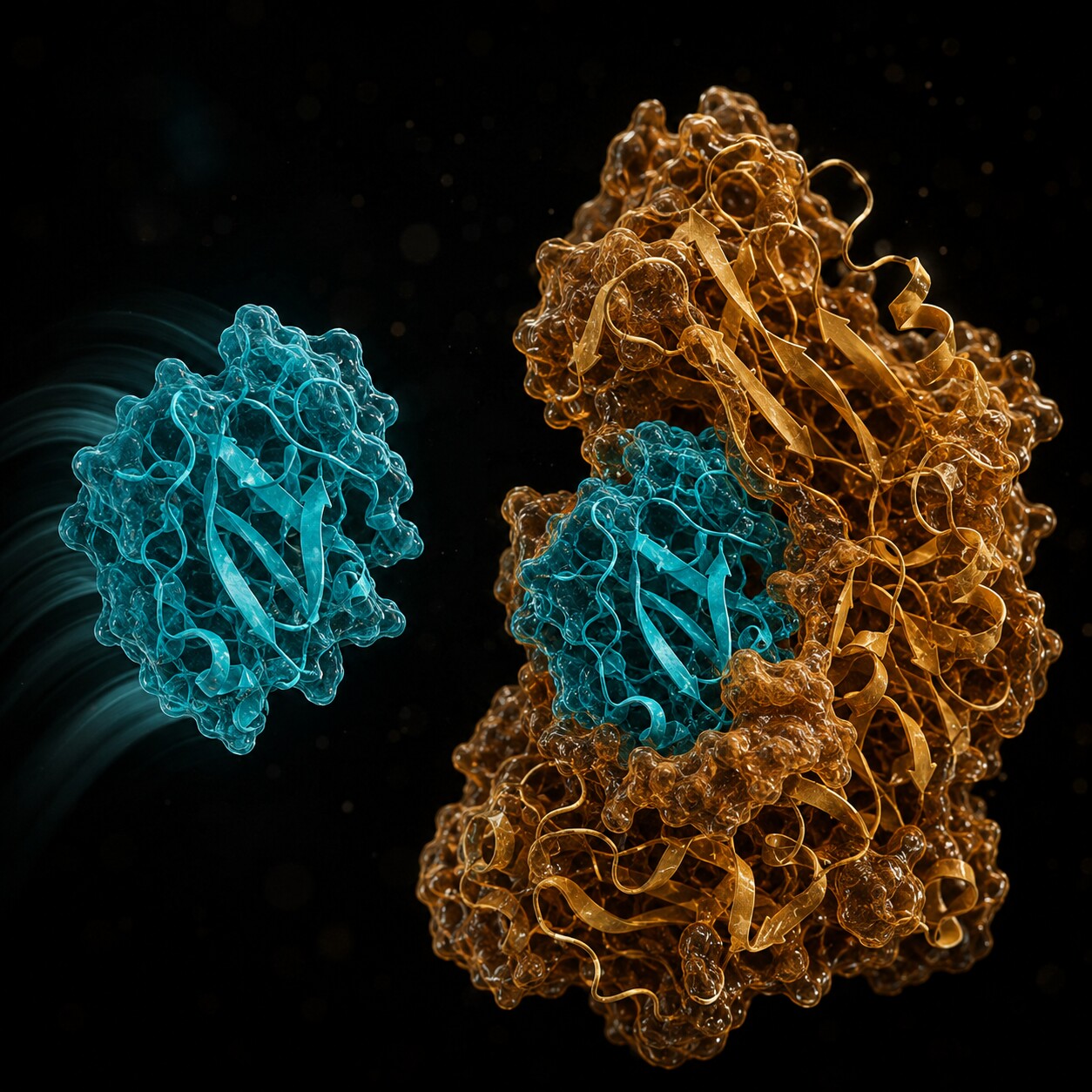
Figure 2. A free PSA molecule circulates unattached, while a bound PSA molecule is chemically locked to alpha-1-antichymotrypsin and can no longer function as an enzyme.
Once a PSA molecule crosses out of the prostate and into your bloodstream, something happens to it that doesn't happen inside the gland itself: your blood is full of other proteins, and some of those proteins are specifically built to grab onto and neutralize loose enzymes. The main one responsible here is called alpha-1-antichymotrypsin, usually shortened to ACT in medical shorthand. Think of ACT as a kind of security escort patrolling the bloodstream for active enzymes that shouldn't be running around unsupervised. When ACT encounters a PSA molecule, it locks onto it, forming one larger, combined unit — this is what's called "complexed PSA" or "bound PSA." Once bound this way, that PSA molecule can no longer function as an enzyme; it has effectively been handcuffed. A smaller amount of PSA in the blood remains unattached, floating on its own without a partner protein — this is "free PSA." Add the two together, everything bound to ACT plus everything still free, and you get "total PSA," the single number that has traditionally been the only one reported on a standard PSA blood test.
In most men, this split isn't close to even. On average, somewhere between 70% and 90% of the PSA circulating in blood is already bound to ACT at any given moment, with only the remaining 10% to 30% floating free. There's also a third, much smaller player: a protein called alpha-2-macroglobulin can bind PSA too, but it wraps so completely around the molecule that standard lab tests can't detect it at all — for practical purposes it's invisible to the assay (the laboratory measurement method used to detect and quantify a substance) and doesn't factor into any of these calculations. One more detail worth knowing: the complexed form tends to linger in your bloodstream longer than the free form does, because free PSA is small enough to be filtered out by the kidneys relatively quickly, while the larger PSA-ACT complex is not. That difference in how long each form sticks around is part of why the ratio between them can shift depending on exactly when blood is drawn relative to whatever is driving your PSA upward in the first place.
The Free PSA Percentage — What the Math Actually Tells You
Here's where the second number on your lab report comes from. Once a lab measures both your total PSA and your free PSA separately from the same blood sample, it can calculate what fraction of the total is the free, unbound kind. The formula is simple: divide free PSA by total PSA, then multiply by 100 to express it as a percentage. So if your total PSA is 6.0 ng/mL (nanograms per milliliter, the standard unit for PSA — a vanishingly small quantity, billionths of a gram, in a thousandth of a liter of blood) and your free PSA is 0.9 ng/mL, your percent free PSA works out to 0.9 divided by 6.0, times 100, or 15%.
It helps to think of this less like a single measurement and more like a ratio, the way a recipe calls for a certain proportion of flour to water rather than just a total weight of ingredients. Two men can have the exact same total PSA of 6.0 ng/mL and yet mean two very different things, depending on how that 6.0 breaks down underneath. One man might have a free PSA of 2.0 ng/mL, giving him a percent free PSA around 33%. Another might have a free PSA of only 0.5 ng/mL, giving him a percent free PSA of roughly 8%. Same total, very different ratio — and, as the next section explains, a very different statistical likelihood attached to what's actually driving that number.
This is also why free PSA is never ordered as a standalone test on its own. It only makes sense, mathematically and clinically, alongside a total PSA measured from that same blood draw. A free PSA value with no total PSA to divide it into is just a number without context; the percentage is the entire point.
Why Prostate Cancer Tends to Lower the Free PSA Percentage — and Benign Enlargement Tends to Raise It
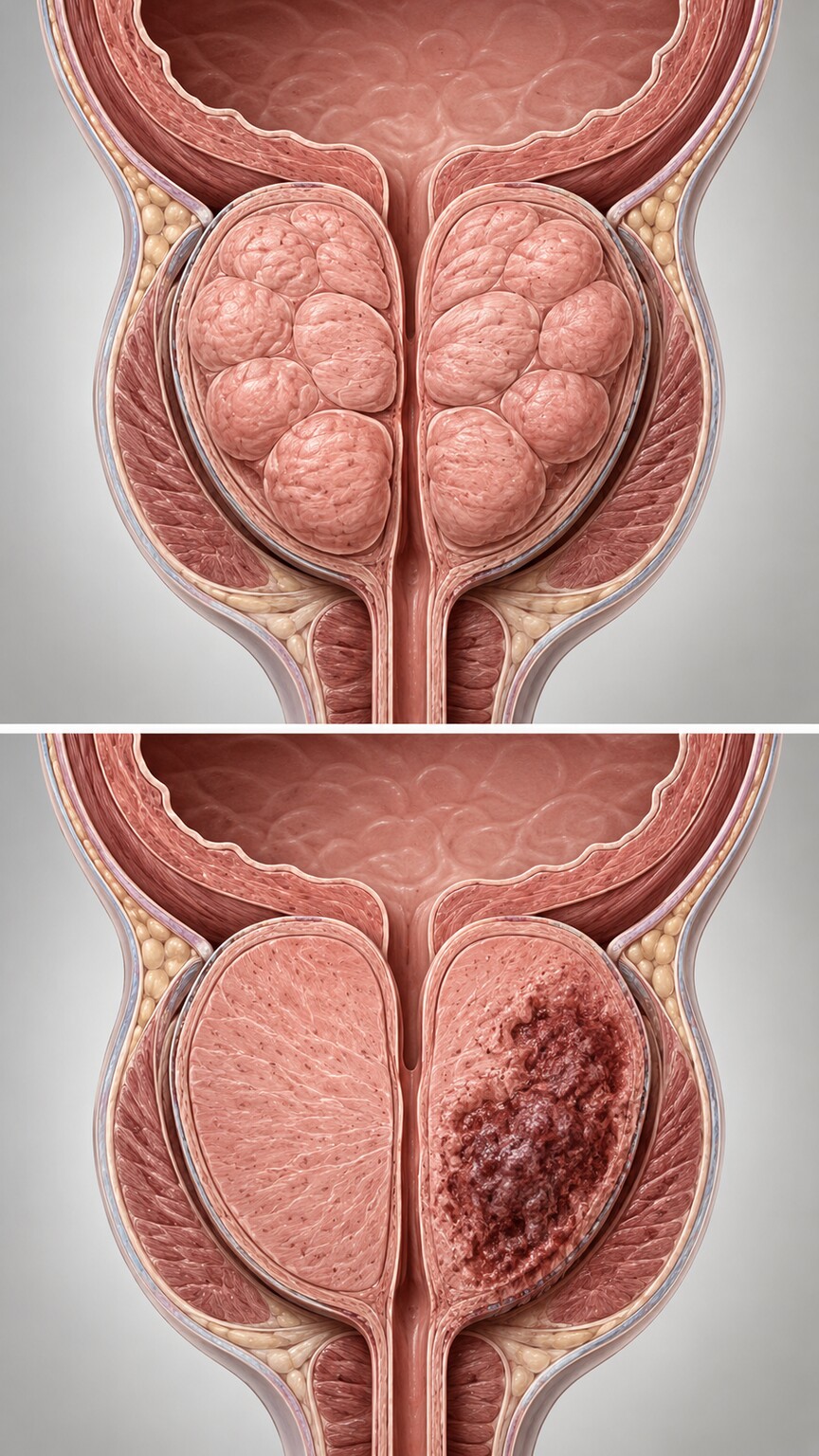
Figure 3. Benign prostatic hyperplasia and prostate cancer both raise total PSA, but tend to shift the free-to-bound ratio in different directions.
Researchers have consistently observed, across large studies going back to the 1990s, that prostate tissue affected by cancer tends to release PSA into the bloodstream in a form more likely to end up bound to ACT, while benign prostatic hyperplasia, or BPH — the common, non-cancerous enlargement of the prostate that affects a large share of men as they get older — tends to release relatively more of the free, unbound form. The practical result is that, on average, men with prostate cancer tend to have a lower percent free PSA than men whose elevated total PSA is being driven by benign enlargement, even when their total PSA numbers look identical on paper.
The full biological explanation for this pattern is still an active area of research, but a few contributing factors are reasonably well understood. Free PSA itself isn't one uniform substance — it's a mix of several sub-forms, including one called BPSA (benign PSA), which is specifically associated with the tissue changes seen in benign enlargement and doesn't bind well to ACT, helping push the free percentage upward in BPH. Cancerous tissue, by contrast, tends to produce more of a precursor fragment called proPSA, and the disruption of the prostate's normal cellular architecture that comes with cancer appears to make PSA more available to bind with ACT once it reaches the bloodstream. Whatever the exact underlying mechanism, the resulting statistical pattern has proven reliable enough that urologists have used it for decades as one more piece of evidence when deciding how urgently to investigate an elevated PSA.
It's worth being precise about what this pattern does and doesn't mean. A low percent free PSA does not mean you have cancer, and a high percent free PSA does not guarantee you don't. This is a probability shift, not a diagnosis. Plenty of men with BPH land in the percentage range typically associated with cancer, and a smaller number of men who do have prostate cancer land in the range usually considered reassuring. What changes, cutoff by cutoff, is the odds — the same way a weather forecast calling for an 80% chance of rain doesn't guarantee rain on any single day, but does reasonably change whether you decide to bring an umbrella. That's exactly the kind of information percent free PSA is built to add: not a verdict, but a meaningfully better-informed estimate than total PSA can offer on its own.
The "Gray Zone": Why Free PSA Matters Most When Total PSA Falls Between 4 and 10 ng/mL
Total PSA works reasonably well at the extremes. A total PSA under roughly 2.5 to 4.0 ng/mL (the exact cutoff used varies somewhat by lab and by age) is reassuring for the vast majority of men, and a total PSA well above 10 ng/mL is concerning enough on its own that free PSA testing usually doesn't change the next step much — further evaluation is warranted either way. The real ambiguity lives in the middle, in what clinicians commonly call the diagnostic "gray zone": a total PSA roughly between 4 and 10 ng/mL.
This gray zone is genuinely gray. Research following men who undergo a prostate biopsy after landing in this range has consistently found that roughly one in four actually has prostate cancer, while the other three out of four have a benign explanation — most commonly BPH, sometimes prostatitis (inflammation or infection of the prostate), and occasionally no clear cause identified at all. Total PSA on its own, within this range, correctly separates cancer from non-cancer only modestly better than chance; its statistical ability to correctly rule out cancer in someone who doesn't have it — a property called specificity — hovers around only 50% to 60%.
Part of why the gray zone is so crowded comes down to how common a slowly rising PSA becomes simply with age, independent of any disease process. The prostate gland naturally continues to grow throughout adult life for most men, and as it does, the baseline amount of PSA leaking into the bloodstream tends to creep upward too. Some labs account for this by using age-adjusted reference ranges — for example, treating a total PSA up to roughly 2.5 ng/mL as typical for a man in his 40s, but allowing up to around 6.5 ng/mL to still be considered within an expected range for a man in his 70s. Not every lab or guideline uses age-adjusted cutoffs, and there's ongoing debate in the field about how much they should influence decision-making, but they help explain why a "borderline" PSA in an older man is interpreted somewhat differently than the identical number in a much younger one — and why free PSA testing becomes an especially useful tiebreaker precisely in this crowded, age-influenced middle range.
That's precisely the gap free PSA testing was developed to close. By folding the free PSA percentage into the picture, research has found the specificity of testing in this gray zone can climb to somewhere around 70% to 80% — a meaningful jump when the alternative is deciding, close to a coin flip, whether a man should undergo a prostate biopsy, a procedure that carries its own real risks and discomforts, including bleeding, infection, and the anxiety of the procedure itself. Free PSA doesn't eliminate the gray zone, but it narrows it — nudging some men more clearly toward "this is very likely benign, let's monitor" and others more clearly toward "this pattern is worth investigating further, let's discuss a biopsy."
How Doctors Interpret Your Free PSA Percentage — the Cutoffs Explained
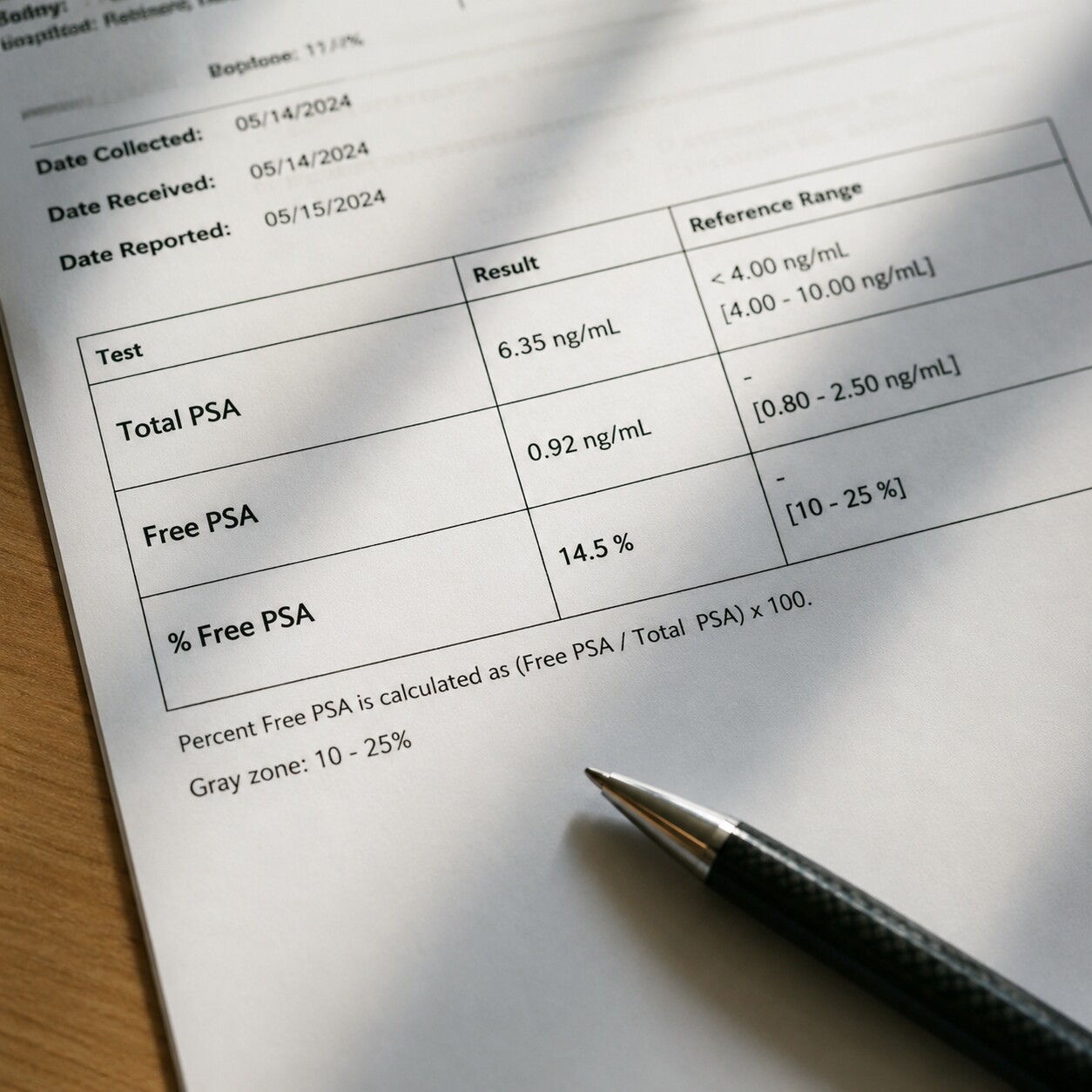
Figure 4. A lab report calculates percent free PSA by dividing the free PSA value by the total PSA value, a figure most useful when total PSA falls between 4 and 10 ng/mL.
The most widely cited benchmark for interpreting percent free PSA comes from a large multicenter study published in the Journal of the American Medical Association in 1998, led by urologist Dr. William Catalona, which tested a range of free-PSA cutoff points in men with total PSA in the 4 to 10 ng/mL gray zone. That study found that using a cutoff of 25% — meaning free PSA makes up 25% or more of total PSA — correctly identified 95% of the prostate cancers present, while allowing about 20% of the men who didn't have cancer to avoid an unnecessary biopsy. That balance, catching the large majority of cancers while meaningfully reducing unneeded procedures, is why 25% became, and largely remains, the most commonly referenced threshold in clinical practice.
In practice, most labs and urologists think about the result less as a single hard line and more as three loose zones. A percent free PSA below roughly 10% is generally treated as the most concerning pattern, one that tends to prompt a more serious conversation about biopsy given the higher statistical likelihood of cancer in that range. A percent free PSA above 25% is generally the most reassuring pattern, often supporting a decision to hold off on biopsy and instead repeat PSA testing down the road to track the trend. The middle stretch, roughly 10% to 25%, is where individual clinical judgment matters most — your urologist will typically weigh it alongside your age, family history, findings from a digital rectal exam, prior biopsy history if you've had one, and how your total PSA has trended over time, rather than leaning on the free PSA percentage in isolation.
These exact percentage cutoffs are not universal law. Different professional bodies and different labs have published slightly different thresholds over the years, and some apply age-specific adjustments, since percent free PSA has its own tendency to shift somewhat with age, independent of what's happening inside the prostate. What stays consistent across essentially all of the research, though, is the underlying direction: a lower percent free PSA points toward a higher relative likelihood of cancer, and a higher percent free PSA points toward a lower relative likelihood, within that gray-zone population specifically. Outside the gray zone — for very low or very high total PSA — the free PSA percentage carries much less additional weight, which is part of why it's rarely ordered as a routine, first-line test alongside every total PSA.
Beyond Free PSA: proPSA, BPSA, and the Prostate Health Index
Free PSA testing was a genuine advance when it became widely available in the late 1990s, but researchers didn't stop there. Free PSA, remember, isn't one single substance — it's a mix of several different sub-forms, and scientists have since learned that some of those sub-forms carry even more specific information than the free-versus-bound split alone captures. The one that has gained the most clinical traction is called [-2]proPSA, often written as p2PSA, a particular precursor fragment of the PSA molecule that shows up disproportionately in prostate cancer tissue compared with benign tissue.
That discovery led to a newer, more refined blood test called the Prostate Health Index, usually abbreviated PHI. Rather than relying on just two numbers, PHI combines three: total PSA, free PSA, and p2PSA, run through a specific formula — p2PSA divided by free PSA, multiplied by the square root of total PSA — to produce a single composite score. You don't need to calculate this yourself; the lab reports the final PHI value directly. What matters is what that combination captures that percent free PSA alone can't: because p2PSA specifically tracks the cancer-associated precursor fragment, folding it in sharpens the picture even further.
The evidence backs this up. In multicenter studies of men with total PSA in the classic 4 to 10 ng/mL gray zone, PHI has outperformed both total PSA and percent free PSA at correctly ruling out cancer in men who don't have it, while still catching a comparable share of the actual cancers present — one analysis found clinical specificity of roughly 16% for PHI compared with about 8% for free PSA and 7% for total PSA, all measured at the same 95% sensitivity. The U.S. Food and Drug Administration has approved PHI for this purpose, and the National Comprehensive Cancer Network, a widely followed group of cancer centers that publishes clinical practice guidelines, includes it as an option physicians can use to further refine biopsy decisions in men with an elevated PSA. Some research suggests appropriate use of PHI could help avoid roughly three in ten unnecessary biopsies that might otherwise have been recommended based on total PSA and percent free PSA alone.
PHI isn't available at every lab and isn't ordered as often as standard free PSA testing, partly because it's newer and partly because it requires specialized equipment not every laboratory has invested in. If your own doctor ordered a standard percent free PSA rather than a PHI score, that doesn't mean you're getting outdated or lesser care — it remains a well-validated, widely used test in its own right. PHI is best understood as a more specialized next step some urologists reach for when a case is particularly ambiguous, not a replacement that has made free PSA obsolete.
What Can Throw Off Your Free PSA Percentage Besides Cancer and BPH
Percent free PSA is a genuinely useful number, but it isn't immune to outside influences. A handful of common, everyday factors can shift it in ways that have nothing to do with whether cancer is present, which is part of why your doctor interprets it in context rather than treating it as an isolated verdict.
Recent ejaculation is one of the more commonly cited factors. Because semen itself contains an enormous concentration of PSA compared with blood, sexual activity in the 24 to 48 hours before a blood draw can cause a small, temporary bump in total PSA in some men. Many urology practices recommend avoiding ejaculation for a day or two before testing simply to keep the reading as clean as possible, though the effect tends to be modest and doesn't derail the test for everyone.
Infection or inflammation of the prostate — a condition called prostatitis, or sometimes a urinary tract infection that irritates the gland — can raise total PSA substantially, occasionally into ranges that would otherwise look quite alarming, and can also shift the free-to-bound ratio in ways that don't reflect cancer risk at all. Because of this, if there's reason to suspect an active infection, most physicians will treat it first and repeat PSA testing several weeks later rather than trying to interpret a free PSA percentage drawn during the flare-up.
Certain medications matter too. Drugs known as 5-alpha-reductase inhibitors — finasteride and dutasteride, commonly prescribed for BPH symptoms and, at lower doses, for hair loss — reduce total PSA by roughly half, on average, within six months to a year of starting treatment, by directly shrinking prostate tissue. Doctors familiar with this effect typically double a man's measured total PSA to estimate what it would have been off the medication. The effect of these drugs on percent free PSA specifically is less consistently established in the research, so most clinicians lean on adjusting total PSA rather than trying to reinterpret the free PSA percentage in men taking them.
There's also a purely technical, behind-the-scenes factor worth knowing about: free PSA is chemically less stable once blood is drawn than total PSA is. If a blood sample sits too long at room temperature before a lab separates and processes it — even by a matter of hours — free PSA can start to degrade faster than the bound form does, artificially lowering the calculated percentage in a way that has nothing to do with your actual biology. Reputable labs know this and follow handling protocols designed to process samples promptly for exactly this reason, but it's one more example of why a single unusual free PSA percentage is rarely treated as a final word without context or repeat testing.
Finally, prostate size itself plays a role independent of cancer or BPH specifically — a naturally larger prostate tends to produce more free PSA simply because there's more benign glandular tissue contributing to the total. This is part of why some urologists also look at a related measurement called PSA density, which divides total PSA by prostate volume (typically measured by ultrasound or MRI) to account for gland size directly, sometimes used alongside or instead of percent free PSA depending on the clinical picture.
What to Do With Your Total and Free PSA Numbers

Figure 5. Reviewing total PSA and free PSA results together, rather than in isolation, gives a fuller picture than either number provides on its own.
Seeing both a total PSA and a free PSA percentage on the same report can feel like more to worry about, not less — but the honest reframe is that free PSA exists specifically to give you and your doctor more clarity, not less. If your total PSA landed in the gray zone and your free PSA percentage came back reassuringly high, that's genuinely useful information supporting a reasonable decision to monitor rather than rush into an invasive procedure. If it came back low, that isn't a diagnosis either — it's a signal that a more thorough conversation, possibly including imaging like an MRI or a referral to a urologist for further evaluation, is a sensible next step rather than an optional one.
Either way, the most useful thing you can do with these numbers is bring them into a real conversation, not try to resolve them alone from a screen. A urologist can weigh your percent free PSA alongside details a lab report can't capture on its own — your age, your family history of prostate cancer, findings from a physical exam, how your PSA has trended over previous tests if you have them, and your own preferences about risk and intervention. Two men with an identical 15% free PSA result might reasonably receive two different recommendations, because the number is one input into a larger clinical picture, not a self-contained answer.
It's also worth knowing that even when a biopsy is recommended and does find cancer, a favorable free PSA percentage earlier in the process isn't wasted information — it often feeds into the broader risk picture doctors use afterward, alongside biopsy grade and imaging findings, to decide whether a slow-growing, low-risk cancer might be reasonable to monitor closely through what's called active surveillance rather than treat immediately. And when a biopsy comes back negative despite a low free PSA percentage, that isn't necessarily the end of the conversation either — some men are advised to repeat both total and free PSA testing again in six to twelve months, since a persistently low percentage over more than one test carries more weight than a single reading. None of this is meant to be worked out alone; it's exactly the kind of nuance a treating physician is positioned to walk through with you.
Frequently Asked Questions
Is a low free PSA percentage the same as a cancer diagnosis?
No. A low percent free PSA means the statistical odds of cancer being present are higher within that particular range, based on large population studies — it is not a diagnosis. The only way to actually diagnose prostate cancer is with a tissue biopsy examined under a microscope. Many men with a low free PSA percentage turn out to have benign prostatitis or another non-cancerous explanation once further testing is done.
Why didn't my doctor order free PSA along with my very first PSA test?
Free PSA is specifically designed to add value when total PSA falls in the ambiguous 4 to 10 ng/mL gray zone. If your total PSA came back clearly low or clearly high, the free PSA percentage typically wouldn't change the next recommended step much, so many doctors reserve it for cases where the total number alone leaves real uncertainty.
Can my free PSA percentage change from one test to the next without anything being wrong?
Yes. Recent ejaculation, an unrelated infection, how quickly your blood sample was processed, and normal biological variation can all cause meaningful swings from one draw to the next. This is one reason doctors often prefer to look at a trend over time rather than a single isolated number, especially when a result falls in a borderline zone.
Does a high free PSA percentage mean I don't need to worry about my prostate at all?
A high percent free PSA is reassuring and statistically associated with a lower likelihood of cancer, but it isn't an absolute guarantee. It's one factor among several your doctor considers. If you have other risk factors, such as a strong family history, or if your total PSA keeps rising over time, your doctor may still recommend continued monitoring regardless of a favorable free PSA percentage.
What's the difference between free PSA testing and the Prostate Health Index (PHI) test?
Free PSA testing compares only two values — free PSA and total PSA — to calculate a percentage. PHI goes a step further, adding a third measurement called p2PSA into a combined formula, which research shows can be even more accurate at distinguishing cancer from benign causes in that same gray-zone range. PHI isn't available at every lab, so free PSA remains the more commonly ordered of the two.
Is free PSA measured from a separate blood draw?
No — free PSA and total PSA are almost always measured from the exact same blood sample, drawn during a single visit. The lab simply runs two different assays on that one sample: one measuring total PSA and one measuring only the unbound, free portion, then calculates the percentage from both results.
Does insurance typically cover free PSA testing?
In most cases, yes, when it's ordered by a physician for a clinically appropriate reason — most commonly a total PSA that has landed in the gray zone. Because free PSA is considered a well-established, medically necessary follow-up test rather than an elective or experimental one, it's generally handled the same way as the original PSA test itself. Coverage specifics still vary by insurance plan, so it's reasonable to confirm with your provider if cost is a concern.
Conclusion
Total PSA tells you that something is happening in or around your prostate; free PSA tells you a little more about what kind of something it might be. Neither number, alone or combined, can replace an actual clinical evaluation or, when needed, a biopsy — but together they give doctors a meaningfully sharper tool than total PSA alone ever could, especially for the large group of men whose results land in that uncertain middle range. If your own report includes both numbers, the most productive move isn't to try to self-diagnose from the percentage — it's to bring both values into a real conversation with a doctor who can weigh them against everything else that makes your situation unique.
Still Not Sure What Your Results Mean?
Upload your labs and get a complete, visual, plain-language interpretation of every biomarker — delivered to your inbox in under 15 minutes.
Get My ReportThis article is for educational purposes only and does not constitute medical advice. Always consult your healthcare provider regarding your specific lab results.