
Age and Kidney Function Can Significantly Affect BNP Levels
Yes — BNP is far more than a simple "heart failure yes-or-no" number, and two things unrelated to how your heart is actually doing can move it substantially: how old you are, and how well your kidneys are filtering your blood. BNP, short for B-type natriuretic peptide, is a hormone your heart releases when its chambers are stretched under pressure, which is exactly why it's so useful for spotting heart failure. But the amount circulating in your blood at any given moment isn't just about production — it also depends on how quickly your body clears it out, and clearance slows down for entirely separate reasons as you get older or as your kidney function declines. That means the exact same BNP number can mean something meaningfully different for a healthy 30-year-old than it does for an 80-year-old with reduced kidney function. Here's what's actually driving that difference.
Curious what your own lab results are really telling you? Upload them and get a complete, plain-language breakdown in under 15 minutes.
Analyze My ResultsWhat BNP Is Actually Reacting To
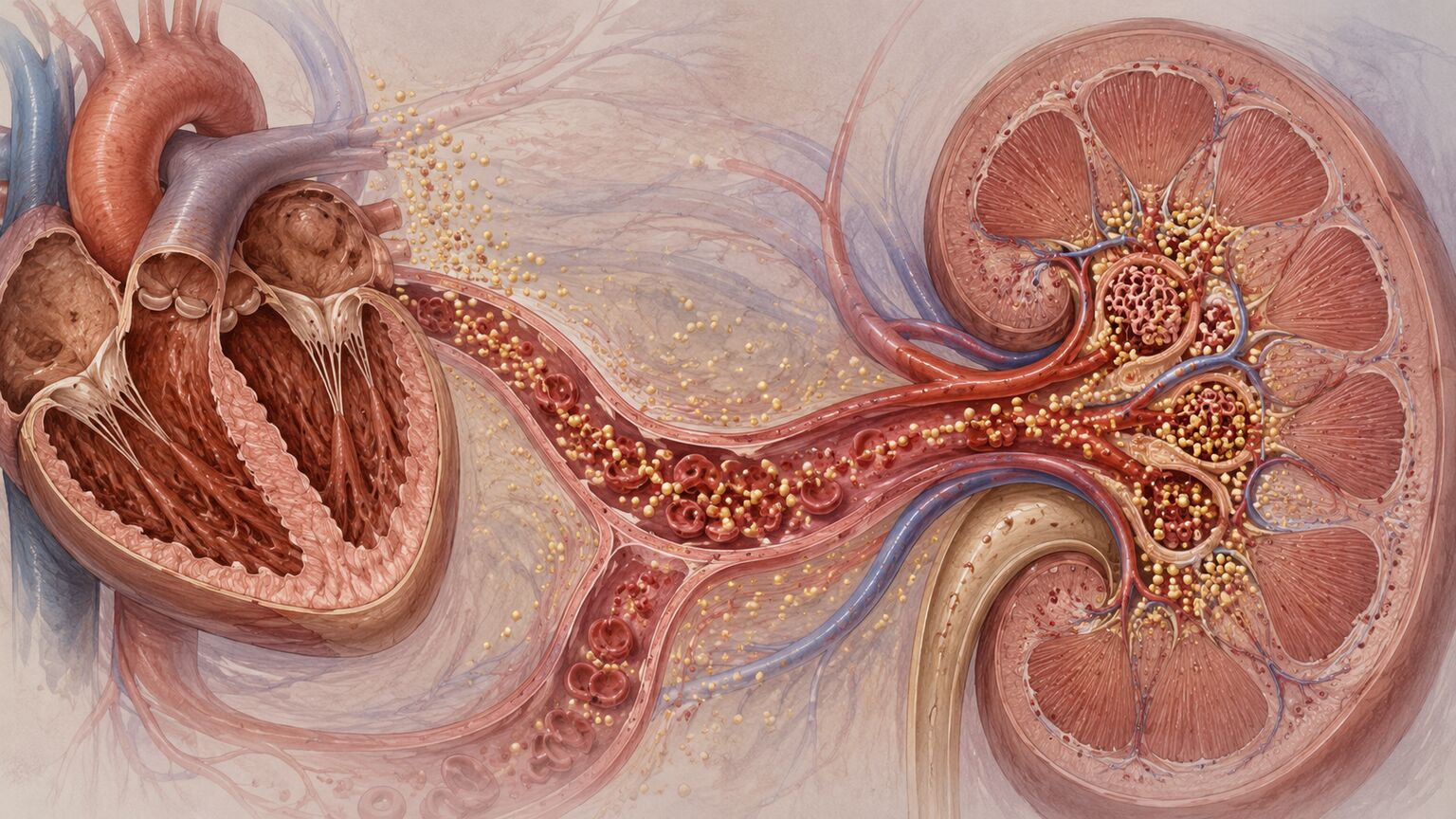
BNP is produced mainly by the muscle cells in your heart's ventricles, the two lower pumping chambers, and it's released in response to stretch. When those chamber walls are stretched more than usual — because there's extra fluid volume to pump, or because the heart is working against higher pressure than it should be — the muscle cells respond by releasing more BNP into the bloodstream. Think of it as a pressure-relief valve: once released, BNP travels to the kidneys and signals them to excrete more sodium and water, which helps ease the workload back down. This is exactly why BNP climbs in heart failure, where the heart is chronically struggling to keep up with the volume or pressure demands placed on it. But that same signal — chamber stretch — can also come from things that have nothing to do with a failing heart, and just as importantly, how much BNP shows up on a blood test depends on how efficiently it's cleared from circulation afterward, not only on how much was released in the first place.
Why BNP Climbs Naturally as You Get Older
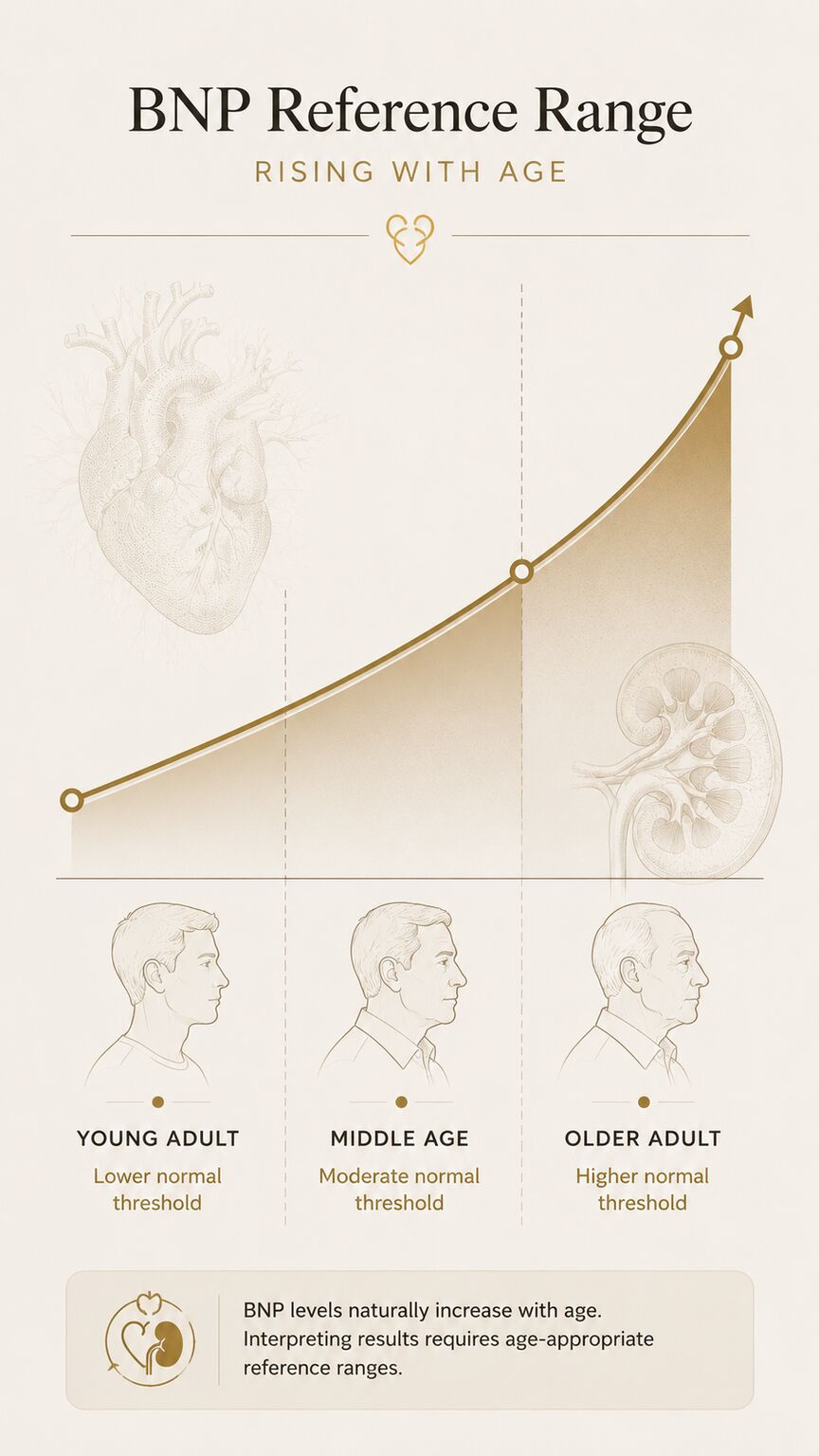
Even in people with no diagnosed heart condition at all, BNP tends to creep upward with each passing decade of life, and this isn't considered an error or a red flag on its own — it's an expected part of aging. Over many years, the heart's walls gradually become slightly stiffer, a subtle change in how the chambers relax between beats that's extremely common by the time someone reaches their 70s or 80s, even without any diagnosed disease. A stiffer chamber doesn't fill quite as easily, which translates into a bit more wall stretch with each heartbeat — and more stretch means more BNP released, following the exact same mechanism described above. Decades of even normal, average blood pressure exposure also play a role, gradually reshaping the heart's chambers in ways that nudge this signal upward. Because of this well-documented pattern, many labs use age-adjusted reference ranges rather than a single cutoff for every adult, and a result that would be flagged as concerning in a 35-year-old might be squarely ordinary for someone in their 80s.

This is an important point for anyone who feels completely well but sees a mildly elevated BNP on a routine panel: an older adult with no shortness of breath, no swelling, and no other symptoms can have a BNP that would look abnormal by a young adult's standard, purely as a function of age-related changes that have nothing to do with heart failure. It's one of several reasons doctors weigh a BNP result against the whole clinical picture — symptoms, physical exam findings, and imaging — rather than treating the number as a verdict on its own.
The Kidney Connection: Why Reduced Clearance Raises BNP on Its Own
The second major non-cardiac factor is how well your kidneys are working, and its effect can be even larger than age. A meaningful portion of the BNP circulating in your blood is cleared out through the kidneys and through natural enzymatic breakdown elsewhere in the body, rather than being used up instantly. When kidney function declines — measured by a number called eGFR, which estimates how efficiently your kidneys filter blood — that clearance pathway slows down. BNP that would normally be filtered out and broken down instead lingers in the bloodstream longer, building up to higher concentrations even if your heart's chambers aren't under any more stretch than before. This effect is even more pronounced for a related, closely watched value called NT-proBNP, which relies on the kidneys for clearance more heavily than BNP itself, meaning it can climb even further in someone with reduced kidney function.
This matters most for the roughly one in seven adults who have some degree of chronic kidney disease, a great many of whom aren't aware of it because early kidney function decline typically causes no symptoms at all. Someone with moderately reduced kidney function can have a BNP result that looks quite high on paper while their heart is functioning reasonably well — the number is telling a real story, just one that's partly about the kidneys rather than entirely about cardiac strain. This is also precisely why age and kidney function are so often discussed together in this context: kidney function itself naturally declines with age in most people, so the two effects frequently compound rather than acting in isolation.
How Doctors Read a BNP Number in Context
Because of both of these influences, an experienced clinician rarely interprets a BNP result as a single, standalone verdict. Instead, they look at eGFR and creatinine alongside the BNP itself, effectively asking whether reduced clearance could explain part or all of an elevated number before attributing it entirely to the heart. Age is factored in the same way, sometimes through explicit age-banded reference ranges provided by the lab, and sometimes just as clinical judgment layered on top of the raw result. Symptoms carry significant weight too — shortness of breath, swelling in the legs or abdomen, and difficulty lying flat all point toward a cardiac explanation, while their absence makes a purely age- or kidney-driven elevation more likely. An echocardiogram, which directly images how the heart's chambers are functioning, is often the deciding piece of information when a BNP result doesn't clearly fit the rest of the picture.

What This Looks Like in Everyday Practice
Consider two people with an identical BNP result. The first is 34 years old, has normal kidney function, and no cardiac symptoms — for this person, that same number would generally prompt closer cardiac evaluation, since there's little else to explain it. The second is 81, has moderately reduced kidney function from decades of ordinary wear, and also has no symptoms — for this person, a substantial portion of that identical number may simply reflect age-related stiffening and slower clearance, and it may not indicate any new or worsening cardiac problem at all. Neither interpretation dismisses the number; both take it seriously, but they arrive at very different conclusions once age and kidney function are factored in, which is exactly why context changes everything with this particular test.

This is often exactly the conversation that plays out between adult children and aging parents after a routine panel comes back with an unfamiliar flag on it. Bringing the full picture — the parent's age, their known kidney function, whether they've had any new symptoms, and any prior BNP results for comparison — to that follow-up conversation with a doctor tends to be far more useful than fixating on whether a single number is technically inside or outside a generic reference range.
Frequently Asked Questions
Is it normal for BNP to be higher in older adults with no heart problems?
Yes. BNP tends to rise gradually with age due to normal, age-related stiffening of the heart's chambers, even in people with no diagnosed cardiac condition. Many labs use age-adjusted reference ranges specifically because of this well-documented pattern.
Why does kidney disease raise BNP if the problem isn't in the heart?
BNP is partly cleared from the bloodstream through the kidneys. When kidney function declines, that clearance slows down, so BNP can build up to higher levels even without any additional strain on the heart. NT-proBNP is affected by this even more than BNP itself.
How do doctors know if a high BNP is from the heart, the kidneys, or just age?
They look at the result alongside eGFR and creatinine, the person's age, and whether cardiac symptoms like shortness of breath or swelling are present. An echocardiogram is often used to directly confirm or rule out how the heart's chambers are actually functioning when the picture isn't clear from the lab values alone.
Conclusion
BNP is a genuinely valuable window into how your heart is handling pressure and volume, but the number on your report is shaped by more than cardiac strain alone — age and kidney function both influence how much BNP accumulates in your blood, independent of what's happening inside your heart's chambers. Neither factor makes the test less useful; they simply mean the same number needs to be read differently depending on who's holding the report. If you've seen an elevated BNP and aren't sure what it means for you specifically, bringing your age, your kidney function, and any symptoms you have (or don't have) into that conversation with a healthcare provider is the most reliable way to find out what the number is really saying.
Still Not Sure What Your Results Mean?
Upload your labs and get a complete, visual, plain-language interpretation of every biomarker — delivered to your inbox in under 15 minutes.
Get My ReportThis article is for educational purposes only and does not constitute medical advice. Always consult your healthcare provider regarding your specific lab results.