
Can Obesity Lower Your BNP Test Results?
Yes — and it's one of the more counterintuitive findings in cardiac lab testing. You'd expect that carrying more body weight, which puts extra demand on the heart, would push a heart-strain marker like BNP higher. Instead, research has consistently found the opposite: people with obesity tend to have lower BNP (B-type natriuretic peptide) levels than people at a healthy weight, even when their hearts are working just as hard, or harder. Doctors call this the "obesity paradox" in natriuretic peptide testing, and it isn't a fluke or a lab artifact — it comes down to how fat tissue itself interacts with this particular hormone, clearing it from the bloodstream faster than normal. That matters for anyone with a higher body weight, because it means a "normal-looking" BNP result doesn't rule out heart strain the way it would in someone leaner. Here's exactly why this happens, and what it means for how your result should actually be read.

Curious what the rest of your cardiac panel is telling you? Upload your results and get a complete, plain-language breakdown in under 15 minutes.
Analyze My ResultsWhat BNP Is Actually Measuring in the First Place
Before getting into why obesity changes the number, it helps to understand what BNP is doing in your body to begin with. BNP, short for B-type natriuretic peptide, is a hormone made and released by the muscle cells of your heart's ventricles — the two lower chambers responsible for pumping blood out to your lungs and the rest of your body. Those muscle cells release BNP in direct response to stretch: when the walls of the heart are stretched more than they should be, whether from extra fluid volume or from higher-than-normal pressure inside the chamber, the cells respond by manufacturing and secreting more of this hormone into your bloodstream. Once released, BNP acts like a built-in pressure-relief valve. It travels to your kidneys and signals them to get rid of more sodium and water through urine, which helps bring blood volume — and therefore pressure on the heart — back down. It also relaxes blood vessels slightly, further easing the heart's workload. This is precisely why BNP has become one of the most useful blood tests for detecting heart failure: a heart that's struggling to keep up with the volume or pressure it's being asked to handle releases more of this hormone, and that shows up clearly on a lab report. But — and this is the part that trips people up — how much BNP shows up in a blood sample depends on two separate things: how much gets released, and how much gets removed from circulation afterward. Obesity turns out to affect that second part in a big way.
The Obesity Paradox: Why More Body Weight Often Means a Lower Number
Across dozens of studies spanning both the general population and people specifically being evaluated for heart failure, the same pattern shows up again and again: as body mass index (BMI) climbs, average BNP levels fall. This holds true even after researchers control for other factors that might explain it, like age, sex, kidney function, and the presence or absence of diagnosed heart disease. In some of the larger studies on this relationship, BNP levels in people classified as obese were found to run roughly 40% to 50% lower than in people of normal weight with comparable cardiac status. For a hormone that's supposed to be a fairly direct readout of how much strain the heart is under, that's a substantial gap — and it's the exact opposite direction you'd intuitively expect, since obesity is itself a well-established risk factor for the heart problems BNP is designed to catch, including heart failure, high blood pressure, and coronary artery disease. This mismatch is exactly what earned the phenomenon its name: the "natriuretic peptide obesity paradox." It isn't that obesity somehow protects the heart from strain — quite the opposite is generally true — it's that something about carrying excess fat tissue changes how much of the hormone actually ends up measurable in a blood sample once it's been released.

The Main Culprit: Fat Tissue Actively Pulls BNP Out of Your Blood
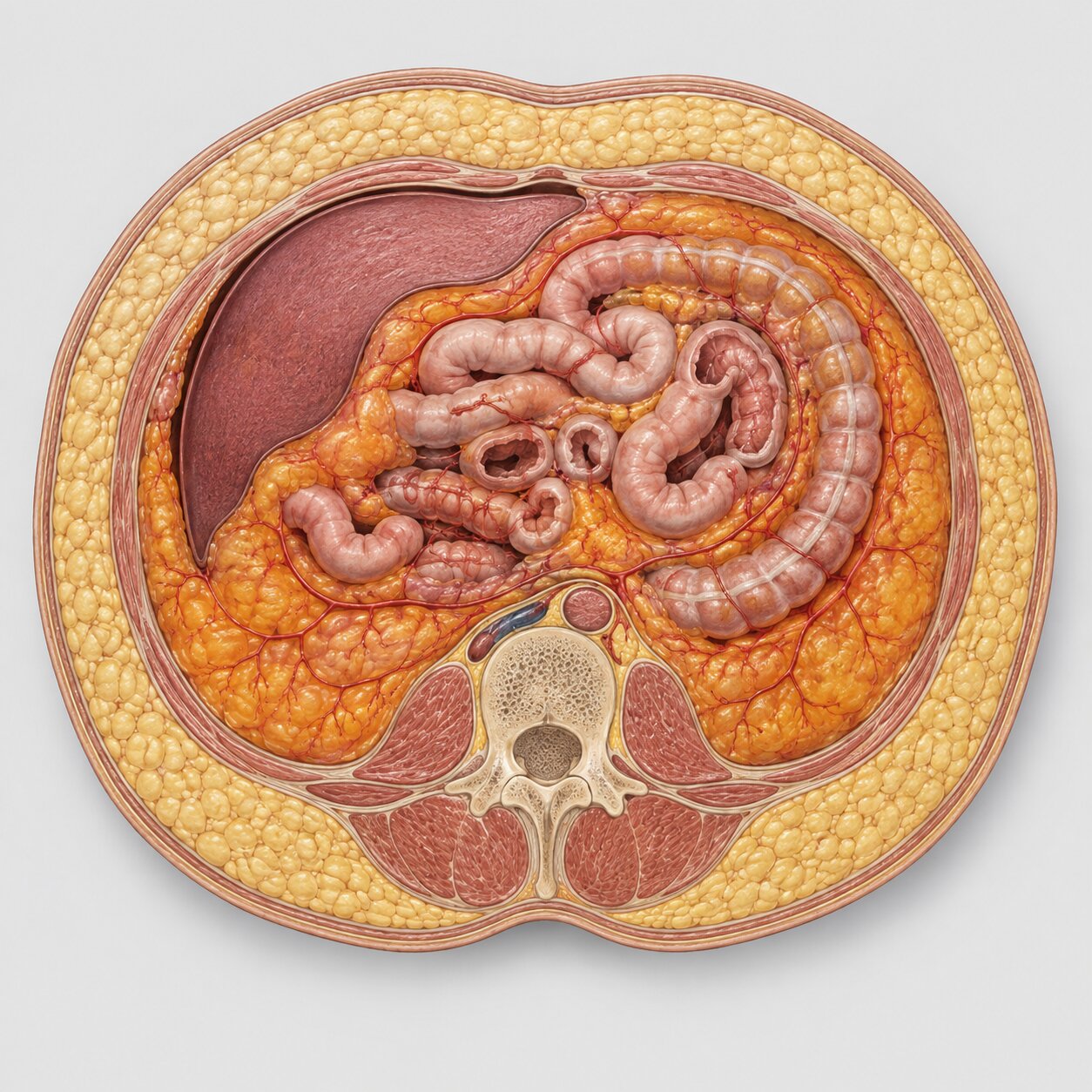
The leading and best-supported explanation for the obesity paradox is mechanical, not hormonal in the way you might guess — it comes down to a specific receptor that fat cells carry on their surface, called the natriuretic peptide clearance receptor, or NPR-C for short. Unlike the receptors that let BNP do its job of signaling the kidneys and blood vessels, NPR-C exists purely to grab BNP molecules out of circulation and break them down, effectively deactivating them. Every cell type in the body carries some amount of NPR-C, but adipose tissue — the technical name for body fat — is particularly rich in it. The more fat tissue a person carries, the more total NPR-C receptors are circulating throughout the body ready to bind and clear BNP, essentially acting as a much larger "sponge" pulling the hormone out of the bloodstream before it can be measured on a lab draw. Picture two people whose hearts are releasing the exact same amount of BNP per minute in response to identical strain. In the person with substantially more body fat, a larger share of that released hormone gets mopped up by NPR-C receptors on fat cells throughout the body before a blood sample is ever taken, while in the leaner person, more of it stays in circulation long enough to be captured on the test. The heart's signal was the same; what differs is how much of the signal survived to be measured. Research directly measuring NPR-C receptor density in fat tissue has found meaningfully higher expression in people with obesity compared with lean individuals, supporting this as the dominant mechanism rather than a coincidence.

Blood Volume, Hormones, and Other Contributing Factors
NPR-C clearance is the biggest piece of the puzzle, but it isn't the only thing going on. People with obesity typically have a larger total blood volume in absolute terms, simply because there's more tissue mass to perfuse — and a larger blood volume means any given amount of a circulating hormone gets diluted across more fluid, producing a lower measured concentration even if the total amount released is unchanged. Insulin resistance, which is common in obesity and often present even before a formal diabetes diagnosis, has also been shown in laboratory studies to reduce how much BNP the heart's muscle cells produce and release in the first place, independent of the clearance effect from fat tissue. There's some evidence that inflammatory signaling from expanded fat tissue — particularly visceral fat, the metabolically active fat stored around abdominal organs rather than just under the skin — may further suppress the genes responsible for natriuretic peptide production inside heart muscle cells. None of these secondary factors is as large a contributor as NPR-C-driven clearance, but they tend to push in the same direction, which is part of why the overall effect of obesity on BNP is as consistent and sizable as it is across so many different studies and patient populations.
Why This Matters: The Risk of a Missed or Delayed Diagnosis
This isn't just an interesting quirk of physiology — it has real, practical consequences for how heart failure gets diagnosed. BNP (and its related marker, NT-proBNP) is one of the primary tools doctors use in the emergency room and in outpatient clinics to decide whether shortness of breath, leg swelling, or fatigue is being caused by the heart. Standard reference ranges and diagnostic cutoffs for these tests were established using study populations that, on average, skew toward normal or overweight body composition — not the full spectrum of obesity seen in current clinical practice. Because of the clearance effect described above, a person with obesity who is genuinely experiencing early or even moderate heart failure can produce a BNP result that falls within, or just barely above, the "normal" range that would clearly flag concern in someone at a healthy weight. If that number is read at face value, without factoring in body weight, it can understate how much cardiac strain is actually present, potentially delaying further workup like an echocardiogram, or delaying treatment that would otherwise start sooner. This effect becomes more pronounced as BMI climbs further into the higher classes of obesity, meaning the diagnostic blind spot isn't uniform — it grows alongside the degree of excess body weight.
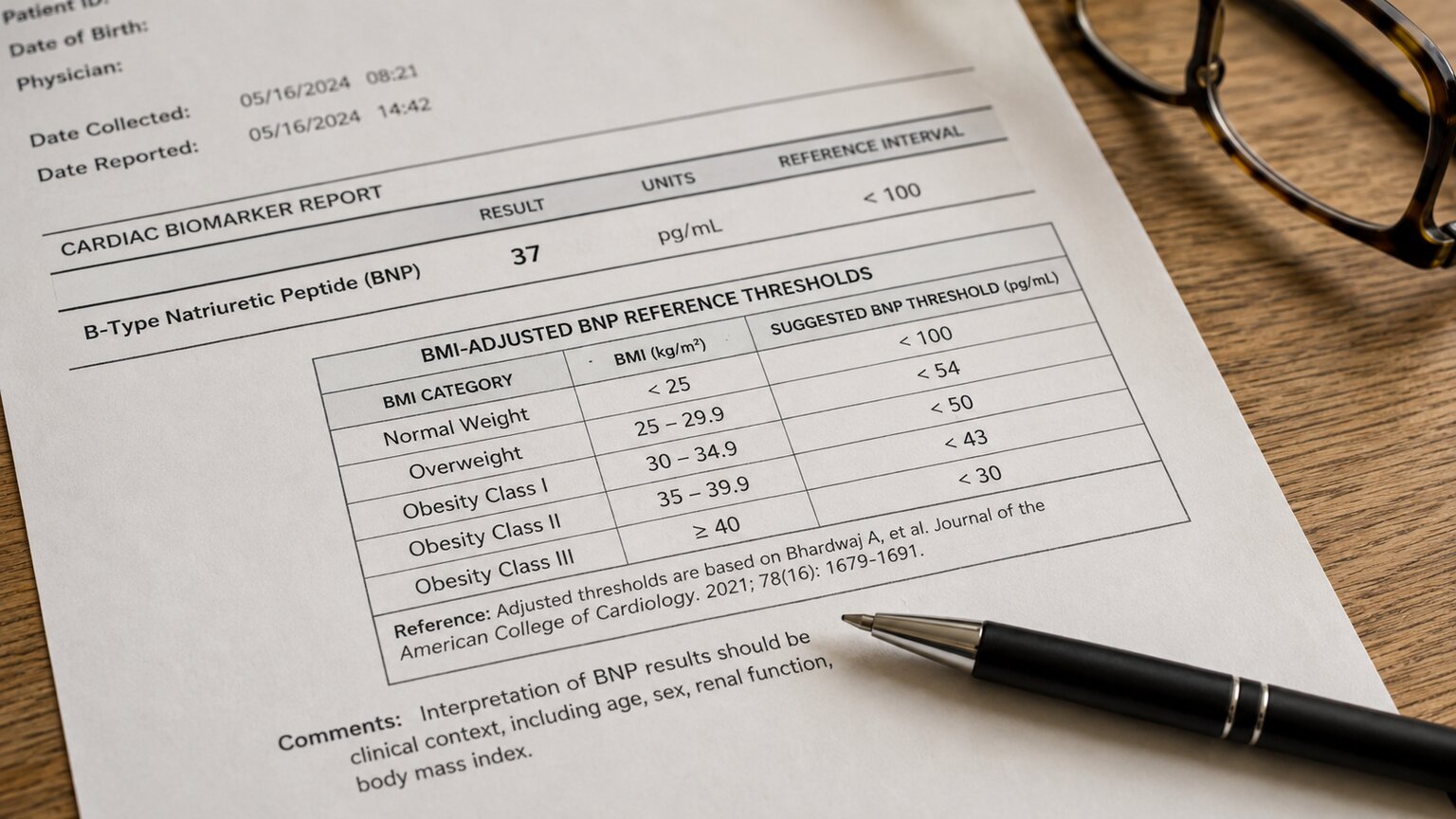
Because of this well-documented gap, several major cardiology and heart failure guidelines — including guidance referenced by the American Heart Association and the European Society of Cardiology — now explicitly recommend that clinicians apply a lower, weight-adjusted threshold for "abnormal" when interpreting BNP or NT-proBNP in patients with obesity, rather than using a single fixed cutoff for every adult regardless of body size. In practical terms, this can mean a BNP or NT-proBNP result that would be waved off as unremarkable using the standard cutoff is treated as clinically significant once the person's BMI is factored in. This adjustment doesn't require a different test or a special order from your doctor — it simply requires that whoever is interpreting the number knows to view it through the lens of body weight rather than reading it in isolation, which is exactly the kind of context that's easy to lose when a single number is quoted on its own without the full clinical picture behind it.
Does This Affect NT-proBNP the Same Way as BNP?
NT-proBNP is a closely related marker frequently used interchangeably with BNP in clinical practice, but the two are cleared from the body through different pathways — BNP is cleared partly through NPR-C receptors and partly broken down by an enzyme called neprilysin, while NT-proBNP is cleared almost entirely by the kidneys and isn't a direct substrate for NPR-C at all. Because of this difference, the obesity-related lowering effect is present in both markers, but it tends to be somewhat less pronounced for NT-proBNP than for BNP itself, since NT-proBNP isn't being actively mopped up by fat tissue's clearance receptors in the same direct way. That said, the effect on NT-proBNP is still real and still clinically meaningful — studies measuring both markers in the same obese patients have found NT-proBNP levels running measurably lower than expected for the degree of cardiac strain present, just not quite to the same magnitude as BNP. In practice, this means neither test fully escapes the obesity effect, and both still warrant weight-adjusted interpretation, even if the exact size of the adjustment differs slightly between the two.
Common Symptoms That Get Overlooked Because of This
Shortness of breath with exertion, needing extra pillows to breathe comfortably while lying down, ankle or leg swelling by the end of the day, and unusual fatigue are the classic symptoms doctors watch for when heart failure is suspected. In someone with obesity, several of these same symptoms are also common, everyday experiences that have nothing to do with the heart — carrying extra weight alone can cause breathlessness on exertion and mild ankle swelling by evening, purely from mechanical and circulatory load, independent of any cardiac problem. This creates a frustrating overlap: the symptoms that should prompt heart failure testing are partly masked by being "explainable" by weight alone, and then the confirmatory blood test itself is blunted by the very same excess body fat. Together, these two effects can compound into a real diagnostic gap, where genuine early heart strain in a person with obesity goes unrecognized longer than it would in someone leaner presenting with the exact same underlying cardiac problem.

This is exactly why doctors are trained not to lean on a single lab value in isolation, especially in patients with obesity. A BNP result sitting comfortably inside the "normal" range doesn't, by itself, rule out heart failure in this population the way it more reliably would in a lean adult — it needs to be weighed alongside the physical exam, reported symptoms, any relevant imaging, and, where available, a body-weight-adjusted interpretation of the number itself. If you carry excess weight and are experiencing new or worsening breathlessness, swelling, or fatigue, it's worth explicitly raising the possibility of heart strain with your provider even if a BNP result comes back looking unremarkable, rather than assuming the number alone has settled the question.
How Doctors Confirm the Picture When BNP Alone Isn't Enough
When there's a reasonable suspicion of heart failure in a patient with obesity, despite a BNP or NT-proBNP result that looks reassuring, clinicians typically don't stop at the blood test. An echocardiogram — an ultrasound of the heart — can directly visualize how well the chambers are filling, pumping, and relaxing, giving a much more direct read on cardiac function than a hormone level that's being filtered through the extra variable of body composition. A careful physical exam looking for fluid overload signs, a review of exercise tolerance compared to the person's own baseline, and sometimes additional imaging or stress testing round out the picture. The goal in all of this isn't to throw out BNP testing in people with obesity — it remains a genuinely useful and fast first-line tool — but to make sure it's never treated as the single, final word when the clinical suspicion for heart strain is high enough to warrant a closer look, particularly given how well-documented the weight-related blunting effect on this specific test has become.
What This Means If You're Overweight and Have a "Normal" BNP Result
If your BNP or NT-proBNP came back within the standard reference range and you carry significant excess weight, it's reasonable to feel some relief — a normal result is still a genuinely good sign, and most people with a normal BNP do not have heart failure. But it's worth understanding that "normal" carries a bit less certainty for you than it would for someone at a lower body weight, purely because of the clearance effect described throughout this article. If you have no symptoms at all — no unusual breathlessness, no swelling, no unexplained fatigue — a normal result combined with feeling well is genuinely reassuring and doesn't require further action on its own. But if you do have symptoms that would otherwise raise a flag for heart strain, a normal BNP shouldn't be treated as the end of the conversation. It's worth explicitly telling your provider that you'd like your BNP interpreted in the context of your body weight, or asking directly whether further evaluation, like an echocardiogram, makes sense given your symptoms even with a reassuring lab number. Being your own advocate in that specific way — flagging the weight-BNP relationship yourself if it isn't raised — can meaningfully shorten the path to an accurate diagnosis.
Frequently Asked Questions
Does losing weight change my BNP level?
It can, though the direction depends on the situation. Because NPR-C clearance receptors are concentrated in fat tissue, significant weight loss can reduce total clearance capacity and cause BNP to rise somewhat, even without any change in actual cardiac strain. This is a recognized pattern after major weight loss, including after bariatric surgery, and it's generally not a cause for alarm on its own — it usually reflects less clearance, not new heart strain.
Is BNP even worth testing in someone with obesity if it's less reliable?
Yes. BNP still adds real diagnostic value in people with obesity — it just needs to be interpreted with weight-adjusted expectations rather than a single universal cutoff. A markedly elevated result is still strongly meaningful even in obesity, since the clearance effect only pushes numbers down, not up. The main caution is not over-trusting a "normal" result in someone with obesity and concerning symptoms.
Does obesity affect other cardiac biomarkers the same way it affects BNP?
Not identically. Troponin, the marker used to detect heart muscle injury, isn't cleared through the same NPR-C pathway and generally isn't blunted by obesity in the same way. The natriuretic peptides — BNP and, to a lesser degree, NT-proBNP — are the primary cardiac markers where this specific weight-related lowering effect has been well established.
Conclusion
Obesity doesn't protect the heart from strain — if anything, it's a well-established risk factor for the very conditions BNP is used to detect. What it does do is change how much of the hormone survives long enough in the bloodstream to be measured, mainly because fat tissue is unusually rich in the clearance receptors that pull BNP out of circulation. The result is a test that tends to read lower than the true amount of cardiac strain would suggest, which can quietly delay a heart failure diagnosis in people carrying excess weight if the number is read without that context. None of this makes BNP testing less worthwhile — it remains fast, accessible, and genuinely useful — it simply means the result needs to be read through the lens of body weight, not treated as a flat, one-size-fits-all cutoff. If you carry excess weight and have symptoms that concern you, that context is worth bringing into the conversation yourself.
Still Not Sure What Your Results Mean?
Upload your labs and get a complete, visual, plain-language interpretation of every biomarker — delivered to your inbox in under 15 minutes.
Get My ReportThis article is for educational purposes only and does not constitute medical advice. Always consult your healthcare provider regarding your specific lab results.