
A Chromosomal Variant Doesn't Always Cause Health Problems
If a genetic test report just handed you the words "chromosomal variant" and your mind immediately jumped to the worst-case scenario, take a breath first. In a large share of cases, that finding turns out to be nothing more than a normal difference in how your DNA happens to be arranged — not evidence that something is broken inside you. Every person alive carries small structural quirks in their chromosomes, and the tools labs use today are sensitive enough to catch changes that would have gone completely unnoticed a generation ago. Whether a specific variant actually causes a health problem comes down to a handful of concrete questions: which genes sit inside the affected stretch of DNA, whether genetic material was actually gained or lost or just rearranged, whether a healthy parent carries the exact same change, and how that variant has behaved in the thousands of other people who've had it looked up in shared genetic databases. This article walks through what really separates a harmless variant from one worth worrying about.
What Is a Chromosomal Variant, Exactly?
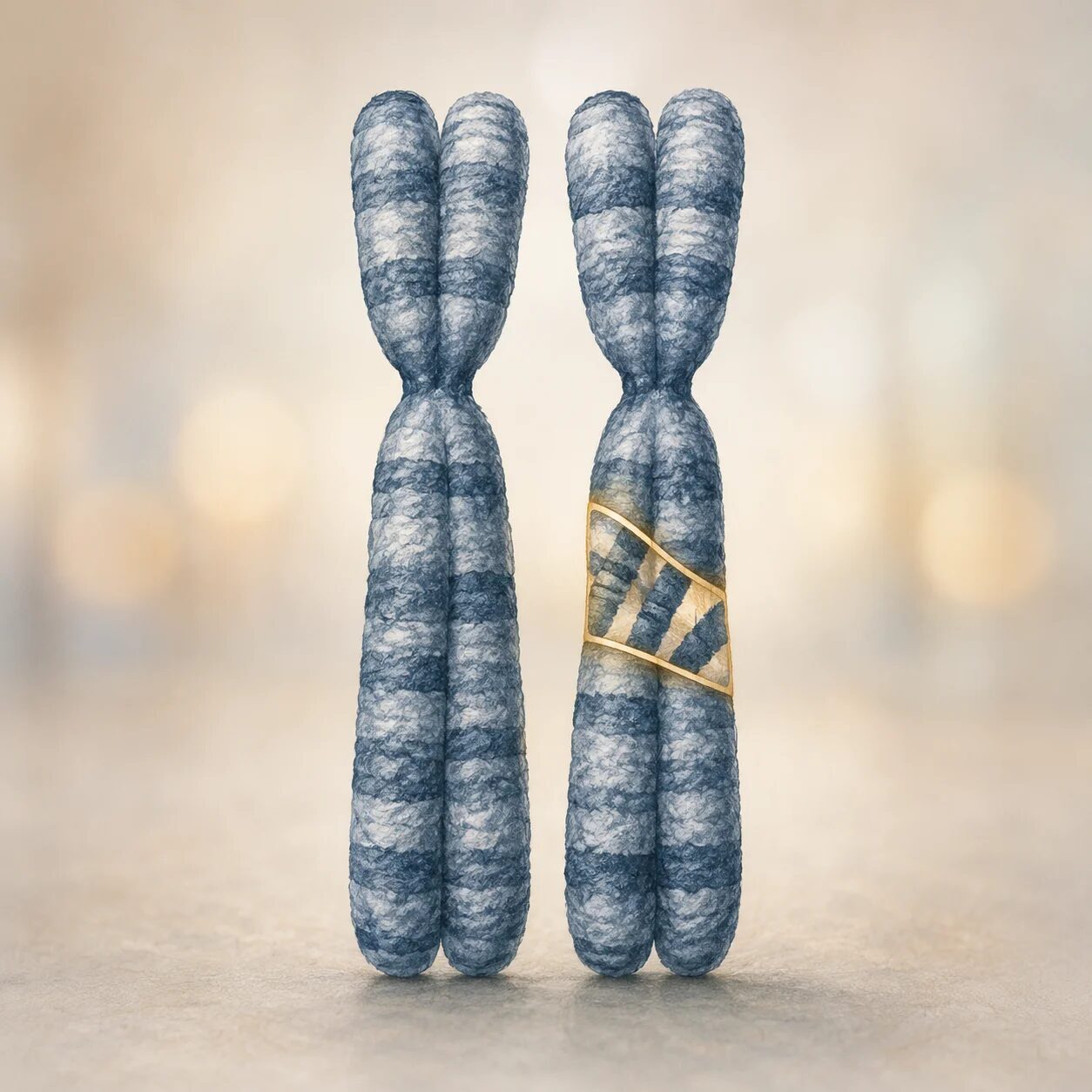
Your chromosomes are the 46 tightly coiled bundles of DNA — 23 inherited from each parent — that carry every gene your body uses as an instruction manual. A "variant" simply means a spot where your version of a chromosome looks or reads a little differently than the standard reference map that labs compare everyone's results against. That difference can take several forms: a segment of DNA might be flipped end to end (an inversion), duplicated so there's an extra copy of a stretch of genetic material, missing entirely (a deletion), or swapped between two chromosomes without any genetic material actually being lost (a translocation). Two main technologies pick these changes up. A karyotype test takes a photograph-like image of all 46 chromosomes lined up by size, useful for spotting larger structural changes. A chromosomal microarray goes a level deeper, scanning for tiny gains or losses of DNA too small to see under a microscope. Neither test tells you, by itself, whether what it found is dangerous — that interpretation is a separate, more involved step.
Why So Many Variants Turn Out to Be Completely Normal
Here's something most people are never told before their test: geneticists have spent decades cataloging how much chromosomal variation exists in perfectly healthy people. One of the best-known examples is a small flip in the middle section of chromosome 9, found in roughly one to three out of every hundred people tested, with no symptoms, no disease association, and no reason for concern — it's simply one of the more common "spelling variants" in the human genome. Researchers keep enormous, continuously updated databases that record which variants have shown up in tens of thousands of healthy volunteers with no related health issues. When your variant already has a long track record of appearing in people who are entirely well, a lab can label it "benign" with real confidence, because the evidence isn't theoretical — it's been observed directly, over and over, in the general population.

It helps to think of your genome less like a single fixed blueprint and more like a shared recipe that every family tweaks slightly. Siblings who grew up in the same house can have noticeably different chromosomal quirks and still be equally healthy, in the same way they might have different eye colors or heights without either being "wrong." This natural variability is exactly why a lab report might flag something as technically different from the reference genome while still classifying it as a routine finding rather than a diagnosis. The reference genome itself was built by combining DNA from a limited number of people — it was never meant to represent the one "correct" version of human DNA that everyone else must match.
Curious what your own genetic or chromosomal results are actually telling you? Upload them and get a complete, plain-language breakdown in under 15 minutes.
Analyze My ResultsBalanced Changes vs. Unbalanced Changes: Why This Distinction Matters So Much
Not all rearrangements are created equal, and the single most important question a geneticist asks about any structural variant is simple: was any genetic material actually gained or lost, or did it just move around? A "balanced" rearrangement — like a translocation where two chromosomes trade segments evenly, or an inversion where a piece flips in place — keeps the total amount of genetic material exactly the same. The instruction manual is reorganized, but every page is still there. Because of this, people who carry a balanced rearrangement are frequently, though not always, completely unaffected by it. An "unbalanced" change is different: genetic material is truly missing (a deletion) or duplicated (a duplication), meaning the body ends up with too little or too much of certain genetic instructions. Unbalanced changes are more likely to cause noticeable effects, though even here, size and location decide almost everything else.
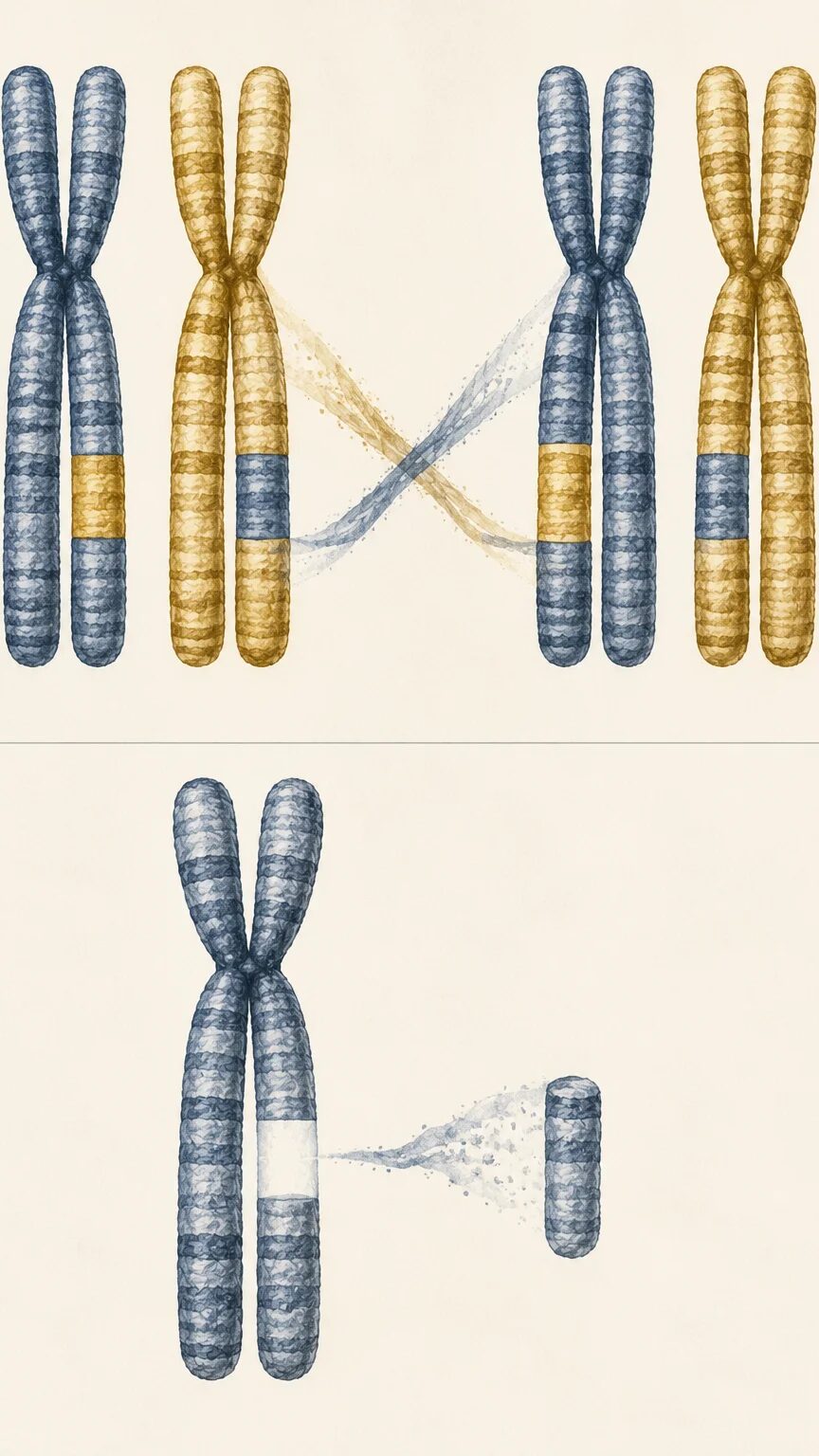
This is also why a balanced rearrangement that causes no problems for the person carrying it can still matter for family planning. When that person has children, there's a chance the rearrangement gets passed down in an unbalanced form — meaning a child could inherit extra or missing genetic material even though the parent's own version caused no issues at all. This is one of the main reasons genetic counselors sometimes recommend testing close relatives after an unexpected finding: not because the original result is necessarily worrying, but because it clarifies the full picture for the whole family, including future pregnancies.
Why Location Matters More Than Size
It's tempting to assume a bigger variant is automatically more serious than a small one, but that's not how the genome works. Some stretches of DNA are packed with genes that the body depends on for precise, tightly controlled amounts — lose or duplicate even a small piece of one of these "dosage-sensitive" regions, and the effects can be significant. Other stretches, sometimes nicknamed gene deserts, contain very few active genes or long repetitive sequences that don't code for much of anything; a sizable change in one of these regions can pass completely unnoticed. There's also built-in redundancy to consider — some genes have backup copies or overlapping functions elsewhere in the genome, softening the impact if one copy is lost. This is exactly why two people can have variants of a similar size, on paper, with completely different real-world consequences: what's actually written inside that stretch of DNA matters far more than how long it is.
Why the Same Variant Can Affect Two People Differently
Even variants known to sometimes cause health issues don't affect everyone who carries them the same way — a phenomenon geneticists call variable "penetrance" and "expressivity." Penetrance describes whether a variant produces any noticeable effect at all in a given person; some variants only cause symptoms in a fraction of the people who carry them, while the rest go through life unaffected. Expressivity describes how severe those effects are when they do show up — mild in one person, more pronounced in another, even within the same family carrying the identical change. This happens because your chromosomes don't operate in isolation. Other genes can compensate or amplify an effect, environmental and developmental factors play a role, and sheer chance influences how cells divide and organize themselves early in development. It's part of why a genetic counselor will often ask about a variant's history in your specific family rather than relying only on general statistics.
What "Variant of Uncertain Significance" Actually Means
Sometimes a lab report lands in a gray zone, labeling a finding a "variant of uncertain significance," often shortened to VUS. This isn't a diagnosis, and it isn't a way of saying something is definitely wrong — it's an honest admission that there isn't yet enough evidence to confidently sort the variant into "benign" or "clinically significant." That might be because the variant is rare enough that few other people carrying it have been studied, or because it sits in a part of the genome scientists don't yet fully understand. The reassuring part is that a VUS label isn't permanent. As more people around the world get tested and shared genetic databases grow, variants once labeled uncertain are frequently reclassified — most often downgraded to benign once enough healthy carriers turn up. Many labs and genetic counselors will proactively re-review old VUS findings every year or two for exactly this reason.

How Specialists Actually Decide Whether Follow-Up Is Needed
When a variant doesn't fall neatly into "clearly fine" or "clearly concerning," genetic counselors and clinical geneticists lean on a few practical strategies rather than guesswork. Testing parents, a step called segregation analysis, shows whether the variant was inherited from an apparently healthy parent (reassuring) or arose new in the person being tested, sometimes called a de novo variant (which warrants a closer look, though it still doesn't guarantee a problem). They compare the specific location and size of the variant against detailed maps of which genes live there and how sensitive those genes are known to be to extra or missing copies. And they look at the whole person, not just the report — matching or mismatching the variant against any symptoms, developmental history, or family patterns that prompted testing in the first place. This layered approach is exactly why the same word, "variant," can mean reassurance for one person and a starting point for further evaluation in another.
Frequently Asked Questions
If my chromosomal test shows a variant, does that mean I have a genetic disorder?
Not necessarily. Most chromosomal variants identified on routine testing are common, well-documented changes that don't cause any health effects. Whether a variant matters depends on its type, size, location, and how it has behaved in other people who've been tested — not on the fact that a difference was found at all.
Why did my doctor ask my parents to get tested after my result came back?
This is called segregation analysis. If a parent carries the exact same variant and has no related health issues, it's strong evidence the variant is harmless. If the variant appears only in you and not in either parent, your care team may look more closely, though even these "new" variants frequently turn out to be benign.
Can a "variant of uncertain significance" change classification over time?
Yes, and it happens regularly. As shared genetic databases grow and more people with the same variant are studied, labs periodically re-review older results. Most uncertain variants are eventually reclassified as benign once enough healthy carriers are identified, though some are updated in the other direction as new evidence emerges.
Conclusion
A chromosomal variant on your report is a description, not a verdict. Whether it deserves your attention depends on concrete details — whether it's balanced or unbalanced, which genes sit inside it, whether a healthy parent carries it too, and what thousands of other people's results have already shown about it. Most of the time, the variant is simply part of the ordinary variation that makes every person's genome slightly different from the next. If your result still feels confusing after reading this, that's a completely reasonable reaction to a genuinely technical topic, and it's worth bringing your questions to a genetic counselor or your ordering provider, who can weigh your specific finding against your personal and family history.
Still Not Sure What Your Results Mean?
Upload your labs and get a complete, visual, plain-language interpretation of every biomarker — delivered to your inbox in under 15 minutes.
Get My ReportThis article is for educational purposes only and does not constitute medical advice. Always consult your healthcare provider or a genetic counselor regarding your specific results.