
Understanding What a Chromosomal Microarray Actually Detects
A chromosomal microarray is a test that scans your DNA for tiny stretches that are missing or duplicated — pieces so small that a standard chromosome test, the kind that looks at chromosomes under a microscope, would simply never catch them. Instead of counting whole chromosomes, it measures the actual amount of genetic material at thousands of points across your genome, flagging spots where you have less than expected or more than expected. It doesn't read the individual letters of your genetic code the way full genome sequencing does, and it can't tell you about a gene that's rearranged in place without changing its total amount. If your doctor ordered one for a child's developmental delay, an unexplained pregnancy loss, or a prenatal finding, here's what the test is actually built to find — and just as important, what it isn't.
Curious what the rest of your labs are telling you? Upload your results and get a complete, plain-language breakdown in under 15 minutes.
Analyze My ResultsThe Basic Idea: Counting Genetic Material, Not Reading It
Every cell in your body carries 46 chromosomes — 23 inherited from each parent — and those chromosomes are essentially long strands of DNA tightly coiled into packages. A chromosomal microarray works by comparing your DNA to a reference sample at thousands to millions of specific locations along those strands, checking whether the amount of DNA at each spot matches what's expected. Think of it less like reading a book page by page and more like weighing sealed boxes on a shelf: the test can tell you a box is lighter or heavier than it should be, which means something was removed or added inside, but it won't describe what that something actually says. When a region comes back with less DNA than expected, that's called a deletion. When there's more than expected, it's a duplication. Both are grouped under the umbrella term "copy number variant," and finding one is the entire point of running this test.

Why It Sees What a Karyotype Test Misses
The older, more familiar chromosome test — a karyotype — involves photographing chromosomes under a microscope and arranging them by size and shape. It's excellent at catching large-scale problems, like an entire extra chromosome or a piece so big it visibly changes a chromosome's outline. But a microscope has limits: a karyotype typically can't detect anything smaller than about 5 to 10 million DNA base pairs, which sounds tiny but actually represents a huge chunk of genetic material. A microarray, by contrast, routinely picks up changes as small as 50,000 to 100,000 base pairs — roughly 50 to 100 times more sensitive. That resolution gap matters because many recognized genetic conditions are caused by deletions or duplications far too small for a microscope to ever notice, yet large enough to remove or duplicate several important genes at once. This is why a microarray has largely replaced the karyotype as the first-line test for children with unexplained developmental delay, intellectual disability, or autism spectrum features, and why it's often recommended after an unexplained miscarriage.
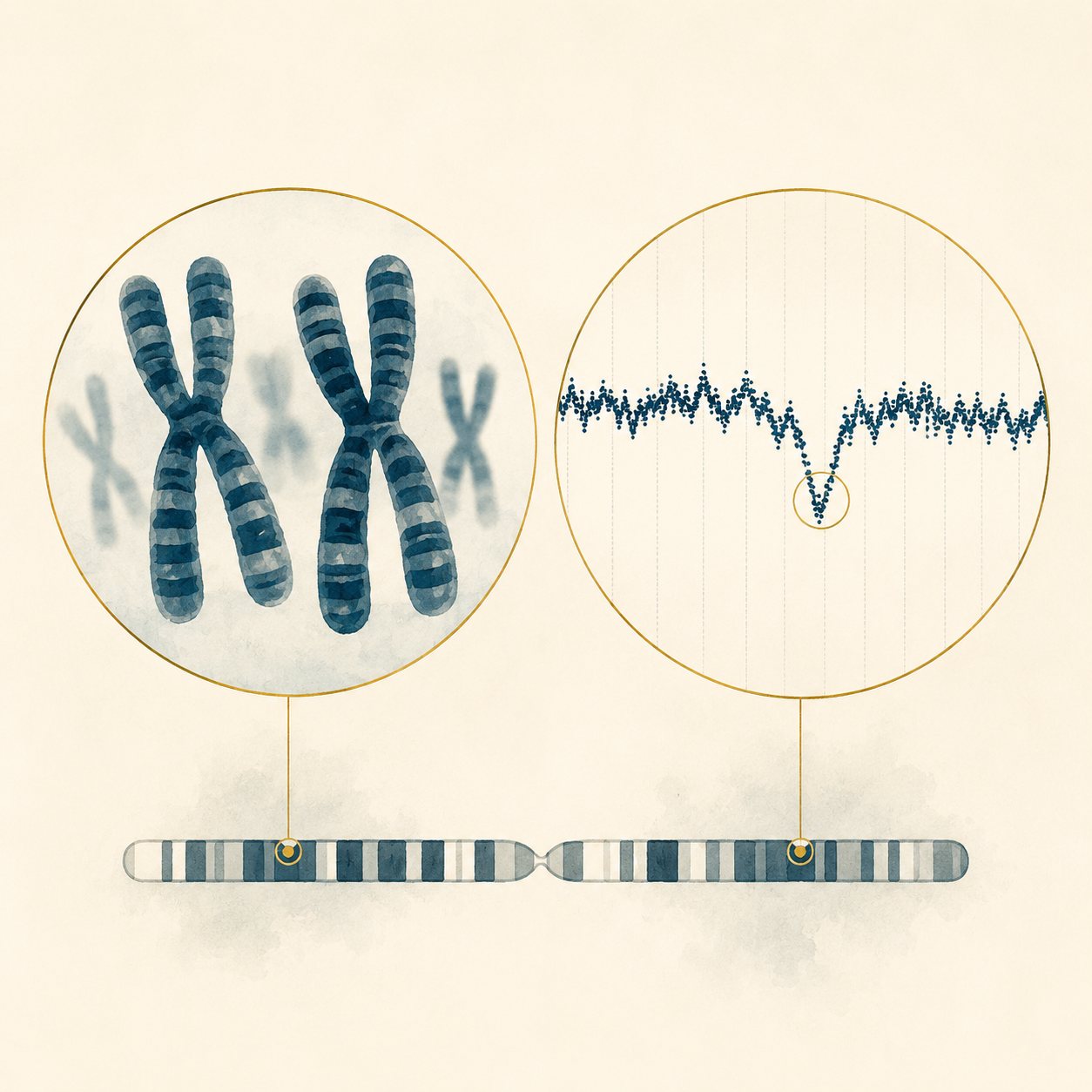
To picture the difference concretely, imagine your genome as an enormous printed encyclopedia. A karyotype checks whether entire volumes are missing, duplicated, or bound in the wrong order — changes obvious enough to spot by flipping through the set from across the room. A microarray instead checks whether individual paragraphs, sometimes even single sentences, have been deleted or copy-pasted twice within a volume that otherwise looks completely normal from the outside. Both problems can matter medically, but they require very different tools to catch. Because so many of the genetic conditions associated with intellectual disability, congenital heart defects, and certain seizure disorders trace back to these paragraph-level changes rather than whole-volume ones, ordering a microarray instead of, or in addition to, a karyotype has become standard practice in many of these clinical situations.
What a "Positive" Result Usually Means
When a microarray reports a copy number variant, the lab doesn't stop at just flagging that something is missing or duplicated — it also tries to classify how worrying that finding is. Results are generally sorted into a few buckets: pathogenic (known to cause disease), likely pathogenic, a variant of uncertain significance (meaning not enough is currently known to say either way), likely benign, or benign. This classification depends heavily on databases built from thousands of other people who've had the same region tested, cross-referenced against their symptoms. A deletion that removes a well-studied gene tied to a specific syndrome will usually be classified with more confidence than a duplication in a region scientists haven't fully mapped out yet. It's worth knowing going in that a meaningful share of microarray results — often cited in the range of several percent — come back as variants of uncertain significance, which can feel unsatisfying but simply reflects how much of the genome's function is still being actively researched.
What the Test Cannot Tell You
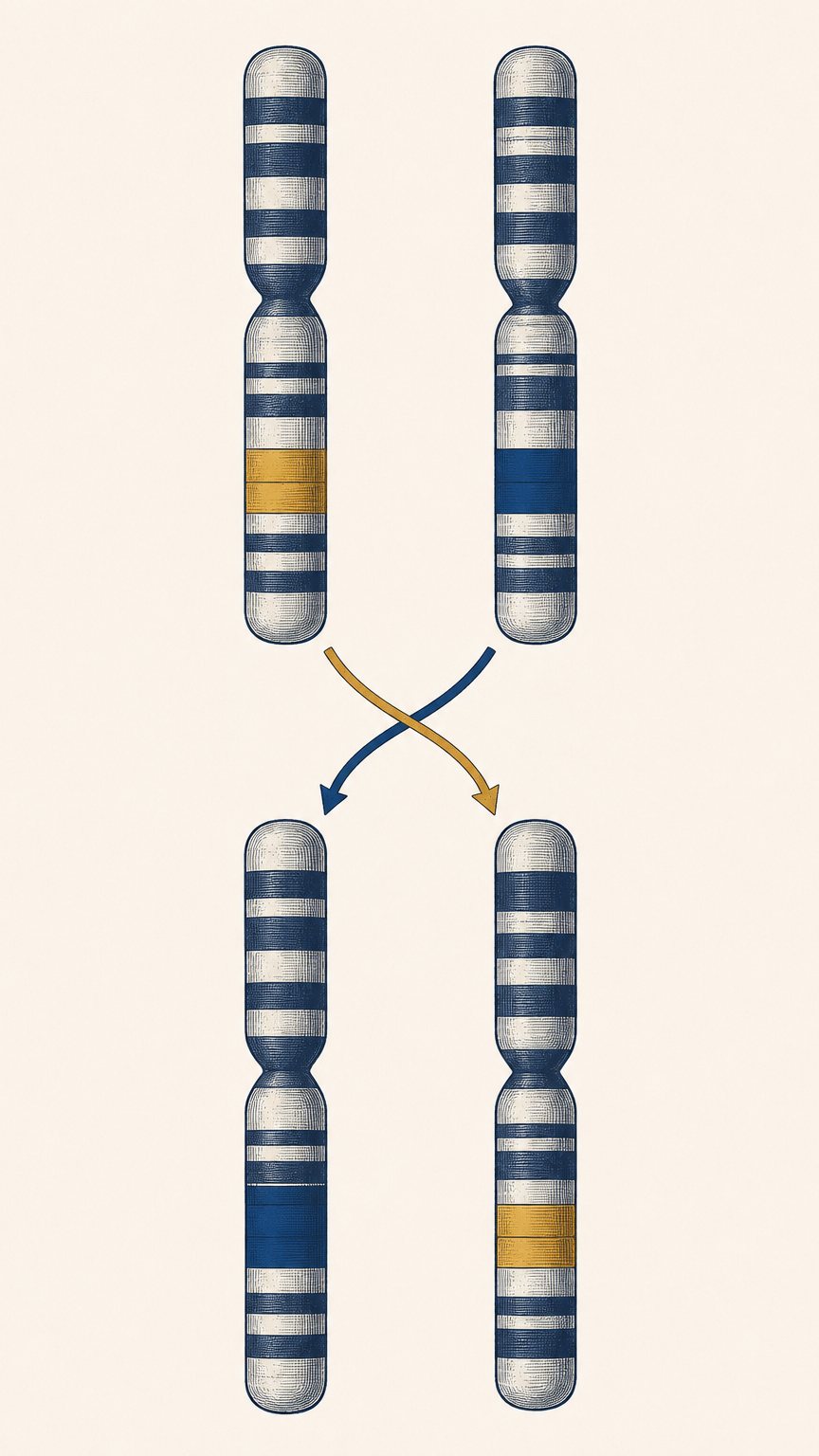
Because a microarray only measures quantity of DNA, it's structurally blind to a category of changes called balanced rearrangements — situations where a piece of one chromosome has swapped places with a piece of another, but no genetic material was actually gained or lost overall. A balanced translocation, for example, can be completely invisible to a microarray even though it's picked up easily on a karyotype, because the total amount of DNA at every location still adds up correctly; it's simply been relocated. The test also can't detect single-letter changes within a gene — the kind of small spelling errors that cause many well-known inherited conditions — since those don't change how much DNA is present, only what it says. And a microarray can't diagnose conditions caused by problems in how genes are switched on or off without any underlying change in DNA amount. For these reasons, a "normal" or "negative" microarray result doesn't rule out every possible genetic explanation for a symptom; it specifically rules out copy number changes, which is exactly what it was designed to look for.
Understanding Inherited Versus New Findings
Once a copy number variant is identified, one of the most useful next steps is testing the parents to see whether either of them carries the same change. If a parent has the identical deletion or duplication and shows no related health effects, that's often reassuring evidence the finding may not be the cause of the child's symptoms — though not always, since some conditions have variable severity even within the same family. If the change is absent in both parents, meaning it arose newly in the child, that's called a de novo variant, and it tends to raise the likelihood that the finding is medically significant, since it wasn't inherited from an apparently healthy parent. This is why genetic counselors frequently recommend parental blood samples alongside the original test — the child's result alone often can't be fully interpreted without that family context.
Why It's Used During Pregnancy and in Newborns
Prenatally, a microarray is typically performed on a sample obtained through amniocentesis or chorionic villus sampling, most often after an ultrasound finds something unexpected, such as a structural difference in the developing fetus, or after a screening test comes back with an elevated risk. It's also increasingly offered as a direct upgrade to standard prenatal chromosome testing because of its higher resolution. In newborns and children, it's commonly ordered when a child shows developmental delay, unusual physical features, multiple birth differences, or autism spectrum traits without an obvious explanation. In both settings, the goal is the same: identify a genetic cause precisely enough that families can get an accurate prognosis, connect with the right specialists, and, in future pregnancies, understand their chances of recurrence.
Frequently Asked Questions
Is a chromosomal microarray the same as genetic sequencing?
No. A microarray measures how much DNA is present at specific locations across the genome, detecting deletions and duplications. Sequencing reads the actual letter-by-letter code of DNA and can catch small spelling changes within a gene that a microarray would miss entirely. Many labs now recommend both tests together when a microarray alone doesn't provide an answer.
Can a chromosomal microarray miss something important?
Yes. It can't detect balanced rearrangements, single-letter DNA changes within genes, or problems with how genes are regulated rather than how much DNA is present. A normal microarray result means no copy number changes were found — it doesn't rule out every possible genetic cause of a symptom.
What happens if my result comes back as a "variant of uncertain significance"?
It means the lab found a deletion or duplication that hasn't yet been clearly linked to health effects in the medical literature. Genetic counselors often recommend testing parents for the same change and periodically checking updated databases, since classifications can be revised as more people are tested and more research is published.
Conclusion
A chromosomal microarray is built to answer one specific question extremely well: is there DNA missing or duplicated anywhere across your genome, down to a resolution far beyond what a microscope can see. That precision is exactly why it has become the standard first test for unexplained developmental delay, certain pregnancy complications, and unexplained pregnancy loss. But precision comes with a boundary — it can't see balanced rearrangements, single-gene spelling errors, or regulatory problems, which is why a clear result from this test is reassuring for what it checked, not a guarantee against every genetic possibility. If you're holding a microarray report and unsure what your specific finding means, a genetic counselor can walk through it with you in the context of your own health history.
Still Not Sure What Your Results Mean?
Upload your labs and get a complete, visual, plain-language interpretation of every biomarker — delivered to your inbox in under 15 minutes.
Get My ReportThis article is for educational purposes only and does not constitute medical advice. Always consult your healthcare provider regarding your specific lab results.