
What Does a Balanced Translocation Mean?
A balanced translocation is one of genetics' more counterintuitive findings: two chromosomes have swapped pieces with each other, yet no genetic material was actually lost or gained in the exchange. Because nothing is missing and nothing is duplicated, someone carrying a balanced translocation is, in the overwhelming majority of cases, completely healthy and shows no outward signs of it at all — they may go their entire life never knowing it's there. What makes this finding worth understanding isn't a risk to the carrier's own health; it's what can happen at the single, specific moment their chromosomes get divided in half to create an egg or sperm cell, since that division doesn't always go as smoothly as it does for someone without a rearrangement.
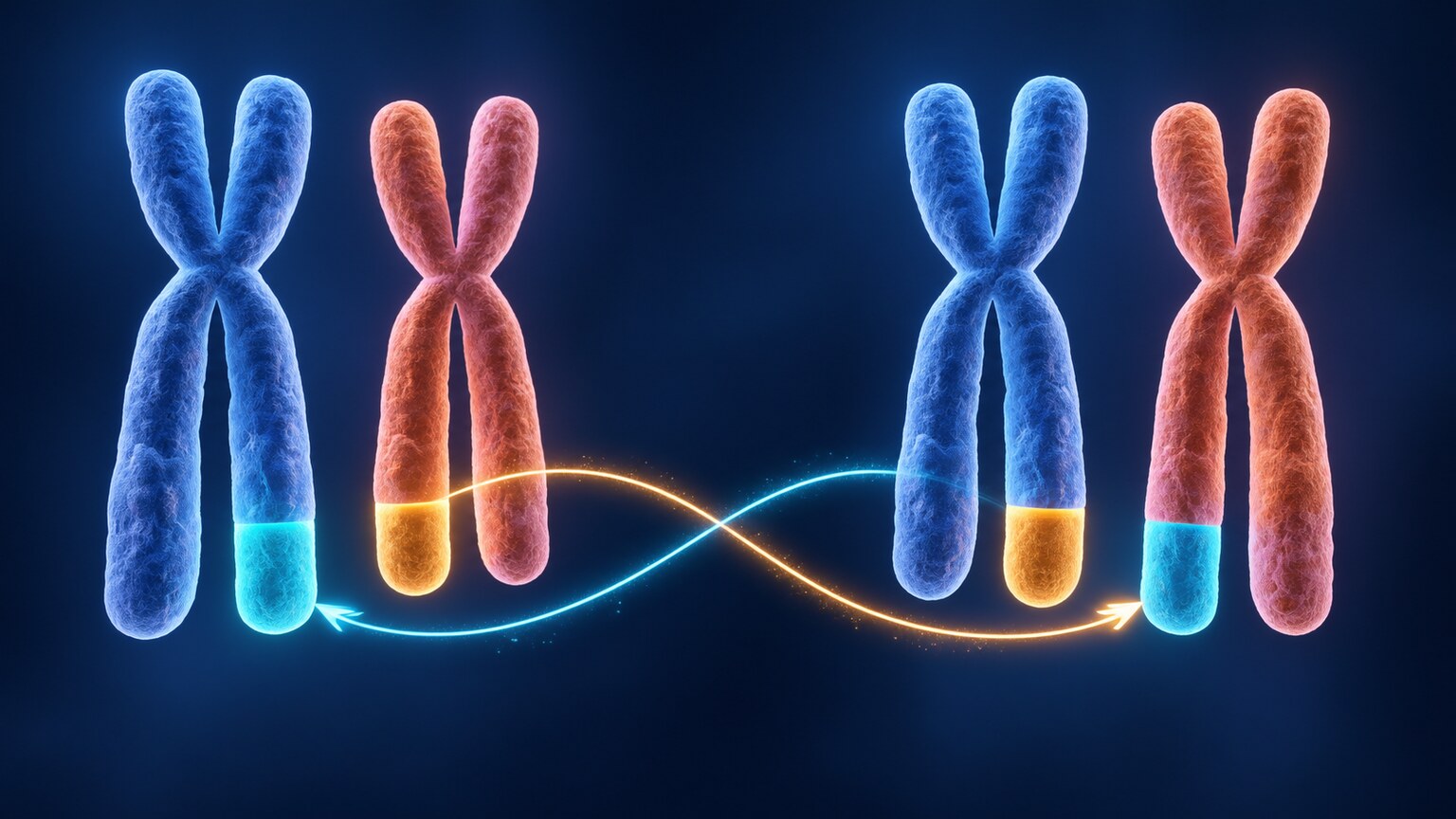
Figure 1. In a reciprocal translocation, two chromosomes break and swap segments with each other — since every piece finds a new home rather than disappearing, the total amount of genetic material stays exactly the same.
What Actually Happens at the Chromosome Level
Every cell in the human body normally carries 46 chromosomes, arranged as 23 matched pairs, with each chromosome holding thousands of genes strung along its length in a specific, consistent order. A translocation occurs when a break happens on two different chromosomes at the same time, and instead of each broken piece rejoining its original partner, the pieces swap places and attach to the wrong chromosome. The genes themselves aren't damaged or deleted in this process — they're simply relocated to a new chromosomal address, still fully present and, in the vast majority of cases, still fully functional, since genes generally work the same way regardless of which specific chromosome they happen to sit on.
This is precisely what separates "balanced" from "unbalanced." In a balanced translocation, the swap is even — everything that left chromosome A arrived intact on chromosome B, and everything that left chromosome B arrived intact on chromosome A, so the total genetic content of the cell remains complete, just rearranged into a new configuration. An unbalanced translocation, by contrast, involves an uneven exchange where a piece is lost or an extra copy ends up duplicated somewhere, and it's this kind of imbalance — not simply having chromosomes attached in an unusual arrangement — that typically causes noticeable health effects, since missing or duplicated genes disrupt the carefully calibrated dosage of gene activity the body depends on.
The dosage concept is worth dwelling on, since it's the real reason imbalance matters so much more than rearrangement itself. Genes don't simply switch on or off in a binary way — many are expressed in a carefully tuned amount, with the body's cells depending on receiving neither too little nor too much of a given gene's product to function normally. Having only one copy of a gene where two are expected (a deletion) or three copies where two are expected (a duplication) throws off that calibrated dosage, and depending on which specific gene is involved, this kind of dosage imbalance can meaningfully disrupt development or ongoing bodily function. A balanced translocation sidesteps this problem entirely, since every gene remains present in its normal two copies — they've simply been relocated to sit on a different chromosome than usual, with no effect on how much of each gene's product actually gets made.
It's estimated that roughly 1 in 500 to 1 in 1,000 people in the general population carry a balanced translocation of some kind, making it one of the more common categories of structural chromosome variation identified in humans. Because carriers are typically symptom-free, the true prevalence is almost certainly higher than what gets formally documented, since many carriers are never specifically tested and never have a reason to be — the finding surfaces only when a related reproductive issue prompts genetic testing in the first place.
The Two Main Types: Reciprocal and Robertsonian
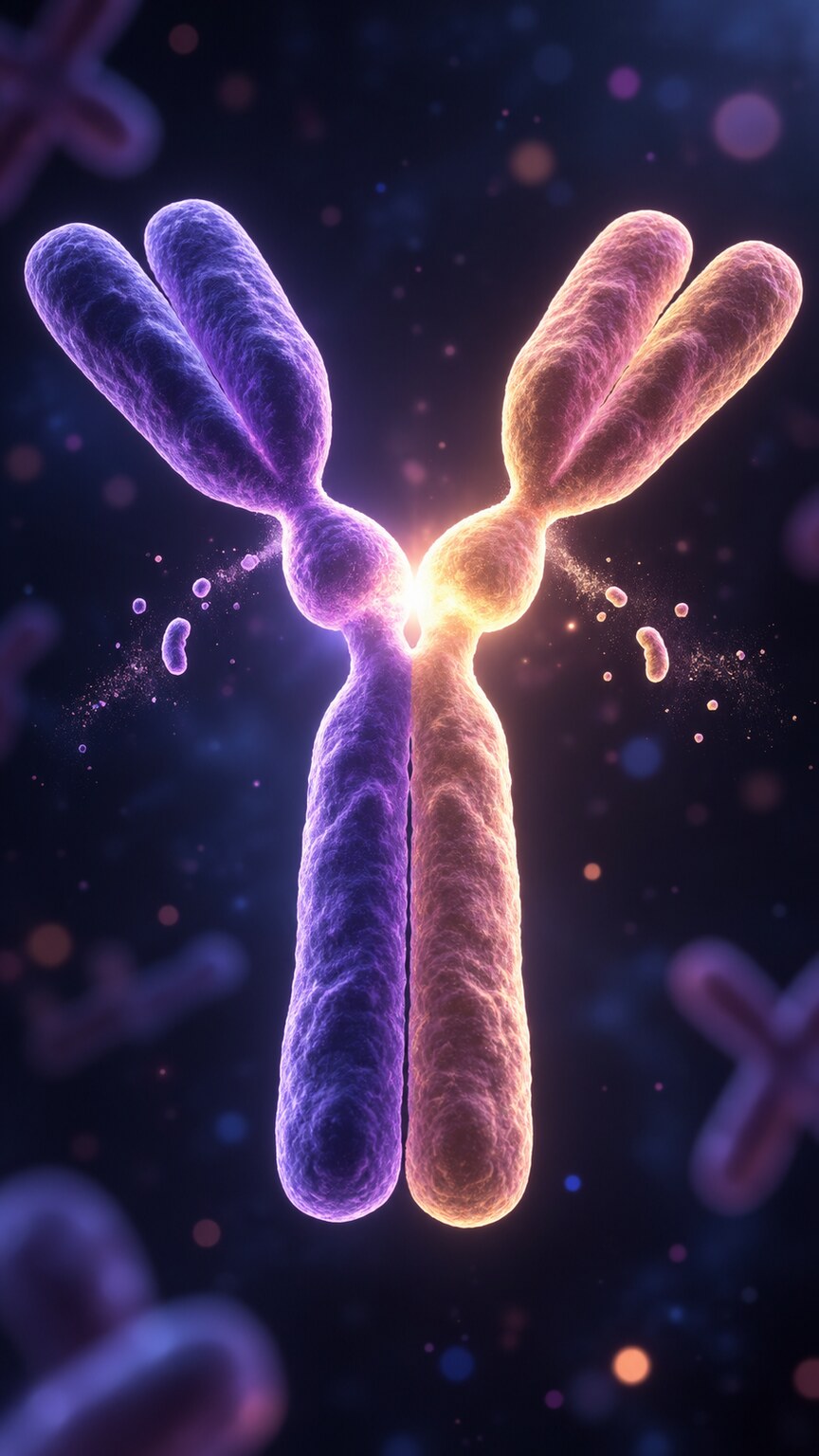
Figure 2. A Robertsonian translocation specifically involves two of the five acrocentric chromosomes fusing near their centromeres, reducing the total chromosome count to 45 while keeping all the meaningful genetic material intact.
A reciprocal translocation, the more common of the two types, can involve any two of the body's 23 chromosome pairs, with breakpoints occurring essentially anywhere along either chromosome's length. Because the specific chromosomes involved and the exact location of the breaks vary from one person's translocation to the next, reciprocal translocations are highly individual — two carriers are rarely found to have the exact same rearrangement unless they're closely related, since the specific translocation runs in that particular family.
A Robertsonian translocation is a distinct, more specific phenomenon involving only five particular chromosomes — 13, 14, 15, 21, and 22 — known as acrocentric chromosomes because their centromere, the pinch point where the two arms of a chromosome meet, sits very close to one end rather than the middle. In a Robertsonian translocation, two of these acrocentric chromosomes fuse together near their centromeres, and the small arms lost in the fusion contain only redundant genetic material that's also present in multiple copies elsewhere in the genome, meaning nothing functionally important is actually lost. The practical result is that a Robertsonian carrier has only 45 total chromosomes instead of the usual 46, yet remains completely unaffected, since the fused chromosome still carries all the functionally important genetic material from both original chromosomes.
Robertsonian translocations carry a particular clinical significance because two of the five chromosomes involved — 21 and 13 — are the same chromosomes responsible for Down syndrome and Patau syndrome respectively when present as a full extra copy. A carrier of a Robertsonian translocation involving chromosome 21, for instance, can produce an unbalanced egg or sperm cell carrying an effectively extra copy of chromosome 21, resulting in a form of Down syndrome caused by translocation rather than by the more commonly discussed and more common form involving a simple extra free-standing chromosome 21. This translocation-related form accounts for a small percentage of all Down syndrome cases overall, but it carries a meaningfully different, often higher recurrence risk for future pregnancies compared with the standard form, which is precisely why identifying the underlying mechanism through karyotype testing matters so much for a family's subsequent reproductive planning.
A rarer, related phenomenon worth knowing about is the Robertsonian translocation formed between two copies of the exact same chromosome — for instance, two copies of chromosome 21 fusing together. A carrier of this specific type cannot produce a chromosomally balanced egg or sperm cell at all with respect to that chromosome; every resulting reproductive cell will carry either zero copies or two copies of the involved chromosome, rather than the single copy a normal reproductive cell requires. This specific scenario carries distinct reproductive implications significant enough that it's always discussed individually and explicitly during genetic counseling, precisely because it removes the possibility of a balanced outcome that exists with virtually every other translocation type.
Curious what your own lab results actually mean for your specific situation? Upload your results and get a complete, plain-language breakdown in under 15 minutes.
Analyze My ResultsWhy Carriers Are Almost Always Completely Healthy
The reason a balanced translocation carrier typically has no symptoms at all comes down to a simple accounting principle: every gene the body needs is still present somewhere in the genome, just relocated rather than deleted. Occasionally, though, a break happens to land directly within a gene itself rather than in the space between genes, which can disrupt that specific gene's function and, in rare cases, cause a health condition tied to that particular disrupted gene. This outcome is uncommon precisely because genes make up only a modest fraction of the total genome, with much more of the chromosome consisting of non-coding regions between genes — meaning a random break is statistically far more likely to land somewhere that causes no functional disruption at all.
This is also why a balanced translocation is so often discovered entirely by accident, rather than through any symptom prompting the test in the first place. Many carriers first learn about their translocation only after a fertility evaluation, a pregnancy loss workup, or — increasingly common — after their own child is born with an unbalanced form of the same translocation and the family undergoes testing to understand where it came from.
De novo translocations — meaning ones that arose spontaneously in an individual rather than being inherited from a parent — represent a genuinely distinct scenario worth understanding separately. These occur when a translocation forms fresh during the formation of a particular egg or sperm cell, or very early in embryonic development, meaning neither parent carries the rearrangement themselves and it cannot be traced back through the family history. A de novo balanced translocation is generally considered to carry a somewhat higher, though still not dramatically elevated, chance of an associated health effect in the person who carries it, compared with one inherited from an entirely healthy parent, since an inherited translocation has effectively already been "proven safe" by that parent's own good health, whereas a de novo one hasn't had that same natural validation. This distinction is one of the first things a genetic counselor typically clarifies when a translocation is newly identified, since it meaningfully shapes how the finding gets interpreted.
It's also worth understanding what doesn't change simply because a translocation is present. Carrying a balanced translocation has no bearing on cognitive ability, physical appearance, general health, or life expectancy in the vast majority of cases — the finding exists purely at the level of chromosome architecture, invisible in every practical sense unless specifically tested for. This is precisely why balanced translocations were entirely undiscoverable before the development of karyotype analysis in the mid-twentieth century, and why countless carriers throughout human history lived entire lives, had families, and never had any reason to suspect anything unusual about their own chromosomes.
Where the Real Risk Actually Lives: Making Eggs and Sperm
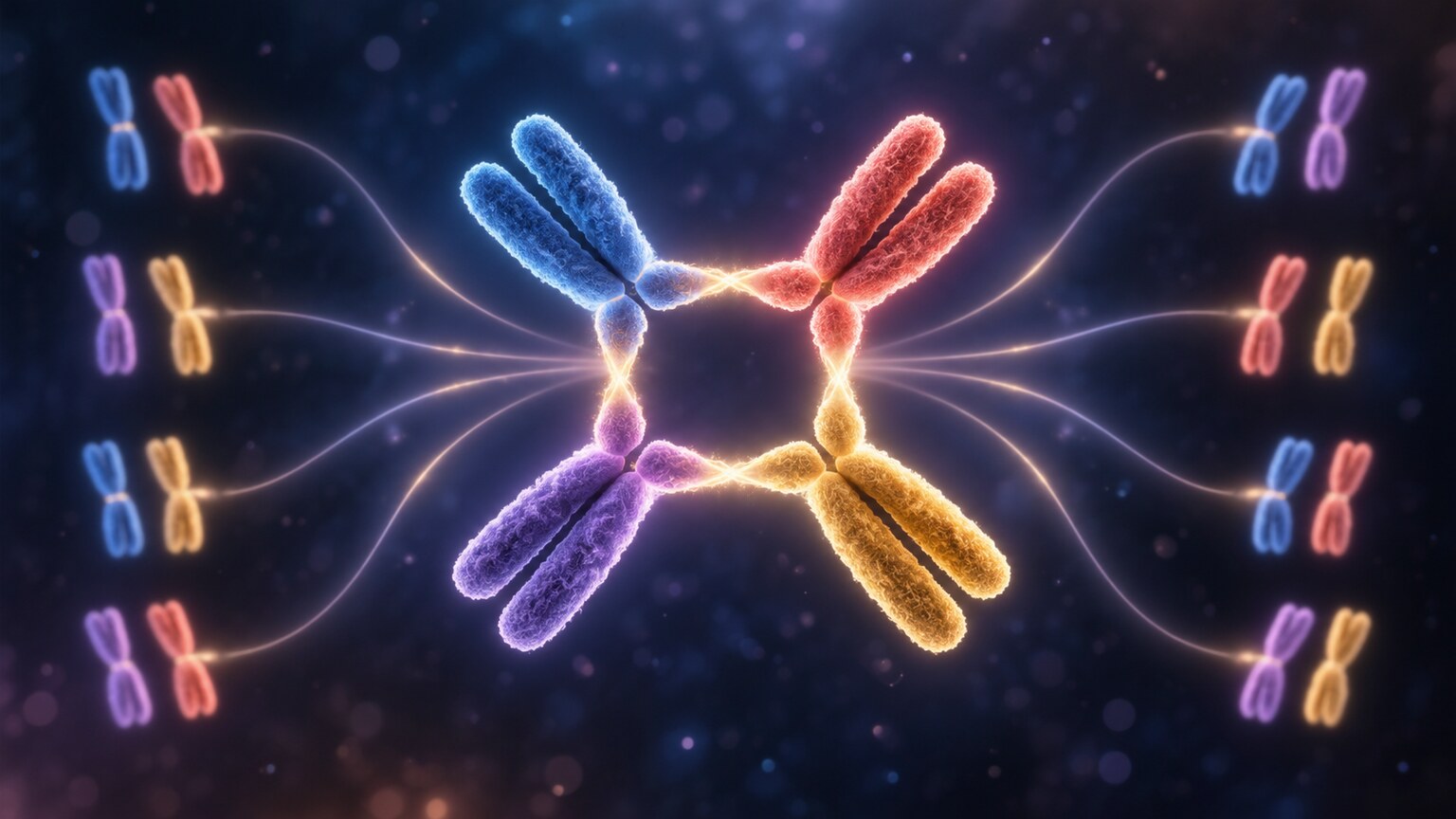
Figure 3. During meiosis, a carrier's rearranged chromosomes must pair up with their normal counterparts in a four-way structure, and how that structure segregates determines whether the resulting egg or sperm ends up balanced or unbalanced.
Every egg or sperm cell is produced through a specialized cell division called meiosis, during which the normal 46 chromosomes are divided down to 23, with one copy of each chromosome pair being packaged into each resulting reproductive cell. In someone without a translocation, this division is straightforward, since each chromosome has an identical, unrearranged partner to pair with. In a translocation carrier, however, the rearranged chromosomes must pair up with their normal counterparts in an unusual four-chromosome structure (rather than the typical two-chromosome pairing), specifically to make sure every gene still finds a matching partner during the pairing process.
This four-way structure can then separate into the resulting egg or sperm cells in several different possible combinations, and only some of those combinations produce a cell that's genetically balanced. A cell can end up with a normal, completely unrearranged set of chromosomes, a balanced set matching the parent's own translocation, or — in the remaining, more common combinations — an unbalanced set carrying either an extra piece of one chromosome or a missing piece of another. Which specific combination occurs at fertilization is a matter of chance at each individual conception, which is precisely why translocation carriers face an elevated, but not universal, risk with each pregnancy rather than a certainty of any particular outcome.
Geneticists describe several distinct patterns by which this four-chromosome structure can separate, each with its own name and its own likelihood of producing a balanced versus unbalanced result. "Alternate segregation" is the pattern most likely to produce a balanced outcome, since it separates the four chromosomes into two genetically complete groups. "Adjacent-1" and "adjacent-2" segregation patterns, by contrast, separate chromosomes in a way that reliably produces an unbalanced result, missing certain pieces while duplicating others. The relative likelihood of each specific pattern occurring isn't identical across all translocations — it depends on the size of the chromosome segments involved and the specific location of the breakpoints, which is part of why some translocations carry a meaningfully higher practical risk of an unbalanced pregnancy than others, even though the same general four-way pairing mechanism is at work in every case.
An additional factor affecting real-world risk is that many severely unbalanced combinations are simply incompatible with ongoing embryonic development at all, meaning they never progress far enough to be clinically recognized as a pregnancy in the first place, or they end in a very early miscarriage before a person even realizes they conceived. This means the unbalanced outcomes that do result in a recognized, ongoing pregnancy tend to be the ones involving a comparatively smaller, more survivable amount of genetic imbalance — which is precisely the situation most likely to result in a liveborn child with an unbalanced translocation and associated health effects, rather than an early pregnancy loss.
What an Unbalanced Outcome Actually Leads To
When a genetically unbalanced egg or sperm cell is involved in conception, the resulting embryo carries either extra or missing genetic material, and what happens next depends heavily on exactly how much material is involved and which specific genes are affected. Many unbalanced combinations involve enough genetic material that the resulting pregnancy doesn't continue to develop at all, ending in an early, often unrecognized miscarriage — this is, in fact, one of the more common underlying explanations behind recurrent pregnancy loss once other more common causes have been ruled out. Other unbalanced combinations, involving a smaller amount of genetic material, can result in a pregnancy that continues but leads to a baby born with an unbalanced translocation, which — unlike the balanced version carried by the parent — typically does cause health effects, potentially including developmental delays, intellectual disability, distinctive physical features, or other congenital differences, depending entirely on which specific genes end up duplicated or missing.
It's important to understand that these are possible outcomes, not guaranteed ones. A translocation carrier can, and very often does, have completely unaffected, healthy children, since a meaningful proportion of their eggs or sperm carry either a fully normal chromosome set or the same balanced translocation passed down unchanged. The specific proportion of balanced-versus-unbalanced outcomes varies considerably depending on which chromosomes are involved and exactly where the breakpoints occurred, which is why genetic counseling for a specific, identified translocation can offer a meaningfully more personalized risk estimate than a generic statistic could.
Interestingly, whether the carrier is the mother or the father can also shift the practical risk picture somewhat, since egg and sperm production involve genuinely different biological processes and different opportunities for the four-way chromosome structure to be checked and, in some cases, corrected before an egg or sperm is finalized. Some research suggests certain unbalanced combinations are somewhat less likely to result in a viable, ongoing pregnancy when passed through sperm compared with eggs, though this varies by the specific translocation involved and isn't considered a reliable enough pattern to predict outcomes for any individual couple without more specific evaluation.
The severity of health effects in a child born with an unbalanced translocation also depends heavily on which specific genes fall within the duplicated or deleted segment, not simply on the physical size of the segment involved. A relatively small segment containing several genes that are highly sensitive to dosage changes can cause more significant effects than a considerably larger segment containing mostly non-coding genetic material or genes more tolerant of an altered dose. This is why two families dealing with unbalanced translocations of roughly similar physical size can experience meaningfully different outcomes, and why detailed genetic analysis of exactly which genes fall within the affected region is such an important part of counseling a family through this specific finding.

Figure 4. A balanced translocation can pass silently through several generations of a family, each carrier unaffected, until a particular pregnancy happens to inherit an unbalanced combination.
Why It So Often Runs Quietly Through a Family for Generations
Because balanced carriers are typically healthy and show no signs of anything unusual, a specific familial translocation can pass silently from parent to child across multiple generations, with each carrier living an entirely normal life, until a particular pregnancy happens to inherit an unbalanced version and the underlying rearrangement finally comes to light. This is why, once a balanced translocation is identified in one family member — often triggered by exactly this kind of unbalanced outcome — genetic counselors typically recommend offering testing to that person's siblings, parents, and other close relatives, since roughly half of a carrier's first-degree relatives who inherited the family's chromosome from that side would be expected to carry the same rearrangement.
This cascading family-testing approach is one of the most practically useful aspects of identifying a balanced translocation at all: a finding that seems to only explain one difficult pregnancy or one affected child often turns out to explain a pattern of pregnancy losses or developmental conditions spread across multiple family members and multiple generations, once the underlying rearrangement is traced back to its source.
Family case histories illustrate this pattern well. It's not unusual for genetic counselors to encounter a family where a grandparent, several aunts or uncles, and multiple cousins across two or three generations all turn out to carry the exact same balanced translocation once cascade testing begins, with only a small handful of pregnancies across that entire extended family ever having resulted in an unbalanced, clinically significant outcome. Retrospectively, family members often recall a pattern of unexplained miscarriages or a relative with an unspecified developmental condition scattered across the family tree, details that made little sense in isolation but suddenly form a coherent picture once the underlying translocation is identified and its inheritance pattern is mapped across the family.
This retrospective clarity is part of why identifying a balanced translocation, even when it emerges from a difficult circumstance like a pregnancy loss or an affected child, is generally considered valuable information rather than simply distressing news. It replaces years of unexplained reproductive difficulty scattered across a family with a single, specific, well-understood explanation, along with concrete options — PGT-SR, prenatal diagnosis, or simply informed awareness of the odds — that weren't available before the underlying cause was identified.
How a Balanced Translocation Is Actually Detected

Figure 5. A standard karyotype, which arranges all 46 chromosomes side by side under a microscope, remains the primary test capable of detecting a balanced translocation, since the rearranged material is simply relocated rather than missing.
A standard karyotype test — in which a lab technologist arrests dividing cells, stains the chromosomes, and arranges all 46 side by side under a microscope by size and banding pattern — remains the primary tool for detecting a balanced translocation, since it directly visualizes the physical structure and arrangement of each chromosome rather than just measuring the total quantity of genetic material present. This is a genuinely important distinction from a newer, increasingly common test called chromosomal microarray, which is excellent at detecting missing or extra genetic material (the kind seen in unbalanced rearrangements) but is specifically unable to detect a balanced translocation, precisely because a microarray measures quantity, and a balanced translocation involves no change in quantity at all — only in arrangement. This is one of the more important, commonly misunderstood distinctions in clinical genetics: a normal microarray result does not rule out a balanced translocation, and a karyotype is the specific test needed to answer that particular question.
For situations requiring more precision than a standard karyotype offers — confirming the exact breakpoints, or checking a specific known familial translocation in a relative — a technique called FISH (fluorescence in situ hybridization) uses fluorescently labeled genetic probes that bind to specific chromosome regions, lighting up under a specialized microscope to confirm whether a particular segment is present in its expected location or has relocated elsewhere.
Once a translocation is identified by karyotype, increasingly sophisticated follow-up techniques can pin down exactly which genes sit at each breakpoint. Chromosomal microarray, despite being unable to detect the balanced translocation itself, becomes genuinely useful as a follow-up test specifically to check whether an unbalanced version found in an affected relative involves any additional microscopic gain or loss too small for a standard karyotype to visualize on its own. In more complex or ambiguous cases, whole genome sequencing can precisely map the exact DNA sequence at each breakpoint, definitively confirming which specific genes, if any, were directly disrupted by the rearrangement itself, information that can meaningfully refine the risk assessment beyond what chromosome-level analysis alone can offer.
Turnaround time for a standard karyotype is typically one to three weeks, since it requires growing living cells in culture long enough to capture them actively dividing, a genuinely biological process that can't be meaningfully sped up beyond a certain point regardless of laboratory efficiency. This is worth setting expectations around, since a result this important can feel like it's taking an unusually long time to arrive, when in fact the turnaround reflects the fundamental biology of the test itself rather than any unusual delay specific to a given laboratory or patient.
Testing During Pregnancy: PGT-SR for IVF and Prenatal Diagnosis
For a known translocation carrier planning a pregnancy, a specific form of preimplantation genetic testing called PGT-SR (testing for structural rearrangements) can be performed on embryos created through in vitro fertilization, before any embryo is actually transferred to the uterus. This testing identifies which embryos carry a balanced chromosome complement — either fully normal or the same balanced translocation as the parent — allowing only those embryos to be considered for transfer, meaningfully reducing the chance of an unbalanced pregnancy or a related early miscarriage. It's worth understanding that PGT-SR cannot always distinguish a normal chromosome set from a balanced translocation matching the parent's own, since both are chromosomally balanced; it can, however, distinguish either of those from a genuinely unbalanced result, which is the distinction that carries the meaningful health risk.
For carriers who become pregnant without IVF, prenatal diagnostic testing — chorionic villus sampling in the first trimester or amniocentesis in the second — followed by karyotype analysis of the fetal cells obtained, can determine during the pregnancy itself whether the fetus has inherited a balanced or unbalanced version of the family's translocation, giving parents information to plan for accordingly.
It's worth distinguishing this targeted diagnostic testing from standard non-invasive prenatal screening (NIPT), a blood test increasingly offered to all pregnant patients regardless of known family history. Standard NIPT is specifically designed and validated to screen for common numerical differences like an extra chromosome 21, 18, or 13, and is generally not built or validated to reliably detect an unbalanced translocation, particularly a smaller one, meaning a normal standard NIPT result does not provide the same reassurance for a known translocation carrier that it does for the general population. Some specialized NIPT laboratories now offer expanded testing specifically designed to screen for a known familial translocation, but this requires the laboratory to be informed of the specific rearrangement in advance, and even then, it functions as a screening test with real, quantifiable false-negative and false-positive rates rather than the diagnostic certainty that comes from directly analyzing fetal cells through CVS or amniocentesis.
Given this distinction, known translocation carriers planning a pregnancy are generally counseled specifically about which testing pathway — standard screening, translocation-specific screening, or direct diagnostic testing — best fits their own risk tolerance and specific translocation, rather than defaulting to whichever prenatal test is most commonly offered to the general pregnant population without translocation-specific consideration.
Living With a Known Balanced Translocation: What Actually Changes Day to Day

Figure 6. A genetic counselor translates the specific chromosomes and breakpoints identified on a carrier's karyotype into a personalized estimate of reproductive risk, rather than relying on a generic statistic.
For most day-to-day purposes, carrying a balanced translocation changes remarkably little about a person's actual life. It doesn't require ongoing monitoring, medication, or any particular lifestyle adjustment, and it has no bearing on general health screenings, life expectancy, or the vast majority of routine medical care a carrier will ever receive. Where it genuinely matters is in a fairly narrow, specific set of circumstances: family planning conversations, fertility evaluations, recurrent pregnancy loss workups, and decisions around prenatal or preimplantation testing. Outside of those specific contexts, a balanced translocation is, practically speaking, a piece of genetic information rather than a medical condition requiring active management.
That said, once a translocation is identified, many carriers find real value in an initial, thorough consultation with a genetic counselor, specifically to have their exact rearrangement mapped out and its particular reproductive implications explained in personalized terms, rather than relying on generic statistics that don't account for which specific chromosomes and breakpoints are involved. This is typically a one-time or infrequent conversation rather than an ongoing relationship, useful primarily around major reproductive decision points — starting a family, considering IVF, or evaluating a pregnancy loss — rather than something requiring continuous follow-up in between.
Emotionally, many carriers describe a mix of relief and adjustment upon first learning about a balanced translocation, particularly when the finding emerges from a difficult circumstance like a miscarriage. The relief typically comes from finally having a concrete, well-understood explanation after a period of uncertainty; the adjustment comes from processing new information about reproductive risk that didn't exist as a consideration before testing. Connecting with a genetic counselor experienced specifically in chromosomal rearrangements, and in some cases with support groups or organizations focused on this particular category of genetic finding, can be genuinely helpful during this adjustment period, since the specific combination of "generally healthy carrier" alongside "genuine reproductive risk" is a nuanced situation that benefits from guidance tailored to it specifically.
Frequently Asked Questions
If I have a balanced translocation, will I definitely have fertility problems?
Not necessarily. Many carriers conceive without difficulty and have healthy children. The elevated risk shows up statistically across many potential conceptions — some translocation carriers experience no noticeable fertility impact at all, while others face recurrent miscarriage or difficulty conceiving, depending on which specific chromosomes and breakpoints are involved in their own individual rearrangement.
Can a balanced translocation ever cause symptoms in the carrier?
Rarely, yes — if one of the chromosome breakpoints happens to land directly within a functionally important gene, disrupting it. This is uncommon, since most of the genome consists of non-coding regions where a break causes no functional disruption, which is why the overwhelming majority of carriers are completely unaffected regardless of which two chromosomes are involved in their specific rearrangement.
Why didn't a normal chromosomal microarray catch my translocation?
A microarray specifically measures whether genetic material is missing or duplicated, and a balanced translocation involves no such change in quantity — only relocation. A karyotype, which visualizes the physical structure of each chromosome, is the correct test to detect a balanced rearrangement.
Should my siblings or parents get tested if I'm found to carry one?
Genetic counselors generally recommend offering testing to close relatives, since a familial translocation can pass silently through a family for generations. Identifying other carriers gives them the same reproductive planning information you now have, and can retroactively explain unresolved pregnancy losses elsewhere in the family.
Is a Robertsonian translocation more or less risky than a reciprocal one?
Risk varies by the specific chromosomes and breakpoints involved in either type, rather than one category being uniformly riskier than the other. A genetic counselor can provide a risk estimate specific to your particular translocation once it's been precisely characterized.
Does a standard prenatal screening test detect an unbalanced translocation?
Not reliably. Standard non-invasive prenatal screening is validated for common numerical differences like extra chromosome 21, not for detecting unbalanced translocations. Known carriers generally need translocation-specific screening or direct diagnostic testing like CVS or amniocentesis for reliable information.
Cost and insurance coverage for this testing pathway vary depending on the specific circumstance prompting it. Karyotype testing ordered for a documented clinical indication — recurrent pregnancy loss, an affected child, or infertility evaluation — is typically covered by standard health insurance, since these are well-established, medically recognized indications. Cascade testing for extended family members, and specialized procedures like PGT-SR performed alongside IVF, carry more variable coverage depending on the specific insurance plan and country, and are worth confirming directly with an insurer or fertility clinic's financial counseling team before proceeding.
Ultimately, the value of identifying a balanced translocation lies less in the finding itself and more in what it makes possible afterward: a concrete explanation for a pattern that once seemed unexplainable, a personalized risk estimate rather than a generic statistic, and a defined set of testing pathways — cascade family testing, PGT-SR, or targeted prenatal diagnosis — that simply weren't available before the underlying rearrangement was identified and precisely characterized.
Conclusion
A balanced translocation is a genuinely unusual kind of genetic finding: a real, physical rearrangement of chromosome material that almost never affects the health of the person carrying it, yet can meaningfully shape their reproductive future and, potentially, the health of their children. Understanding the difference between the reciprocal and Robertsonian types, why balanced and unbalanced outcomes diverge so sharply in consequence, and why a normal microarray doesn't rule this finding out, turns a confusing genetic report into something with a clear, actionable next step — usually a conversation with a genetic counselor equipped to translate a specific karyotype result into a personalized, meaningful risk estimate rather than a generic, one-size-fits-all statistic.
Still Not Sure What Your Results Mean?
Upload your labs and get a complete, visual, plain-language interpretation of every biomarker — delivered to your inbox in under 15 minutes.
Get My ReportThis article is for educational purposes only and does not constitute medical advice. Always consult your healthcare provider regarding your specific lab results.