
What Does an Incidental Finding on a Genetic Test Report Mean?
An incidental finding on a genetic test report is a result that has nothing to do with the reason you were tested in the first place. You might have had a genetic panel ordered because of a heart rhythm question, a cancer risk in your family, or a newborn screening follow-up — and buried in that same report, completely unrelated to any of that, sits a flagged change in a gene tied to a totally different condition. This happens because modern genetic testing rarely looks at just one gene anymore; it's technically almost as easy to scan dozens or hundreds of genes at once as it is to scan a single one, and that wide net occasionally catches something nobody was looking for. This article walks through exactly what qualifies as this kind of finding, why only a specific, deliberately short list of genes is ever proactively screened this way, what choice you actually get to make about it before testing even begins, and what realistically happens in the weeks and months after one of these results lands on your report.

Figure 1. A broad genetic panel scans far more of the genome than the single condition it was ordered for, occasionally surfacing a flagged change in a gene entirely unrelated to the original reason for testing.
Incidental vs. Secondary: Two Words That Actually Mean Two Different Things
Genetics professionals draw a specific, meaningful line between two terms that sound almost identical in everyday conversation but describe two genuinely different situations. A true incidental finding is one nobody was ever looking for at all — it turns up purely by chance while the lab is analyzing a gene panel for a completely different purpose, the genetic equivalent of a radiologist scanning an X-ray for a broken bone and noticing an unrelated shadow on the edge of the image. A secondary finding, by contrast, is the result of a deliberate, upfront decision: certain laboratories, when they run broad tests like whole-exome or whole-genome sequencing, proactively and intentionally check a specific, pre-agreed list of genes for known, well-documented, serious conditions — regardless of why the test was originally ordered — precisely because catching those particular conditions early is considered valuable enough to actively look for them every single time.
This distinction matters more than it might first seem, because it changes who decided to look and why. An incidental finding is unplanned by definition; a secondary finding is the product of a formal, published policy that a growing number of laboratories and professional genetics organizations have deliberately built into how broad sequencing gets analyzed. In casual conversation, and even sometimes in a doctor's own explanation, both get lumped together under the single phrase "incidental finding" — but understanding that one of them is actually the result of active, intentional screening is the key to understanding everything else in this article, including why you're typically asked a specific question about this before your test even happens.
A genuine incidental finding — the true, nobody-was-looking-for-it kind — is comparatively rare in practice, precisely because most laboratories have moved toward the formal secondary-findings framework as their default approach to handling unrelated discoveries in a structured, consistent way, rather than leaving each unexpected result to be handled case by case as it comes up. When a true incidental finding does occur outside that formal system — say, a finding in a gene not on the standard actionability list, discovered by chance during analysis of the primary condition — how it gets handled varies more from one laboratory or hospital system to the next, since there's no single universal protocol governing every possible unplanned discovery the way there is for the pre-agreed secondary-findings list. Some institutions have their own internal review process for evaluating whether an unplanned finding is serious and actionable enough to warrant reporting back to the patient regardless of the formal list; others rely on the individual judgment of the interpreting laboratory geneticist or the ordering physician. This inconsistency is itself an active area of ongoing discussion within the genetics field, and it's part of why the formal secondary-findings list, imperfect and narrow as it is, still represents a meaningful improvement over the alternative of no consistent standard at all.
The Actionability Standard: Why Only Some Genes Ever Make the List
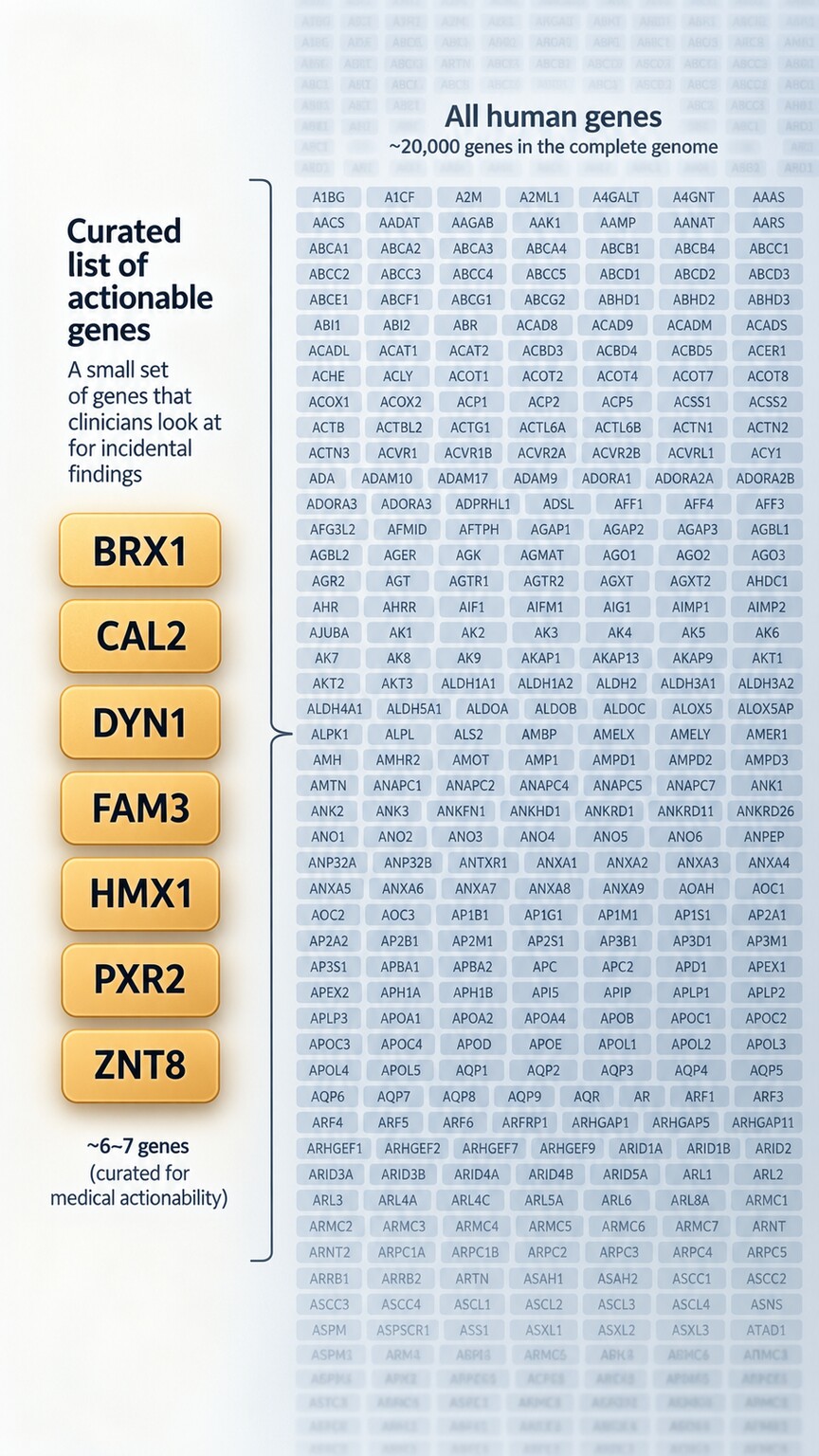
Figure 2. The American College of Medical Genetics and Genomics maintains a specific, curated list of genes recommended for proactive secondary-finding screening, deliberately kept short and periodically revised.
The American College of Medical Genetics and Genomics, the same professional body that sets the variant-classification rules covered elsewhere on this site, maintains a specific, official list of genes recommended for this kind of proactive secondary-finding screening. That list is deliberately short — currently covering somewhere around 80 genes, out of roughly 20,000 total genes in the human genome — and it is not a list of every gene where a dangerous mutation is possible. It's a much narrower, more carefully curated list built around one specific, deliberately strict standard: a condition only makes the list if there's a genuinely effective medical action a person could actually take once they know about it.
This "actionability" requirement is the single filter every candidate gene has to pass. A hereditary cancer gene like one of the BRCA genes makes the list because a person who learns they carry a pathogenic variant has real, concrete options available — earlier and more frequent cancer screening, preventive medication, or in some cases risk-reducing surgery — that meaningfully change their actual medical outcome. A gene tied to a serious inherited heart rhythm disorder makes the list for the same reason: knowing about it in advance can lead to protective medication, activity guidance, or a cardiac device that can prevent a sudden, catastrophic event before it ever happens. A gene tied to a condition with no meaningful preventive or treatment option, no matter how medically interesting or scientifically well-understood, generally does not make this particular list — not because the condition isn't real or important, but because the entire premise of proactive secondary screening is offering a person a genuine, usable head start, not simply more information they can't act on.
This same list is revised periodically as medical evidence evolves — a condition can be added once a genuinely effective new treatment or screening approach becomes available, and in rarer cases a gene can be removed if follow-up evidence suggests the original inclusion was too broad. The list was first published in 2013 covering 56 genes, and the most recent major revision expanded it to roughly 80, reflecting new evidence about which conditions genuinely meet the actionability bar and which don't. This is worth knowing because it means the exact list your lab checks against today may look slightly different from the list used on a test run several years ago, or several years from now — the list itself is a living, actively maintained clinical tool, not a fixed, permanent inventory.
The list leans heavily toward three broad categories of disease, and understanding why helps explain the actionability standard in concrete terms rather than the abstract. Hereditary cancer syndromes make up a large share of it, because early, intensified screening or preventive measures in someone who carries a known high-risk variant can catch a cancer years before it would otherwise be found, or prevent it from developing at all. Inherited heart conditions make up another large share, because several of them are entirely silent until a first, sometimes fatal, event — meaning genetic knowledge can prompt monitoring and treatment during the only window when it actually helps, before any symptom exists to prompt that same workup on its own. A smaller third category covers specific inherited metabolic conditions where a known dietary or medical intervention meaningfully changes the trajectory of the disease. Conditions that don't fit one of these general shapes — serious, but with no comparably strong evidence that early knowledge changes the outcome — are the ones that consistently fail to make the cut, regardless of how well-studied or well-known they otherwise are.
Why Broader Tests Make This More Likely, and Narrower Tests Make It Rare
How likely you are to ever encounter a secondary finding at all depends heavily on which specific type of genetic test you're actually having, and this is a detail that's easy to overlook when the phrase "genetic testing" gets used as if it describes one single, uniform kind of test. A targeted panel, built to look at a small, specific handful of genes tied to one particular condition, such as a panel built only around a suspected connective tissue disorder, has no meaningful opportunity to stumble onto an unrelated cardiac or cancer gene, simply because that panel was never designed to look at those genes in the first place — you cannot find a variant in a gene your test never reads.
Whole-exome sequencing, which reads the protein-coding sections of essentially every gene in the genome — roughly 1 to 2% of total DNA, but the portion where the overwhelming majority of currently understood disease-causing variants are found — and whole-genome sequencing, which reads essentially all of a person's DNA including the much larger non-coding regions between genes, both routinely generate enough raw data that checking an additional 80-gene actionability list adds only a small amount of extra analysis on top of data that's already been produced. This is precisely why secondary-finding screening is realistically only offered alongside these two broadest categories of testing, and essentially never alongside a narrow, single-condition panel — the opportunity to check the list only exists when the underlying test was already reading that much of the genome in the first place.
This distinction is worth asking about directly before any broad genetic test, since it isn't always obvious from the name of the test alone which category it falls into. A person told they're having "genetic testing" for a specific suspected condition might reasonably assume that's a narrow, targeted look — but if the ordering physician or laboratory has chosen to use a broader whole-exome approach as the underlying method (a genuinely common practice, since it's often more efficient than building a brand-new narrow panel from scratch), the secondary-findings conversation becomes directly relevant even though the original clinical question was narrow and specific.
Curious what your own genetic panel or lab report is actually telling you? Upload your results and get a complete, plain-language breakdown in under 15 minutes.
Analyze My ResultsThe Choice You Get to Make Before Testing Even Begins

Figure 3. Before broad genetic sequencing begins, a specific consent question asks whether a person wants to receive secondary findings unrelated to the original reason for testing, separate from consent for the primary test itself.
Because secondary-finding screening is a deliberate, active choice rather than an automatic byproduct of testing, most laboratories and genetic counselors build a specific, standalone question into the consent process, entirely separate from the general consent for the test itself: do you want to know about a serious, actionable finding unrelated to why you're being tested, if one happens to turn up? This isn't a hidden fine-print clause — reputable genetic counseling protocols treat this as its own dedicated conversation, precisely because reasonable, well-informed people genuinely land on different answers.
Some people opt in without hesitation, reasoning that any genuinely actionable health information is worth having, regardless of how it surfaces. Others opt out just as deliberately, preferring not to receive unexpected information about a condition they were never worried about in the first place, sometimes citing concerns about anxiety, insurance, or simply not wanting to open a door they didn't ask to open. Both choices are considered entirely legitimate within current genetic counseling practice — there is no professionally "correct" answer here, and a genetic counselor's job in this conversation is to make sure the choice is genuinely informed, not to steer a person toward one option over the other.
It's worth being specific about what this choice actually covers, since it's easy to assume it's broader than it is. Opting out of secondary findings does not affect how your primary test results, the ones actually related to why you were tested, get reported to you — those are reported either way. It specifically and only affects whether the lab will report back a finding from that separate, curated actionability list that has nothing to do with your original reason for testing. And a true incidental finding — the unplanned, nobody-was-looking-for-it kind described earlier — sits slightly outside this formal opt-in system, since by definition it wasn't part of the deliberate screening process this consent question is actually asking about; how a lab or provider handles a genuinely unplanned discovery varies more by institution and by the specific nature of the finding itself.
A Concrete Path: What Happens After a Secondary Finding Comes Back

Figure 4. A secondary finding in a gene tied to an inherited cardiac condition, such as hypertrophic cardiomyopathy, typically leads to a referral for a targeted screening test like an echocardiogram, even in someone with no prior symptoms.
Consider a specific, realistic example that illustrates the whole process end to end. Someone undergoes a broad genetic panel for a completely unrelated reason — say, a workup for recurrent kidney stones — and had opted in, during the consent conversation, to receive secondary findings. The panel comes back showing a pathogenic variant in a gene associated with hypertrophic cardiomyopathy, a structural heart condition that can exist for years without causing any noticeable symptoms and, in rare but well-documented cases, can lead to a dangerous or even fatal heart rhythm event with no advance warning at all.
The realistic next steps follow a fairly predictable, well-established path. First comes confirmatory testing: a second, independent sample is typically drawn and tested specifically for that one variant, since a secondary finding is treated with the same rigor as any other clinically significant result and is never acted on based on a single unconfirmed readout. Once confirmed, the person is referred to a cardiologist, usually alongside a genetic counselor, for baseline evaluation — typically an echocardiogram and an EKG — even though they've never had a single cardiac symptom in their life. If that evaluation reveals early structural changes consistent with the condition, a specific, individualized management plan follows: activity guidance, medication, periodic monitoring, and in some cases family screening (covered in the next section), all built around a real medical head start that traces directly back to a kidney-stone workup that had nothing to do with the heart at all.
This example captures the entire point of restricting secondary-finding screening to genuinely actionable genes in the first place: the value isn't in the discovery itself, but in the concrete, evidence-based path forward that discovery actually opens up. A finding with no such path forward would deliver the same emotional weight without the same practical benefit — which is exactly the distinction the actionability standard described earlier exists to enforce.
It's also worth being realistic about the timeline this whole process actually takes, since the gap between the initial report and a fully worked-out management plan is rarely instantaneous. Confirmatory testing on a second sample typically takes one to three weeks to come back, depending on the laboratory. The specialist referral and initial evaluation often takes another few weeks to schedule, longer in areas with limited access to a cardiologist experienced in inherited heart conditions specifically or a certified genetic counselor. All told, it's common for two to three months to pass between an initial secondary finding and a fully established monitoring plan — a stretch of time that understandably feels uncomfortable to sit with, but one genetic counselors routinely walk patients through in advance, precisely so the waiting period itself doesn't feel like a sign that something has gone wrong with the process.
Why a Secondary Finding Often Becomes a Family Conversation

Figure 5. Because most genes on the secondary-findings list are inherited in a pattern where each first-degree relative has roughly a 50% chance of carrying the same variant, one person's result often prompts cascade testing across the family.
Most of the conditions on the actionable secondary-findings list are inherited in what's called an autosomal dominant pattern, meaning a person only needs to inherit one altered copy of the gene, from just one parent, to be affected — and it means each of that person's first-degree relatives, their parents, siblings, and children, has roughly a coin-flip's chance of carrying that exact same variant themselves. This is why a single secondary finding rarely stays contained to just the one person who was originally tested; genetic counselors routinely recommend a process called cascade testing, where close relatives are offered the opportunity to test specifically for that one already-identified variant, rather than undergoing a full, broad panel of their own.
Cascade testing carries a genuinely different weight than the original broad test, and it's worth understanding why: because the exact variant is already known, testing a relative for that one specific, already-characterized change is faster, considerably less expensive, and far more straightforward to interpret than the original wide-net panel that found it in the first place. A relative testing positive gains the exact same kind of actionable head start the original person did — referral to the appropriate specialist and a tailored monitoring or prevention plan — while a relative testing negative can, in most cases, be genuinely reassured that their own personal risk for that specific inherited condition is essentially back down to that of the general population, since they didn't inherit the variant responsible for the elevated risk in their family.
This cascade process is also precisely why the earlier opt-in conversation matters beyond just the person being tested. A parent who opts into secondary findings and receives one is, in a very real sense, making a discovery that immediately becomes relevant to their children as well — which is one of the specific considerations genetic counselors are trained to raise explicitly during that initial consent conversation, well before testing ever begins.
What GINA Actually Protects — and the Real Gaps Left Behind

Figure 6. The Genetic Information Nondiscrimination Act prevents health insurers and most employers from using a genetic finding against someone, but it does not extend to life, disability, or long-term care insurance applications.
A federal law called the Genetic Information Nondiscrimination Act, passed in 2008 and generally referred to by its acronym GINA, is one of the most common topics that comes up during the pre-test consent conversation, and for good reason — a meaningful number of people hesitate to opt into secondary findings specifically out of concern about exactly this kind of discrimination. GINA does provide real, legally enforceable protection in two specific areas: it prohibits health insurance companies from using genetic information to deny coverage, raise premiums, or impose different terms, and it prohibits most employers from using genetic information in hiring, firing, promotion, or other employment decisions.
What GINA explicitly does not cover is just as important to understand clearly, because the gap catches many people by surprise. The law's protections do not extend to life insurance, disability insurance, or long-term care insurance — all three of these types of insurers remain legally permitted, in most states, to ask about and factor in known genetic test results when deciding whether to offer a policy and at what price. Someone who receives a secondary finding for a serious hereditary condition and later applies for a new life insurance policy may be required to disclose that result, and the insurer may be allowed to use it in underwriting, depending on the specific state and the specific type of policy involved.
This is precisely why a thorough genetic counseling conversation, ahead of testing, often includes a practical, concrete suggestion: securing life, disability, and long-term care insurance policies before undergoing broad genetic testing, if that's a realistic option, specifically because those particular protections don't yet exist at the federal level the way they do for health insurance and employment. This isn't offered as a reason to avoid testing altogether — for most people, the medical value of an actionable secondary finding meaningfully outweighs this insurance consideration — but it's exactly the kind of concrete, practical detail a genetic counselor is trained to walk through before the consent decision is made, not after a result has already come back.
Secondary Findings in Children: A Genuinely Different Set of Questions

Figure 7. Because a child cannot personally consent, parents make the secondary-findings decision on their behalf — a choice genetic counselors approach differently than the same decision made by an adult for themselves.
When the person being tested is a child, the entire opt-in conversation shifts in a specific, deliberate way, because a child cannot personally weigh and consent to this decision the way an adult can — a parent or guardian makes the choice on the child's behalf. Current professional guidance takes a notably firm position here: the same actionable adult-onset conditions on the secondary-findings list are generally still recommended for reporting in children, even though some of those specific conditions, such as certain hereditary cancer syndromes, wouldn't typically become medically relevant until adulthood. The reasoning is that once a child's genome has already been sequenced for their own current medical reason, and once that same secondary-findings analysis is already technically part of the standard process, withholding an actionable result from the family delays a piece of information that could matter decades sooner than the point at which it would otherwise ever be discovered — and cascade testing of parents (see the family-testing section above) sometimes reveals a parent's own previously unknown risk in the process.
This particular practice has been genuinely debated within the field, and it's worth understanding both sides rather than presenting it as an uncontroversial default. One line of argument holds that a child has a right to an open future — the right to decide for themselves, once they're old enough, whether they want to know about an adult-onset condition that won't affect them for years or decades, a decision some bioethicists argue shouldn't be made for them in advance by their parents. The counterargument, generally reflected in current professional guidelines, holds that the practical medical value of early knowledge (starting cancer screening years ahead of when it would otherwise begin, for example) outweighs that autonomy concern for genuinely actionable conditions specifically, precisely because the entire secondary-findings list was built around conditions where waiting has a real, measurable cost. Reasonable, well-informed genetics professionals continue to disagree on where exactly to draw this particular line, and it remains one of the more actively discussed ethical questions in pediatric genetics today.
What isn't up for debate, at least under current mainstream guidance, is that conditions on the list that only become relevant in adulthood and have no pediatric-specific screening or intervention (as opposed to something like a childhood-onset cardiac condition, where early knowledge changes pediatric care directly) still get reported to parents under the standard framework — the distinction genetics professionals draw isn't between adult-onset and childhood-onset conditions, but between conditions with a genuine actionable intervention and conditions without one, applied consistently regardless of the age at which that intervention would eventually begin.
Common Misconceptions About Incidental and Secondary Findings
A few misunderstandings come up often enough that they're worth directly addressing here. The first is assuming any broad genetic test automatically screens for the full secondary-findings list by default — in reality, this proactive screening is generally specific to whole-exome and whole-genome sequencing, the broadest categories of testing, and even then only happens when a person has specifically opted in; a more narrowly targeted panel built around one particular condition, ordered for one particular reason, typically doesn't include this additional layer of screening at all.
A second misconception is treating any unexpected result on a genetic report as automatically falling into this "incidental/secondary finding" category. A variant of uncertain significance discovered within a gene panel that was already relevant to the original reason for testing, covered in more depth in a related article on this site, is a different situation entirely — that variant lives within the gene(s) the test was already looking at, it's simply not yet classifiable one way or the other, which is a fundamentally different scenario from a finding in a gene that had nothing to do with the original test at all. The two can, in rarer cases, overlap — a secondary finding can itself come back as a variant of uncertain significance within one of the actionability-list genes, rather than a clearly pathogenic result — in which case current guidance is that it generally isn't reported at all, since the entire premise of the secondary-findings framework rests on a confidently classified, genuinely actionable result, not an ambiguous one that would create the exact same interpretive uncertainty this proactive screening was designed to avoid.
A third misconception, understandably common given how emotionally significant these results can feel, is assuming a secondary finding is a diagnosis in the way a symptom-driven medical test result would be. A secondary finding indicates an increased genetic risk or predisposition for a specific condition — it is not, by itself, proof that the condition is already present or that it will definitely develop, and the confirmatory testing and specialist evaluation described earlier in this article exist precisely to determine what that elevated risk actually looks like in that one specific person's case.
A fourth misconception worth addressing directly is the assumption that opting out of secondary findings is somehow the "safer" or more cautious choice, protecting a person from bad news they didn't ask for. That framing leaves out exactly what's being given up in exchange: for the specific, narrow list of conditions this system covers, the entire premise is that early knowledge changes a real, measurable medical outcome. Opting out doesn't make an underlying genetic risk disappear — a person who carries a variant for an inherited heart condition carries it whether or not they know about it — it only removes the early opportunity to act on it before symptoms might otherwise force the issue. This isn't an argument that everyone should opt in; it's simply a clarification that the choice is a genuine trade-off between two different kinds of risk, not a straightforward choice between "finding out something scary" and "avoiding risk altogether."
Frequently Asked Questions
What's the difference between an incidental finding and a secondary finding?
An incidental finding turns up purely by chance during testing for something else entirely. A secondary finding comes from a deliberate, proactive check of a specific, curated list of genes for known, actionable conditions, regardless of why the test was originally ordered.
Do I have to receive secondary findings if I don't want them?
No. Most laboratories ask a specific, standalone consent question before broad genetic testing begins, letting you opt in or opt out of receiving secondary findings unrelated to your original reason for testing.
Why is the secondary-findings gene list so short?
Because a gene only makes the list if there's a genuinely effective medical action a person could take upon learning about it — screening, prevention, or treatment that meaningfully changes the outcome. The list isn't meant to cover every possible serious gene, only the ones where advance knowledge is actually useful.
Will a secondary finding affect my health insurance?
No. The Genetic Information Nondiscrimination Act (GINA) prohibits health insurers and most employers from using genetic information against you. It does not, however, cover life, disability, or long-term care insurance.
If I get a secondary finding, do my relatives need to be tested too?
Often, yes. Most conditions on the secondary-findings list are inherited in a pattern where each first-degree relative has roughly a 50% chance of carrying the same variant, which is why cascade testing of close family members is commonly recommended.
Conclusion
An incidental or secondary finding on a genetic test report is, at its core, a byproduct of how modern genetic testing actually works: scanning many genes at once is barely more effort than scanning one, and that wide net occasionally surfaces something real and unrelated to the original question. What keeps this from being an overwhelming flood of unrelated, unusable information is the deliberate narrowness of the secondary-findings list itself — a short, carefully maintained set of genes chosen specifically because a person who learns about them can actually do something meaningful with that knowledge, and a consent process that puts the choice of whether to receive that information in your hands before testing ever begins, not after.
Whether a specific finding leads to a cardiology referral, a cascade testing conversation with siblings, or simply a documented note for future reference, the throughline is the same one running through most of modern genetic medicine: a result is only as useful as the concrete path it opens up next. Understanding that distinction — between information that's simply interesting and information that's genuinely actionable — is exactly what turns an unexpected line on a lab report from a source of confusion into a specific, well-defined next step.
If you're facing this decision yourself, ahead of an upcoming broad genetic test, the single most useful thing you can do is ask your ordering provider or genetic counselor directly which specific category of test you're actually having — a targeted panel, where this entire conversation is largely moot, or a whole-exome or whole-genome test, where the opt-in decision genuinely applies — and to walk through the practical, real-world implications covered in this article, from the insurance considerations to what a positive result would concretely mean for your day-to-day life, before signing anything. That single conversation, more than any other single step in this whole process, is what turns an abstract choice on a consent form into a genuinely informed one.
Still Not Sure What Your Results Mean?
Upload your labs and get a complete, visual, plain-language interpretation of every biomarker — delivered to your inbox in under 15 minutes.
Get My ReportThis article is for educational purposes only and does not constitute medical advice. Always consult your healthcare provider regarding your specific lab results.