
What Do Immature Blood Cells Mean on a Blood Smear?
Finding immature blood cells on a smear means your bone marrow — the soft factory inside your bones that makes every blood cell your body uses — pushed some cells out the door before they were fully finished growing up. Most of the time, this is your body doing exactly what it's supposed to do: when there's a big infection to fight or a sudden demand for more blood cells, the marrow speeds up its assembly line and some slightly younger, not-quite-finished cells slip into the bloodstream early, the same way a bakery might sell a loaf of bread a few minutes before the timer goes off during a big rush. It is not automatically a sign of leukemia or anything scary, even though that is the first place a worried mind jumps. What actually matters is which cells are immature, how many there are, and what else is happening in your body at the same time — and that is exactly what this article walks through, step by step, in plain language.
Curious what the rest of your blood work is telling you? Upload your results and get a complete, plain-language breakdown in under 15 minutes.
Analyze My ResultsYour Bone Marrow Is a Factory With an Assembly Line
To understand what an "immature" blood cell even is, it helps to picture where every blood cell in your body actually comes from: your bone marrow, a spongy tissue tucked inside your larger bones, especially your hips, spine, and breastbone. Deep inside the marrow live a small number of master cells called stem cells, and their whole job is to divide over and over, with each generation of offspring becoming a little more specialized and a little closer to being a finished, working blood cell — red blood cells that carry oxygen, platelets that help you stop bleeding, and white blood cells that fight infection.
Think of this process like a real factory assembly line, the kind you might see in a documentary about how cars are built. A car doesn't appear all at once — it starts as a bare frame, then gets an engine, then doors, then paint, then a final inspection before it's allowed to drive off the lot. White blood cells go through a very similar staged process inside the marrow, moving through several named stages of growing maturity before they're considered finished and ready for release into your bloodstream. Under normal, calm conditions, the marrow only releases cars that have passed final inspection — fully mature cells. An "immature" blood cell on a smear is a car that rolled off the line a few stations early, still recognizably a car, just not entirely finished.
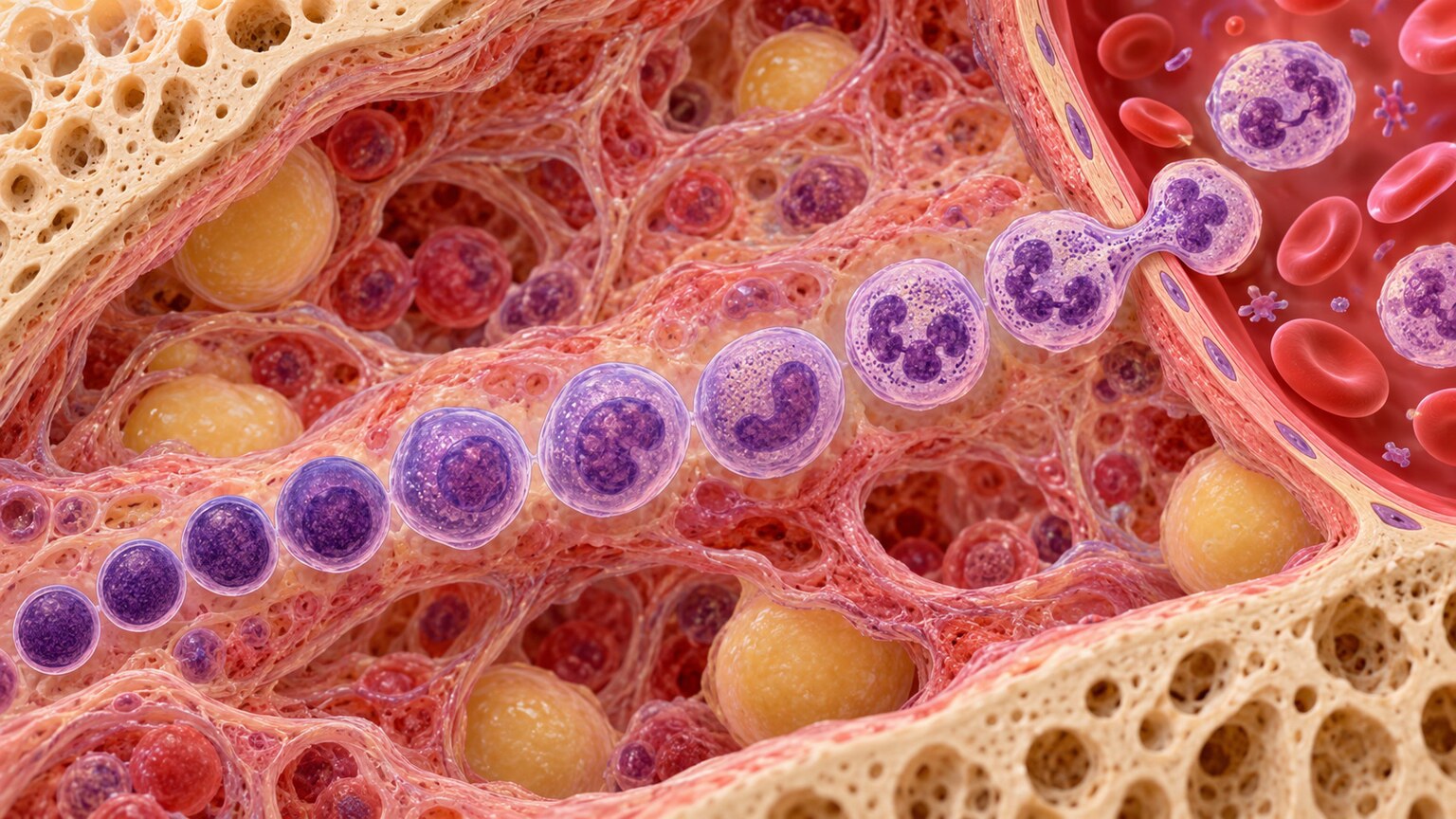
Figure 1. Inside the bone marrow, white blood cells pass through several stages of maturity before normally being released into circulation as finished cells.
Meet the Stages: From Youngest to Fully Grown
The white blood cell line that gets discussed most often in this context is the neutrophil, the most common type of infection-fighting white cell and the one whose immature forms show up most frequently on a routine smear. Going from youngest to oldest, the stages are: myeloblast (the earliest recognizable stage, still very immature), promyelocyte, myelocyte, metamyelocyte, band (also called a "stab" cell, almost fully mature), and finally the segmented neutrophil — the fully finished, normal, everyday cell that should make up the overwhelming majority of white cells seen in a healthy person's blood.
The single easiest visual clue separating a mature cell from an immature one is the shape of its nucleus, the dark, dense control-center structure inside the cell. A fully mature segmented neutrophil has a nucleus pinched into several separate connected lobes, like a cluster of grapes or a knotted balloon animal. As you move backward through the earlier stages, that nucleus becomes progressively less pinched and more solid, oval, or even round — a band cell has a nucleus shaped like a curved, unsegmented horseshoe or the letter C, still one continuous solid band rather than separate lobes, which is exactly where its name comes from.
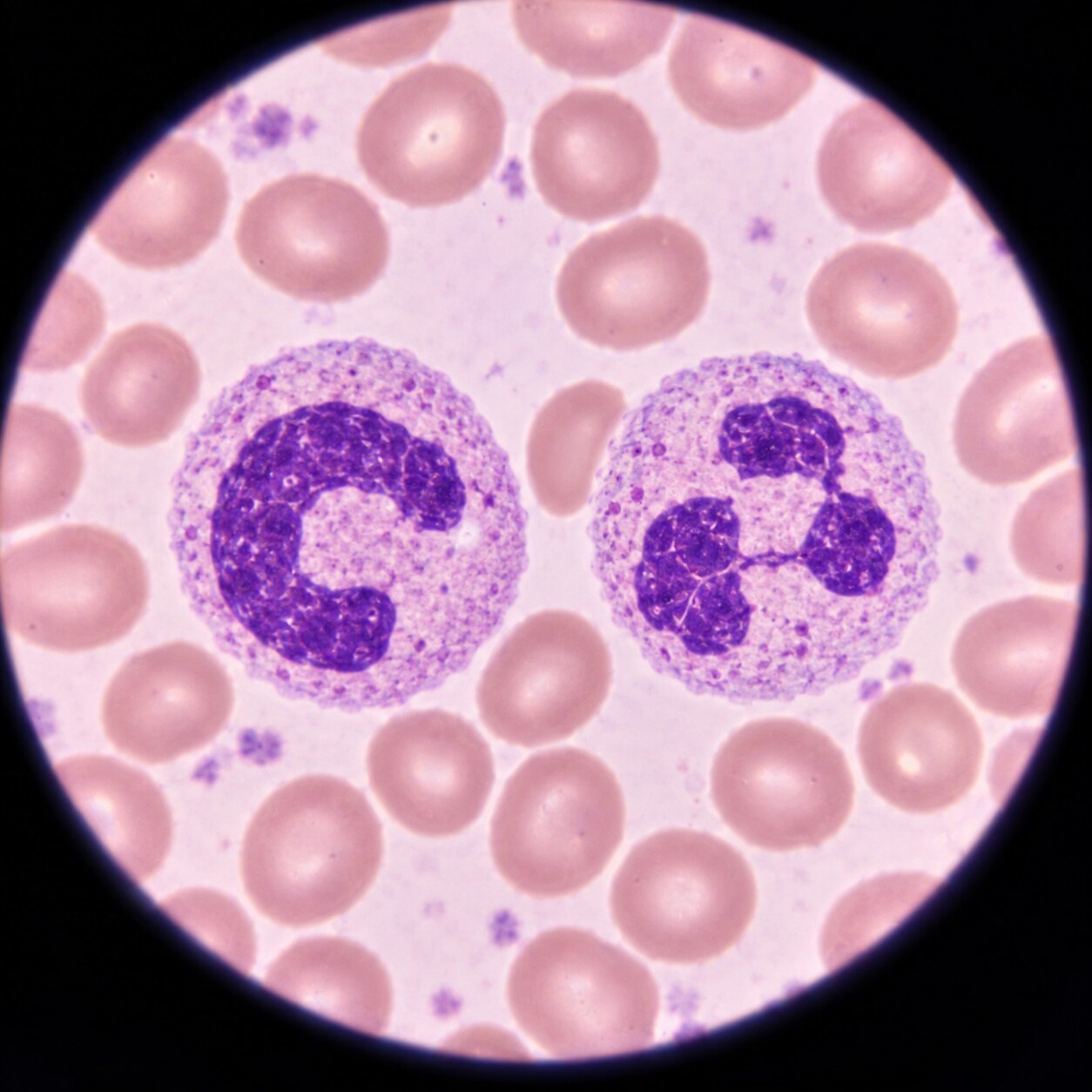
Figure 2. A band neutrophil, with its unsegmented horseshoe-shaped nucleus, beside a fully mature segmented neutrophil, whose nucleus is pinched into separate lobes.
This nucleus shape is exactly what a lab technician, or an automated analyzer's imaging software, is actually looking at when it sorts a cell into one bucket or another on the differential count. It sounds like a small, technical detail, but it's the entire basis for the whole system: no blood test, staining chemical, or measurement is needed beyond a careful look at that one shape, because the shape itself is a reliable, visible fingerprint of exactly how many stations down the assembly line that particular cell had traveled before it got released. A band cell is not sick or damaged — it is simply a completely normal cell caught one stop earlier than usual on its journey.
Most of the time when a report mentions immature cells, it specifically means bands — the least immature, most common, and least concerning of all the stages listed above. Seeing myelocytes, metamyelocytes, or especially myeloblasts on a routine smear is far less common and, as covered further down, carries a different level of significance depending on how many are present and in what setting.
How Many Is Too Many? Why the Percentage Matters
A lab report doesn't just say "bands present" or "bands absent" — it gives an actual percentage, showing what share of all the white blood cells counted on that slide were bands rather than fully mature segmented neutrophils. In a healthy person with no infection or stress happening, bands normally make up a very small slice of the total count, typically under 5 to 6 percent of all white blood cells seen. Once that percentage climbs meaningfully higher — commonly cited thresholds are above 10 percent — the finding is officially called a "significant left shift," and it becomes a more active part of the clinical conversation rather than a passing footnote on the report.
This percentage-based thinking matters because it turns a vague word like "some" or "a few" into something concrete and trackable over time. A person whose band percentage was 8 percent last week and is 4 percent today is clearly improving, most likely because whatever triggered the left shift (commonly an infection responding to antibiotics) is resolving. A person whose band percentage keeps climbing test after test, especially alongside a falling total white count rather than a rising one, is telling a very different story — one where the marrow may be struggling to keep up rather than successfully ramping up production, which is a distinction doctors watch closely in anyone being treated for a serious infection in a hospital setting.
Toxic Changes: Another Clue That Often Travels Alongside a Left Shift
When a lab report mentions immature cells caused by a real infection, it frequently mentions another related finding in the same breath: toxic changes. This is a slightly misleading name, since nothing "poisonous" is actually involved — it simply refers to specific visible changes inside white blood cells that appear when they're being produced and pushed out under urgent, high-demand conditions. Toxic granulation looks like extra-dark, coarse granules scattered inside the cell's body, and Döhle bodies are small, pale-blue patches that appear near the cell's edge, both reflecting the same rushed production process that also produces bands and other immature forms in the first place.
Seeing toxic changes alongside a left shift actually strengthens the "this is a real, active infection" interpretation, since both findings point back to the same underlying cause: a bone marrow working in emergency mode. This site covers toxic granulation on its own, in more depth, in a separate article — the short version relevant here is that finding it next to bands is one more consistent piece of the same picture, not a separate, unrelated worry layered on top.
The Most Common Reason: An Infection Your Body Is Actively Fighting
By far the most frequent reason a doctor sees immature white blood cells, especially bands, on a smear is a bacterial infection that is currently active and serious enough to make the body call in reinforcements faster than the normal, orderly assembly line can produce them. When your immune system detects a big bacterial threat, it sends out chemical distress signals that reach all the way back to the bone marrow, essentially shouting "we need more neutrophils right now, don't wait for them to fully finish." The marrow responds by speeding up production and releasing cells a little earlier than it normally would, including bands and occasionally a few even-younger metamyelocytes.

Figure 3. An active bacterial infection with fever is the single most common reason immature white blood cells, especially bands, appear on a routine smear.
This pattern has an old, still-widely-used nickname among doctors and lab professionals: a "left shift." The name comes from how differential counts used to be written out on paper, decades ago, with the youngest cell stages listed on the left side of the page and the most mature stages on the right. When more immature cells than usual show up, the overall balance of the count visually "shifts" toward that left side of the sheet — and the phrase stuck around long after the paper forms themselves disappeared, so you may still hear a doctor say a patient "has a left shift" as shorthand for exactly this finding.
A left shift caused by infection almost always shows up together with other clues that make the picture make sense as a whole: a fever, an elevated total white blood cell count on the same test, and symptoms that point to where the infection actually is — a cough and chest pain for pneumonia, painful urination for a urinary tract infection, or a red, swollen area of skin for a soft-tissue infection. Doctors don't look at the immature cell finding in isolation; they read it as one piece of a larger, coherent story, the same way a detective treats one clue as meaningful only in the context of everything else at the scene.
Other Everyday, Non-Alarming Reasons This Can Happen
Infection is the most common trigger, but it's far from the only ordinary, non-threatening reason a marrow might release a few cells early. Physical stress on the body in general — recovering from major surgery, a severe burn, a bad car accident, or even an unusually intense physical trauma — can push the marrow into the same kind of urgent, faster-than-normal production mode, since the body interprets serious physical injury as a signal that it may need extra infection-fighting reserves on standby. Certain medications, most notably corticosteroids like prednisone, are well known to cause a mild, temporary left shift on their own, simply by changing how white blood cells are released from and move through the bloodstream.
Pregnancy is another surprisingly common and completely normal cause. As the body ramps up overall blood cell production to support a growing pregnancy, it is not unusual for a small number of bands to appear on a routine prenatal blood smear, with no infection or illness involved at all. Newborn babies, too, often show a mild left shift on their very first blood tests in the hours after birth, reflecting the enormous physiological transition of being born rather than any problem with the baby.
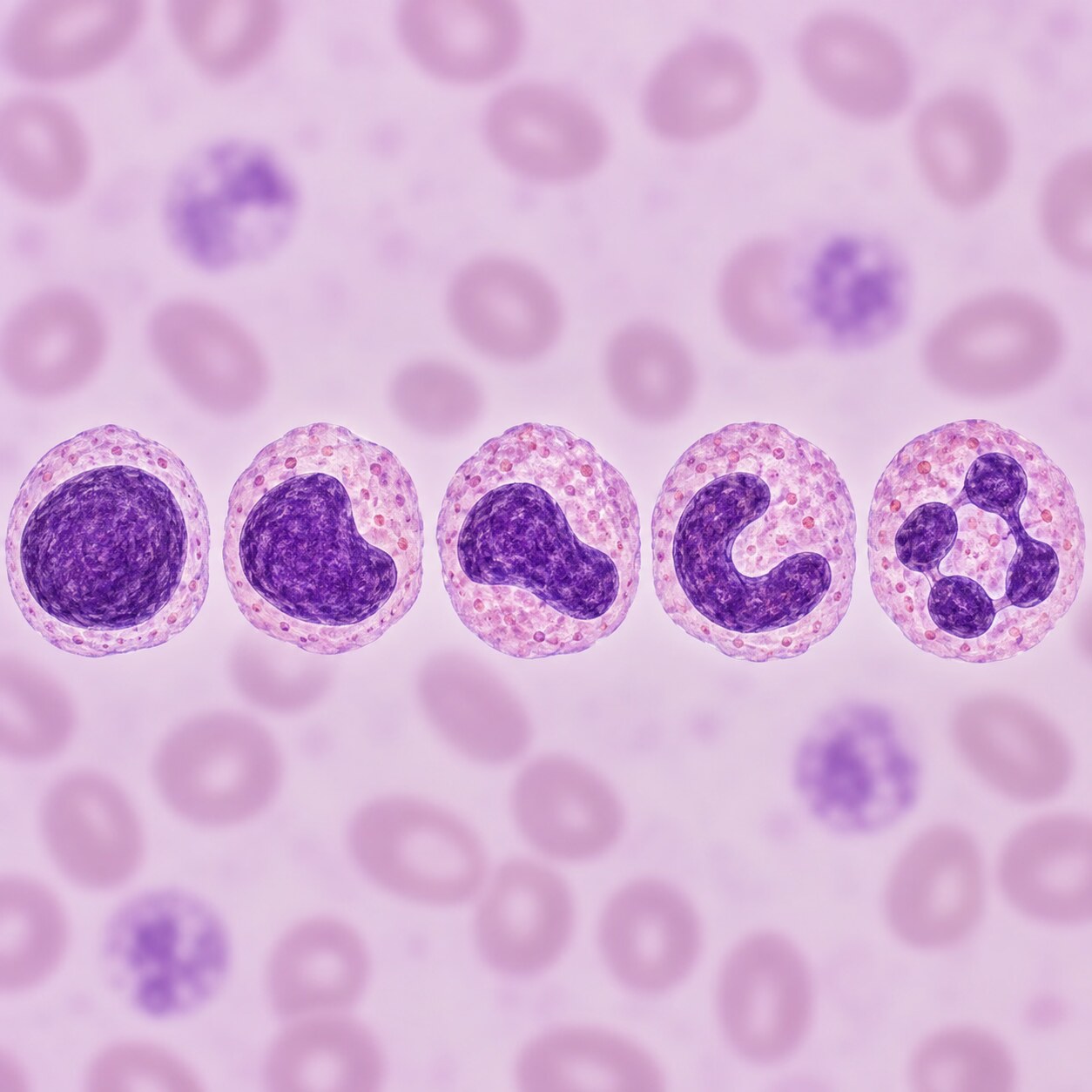
Figure 4. Each stage of white blood cell maturity shows a nucleus that is progressively more segmented, from a young, rounder shape to the fully lobed shape of a finished cell.
A pregnant woman's own blood smear can look, at first glance, mildly abnormal to someone unfamiliar with this pattern, and that alone is a good example of why context always has to be layered onto a raw lab finding rather than reading it in isolation. A hematologist reviewing a prenatal smear already expects to see a small number of bands as a routine, low-stakes part of pregnancy's normal blood changes, in the same way an experienced mechanic isn't alarmed by a completely normal reading on a gauge that behaves differently under a specific, well-understood condition. None of these everyday causes require treatment aimed at the blood itself — the underlying stress, infection, medication, or physiological state is what gets addressed, and the smear returns to its usual mature-cell pattern once that resolves.
When It's More Than Just Bands: Why the Specific Stage Matters
Everything changes in tone once the immature cells found are not simple bands but earlier, less mature stages — myelocytes, metamyelocytes, or especially myeloblasts. Finding a small number of bands during an active infection is expected and unremarkable. Finding myeloblasts circulating in the bloodstream at all, outside of a newborn's first day or two of life, is not part of any normal, everyday response and is taken far more seriously, because myeloblasts are supposed to stay contained inside the marrow at all times under healthy conditions — their presence in circulating blood suggests the marrow's usual gatekeeping process has broken down rather than simply sped up.
The reason this distinction matters so much is that it separates a marrow that is working overtime in a controlled, orderly way from a marrow where the assembly line itself may be malfunctioning. Certain blood cancers, particularly the leukemias, involve abnormal, poorly regulated cells that get stuck at an early stage of development and then multiply out of control, flooding both the marrow and the bloodstream with cells that never should have left in that condition. This is precisely why a doctor's reaction to "a few bands" during a documented infection is calm and expected, while "myeloblasts present" on an otherwise unexplained smear prompts an urgent, same-day conversation and further testing.

Figure 5. A manual differential count, performed by a trained technician under the microscope, identifies exactly which maturity stages are present rather than relying on an automated flag alone.
Why an Automated Machine Alone Isn't the Final Word
Most blood samples today are first processed by an automated analyzer, a machine that can count and roughly sort thousands of cells in seconds using laser light and electrical signals rather than a human eye. These machines are remarkably good at routine counting, but they are far less reliable at correctly identifying the exact maturity stage of an unusual or borderline cell, since that kind of subtle shape recognition is something a trained human eye, looking through an actual microscope, still does better than most automated systems. When an analyzer detects anything unusual — an unexpected cell shape, an odd size, or a pattern it isn't confident classifying — it raises what's called a flag, prompting a human technician to pull that same sample and personally review it under the microscope with their own eyes.
This manual review is exactly where a trained eye distinguishes a benign band from something that needs urgent attention, and it's also why two people can have an identical "immature cells present" flag from the machine but receive very different next steps once a real person actually looks at the slide. The automated flag is a starting alarm bell, not a diagnosis — it exists specifically to make sure nothing unusual slips through without a qualified person taking a direct look, and the manual differential that follows is what actually determines whether the finding is routine or worth investigating further.
Benign Physiological Causes Beyond Infection and Stress
Pregnancy was mentioned earlier as one everyday cause, and it's worth returning to with a bit more detail because it illustrates a broader principle: the body's baseline blood cell behavior genuinely shifts during certain normal life stages, and what counts as "abnormal" has to be judged against the right baseline for that specific situation. Strenuous, prolonged physical exertion — the kind seen in marathon runners or people doing extremely demanding physical labor — can also trigger a mild, temporary left shift through the same general stress-response pathway as illness or injury, even though nothing is medically wrong. Smoking has likewise been associated with a mildly elevated white blood cell count that can include a small proportion of immature forms, reflecting chronic, low-grade irritation and inflammation in the body rather than an infection or blood disorder.

Figure 6. Pregnancy naturally shifts the body's baseline blood cell production, and a small number of immature white cells on a routine prenatal smear is a well-recognized, harmless part of that change.
This is also why the same finding is interpreted so differently depending entirely on who the patient is and what else is going on with them. A pregnant woman with a couple of bands and no symptoms at her routine prenatal visit needs nothing further at all. A marathon runner who just finished a race and had blood drawn as part of an unrelated checkup can be reassured the same way once the timing is understood. But an older adult with no infection, no recent surgery, no pregnancy, and no obvious explanation who shows the same finding deserves a more careful look, precisely because none of the usual, well-understood explanations apply to their situation.
This is the central skill a hematologist brings to reading any smear: matching the finding to a plausible cause rather than treating every immature cell as equally worrying by default. A number that looks identical on paper can mean nothing at all in one context and something significant in another, and the surrounding clinical picture — age, symptoms, medication list, recent events, and the specific cell stages involved — is what turns a raw observation into an actual answer.
Medications That Deliberately Push the Marrow to Release Cells Early
Corticosteroids were already mentioned as one everyday medication cause, but there's a second, very different category worth understanding on its own: medications given specifically to boost white blood cell production, most commonly a class of drugs called growth factors (filgrastim is one well-known example). These are typically given to people whose bone marrow has been temporarily suppressed by chemotherapy, to help their white blood cell counts recover faster and lower their risk of a dangerous infection during that vulnerable window.
Because these medications work by directly signaling the marrow to speed up production, a person taking one will often show a very pronounced left shift on their blood smear — sometimes including myelocytes and metamyelocytes, not just bands — as a completely expected, intended effect of the treatment rather than an accidental side effect or a warning sign. Anyone reading their own results in this situation, or reviewing a family member's results, should know that this specific pattern, in someone actively receiving these medications, is being watched and interpreted by their oncology team with that treatment fully factored in — it's a deliberately engineered version of the same "marrow speeds up" response the rest of this article describes, just switched on by a medication rather than an infection.
Why Children's Blood Counts Get Read a Little Differently
Age is one more piece of context that changes how a lab team interprets an immature cell finding, and children are the clearest example of why. A newborn baby's white blood cell count, including the proportion of bands and even some slightly earlier forms, looks meaningfully different from a healthy adult's in the first hours and days of life, simply because being born and adjusting to breathing air, regulating temperature, and functioning outside the womb is itself a major physiological event that naturally triggers a temporary left shift. A pediatric hematologist reading a two-day-old newborn's blood smear is comparing it against a newborn-specific reference range, not an adult one, for exactly this reason.
Young children also mount a more vigorous, faster bone marrow response to ordinary childhood infections than adults typically do, so a toddler with a bad ear infection or a case of strep throat may show a more noticeable left shift than an adult would with a similar infection, without that difference meaning anything more serious is going on. This is simply how a younger immune system and a more responsive marrow behave, and pediatric lab reference ranges are built specifically around this reality rather than treating children as small adults.
What Your Doctor Actually Does Next
If bands show up alongside a clear, already-known infection and the rest of the picture fits, the most common next step is simply treating that infection and, if needed, repeating the complete blood count a little later to confirm the numbers return to normal once the infection clears — no additional blood cell testing is typically required. If the finding is unexpected, involves earlier stages like myelocytes or myeloblasts, or doesn't have an obvious explanation, the usual next step is a repeat blood count paired with a manual review by a hematology specialist, sometimes alongside additional blood tests that look at other clues, such as overall cell counts across all three blood cell lines rather than white cells alone.
In situations where the pattern is persistent, unexplained, or accompanied by other concerning findings — very high or very low counts in other cell lines, unexplained bruising, unusual fatigue, or weight loss — a bone marrow biopsy may eventually be recommended. This is a more involved procedure that samples the marrow directly rather than just examining what has already spilled into the bloodstream, giving a much more complete picture of exactly what's happening at the source. It's important to understand that recommending this step is about being thorough when the puzzle pieces don't fit together cleanly — it is not, on its own, a signal that something serious has already been confirmed.
Timing matters too. A single blood count showing a mild left shift, on its own, almost never triggers an urgent same-day workup — the standard approach is to repeat the count anywhere from a few days to a couple of weeks later, depending on the clinical situation, and watch the trend rather than reacting to one number in isolation. The exception is when myeloblasts or other very early forms are seen, or when the person is also visibly unwell, since those situations move the timeline from "routine follow-up" to "same-day specialist call" specifically because the range of possible explanations narrows sharply once those particular cells appear.

Figure 7. A doctor weighs an immature cell finding against the full clinical picture and any prior results before deciding whether a repeat test or specialist referral is warranted.
What This Looks Like Written Out on a Real Report
Seeing this finding in the actual language of a lab report can feel more intimidating than the underlying idea deserves. A typical differential count section might list something like "Segs 68%, Bands 9%, Lymphs 18%, Monos 4%, Eos 1%," with everything expressed as a percentage of the total white blood cells counted, followed by the total white blood cell count itself as a separate number. Some reports spell it out even more plainly with a line reading "left shift noted" or "increased band forms," essentially doing the interpretation work for you in a single short phrase.
If a report also includes earlier stages, they'll usually be listed by name rather than lumped in with bands — "myelocytes 2%" or "metamyelocytes 1%," for example — precisely because, as covered above, the exact stage carries real clinical weight and a good report never blurs that distinction. Learning to spot these specific words — bands, myelocytes, metamyelocytes, myeloblasts — and roughly where each one sits on the maturity spectrum described earlier in this article is enough to read the shape of almost any real-world differential count without needing a medical degree to make sense of it.
Frequently Asked Questions
Does finding immature blood cells always mean leukemia?
No. The overwhelming majority of the time, immature cells (especially bands) reflect the bone marrow responding to an infection, physical stress, certain medications, or pregnancy. Leukemia is a much less common explanation and is usually suspected only when earlier-stage cells like myeloblasts appear, or when the pattern doesn't fit any ordinary explanation.
What is a "left shift" and why is it called that?
A left shift means more immature white blood cells than usual are present. The name comes from older paper lab forms that listed the youngest cell stages on the left side of the page — when immature cells increase, the overall count visually shifts toward that side of the sheet, and the phrase has stuck around as medical shorthand.
Can immature blood cells appear even without any infection?
Yes. Physical stress from surgery, injury, or intense exercise, certain medications like corticosteroids, pregnancy, and the first day or two of a newborn's life can all cause a mild, temporary left shift with no infection or illness involved at all.
Why did the lab need to do a manual review instead of just using the machine's result?
Automated analyzers are excellent at routine counting but less reliable at precisely identifying an unusual or borderline cell's exact maturity stage. When a machine flags something unusual, a trained technician reviews the same sample by eye under a microscope to confirm exactly what's present before anything is reported as final.
What percentage of bands is considered a "significant" left shift?
Reference ranges vary slightly between labs, but a commonly used threshold is above roughly 10 percent bands as a share of the total white blood cell count. Below that, a small number of bands is usually considered a normal variation, especially with an identifiable cause like recent exercise, infection, or pregnancy.
Is a left shift the same thing as a high white blood cell count?
No, though the two often occur together. A high white blood cell count means there are more white cells overall, while a left shift specifically describes a higher-than-usual proportion of those cells being immature. It's possible to have one without the other, though an infection commonly causes both at the same time.
How quickly does a left shift usually go away once the cause resolves?
For a straightforward bacterial infection responding well to treatment, the band percentage typically starts dropping within a few days and returns to baseline within one to two weeks, tracking closely with how quickly the underlying infection itself improves. Left shifts caused by pregnancy or ongoing medication use persist for as long as that underlying condition or treatment continues, which is expected and not a sign of a problem.
Putting the Whole Picture Together, One More Time
It's worth stepping back and connecting every piece covered so far, because each one only really makes sense next to the others. The bone marrow behaves like a staffed assembly line that can run at a normal, unhurried pace or shift into a faster, urgent mode when the body needs more finished white blood cells quickly. The specific cell stage found — band, metamyelocyte, myelocyte, or myeloblast — tells you roughly how far back on that line the marrow reached to pull cells out early, with bands representing a small, routine adjustment and myeloblasts representing something the marrow should never normally hand over at all. The percentage of immature cells present adds a sense of scale, turning a vague "some" into a trackable number that can be followed test to test. And the surrounding context — an infection, a recent surgery, a pregnancy, a medication, or none of the above — is what ultimately tells a doctor whether the finding fits a known, sensible explanation or needs to be chased down further.
None of these pieces mean much in isolation, which is exactly why a single word like "immature" on a lab report can sound alarming out of context while meaning almost nothing once every surrounding detail is accounted for. Reading a result this way — mechanism, stage, quantity, and context, all considered together — is the same approach a hematologist actually uses at the microscope, and it's available to anyone willing to ask those same four questions about their own report, long before any specialist ever needs to get involved.
It also helps to remember that a lab report is a snapshot, not a verdict handed down in isolation — it was drawn from one moment in time, from one sample, and it's meant to be read by a person who also knows your history, your symptoms, and what's been happening in your life lately. Approaching your own results with that same combination of curiosity and context, rather than fear at a single unfamiliar word, is exactly the mindset this whole article has been building toward — and it's a mindset worth carrying into every future lab report you or a family member ever receives, not just this one.
Conclusion
Immature blood cells on a smear are, in the vast majority of cases, nothing more dramatic than a sign that your bone marrow's assembly line sped up to meet a real but ordinary demand — fighting an infection, recovering from physical stress, adjusting to pregnancy, or responding to a medication — not a sign that something is fundamentally broken. The specific stage matters enormously: a band cell caught one step early is a routine, expected finding during an active infection, while an earlier cell like a myeloblast circulating outside of a newborn's first days is unusual enough to warrant a closer, more careful look. Context is what turns this finding from a source of worry into a piece of a larger, sensible story — your age, your symptoms, your recent history, and exactly which cells were found are what your doctor weighs together before deciding whether nothing more needs to happen or whether a repeat test and specialist review are the right next step for your particular situation.
Still Not Sure What Your Results Mean?
Upload your labs and get a complete, visual, plain-language interpretation of every biomarker — delivered to your inbox in under 15 minutes.
Get My ReportThis article is for educational purposes only and does not constitute medical advice. Always consult your healthcare provider regarding your specific lab results.