
What Is Factor V Leiden, and Why Does It Matter?
Factor V Leiden isn't a disease you catch, a number that rises and falls, or something that shows up on a routine blood panel by accident — it's a single, specific spelling change in one gene, present from birth, that changes how one clotting protein behaves for the rest of your life. Roughly 5% of people of European descent carry it, which makes it the most common inherited clotting risk factor in that population, and most of those people will never have a blood clot because of it. What it actually does is disable one of the body's natural "off switches" for clotting, so blood clots that should shut down on their own sometimes linger and grow instead. This article explains exactly what that off switch is, why this particular mutation disables it, and what carrying Factor V Leiden really means for your everyday risk — because the honest answer is a lot more nuanced than "you're going to get a blood clot."

How Your Body Normally Turns Clotting Off
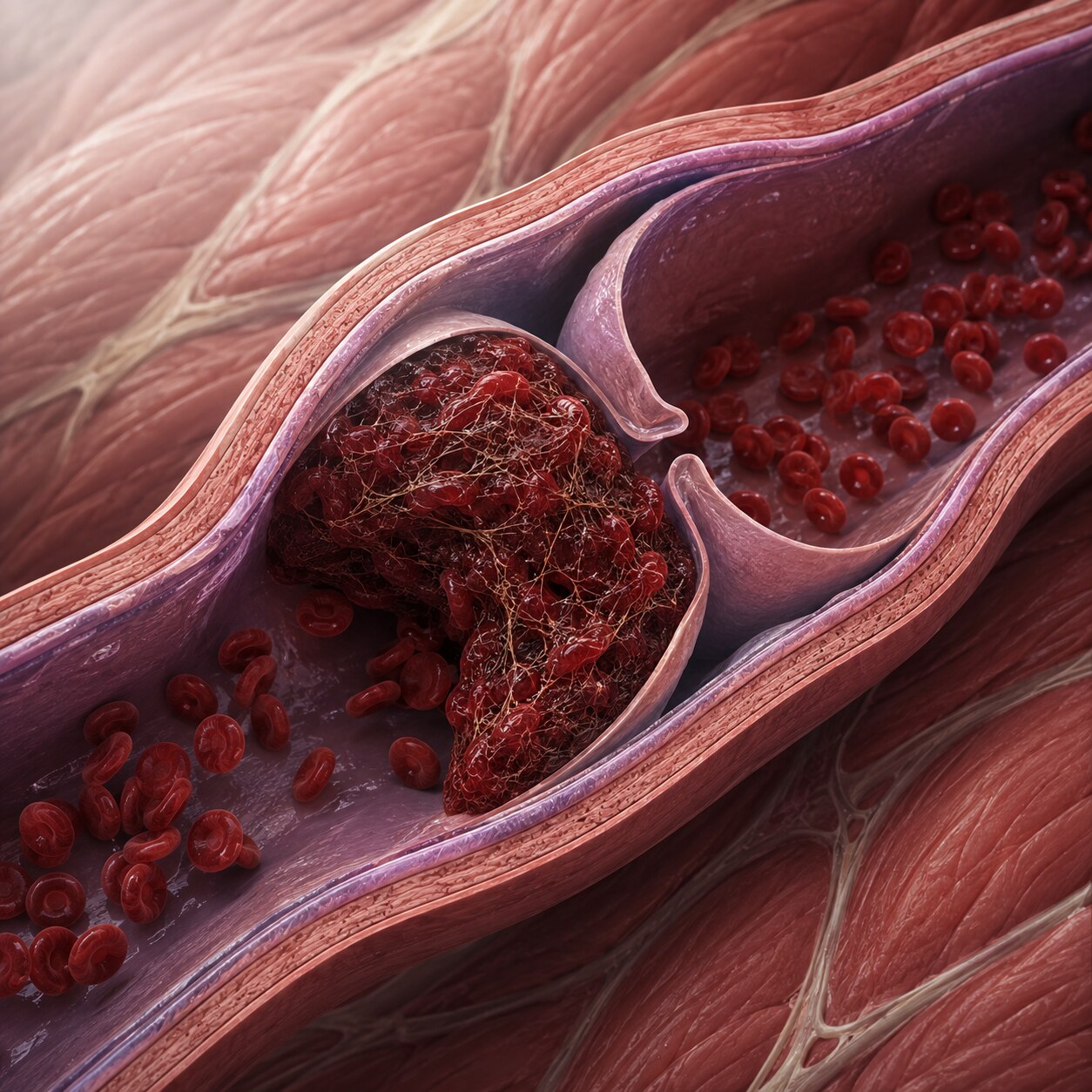
To understand a broken brake, it helps to understand the brake itself. When you cut yourself, your body sets off a rapid chain reaction called the coagulation cascade — a sequence of clotting proteins, numbered with Roman numerals (Factor I, Factor II, and so on through Factor XIII), each one activating the next like a row of dominoes, ending in a mesh of a protein called fibrin that plugs the injury. Factor V is one link in that chain: once activated, it becomes Factor Va, and it acts as an accelerant, dramatically speeding up how fast the final steps of clotting happen at the site of an injury. But a clot that never stops growing is just as dangerous as one that never forms, so your body also runs a built-in braking system alongside the accelerator. The main brake is a protein called activated Protein C, often abbreviated APC, which travels through the bloodstream and physically cuts, or cleaves, Factor Va at a specific point along its structure once a clot has done its job — breaking the accelerant apart and switching clotting back off. This balance between accelerator and brake is what normally keeps clotting precisely contained to the site of an actual injury, rather than spreading uncontrolled through the rest of the bloodstream.
The One-Letter Typo That Breaks the Brake
Factor V Leiden is named after the city in the Netherlands where researchers first identified it in 1994, not after any structure in the body. Genetically, it's remarkably small in scope: a single change in the gene that codes for Factor V, swapping one DNA building block for another at one specific position, which results in one amino acid substitution in the finished protein — arginine is replaced with glutamine at position 506. That position happens to be exactly where activated Protein C is supposed to grab onto Factor Va and cut it. With the wrong amino acid sitting at that exact spot, APC can still recognize Factor Va and attempt to bind it, but it cleaves it roughly ten times more slowly than it would normal Factor Va — a phenomenon with its own name, activated protein C resistance. The brake pedal still exists and still gets pressed; it just barely works. Factor Va sticks around far longer than it should, continuing to accelerate clot formation well past the point where a normal clot would have been reined in, which is the entire mechanical basis for the increased clotting risk associated with this mutation.
It's worth pausing on just how small this change is at the molecular level, because it's genuinely one of the clearer examples in medicine of a single altered building block having an outsized effect on an entire physiological system. Proteins are built from chains of amino acids that fold into precise three-dimensional shapes, and those shapes are what let other molecules recognize and interact with them correctly — arginine, the amino acid that's supposed to sit at position 506, has a particular chemical structure that activated Protein C's cutting mechanism is built to grab onto and slice through. Glutamine, the amino acid that replaces it in Factor V Leiden, is close enough in overall size that Factor Va still folds into a nearly normal shape and still works as an effective clotting accelerant, but different enough at that one specific point that APC's cutting mechanism can't get a clean grip on it. This is why the mutation doesn't cause any bleeding problems or other clotting-cascade dysfunction elsewhere — Factor Va performs its normal accelerant job perfectly well right up until the moment it's supposed to be shut off, at which point it simply doesn't respond to the shutoff signal as efficiently as it should.
Curious what the rest of your coagulation panel is telling you? Upload your results and get a complete, plain-language breakdown in under 15 minutes.
Analyze My ResultsOne Copy vs. Two: Why Zygosity Changes Everything
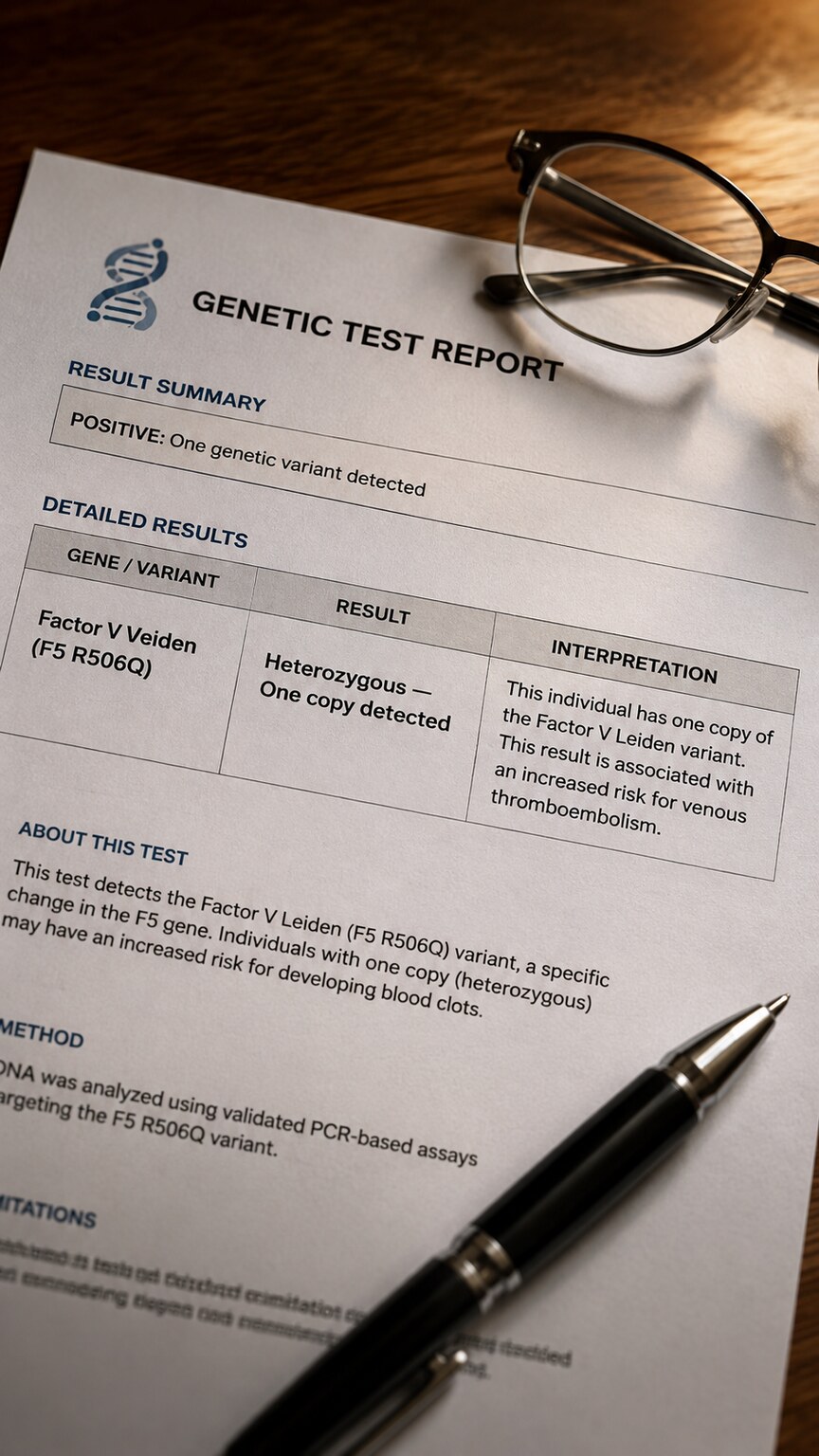
Like most inherited traits, Factor V Leiden comes from a gene you receive one copy of from each parent, and how many of your two copies carry the mutation makes a substantial difference in risk. Someone who is heterozygous has inherited one normal copy and one Factor V Leiden copy — this is by far the more common pattern, and it raises the lifetime risk of a blood clot to somewhere around three to eight times that of someone with no copies at all, which sounds dramatic as a multiplier but still leaves the absolute yearly risk fairly low for most otherwise healthy people. Someone who is homozygous has inherited the mutation from both parents, meaning every molecule of Factor V they produce is the resistant version rather than a mix — this is much rarer, and it raises clotting risk far more steeply, commonly cited at 10 to 80 times that of the general population, with the wide range reflecting how much other individual risk factors matter even within this group. This distinction is exactly why a lab report noting "heterozygous" versus "homozygous" isn't a technicality — it meaningfully changes the conversation a doctor will have about monitoring, prevention, and how cautious to be around other risk factors layered on top.
How the Mutation Is Actually Detected
There are two distinct ways labs approach this, and they answer slightly different questions. The first is a functional screening test, the activated protein C resistance assay, which doesn't look at DNA at all — instead, it adds activated Protein C to a blood sample and measures how much it slows down clotting time compared to a normal sample. If clotting time barely changes, that's a strong functional signal that Factor Va isn't responding to APC the way it should, whatever the underlying cause. The second, more specific approach is direct genetic testing, which reads the actual DNA sequence of the Factor V gene at position 506 and reports back exactly whether zero, one, or two copies of the Leiden variant are present. Genetic testing is considered the definitive, gold-standard confirmation, since it directly identifies the mutation itself rather than inferring it from downstream clotting behavior, and it's typically what's ordered after an abnormal APC resistance screen, or directly when there's a known family history of the mutation. Because this is a fixed genetic trait, not a value that fluctuates, someone generally only needs to be tested for it once in their lifetime — unlike PT, aPTT, or D-dimer, which reflect what's happening in the blood at the moment the sample was drawn.
Where the Mutation Comes From, and Who Carries It
Factor V Leiden isn't evenly distributed across humanity — it's found almost exclusively in people of European descent, with carrier rates around 3% to 8% depending on the specific population studied, and it's markedly rarer in people of African, Asian, or Indigenous American ancestry. Genetic studies suggest the mutation arose from a single ancestral event roughly 20,000 to 30,000 years ago, after which it spread through European populations at a rate that's higher than you'd expect from random chance alone for a mutation that raises health risk — which has led researchers to a theory similar to the one explaining why sickle cell trait persisted in malaria-prone regions: a mutation that raises clotting risk might have offered some survival advantage in the past, most plausibly by modestly reducing blood loss during childbirth or from wounds and infections, at a point in history when bleeding to death was a far more immediate threat than a deep vein clot decades later. This kind of trade-off, a genetic change that's a liability in modern life but may have quietly helped earlier generations survive childbirth or injury, shows up in other inherited conditions too, and it's a reasonable partial explanation for why a mutation with real downsides never disappeared from the gene pool.
How Factor V Leiden Compares to Other Inherited Clotting Risk Factors
Factor V Leiden is the most common inherited thrombophilia, but it's not the only one, and understanding where it sits among the others helps explain why doctors sometimes test for more than one at a time. Prothrombin G20210A, the second most common inherited clotting risk factor, works through a completely different mechanism — instead of disabling a brake, it's a mutation in the "on switch" gene itself that causes the body to produce somewhat more prothrombin, the direct precursor to the final clot-forming protein thrombin, than it normally would. Rarer but individually more potent are true deficiencies of the natural anticoagulant proteins themselves — Protein C deficiency, Protein S deficiency, and antithrombin deficiency — where the body simply doesn't make enough of one of its own braking proteins in the first place, rather than making a brake that a mutated Factor V happens to resist. Someone can carry more than one of these at once, and combined thrombophilias raise clotting risk well beyond what either one would cause alone, which is part of why a doctor investigating an unprovoked blood clot in a younger person, or a strong family history of clotting, often orders a fuller thrombophilia panel rather than testing for Factor V Leiden in isolation.
What This Actually Means for Real-World Clotting Risk
It's worth being direct about something many people misunderstand after receiving this result: having Factor V Leiden is a risk factor, not a diagnosis of a blood clot, and the large majority of people who carry it — even the more common heterozygous form — will go their entire lives without ever developing one. Blood clots almost always result from a combination of factors stacking on top of each other rather than a single cause acting alone, a concept sometimes called Virchow's triad: sluggish blood flow, changes to the blood vessel wall, and a blood composition that clots too easily. Factor V Leiden supplies that third piece, but it usually takes another contributing factor — prolonged immobility, surgery, an injury, or a hormonal shift — actually pushing that risk from theoretical into a real, physical clot. This is precisely why so many people carry the mutation for decades without incident, only for it to become clinically relevant during a specific high-risk window, like a long-haul flight, a hospital stay, or a pregnancy, rather than showing up unpredictably on an ordinary day.
The Situations That Turn a Genetic Risk Into an Actual Clot

Pregnancy is one of the most significant of these windows, since the body naturally increases several clotting factors and reduces blood flow efficiency in the legs as the pregnancy progresses — a normal, protective adaptation meant to limit blood loss at delivery, but one that layers directly on top of whatever baseline risk Factor V Leiden already creates. Estrogen-containing birth control pills, patches, and rings, along with estrogen-based hormone replacement therapy, work through a related pathway: estrogen itself modestly increases several pro-clotting proteins in the blood, and in someone whose braking system is already impaired, that additional push can be enough to tip the balance. Surgery, particularly orthopedic procedures involving the hips or knees, and any situation involving prolonged immobility — a long flight, bed rest after an injury, a long car ride — reduce blood flow through the deep veins of the legs, letting blood pool and giving a clot more opportunity to form and grow before it gets swept back into faster-moving circulation. None of these situations are dangerous in isolation for most people; the concern specifically arises when one of them is combined with an already-impaired clotting brake.
Age and body weight compound these situational risks in ways that are easy to overlook. Clotting risk climbs steadily with age in the general population regardless of Factor V Leiden status, since veins lose some of their elasticity and people tend to become less physically active over time — layering that natural age-related increase on top of an already-impaired clotting brake means the same mutation can feel functionally irrelevant at 25 and considerably more worth monitoring at 55. Obesity works similarly, both by making veins in the legs more prone to sluggish flow and by independently nudging several clotting factors upward, so a heterozygous carrier who is also significantly overweight and sedentary is looking at a meaningfully different real-world risk than a heterozygous carrier who is young, lean, and active, even though their genetic test results would read identically. Smoking adds yet another layer, since it damages the inner lining of blood vessels in a way that makes clot formation easier throughout the entire vascular system, not just the legs. None of this changes the genetic result itself, but it's exactly why a knowledgeable clinician treats a Factor V Leiden diagnosis as one input into a broader personal risk profile rather than a single number that determines the outcome on its own.
What a Real Blood Clot Actually Feels Like
The clinical concern with Factor V Leiden centers mainly on two related events: deep vein thrombosis (DVT), a clot forming in one of the large veins deep inside a leg, and pulmonary embolism (PE), which happens when part of that clot breaks free and travels to the lungs. A DVT typically causes swelling, warmth, redness, and a persistent aching or cramping pain in one leg — usually just one side, which is an important distinguishing detail, since symmetric swelling in both legs is far more often related to something else entirely, like prolonged standing or a heart or kidney issue. A pulmonary embolism is more urgent and can cause sudden shortness of breath, sharp chest pain that worsens with a deep breath, a rapid heart rate, or coughing up blood — any of these symptoms, especially appearing suddenly, warrants emergency medical attention rather than a wait-and-see approach, particularly in someone who already knows they carry a clotting risk factor like this one.
It helps to know what a DVT is not, too, since so much everyday leg discomfort gets nervously compared against it. Muscle soreness from exercise, a mild ankle sprain, or ordinary end-of-day swelling from standing tends to affect both legs evenly, improves with rest and elevation, and doesn't come with noticeable warmth or a specific tender cord-like area along the inside of the calf or thigh. A DVT, by contrast, tends to stay one-sided, doesn't meaningfully improve with a few hours of rest, and often has a distinct area that feels warmer and more tender to the touch than the surrounding skin. None of this is meant to replace a medical evaluation — the two can genuinely be hard to tell apart without imaging, which is exactly why any new, one-sided leg swelling in someone who carries Factor V Leiden is worth a same-day call to a healthcare provider rather than a wait-and-see approach at home.

How Doctors Actually Manage a Factor V Leiden Diagnosis
One detail that surprises many people is that lifelong blood thinners are not automatically prescribed just for carrying Factor V Leiden without ever having had a clot. Whether ongoing anticoagulation makes sense for a given person weighs their individual bleeding risk against their clotting risk, and that balance depends on factors like whether they're heterozygous or homozygous, whether they carry other risk factors, and their personal and family history — which is exactly why this is a decision a hematologist makes case by case, not something that follows automatically from the test result alone. For many carriers without a prior clot, management instead centers on awareness and situational prevention: telling every doctor involved in your care about the diagnosis before any surgery, so preventive measures like compression devices or short-term blood thinners can be used during and after the procedure; discussing alternative, non-estrogen forms of contraception with a gynecologist; staying mobile and hydrated during long flights or car rides; and knowing the warning signs of DVT and PE well enough to seek care quickly rather than waiting them out. If someone has already had a blood clot, the calculus shifts substantially — treatment typically involves a defined course of anticoagulation, and the decision about how long to continue it, sometimes indefinitely, depends on whether the clot was triggered by an identifiable temporary situation or happened without any clear provoking cause, alongside whether the person is heterozygous or homozygous and whether they carry any additional inherited clotting risk factors at the same time.
What a Diagnosis Means for the Rest of the Family
Because Factor V Leiden is inherited, a diagnosis in one person is naturally relevant information for their close biological relatives, particularly parents, siblings, and children. A heterozygous carrier has a 50% chance of passing that single copy to each child, and if a person's partner also happens to carry a copy, there's a smaller but real chance of a child inheriting the homozygous, higher-risk form. Testing family members isn't automatically recommended for everyone, though — most guidelines suggest it's most useful for relatives who are also planning a pregnancy, considering estrogen-based contraception, facing upcoming surgery, or who have themselves had an unexplained blood clot, since in those specific circumstances, knowing the result in advance can genuinely change how a doctor manages the situation. For a relative with no plans involving any of those specific circumstances, testing purely out of curiosity is a more personal decision, since the result, either way, doesn't call for any different day-to-day behavior in the absence of one of those higher-risk situations.
It's also worth noting what a negative family test doesn't tell you. If a parent is heterozygous and a child tests negative, that child didn't inherit the specific copy of the gene carrying the mutation — genuinely reassuring news for that individual — but it says nothing about that child's siblings, each of whom had their own independent 50% chance at conception, unrelated to how any other sibling's test turned out. Genetic counselors sometimes describe this using a coin-flip analogy: each pregnancy is a fresh flip, not a draw from a shrinking pool, so a family with several children can end up with a mix of carriers and non-carriers in almost any combination, and that pattern says nothing about which parent's genetics are "stronger" or more likely to be passed on going forward. Framing it this way tends to help families avoid the common but mistaken assumption that once one or two children have tested negative, the rest are statistically more likely to test positive to "even things out" — genetically, they aren't.
Factor V Leiden and Pregnancy Loss: What the Evidence Actually Shows
Because placental blood flow depends on tiny vessels staying open throughout pregnancy, researchers have long investigated whether Factor V Leiden contributes to recurrent miscarriage, stillbirth, or other pregnancy complications like preeclampsia and poor fetal growth, on the theory that small clots forming in placental vessels could interfere with the baby's blood supply. The evidence here has turned out to be more mixed and more modest than early studies suggested — some individual studies found an association, particularly with later pregnancy losses, while larger and more rigorous reviews have found the overall effect to be smaller than initially believed, and Factor V Leiden alone does not appear to be a major driver of early first-trimester miscarriage, which has many other far more common causes. Current guidelines generally don't recommend blanket Factor V Leiden testing for every woman experiencing pregnancy loss, but they do support it as part of a broader workup in specific situations, such as recurrent later losses or a personal or strong family history of blood clots, where the result might genuinely change how a subsequent pregnancy is monitored and managed alongside a maternal-fetal medicine specialist.
The Anticoagulants Used When Treatment Is Actually Needed
For the subset of people who do develop a blood clot linked to Factor V Leiden, treatment has changed substantially over the past couple of decades. Warfarin, an older medication that blocks the liver's ability to use vitamin K to produce several clotting factors, was long the default choice, but it requires regular blood testing to keep its effect within a safe range and interacts with a long list of foods and other medications, making it inconvenient for many people to manage over the long term. Direct oral anticoagulants, often called DOACs — medications like apixaban, rivaroxaban, and dabigatran — have largely replaced warfarin as the first choice for most people today, since they work through more targeted, predictable mechanisms, don't require routine blood monitoring, and carry fewer dietary interactions. The choice between these options, along with how long treatment continues after an initial clot, is individualized based on where the clot occurred, whether it was provoked by an identifiable temporary situation, the person's Factor V Leiden zygosity, and whether any additional clotting risk factors are present — which is exactly why this decision is made collaboratively with a hematologist rather than following one fixed rule for everyone with this mutation.
Frequently Asked Questions
If I have Factor V Leiden, does that mean I will definitely get a blood clot?
No. Most people with Factor V Leiden, especially the more common heterozygous form, never develop a blood clot. It raises risk compared to someone without the mutation, but it usually takes an additional factor — surgery, pregnancy, estrogen use, or prolonged immobility — to actually trigger a clot.
Do I need to take blood thinners just because I carry the mutation?
Not automatically — that decision depends on your individual risk profile and should be made with a hematologist rather than assumed either way. For many carriers who've never had a clot, ongoing anticoagulation isn't the typical path, and management instead centers on awareness and extra precautions during known higher-risk situations, but factors like whether you're heterozygous or homozygous, other risk factors, and personal history can change that calculation for a given individual.
Can I still take birth control pills if I have Factor V Leiden?
This is a conversation to have directly with a healthcare provider. Estrogen-containing contraceptives add to clotting risk in someone who already has an impaired clotting brake, so many providers recommend non-estrogen alternatives, though individual circumstances and zygosity status affect the specific recommendation.
What's the difference between heterozygous and homozygous Factor V Leiden?
Heterozygous means one of your two gene copies carries the mutation; homozygous means both do. Homozygous carriers have a substantially higher clotting risk than heterozygous carriers, which is why the specific result on a genetic test meaningfully shapes the management conversation.
Should my family members get tested too?
It depends on their own circumstances. Testing is generally most useful for relatives who are planning a pregnancy, considering estrogen-based birth control, facing upcoming surgery, or have had an unexplained blood clot themselves, since the result can directly change how those specific situations are managed.
Conclusion
Factor V Leiden comes down to one letter changed in one gene, disabling — not destroying, just slowing — one of the body's built-in brakes on clotting. That single mechanical detail explains everything else about the condition: why most carriers never have a problem, why certain situations like pregnancy, estrogen use, and surgery meaningfully raise the stakes, and why management leans on awareness and situational precaution rather than continuous medication for most people. If you've been told you carry this mutation, the most useful next step isn't worry — it's making sure every doctor involved in your care, especially around surgery, pregnancy, or contraception, knows about it, so the handful of situations where it actually matters can be planned for in advance.
Still Not Sure What Your Results Mean?
Upload your labs and get a complete, visual, plain-language interpretation of every biomarker — delivered to your inbox in under 15 minutes.
Get My ReportThis article is for educational purposes only and does not constitute medical advice. Always consult your healthcare provider regarding your specific lab results.