
Low Hemoglobin Doesn't Always Mean Iron Deficiency
Iron deficiency is the reflex explanation almost everyone reaches for the moment hemoglobin comes back low, and honestly, that reflex exists for a good reason — it's genuinely the single most common cause of anemia worldwide. But "most common" isn't the same as "only," and a meaningful share of people with low hemoglobin have something else going on entirely, sometimes something that iron supplements wouldn't touch at all, and occasionally something that iron supplements could actively make worse. Hemoglobin is simply the protein inside red blood cells that carries oxygen through your body, and a low number just means your blood isn't carrying quite as much oxygen-delivering capacity as it should — it doesn't, by itself, say anything about why. This article walks through the real, well-documented alternatives to iron deficiency that can drive hemoglobin down, how doctors use a few key clues on your own blood count to tell them apart, and why getting the actual cause right matters far more than just reaching for a supplement bottle.

Curious what the rest of your bloodwork is telling you? Upload your results and get a complete, plain-language breakdown in under 15 minutes.
Analyze My ResultsWhy Iron Deficiency Gets Blamed First
There's a reason doctors and patients alike jump to iron deficiency the instant hemoglobin looks low: it really is the most frequent explanation, particularly in women of reproductive age due to regular blood loss through menstruation, in pregnancy, and in anyone with an underlying source of chronic, low-grade blood loss such as a slowly bleeding stomach ulcer. Iron is a literal building block of hemoglobin itself, so when the body doesn't have enough of it, red blood cell production doesn't just slow down — the cells that do get made come out smaller and paler than normal. That combination of low hemoglobin, small red cells, and a plausible source of ongoing blood loss is such a recognizable pattern that it's easy to see why it becomes the default assumption. The problem is that several other conditions can produce a very similar-looking low hemoglobin result on the surface, and treating all of them as if they were iron deficiency delays finding out what's actually happening, sometimes for months, while the real underlying cause continues quietly unaddressed in the background.
The First Clue: What Your Red Blood Cell Size Is Actually Telling You
Before chasing any specific cause, doctors lean heavily on one value buried inside your complete blood count: mean corpuscular volume, or MCV, which measures the average size of your individual red blood cells. This single number splits the entire universe of anemia causes into three broad, genuinely useful categories. Microcytic anemia means your red blood cells are smaller than normal, and it's the pattern classically associated with iron deficiency — but, importantly, it's also the pattern produced by thalassemia trait, an entirely different, inherited condition covered later in this article. Macrocytic anemia means the cells are larger than normal, a pattern that points away from iron entirely and toward causes like vitamin B12 or folate deficiency. Normocytic anemia means the cells are a completely normal size despite hemoglobin being low, and this middle category is where several of the most commonly missed causes tend to live — anemia of inflammation, kidney disease, and early bone marrow problems all frequently show up with red blood cells that look perfectly normal in size, which is exactly why they can be so easy to overlook if MCV is read as reassuring rather than as one clue among several.
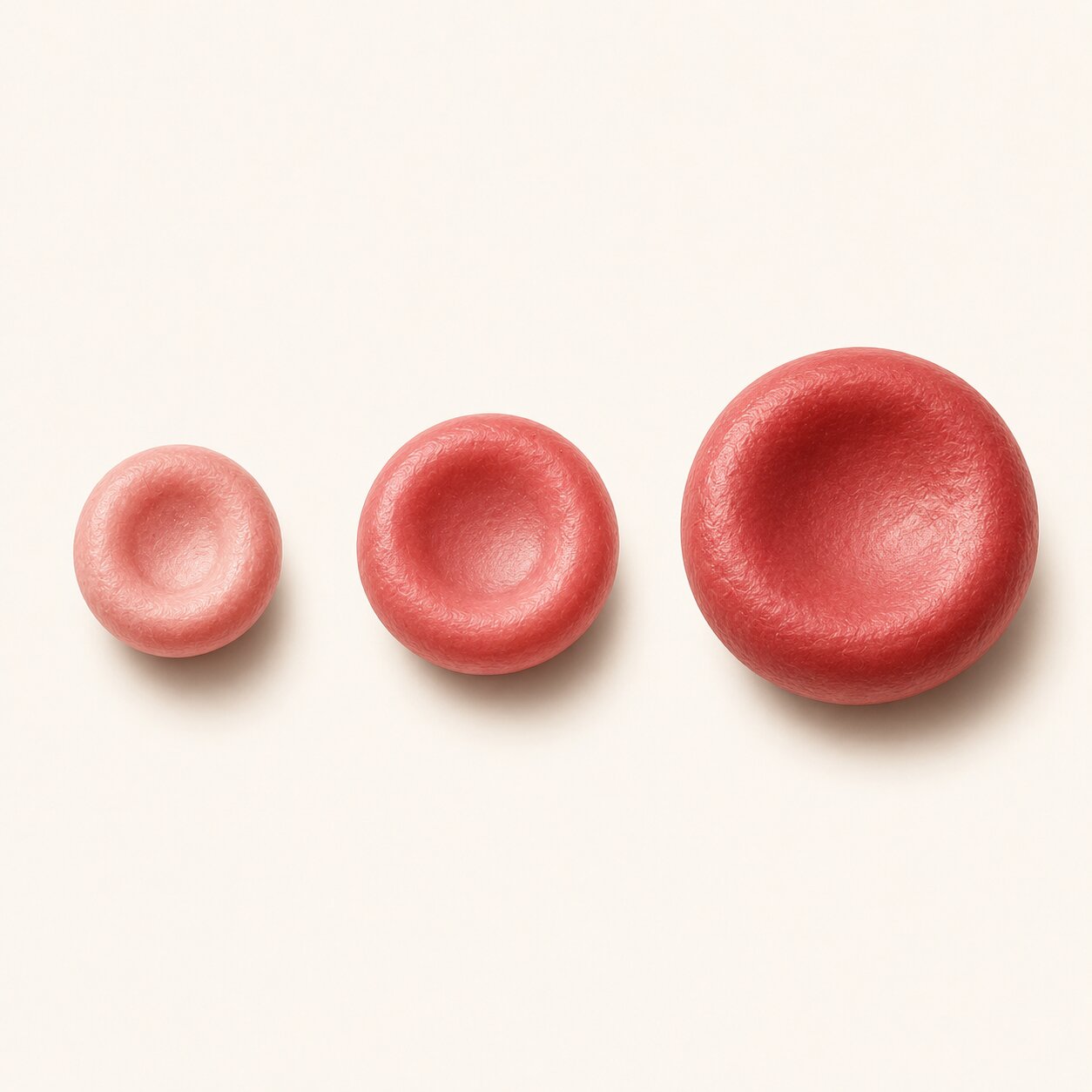
This is why a smart lab report, and a smart doctor, never reads hemoglobin in isolation. The size, shape, and variability of your red blood cells, along with your reticulocyte count — a measurement of how many brand-new, young red blood cells your bone marrow is actively releasing — together paint a far more specific picture than the hemoglobin number ever could on its own. A low reticulocyte count suggests your bone marrow simply isn't making enough new cells, whether from a lack of raw materials, a hormone signal problem, or a marrow disorder itself. A high reticulocyte count suggests your marrow is working overtime, usually because cells are being lost or destroyed faster than normal — a completely different diagnostic direction than a production problem, and one where iron deficiency is rarely the culprit.
Anemia of Inflammation — When Chronic Illness Hides Iron Away
One of the most frequently confused alternatives to true iron deficiency is a condition doctors now generally call anemia of inflammation, though it's still sometimes referred to by its older name, anemia of chronic disease. This shows up in people living with ongoing inflammatory conditions — rheumatoid arthritis, inflammatory bowel disease, chronic infections, and cancer are among the most common triggers — and the mechanism behind it is genuinely fascinating. Inflammatory chemical messengers in the body, especially one called interleukin-6, signal the liver to produce more of a hormone called hepcidin. Hepcidin's job is to control a protein called ferroportin, which normally acts as a gateway letting stored iron move out of cells and into the bloodstream where it can be used to build new red blood cells. When hepcidin rises, it essentially locks that gateway, trapping iron inside storage cells even though there may be plenty of it sitting right there in the body. The result is a person who isn't actually iron deficient in the classic sense — their iron stores are fine or even elevated — but whose iron is functionally unavailable for making new red blood cells, producing an anemia that looks superficially similar to iron deficiency without actually being caused by a lack of iron.
This mechanism creates a specific, well-documented trap when interpreting lab results, because ferritin — the protein most commonly used to estimate the body's iron stores — is also what's called an acute-phase reactant, meaning inflammation itself pushes ferritin upward independent of how much iron is actually stored. In genuine iron deficiency, ferritin is reliably low. In anemia of inflammation, ferritin often lands in a moderate-to-elevated range, and in more extreme inflammatory states it can rise dramatically higher for reasons that have nothing to do with iron at all — case reports have described patients with severe inflammatory conditions whose ferritin measured extremely high while true, underlying iron deficiency was still present once the inflammation was accounted for, illustrating just how misleading the number can be on its own. This is exactly why doctors interpret ferritin in the context of inflammation markers and the whole clinical picture, rather than as a single number that tells the whole story on its own.

Recognizing anemia of inflammation matters practically, not just academically, because the treatment is almost entirely different from iron deficiency. Where iron deficiency responds well to iron supplementation, anemia of inflammation generally improves only when the underlying inflammatory condition itself is brought under control — pouring in more iron supplements does little good when the problem isn't a shortage of iron but a body actively refusing to release the iron it already has.
Thalassemia Trait — A Genetic Look-Alike for Iron Deficiency
Thalassemia trait is an inherited condition affecting how the body produces the protein chains that make up hemoglobin, and it's one of the single most common reasons someone with small, iron-deficiency-looking red blood cells turns out not to have an iron problem at all. Unlike iron deficiency, thalassemia trait doesn't reduce the total number of red blood cells your bone marrow makes — it changes how those cells are built, resulting in smaller, sometimes oddly shaped cells produced in perfectly normal or even higher-than-normal numbers. That distinction — normal cell count, small cell size — is the exact opposite pattern from iron deficiency, where both the cell count and the cell size tend to drop together. Labs sometimes use a simple ratio of MCV to red blood cell count, called the Mentzer index, as one screening clue that can point toward thalassemia trait versus iron deficiency, though it's an aid a clinician weighs alongside other testing rather than a standalone diagnostic threshold.

Getting this distinction right matters for reasons beyond simply avoiding an unnecessary supplement. Thalassemia trait is a genetic condition, meaning it can be passed on to children, and confirming it — typically through hemoglobin electrophoresis, a lab test that separates out the different types of hemoglobin in the blood — opens the door to genetic counseling for anyone planning a family, information a misdiagnosis of iron deficiency would never surface. It's also worth knowing that thalassemia trait itself usually doesn't require any treatment at all, since it's typically a mild, lifelong condition rather than a progressive disease, which makes correctly identifying it not just diagnostically satisfying but genuinely reassuring once someone understands what they're actually dealing with.
B12 and Folate Deficiency — When Red Blood Cells Grow Too Big Instead of Too Small
Moving to the opposite end of the cell-size spectrum, vitamin B12 and folate are both essential for DNA synthesis inside developing red blood cells, and when either is deficient, those cells can't divide properly as they mature. Rather than producing smaller cells the way iron deficiency does, this produces larger-than-normal, macrocytic red blood cells — a completely different visual and numerical signature that immediately steers a workup away from iron. B12 deficiency has several distinct causes worth knowing: a diet low in animal products, since B12 occurs almost exclusively in animal-derived foods; pernicious anemia, an autoimmune condition that destroys the stomach cells needed to absorb B12; and various gut absorption problems, including some forms of prior stomach or intestinal surgery. Folate deficiency, meanwhile, is more often tied to poor diet, alcohol use disorder, certain medications, or increased demand during pregnancy.

This particular cause carries genuine urgency beyond the blood count itself, since B12 in particular plays a critical role in nerve health, and a deficiency severe or prolonged enough can cause numbness, tingling, balance problems, and other neurological symptoms that, left unaddressed long enough, may not fully reverse even after the deficiency is corrected. This is exactly why a macrocytic anemia pattern on a blood count is taken seriously and investigated specifically, rather than assumed to be a milder cousin of iron deficiency — the underlying cause, the associated risks, and the treatment are all genuinely different.
Chronic Kidney Disease and the Hormone Your Kidneys Are Supposed to Make
Your kidneys do far more than filter waste — they also produce a hormone called erythropoietin, which signals your bone marrow to keep producing red blood cells at a healthy pace. As kidney function declines, whether from long-standing diabetes, high blood pressure, or another chronic kidney condition, erythropoietin production drops along with it, and bone marrow simply receives a weaker signal to keep making new red blood cells. This produces a normocytic anemia — normal-sized cells, just not enough of them — that has nothing to do with iron intake or absorption at all. It's an extremely common finding as kidney disease progresses, common enough that anemia is considered a near-expected complication of moderate-to-advanced chronic kidney disease rather than an unusual coincidence, and it's specifically why anyone with a known kidney condition and low hemoglobin gets evaluated with this mechanism directly in mind, sometimes ultimately treated with medications that replace the erythropoietin signal the kidneys can no longer adequately provide, rather than with iron alone.
What makes this cause particularly easy to overlook is timing. Kidney function often declines gradually over years, and hemoglobin tends to follow that same slow, steady downward drift rather than dropping suddenly in a way that would prompt urgent investigation. Someone might simply notice they feel more tired than they used to and attribute it to age, stress, or being busy, without connecting it back to a kidney function test drawn months or years earlier. This is part of why anemia screening is now a routine, built-in part of ongoing care for anyone with an established chronic kidney disease diagnosis, rather than something only investigated after symptoms become impossible to ignore — catching the erythropoietin-related pattern early means it can be addressed directly, rather than mistakenly chased with iron supplementation that was never going to fix a hormone signaling problem in the first place.
Hemolysis — When Red Blood Cells Are Being Destroyed, Not Just Underproduced
So far, every cause described has involved the body making too few red blood cells. Hemolysis flips that entirely: it's a process where red blood cells are being destroyed faster than normal, whether from an inherited condition affecting the cells themselves, an autoimmune process where the immune system mistakenly attacks its own red blood cells, certain infections, or a reaction to specific medications. The bone marrow in hemolysis is often working perfectly well, pumping out new cells as fast as it can — the problem is that cells are being torn down even faster than that. This is exactly where the reticulocyte count mentioned earlier becomes so useful: a high reticulocyte count alongside low hemoglobin points squarely toward a destruction-based cause like hemolysis rather than a production problem, especially when paired with other telltale lab findings such as elevated bilirubin and LDH, byproducts released when red blood cells break down, and low haptoglobin, a protein that gets used up mopping up the debris from that breakdown.
The causes behind hemolysis are genuinely varied, which is part of why it's treated as its own distinct diagnostic branch rather than a single condition. Inherited causes include conditions affecting the red blood cell's own internal structure or the hemoglobin molecule itself, sometimes present from birth but not noticed until a specific trigger or a routine blood count brings it to light. Autoimmune hemolytic anemia happens when the immune system mistakenly produces antibodies against a person's own red blood cells, marking them for early destruction — this can appear on its own or alongside other autoimmune conditions. Certain infections, some medications, and mechanical damage to red blood cells as they pass through abnormal or narrowed blood vessels can all trigger it as well. Because the underlying cause varies so widely, and because some forms of hemolysis can progress quickly, this is a category where getting an accurate diagnosis promptly, rather than assuming iron deficiency and waiting to see if supplements help, genuinely changes how quickly the right, appropriate treatment actually begins for the person affected.
Bone Marrow Problems — When the Factory Itself Isn't Working
In a smaller but important group of cases, low hemoglobin traces back to the bone marrow itself not functioning properly, independent of raw materials, hormone signals, or destruction rates. Conditions like myelodysplastic syndrome, where the marrow produces abnormal, poorly functioning cells, aplastic anemia, where the marrow's cell-producing capacity is significantly reduced, and marrow that's been crowded out by something else entirely, such as a blood cancer or cancer that has spread there from elsewhere in the body, can all present initially as unexplained low hemoglobin. These causes tend to reveal themselves through additional abnormalities beyond hemoglobin alone — often affecting white blood cell or platelet counts on the same complete blood count — and through a low reticulocyte count reflecting a marrow that simply isn't keeping up, regardless of how much iron, B12, or folate is available to it. These causes are less common than the others described here, but they're exactly the kind of possibility that a persistently unexplained, treatment-resistant anemia is investigated for, usually with more specialized testing including, when needed, a direct bone marrow biopsy.
It's worth being clear that this category is meant to inform, not alarm — bone marrow disorders are considerably less common than iron deficiency, anemia of inflammation, or the other causes covered in this article, and the vast majority of low hemoglobin results never end up tracing back here. They're included specifically because they represent the category doctors are ultimately ruling out as they work through the more common explanations first, and understanding that this step exists helps make sense of why a persistent, unexplained anemia that doesn't respond to any of the more common treatments sometimes leads to more extensive testing rather than simply trying yet another supplement.
Dilutional Anemia — When Your Blood Isn't Actually Short on Red Cells At All
One final, genuinely different category deserves mention because it isn't really anemia in the traditional sense at all: dilutional anemia, where the total number of red blood cells in your body is essentially normal, but the plasma — the liquid portion of blood — has expanded enough to make the concentration of red blood cells per volume look lower than it really is. Pregnancy is the classic example, since plasma volume increases substantially, and more quickly than red blood cell mass does, over the course of a healthy pregnancy, producing a hemoglobin dip that's a normal, expected physiological adjustment rather than a sign that something is wrong. Significant fluid overload from other causes, including certain heart or kidney conditions, or simply having received a large volume of intravenous fluids shortly before a blood draw, can produce a similar, temporary dilutional effect. Recognizing this pattern matters because it's the one cause on this entire list that doesn't reflect any real deficiency or disease process affecting red blood cells at all — it's a reading that will typically normalize on its own once the underlying fluid shift resolves.
Recognizing dilutional anemia matters mainly so it doesn't trigger an unnecessary cascade of testing or supplementation. In pregnancy specifically, this expected physiological dip is well characterized enough that obstetric guidelines account for it directly, using pregnancy-adjusted reference ranges rather than the standard non-pregnant reference range, precisely so a normal physiological change doesn't get chased as if it were a deficiency. That said, the presence of a dilutional effect doesn't rule out a true, additional deficiency existing at the same time — pregnancy also genuinely increases the body's demand for iron and folate, which is exactly why routine prenatal bloodwork checks these levels directly rather than assuming every low hemoglobin reading during pregnancy is purely dilutional.
How Doctors Actually Sort Through All of This
With so many possible explanations, the actual diagnostic process is more organized than it might sound. It typically starts with MCV to broadly categorize the anemia as microcytic, normocytic, or macrocytic, followed closely by the reticulocyte count to distinguish an underproduction problem from a destruction or loss problem. From there, targeted tests follow the specific pattern that emerges: iron studies and ferritin for a microcytic picture, a Mentzer index calculation and possibly hemoglobin electrophoresis if thalassemia trait seems plausible, B12 and folate levels for a macrocytic picture, inflammatory markers and a review of chronic conditions when anemia of inflammation is suspected, and kidney function tests when relevant. This isn't guesswork — it's a structured, evidence-based sequence designed specifically to move efficiently from "hemoglobin is low" to a specific, actionable answer, without assuming iron deficiency by default and without unnecessary testing thrown at every possibility all at once.
Family history and personal medical history do a lot of quiet, unglamorous work in this process too, often narrowing things down before a single extra test is even ordered. Someone with relatives who carry thalassemia trait, someone with a long-standing autoimmune or inflammatory condition, someone recently diagnosed with kidney disease, or someone following a strict plant-based diet without supplementation all walk into this evaluation with a meaningfully different set of likely explanations already in play. A good clinician weighs that context from the very first conversation, using it to decide which tests to prioritize first rather than working through every possibility in a fixed, one-size-fits-all order — which is a big part of why the same low hemoglobin number can lead down noticeably different diagnostic paths for two different people.

None of this is meant to discourage anyone from considering iron deficiency first — it remains, by a wide margin, the single most common reason hemoglobin runs low, and for good reason it's usually the first thing checked. The point being made throughout this entire article is simply that "low hemoglobin" is a finding, not a diagnosis in itself, and the specific pattern surrounding it — cell size, reticulocyte count, family history, other chronic conditions, and a handful of targeted follow-up tests — is what actually turns that finding into an answer worth acting on.
Frequently Asked Questions
How can I tell if my low hemoglobin is from iron deficiency or something else?
The most useful first clue is your MCV, the average size of your red blood cells, combined with a reticulocyte count. Small cells with a low reticulocyte count fit classic iron deficiency, but the same pattern can also fit thalassemia trait, which is why a follow-up iron panel, and sometimes a Mentzer index calculation, is used to tell them apart.
Can taking iron supplements help if my anemia isn't actually from iron deficiency?
That decision should be based on confirmed diagnostic testing with your doctor rather than started or avoided on your own. Conditions like anemia of inflammation, thalassemia trait, and B12 deficiency don't respond meaningfully to iron supplementation, since the underlying problem isn't a shortage of iron, and taking iron without a confirmed deficiency can, in some cases, mask other findings or cause harm in people with an underlying iron-overload condition like hereditary hemochromatosis. A doctor can confirm whether supplementation is actually appropriate for your specific results.
Why can ferritin be high even when someone actually has iron deficiency?
Ferritin is an acute-phase reactant, meaning inflammation itself raises it independent of true iron stores. Someone with both an inflammatory condition and true iron deficiency can show a deceptively normal or even high ferritin, which is why ferritin is interpreted alongside inflammation markers and the full clinical picture rather than as a standalone number.
Is a low hemoglobin during pregnancy always something to worry about?
Not necessarily. A mild drop is a normal, expected result of plasma volume increasing faster than red blood cell mass during a healthy pregnancy. That said, pregnancy also increases the risk of true iron and folate deficiency, so any low hemoglobin in pregnancy is still worth discussing with a healthcare provider to confirm which explanation applies.
What does a high reticulocyte count mean if my hemoglobin is low?
It generally points toward a destruction or loss problem, such as hemolysis or active bleeding, rather than an underproduction problem like iron, B12, or folate deficiency. Your bone marrow is responding appropriately by releasing extra young red blood cells, which is itself a reassuring sign that the marrow is functioning well even though something else is causing cells to be lost faster than normal.
Should I ask my doctor for a reticulocyte count if my hemoglobin comes back low?
It's a reasonable question to raise, especially if a first round of iron studies comes back unclear or normal despite low hemoglobin. A reticulocyte count is inexpensive, widely available, and often the single most useful next test for narrowing down which broad category of cause applies before more specialized testing is considered.
Conclusion
Low hemoglobin is a starting point for a conversation, not an automatic iron deficiency diagnosis — and treating every low result the same way risks missing genuinely different conditions that call for genuinely different treatments, from managing an underlying inflammatory illness to correcting a B12 deficiency to simply recognizing a harmless, temporary dip during pregnancy. The good news is that the tools for telling these apart are well established, inexpensive, and already sitting right there on your complete blood count in the form of cell size and reticulocyte count, waiting to be read together rather than in isolation. If your hemoglobin has come back low, the most useful next step isn't necessarily reaching for an iron supplement — it's asking your doctor which of these specific patterns your own results actually fit, and being genuinely open to the answer being something other than the explanation you walked in expecting to hear.
Still Not Sure What Your Results Mean?
Upload your labs and get a complete, visual, plain-language interpretation of every biomarker — delivered to your inbox in under 15 minutes.
Get My ReportThis article is for educational purposes only and does not constitute medical advice. Always consult your healthcare provider regarding your specific lab results.