
Why Are My Neutrophils Elevated?
Of all the numbers packed into a complete blood count, the neutrophil count is one of the most frequently flagged, and one of the most misunderstood. Neutrophils are your body's most abundant white blood cell and its fastest-arriving defense, which means an elevated count is, in the overwhelming majority of cases, a sign that your immune system noticed something and responded exactly the way it's supposed to — not a sign that something is fundamentally wrong. Still, "elevated" covers a wide range of very different underlying stories, from a bacterial infection your body is actively fighting off, to the aftermath of an intense workout, to a steroid medication doing precisely what it was prescribed to do, all the way to the rarer situations where a persistently high count genuinely warrants a closer look at the bone marrow itself. This article walks through what neutrophils actually do and why they're built to respond so fast, the biological mechanism behind a bacterial infection driving your count up, what a "left shift" and band cells on your report actually mean, why stress and hard exercise alone can raise your count within minutes through a process called demargination, why common medications like corticosteroids reliably push neutrophils higher, the well-documented connection between chronic smoking and neutrophil counts, other inflammatory conditions that can elevate this number, why pregnancy shifts the entire reference range, and how doctors actually sort a reassuring explanation from one that deserves more investigation.
What Neutrophils Actually Do — and Why They're Built to Respond Fast

Figure 1. Neutrophils leave the bloodstream through a step-by-step process of rolling, tight adhesion, and migration across the vessel wall, converging on tissue where bacteria have been detected.
Neutrophils typically make up somewhere between 50 and 70 percent of your total white blood cells, making them the single largest population your immune system keeps in reserve. They're produced continuously in the bone marrow and released into the bloodstream, where they circulate for only a matter of hours before either dying off naturally or getting called into action. What makes them the immune system's first responders is speed and a relatively simple, brute-force weapon: when they detect bacteria, they engulf and destroy them directly through a process called phagocytosis, and they can be recruited to a site of infection within minutes rather than the days it can take for a more specialized, targeted immune response to ramp up.
Because speed is the entire point, your body keeps a substantial standing reserve ready to deploy at a moment's notice, stored in two separate places: a "marginal pool" of neutrophils loosely stuck to the inner walls of small blood vessels, and a much larger reserve sitting in the bone marrow itself, ready for immediate release — together, these two reserves can outnumber the neutrophils actively circulating and visible on a routine blood draw at any given moment. An elevated neutrophil count almost always reflects one of these two reserves being tapped — either the marginal pool detaching and joining the actively circulating count, or the bone marrow ramping up production and releasing extra cells into circulation — and which one is happening, and why, is what actually determines whether an elevated number is routine or worth a second look.
Bacterial Infection: The Textbook Reason This Number Rises
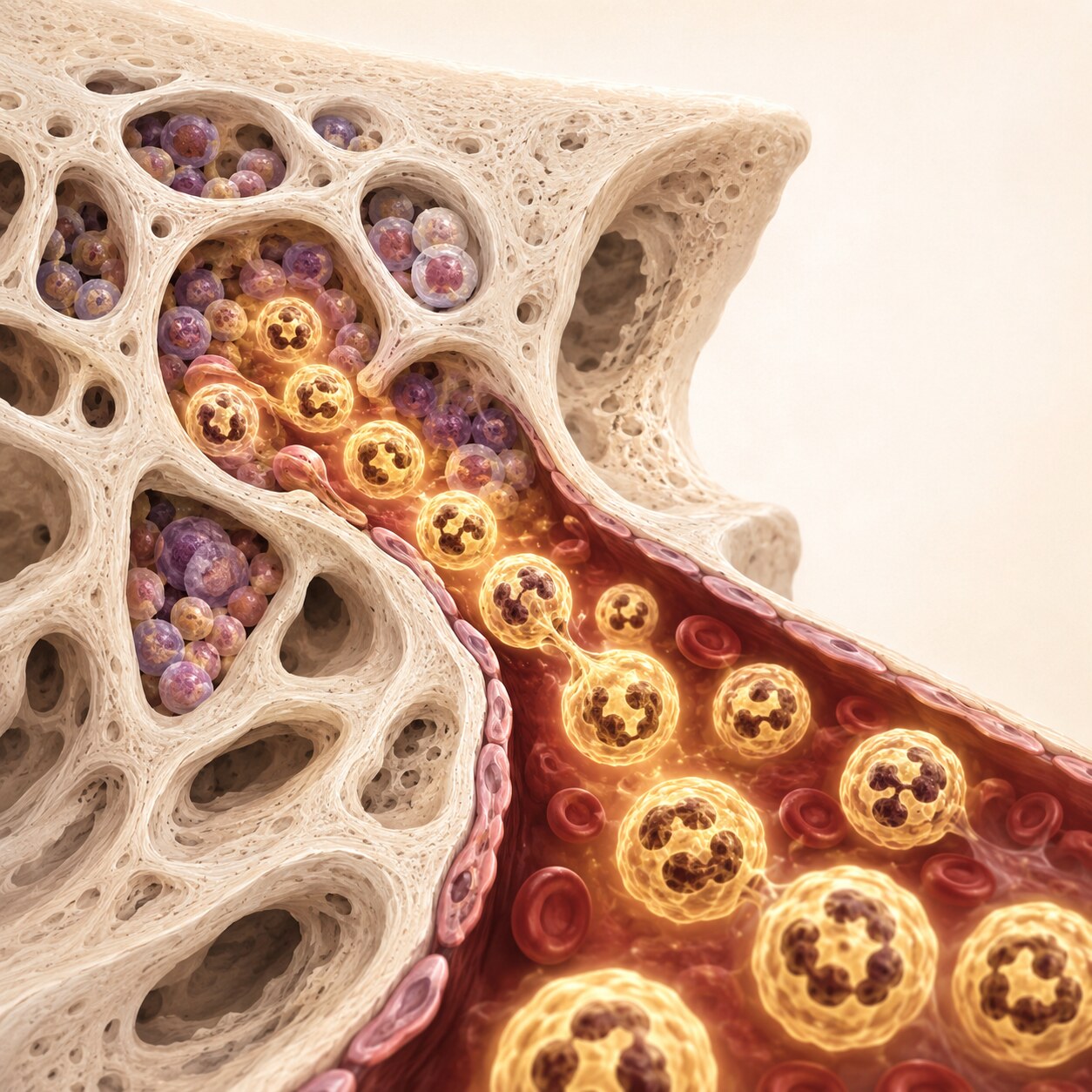
Figure 2. During a bacterial infection, the bone marrow's stored neutrophil reserve empties rapidly into the bloodstream, driving the total count well above its usual baseline within hours.
When bacteria invade tissue, cells at the site release chemical alarm signals, including molecules called cytokines and chemokines, that travel through the bloodstream and reach the bone marrow directly, essentially broadcasting "send reinforcements now." The bone marrow responds by dumping its stored reserve of mature neutrophils into circulation, sometimes within just a few hours of the initial infection — long before the marrow has had time to actually produce brand-new cells from scratch. This is exactly why a rising neutrophil count is one of the fastest, earliest signals doctors have that a bacterial process is underway, often showing up before a fever fully develops or before other symptoms make the diagnosis obvious.
This response is specific enough to be genuinely useful diagnostically: bacterial infections are the classic trigger for a significantly elevated neutrophil count, while viral infections more often do the opposite, either leaving neutrophils roughly unchanged or, in some cases, actually lowering them while raising a different white blood cell type called lymphocytes instead. That's part of why doctors look at the full differential — the breakdown of exactly which white blood cell types are elevated, not just the total white count — rather than treating "high white blood cells" as one undifferentiated finding; a neutrophil-dominant elevation and a lymphocyte-dominant elevation point toward genuinely different categories of infection, which is part of why the differential, not just the total count, so often shapes whether a doctor suspects a bacterial process or a viral one before any culture or additional testing comes back.
The "Left Shift": What Band Cells on Your Report Actually Mean
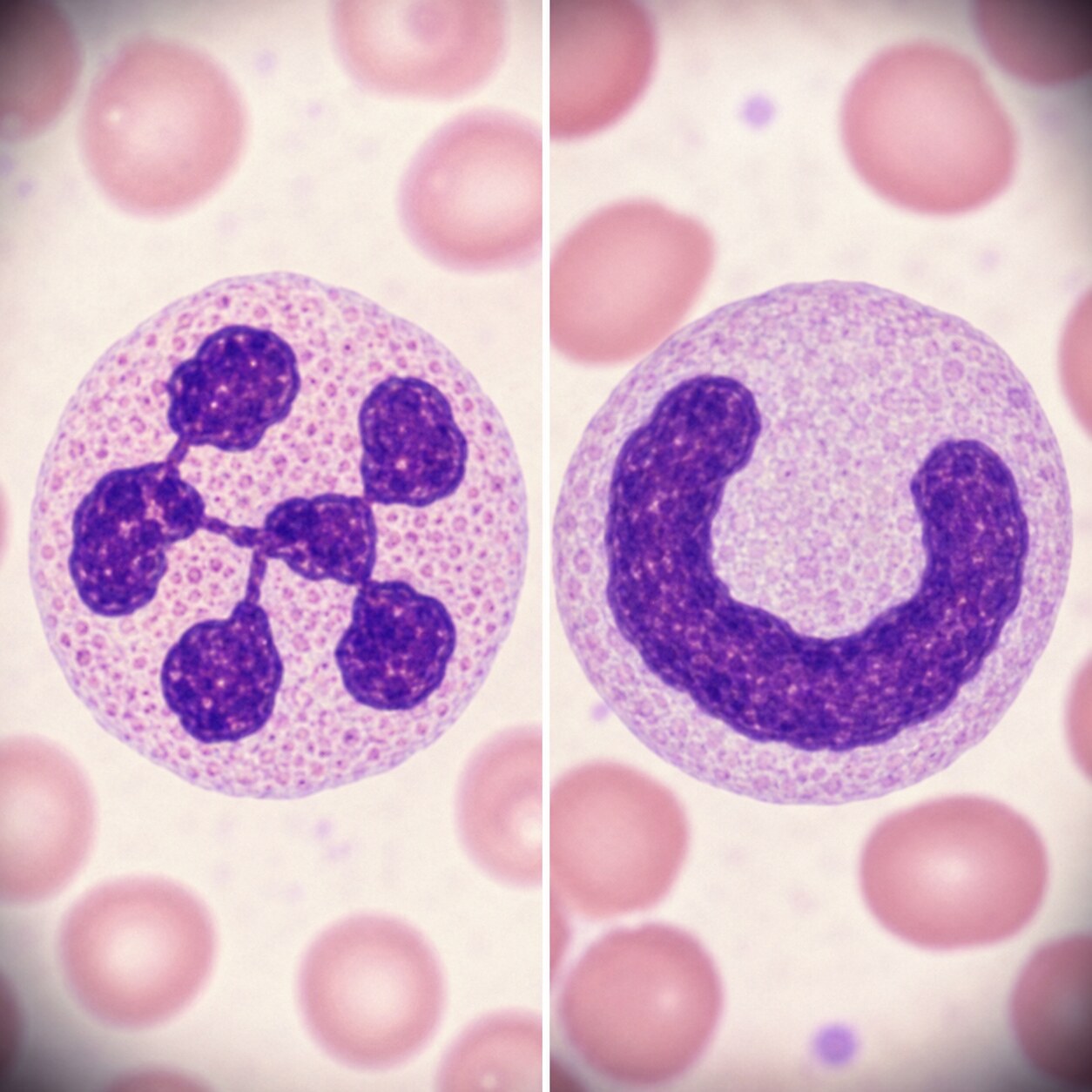
Figure 3. A mature neutrophil's nucleus is divided into several distinct lobes, while an immature band neutrophil still has a single, unsegmented horseshoe-shaped nucleus — the presence of bands signals a "left shift."
If an infection is significant enough, the bone marrow's mature reserve can empty out faster than it can be replenished, forcing the marrow to release younger, not-yet-fully-matured neutrophils called band cells ahead of schedule. On a lab report, this shows up as an increased "band" or "immature granulocyte" percentage, a pattern doctors call a "left shift" — a term that comes from the traditional left-to-right layout of a differential count chart, where immature cells were historically listed on the left. A meaningful left shift is a useful severity signal on top of the neutrophil count itself: it suggests the bone marrow is being pushed hard enough that it's releasing cells before they've finished maturing, which generally correlates with a more significant or more prolonged infection than a high neutrophil count with no left shift at all, and it's one of the details clinicians specifically look for when trying to gauge how aggressively a suspected infection needs to be treated.
Under a microscope, the visual difference between the two cell types is genuinely distinctive: a fully mature neutrophil has a nucleus divided into three to five separate lobes connected by thin strands, while a band cell's nucleus is still a single, continuous, horseshoe- or sausage-shaped structure that hasn't yet segmented. A hematology technologist reviewing a smear can spot this distinction directly, which is why a manual smear review is sometimes ordered alongside an automated CBC when the degree or pattern of an elevated neutrophil count doesn't fully explain itself from the numbers alone.
Curious what the rest of your complete blood count is actually telling you? Upload your results and get a complete, plain-language breakdown in under 15 minutes.
Analyze My ResultsStress and Hard Exercise: A Real Spike With Nothing Wrong

Figure 4. Intense physical exertion triggers adrenaline release, which detaches marginated neutrophils from vessel walls and pushes them into active circulation within minutes — a real but temporary spike.
One of the least intuitive causes of an elevated neutrophil count has nothing to do with illness at all. Intense physical exertion, acute psychological stress, and even a difficult childbirth all trigger a surge of adrenaline and cortisol, and both hormones cause the neutrophils sitting in that "marginal pool" along vessel walls to detach and join the actively circulating count within minutes — a process called demargination. Because this pool can hold a genuinely large number of cells, a hard workout, a sprint up several flights of stairs, or even the stress of a difficult blood draw itself can measurably raise a neutrophil count on a test drawn immediately afterward, with the number returning to baseline within an hour or two once the adrenaline surge passes — a well-documented phenomenon sometimes referred to informally as "stress leukocytosis" in clinical literature.
This is exactly why the circumstances surrounding a blood draw matter more than people usually assume: a neutrophil count drawn right after a stressful commute, an intense gym session, or a panic attack in the waiting room can look mildly elevated for reasons that have nothing to do with infection or illness, which is one reason doctors are generally not alarmed by a single, modestly elevated result with no other supporting findings, and may simply suggest a repeat test under calmer, fasted, well-rested conditions before pursuing anything further.
Corticosteroid Medications: A Predictable, Intended Effect

Figure 5. Corticosteroids like prednisone reliably raise the circulating neutrophil count by the same demargination mechanism triggered by stress, an expected and predictable effect of the medication itself.
Corticosteroids, a class of medication that includes prednisone and is prescribed for everything from asthma flares to autoimmune conditions to poison ivy, produce one of the most predictable, well-documented neutrophil increases of any common medication. Steroids trigger the exact same demargination mechanism described above, pulling neutrophils off vessel walls and into active circulation, while simultaneously slowing how quickly neutrophils exit the bloodstream to migrate into tissue. The combined effect is a reliably higher count for as long as the medication is being taken, an effect so consistent that doctors specifically ask about current or recent steroid use, including inhaled steroids for asthma and steroid injections, whenever they're interpreting an elevated result.
This particular cause is worth understanding clearly because it can otherwise create a confusing, circular situation: someone taking a steroid for an inflammatory condition gets bloodwork done, sees an elevated neutrophil count, and worries a new infection has developed, when the elevation is actually just the steroid doing exactly what steroids reliably do. Reviewing a person's current medication list is consequently one of the very first, simplest steps in interpreting an unexpectedly high count, often resolving the question before any further testing is needed at all — and this effect isn't limited to prednisone specifically, since other corticosteroids, including dexamethasone and hydrocortisone, produce the same demargination-driven rise regardless of which specific formulation is being used.
Chronic Smoking's Well-Documented Effect on Neutrophil Counts

Figure 6. Chronic cigarette smoke exposure produces low-grade, ongoing airway inflammation that keeps the neutrophil count modestly elevated for as long as smoking continues.
Cigarette smoke contains thousands of chemical irritants that come into direct contact with the lining of the airways with every inhalation, and the body responds to this constant low-grade irritation the same way it responds to any other source of tissue inflammation: by keeping extra neutrophils in circulation and ready to deploy. Studies comparing smokers to non-smokers consistently find neutrophil counts running modestly but measurably higher in smokers, an effect that tends to correlate with how much a person smokes and how long they've been smoking, and that generally begins reversing once someone quits, though it can take weeks to months to fully normalize back toward a non-smoker's typical baseline.
This is one of the more commonly overlooked causes of a mildly elevated neutrophil count precisely because it's chronic rather than acute — there's no obvious recent illness or medication to point to, just an ongoing baseline shift that smoking itself produces. It's a routine, expected part of interpreting bloodwork for anyone with a smoking history, and one more reason a thorough history, not just the number on the page, is what actually explains a result — vaping and secondhand smoke exposure have also been studied for a similar, generally milder, effect on baseline neutrophil counts.
Other Inflammatory Conditions Beyond Infection
Infection isn't the only thing that activates this same alarm-and-response system. Neutrophils respond to inflammation broadly, not exclusively to bacteria, which means conditions like a rheumatoid arthritis flare, acute pancreatitis, a gout attack, significant tissue injury or burns, and even the aftermath of major surgery can all elevate the neutrophil count through the same underlying cytokine-signaling pathway a bacterial infection uses. In each of these situations, the body is responding to damaged or distressed tissue, and the neutrophil system doesn't distinguish particularly well between "damage caused by bacteria" and "damage caused by something else" at the level of the initial alarm signal.
Acute pancreatitis in particular can produce one of the more dramatic non-infectious elevations, sometimes rivaling what's seen in a serious bacterial infection, purely from the intensity of the inflammatory signal released by an irritated, self-digesting pancreas. This is exactly why an elevated neutrophil count, taken alone, is a genuinely nonspecific finding — a useful early clue that something is triggering an inflammatory or infectious response somewhere in the body, but not, on its own, a diagnosis of any single condition. Matching the lab finding to the person's actual symptoms, physical exam, and other test results is what turns "your neutrophils are high" into an actual explanation rather than an isolated flag sitting on a printed page with no context attached to it.
Pregnancy: A Normal, Expected Shift in the Reference Range
Pregnancy deserves its own specific mention, since it's one of the few situations where a moderately elevated neutrophil count is simply expected and normal rather than a sign of anything happening. Starting in the second trimester and continuing through delivery, neutrophil counts rise progressively as a normal physiological adaptation, and they can climb substantially higher still during labor itself and in the days immediately after delivery, largely due to the same stress-hormone-driven demargination mechanism already described, amplified by the physical intensity of childbirth.
Because of this, standard reference ranges used outside of pregnancy don't really apply during it, and a result that would look concerning in a non-pregnant adult can be entirely unremarkable in someone who is pregnant or has recently given birth, sometimes running two to three times higher than a typical non-pregnant baseline in the immediate postpartum window alone. This is exactly why pregnancy status is one of the first pieces of context a doctor accounts for before interpreting a CBC as abnormal in the first place.
How Doctors Actually Sort a Reassuring Cause From a Concerning One
Given how many genuinely different explanations can produce the same elevated number, doctors lean on a combination of the surrounding clinical picture and the specific pattern of the result itself, rather than the neutrophil count in isolation. A detailed history covering recent symptoms, current medications, recent exercise or stress, smoking status, and pregnancy status usually narrows the list dramatically before any additional testing is even needed. The degree of elevation matters too: a mild, isolated increase is far more often explained by one of the routine causes above, while a very large increase, a significant left shift, or an elevation that persists across multiple tests over weeks or months prompts a broader workup.
In that broader workup, doctors look for supporting evidence of infection (fever, a localized source, inflammatory markers like CRP), review the full differential rather than the neutrophil count alone, and, in genuinely persistent or unexplained cases with a very high count, consider rarer possibilities like a reactive leukemoid reaction or, in cases involving a specific and highly elevated pattern along with other blood count abnormalities, a bone marrow disorder such as chronic myeloid leukemia — a possibility ruled out with specific additional testing rather than assumed from the CBC alone, and one that represents a small minority of cases behind an elevated count, not the typical explanation. A leukemoid reaction, despite the alarming name, is simply an unusually vigorous but still entirely reactive and benign response to a severe underlying infection or inflammatory trigger, distinguished from true leukemia through additional testing that looks at cell maturity and specific genetic markers rather than the count alone, and it typically resolves completely once the underlying trigger has been treated.
A Practical Comparison of the Main Causes
Acute bacterial infection typically produces a genuinely high count, often with a left shift and accompanying symptoms like fever, and resolves once the infection is treated. Stress and exercise produce a mild-to-moderate, rapid-onset spike with no left shift, no symptoms, and a return to baseline within a couple of hours. Corticosteroid use produces a mild-to-moderate, medication-duration-matched elevation with no left shift and no symptoms of illness. Chronic smoking produces a modest, persistent baseline elevation unrelated to any single recent event. Non-infectious inflammatory conditions produce an elevation that tracks with flares of the underlying condition, alongside that condition's own specific symptoms. Pregnancy produces a gradual, expected rise against a shifted reference range, most pronounced around delivery. Laying these patterns side by side is close to the mental checklist a doctor actually works through when a neutrophil count comes back high with no obvious explanation already in hand.
Reading Your Own Differential: What to Actually Look At
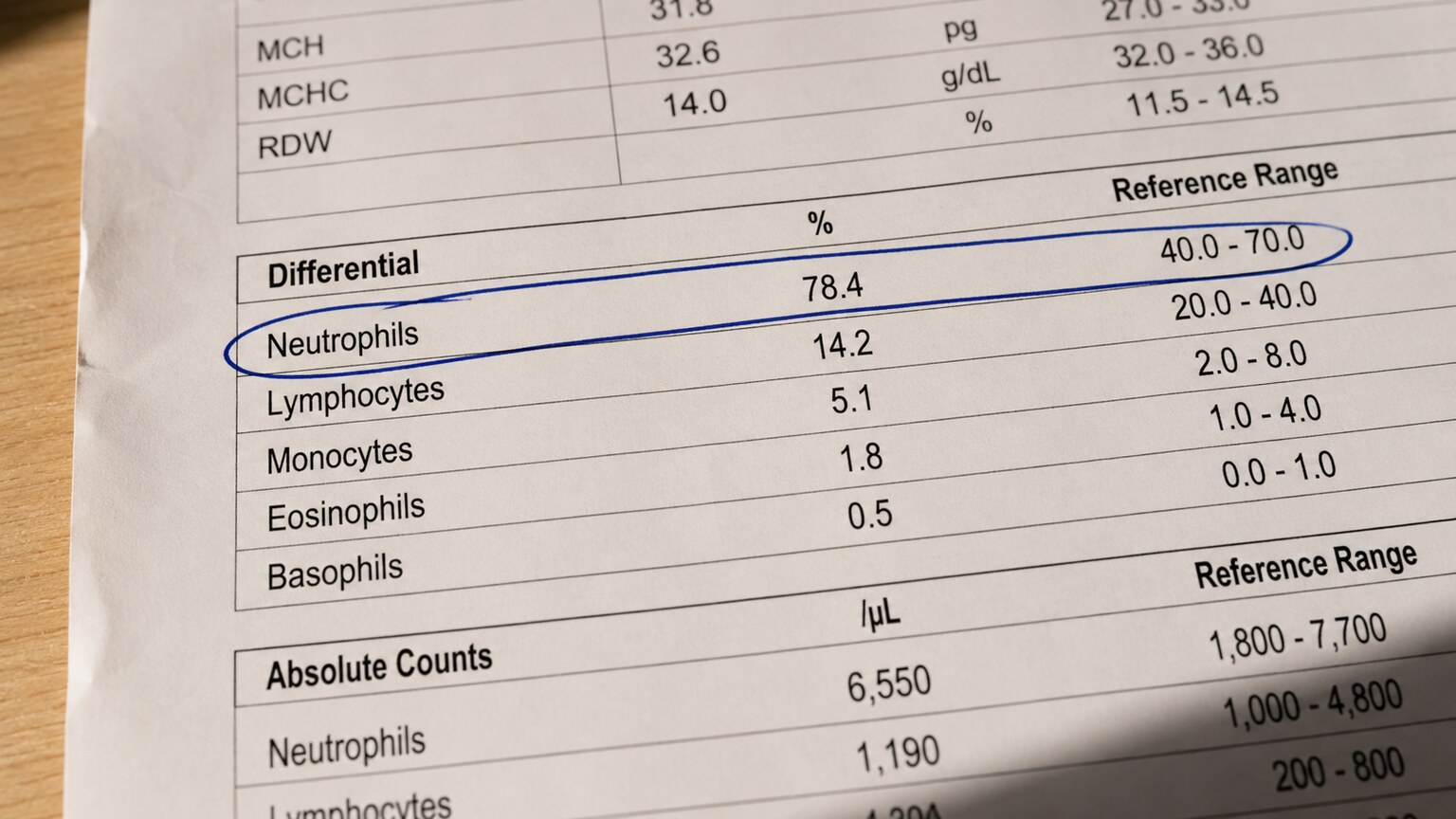
Figure 7. The differential section of a CBC report breaks the total white blood cell count down by cell type, with the neutrophil percentage and absolute count listed alongside their own specific reference range.
When a neutrophil count comes back flagged, the raw number on its own is only half the picture — a complete blood count report typically lists both a percentage (what share of your total white blood cells are neutrophils) and an absolute count (the actual number of neutrophils per microliter of blood), and it's worth understanding that these two figures can occasionally tell slightly different stories. A relative percentage can look elevated simply because a different white blood cell type is running low, even if the absolute neutrophil count is perfectly normal — which is exactly why doctors generally weigh the absolute neutrophil count more heavily than the percentage alone when deciding whether a result is genuinely notable.
The reference range printed next to your result is also worth reading carefully, since labs vary slightly in exactly where they draw that line depending on the specific analyzer and population data each lab uses to establish it, and, as covered earlier, that range itself shifts during pregnancy. A result sitting just barely above a lab's printed upper limit, with no left shift and no other flagged values nearby, carries a very different weight than a result running several times above that same limit — context the raw "H" flag next to a number doesn't communicate on its own, which is exactly the kind of nuance worth discussing directly with whoever ordered the test rather than assuming the worst from the flag alone.
Common Misconceptions About Elevated Neutrophils
One common misconception is that any elevated white blood cell count automatically means a bacterial infection is present somewhere in the body. As this article has covered, exercise, stress, steroids, smoking, non-infectious inflammation, and pregnancy can all produce the same finding, several of them without any illness involved at all — which is exactly why the number alone was never meant to stand as a diagnosis on its own.
A second misconception is that a higher number always means a more serious situation than a lower one within the elevated range. In reality, the pattern and context matter far more than the raw number by itself — a moderately elevated count with a significant left shift and a clear infectious source can represent a more significant process than a higher isolated number explained entirely by a recent workout or a steroid prescription.
A third misconception is that an elevated neutrophil count on a single test is something that needs to be tracked down immediately. When the surrounding picture is unremarkable — no fever, no symptoms, a known recent stressor, exercise, or medication that fully explains it — a simple repeat test under calmer, more standard conditions is often all that's needed before concluding there's nothing more to investigate.
Frequently Asked Questions
Does a high neutrophil count always mean I have an infection?
No. While bacterial infection is the classic cause, stress, exercise, corticosteroid medications, smoking, non-infectious inflammation, and pregnancy can all elevate this count without any infection present.
How quickly can exercise or stress raise my neutrophil count?
Within minutes. The demargination mechanism that detaches neutrophils from vessel walls responds to adrenaline almost immediately, and the count typically returns to baseline within one to two hours.
What does a "left shift" mean on my results?
It means immature band neutrophils are showing up in your bloodstream in higher-than-usual numbers, a sign the bone marrow is being pushed hard enough to release cells before they've fully matured — generally a marker of a more significant infection or inflammatory process.
Should I stop my steroid medication if it's raising my neutrophil count?
No, not on your own. This is an expected, predictable effect of corticosteroids and not a sign the medication is causing harm — any medication changes should be discussed with the prescribing doctor, not made independently based on a CBC result.
When does an elevated neutrophil count warrant a bone marrow workup?
Only in a small minority of cases — typically when the count is very high, persists across multiple tests over weeks or months with no explanation, or appears alongside other abnormal blood counts, prompting evaluation for rarer causes like a reactive leukemoid reaction or a primary bone marrow disorder.
Can dehydration affect my neutrophil count?
Significant dehydration can cause a mild, artificial-looking increase in most blood cell counts, including neutrophils, simply because the same number of cells is concentrated in a smaller volume of plasma — a lab artifact rather than a true rise in cell production.
Is a high neutrophil count in a newborn the same as in an adult?
Not exactly. Newborns naturally run higher neutrophil counts in the first few days of life as part of normal adjustment outside the womb, which is why pediatric reference ranges differ from adult ones rather than using the same cutoffs.
Does obesity affect baseline neutrophil counts?
Yes, modestly. Obesity is associated with a degree of chronic, low-grade inflammation that can shift a person's baseline neutrophil count somewhat higher than someone without that chronic inflammatory load, independent of any acute illness.
Why the Total White Count Alone Can Be Misleading
Many CBC reports lead with a single number labeled "white blood cell count" or "WBC," and it's tempting to treat that one figure as the entire story. But the total WBC count is really just the sum of five distinct cell types, each with its own job and its own set of triggers, and a normal total can quietly hide an abnormal breakdown underneath it. A neutrophil count running high while lymphocytes run correspondingly low, for instance, can leave the total WBC looking perfectly unremarkable even though the differential underneath tells a genuinely different, more specific story.
This is exactly why a doctor reviewing bloodwork rarely stops at the total count, and why this article has focused specifically on the neutrophil figure rather than white blood cells as one undifferentiated category. Each of the five white blood cell types (neutrophils, lymphocytes, monocytes, eosinophils, and basophils) responds to a different category of trigger, and reading the differential as five separate signals, rather than one combined number, is what actually lets a lab result narrow down what's happening in the body rather than simply confirming that something, generically, is.
What a Genuinely Low Neutrophil Count Would Mean Instead
Understanding what an elevated neutrophil count is not can also help clarify what it is. The opposite finding, a low neutrophil count known as neutropenia, reflects an entirely different set of causes: certain viral infections, some medications (including certain chemotherapy drugs and a handful of other prescriptions), autoimmune conditions that mistakenly target neutrophils themselves, severe vitamin B12 or folate deficiency, and less commonly, primary bone marrow conditions that impair neutrophil production altogether. Because neutrophils are the immune system's fastest bacterial responders, a genuinely low count actually raises infection risk rather than reflecting one, which is close to the opposite clinical concern from everything covered in this article.
Seeing both ends of this spectrum side by side helps explain why the neutrophil count carries so much clinical weight in the first place: it isn't just one number among many on a CBC, it's a fairly direct readout of how much of your fastest-acting immune defense is actively available and deployed at the moment your blood was drawn, whether that number is running higher than usual for a reassuring reason, a concerning one, or, in the opposite direction, running low enough to leave you more vulnerable to infection than usual.
How Age and Baseline Health Shift What Counts as Normal
Reference ranges for neutrophils, like most bloodwork, are built from population averages, and a few real, well-documented factors shift where an individual person's own normal baseline sits within that broader range. Children tend to run somewhat different lymphocyte-to-neutrophil ratios than adults at various points in development, which is one reason pediatric reference ranges differ from adult ones rather than simply being a smaller version of the same chart. Chronic conditions involving ongoing low-grade inflammation, including obesity and some autoimmune conditions even outside of an active flare, are also associated with a modestly higher baseline neutrophil count than someone without those conditions, independent of any acute illness on the day of testing.
None of this changes how any single elevated result should be interpreted in isolation, but it does explain why doctors sometimes weigh a result differently for one patient than they would for another with an identical number on paper — a "high" result is always being compared, implicitly, against both a population reference range and, when previous bloodwork exists, that specific person's own historical baseline, and the second comparison, tracking a person's own trend over time rather than a single snapshot, is often the more clinically meaningful one of the two.
Why Neighboring Values on the Same Report Matter
A neutrophil count rarely gets interpreted in true isolation, since the rest of the CBC panel it arrives alongside can either reinforce or complicate the picture. A high neutrophil count paired with a low platelet count and abnormal red blood cell values, for example, points doctors toward a broader marrow-level process rather than a routine, isolated infection response, since an infection or a workout has no real reason to disturb every other cell line at once. Conversely, a high neutrophil count sitting next to an otherwise completely normal panel is exactly the pattern most consistent with one of the routine, non-alarming causes covered throughout this article.
Inflammatory markers ordered alongside a CBC, particularly C-reactive protein (CRP) and erythrocyte sedimentation rate (ESR), add another useful layer of context: both tend to rise alongside neutrophils during a genuine infectious or inflammatory process, but neither responds meaningfully to exercise, stress, or steroid use the same way neutrophils do, which makes them a useful secondary signal for telling a demargination-driven spike apart from a genuinely active inflammatory process when the clinical picture alone isn't fully clear.
When It's Worth Bringing Up With a Doctor Directly
Given everything covered in this article, a reasonable rule of thumb is this: a mildly elevated neutrophil count with a clear, recent, non-illness explanation (a hard workout, a stressful day, a known steroid prescription, pregnancy) generally doesn't need a proactive conversation on its own. A result that's significantly elevated, accompanied by fever, pain, or other symptoms of infection, shows a notable left shift, or persists across more than one test with no clear explanation is worth bringing up directly and promptly, since that combination is exactly the pattern that moves a finding from "routine and explainable" toward "worth a closer look."
Bringing the full context — recent activity, current medications, any symptoms, smoking history, and, when relevant, pregnancy status — into that conversation is what actually lets a doctor interpret the number accurately, rather than working from the isolated figure alone. That combination of context and pattern, far more than the number by itself, is what turns a flagged lab value into a clear, useful answer rather than a lingering source of ongoing, unresolved worry.
Putting the Full Picture Together
Taken together, the mechanisms covered throughout this article all point back to the same underlying theme: neutrophils are built to respond quickly and broadly to almost any signal of tissue distress, whether that distress comes from bacteria, physical exertion, a prescribed medication, chronic low-grade irritation from something like smoking, or the ordinary physiological demands of pregnancy and childbirth. That breadth is exactly what makes the neutrophil count so useful as an early, sensitive signal, and exactly why it isn't, by itself, a specific diagnosis of anything at all — the same numerical rise can mean genuinely different things depending on everything else happening around it at the time the blood was drawn.
For anyone looking at a flagged neutrophil result right now, the most useful next step is the same one outlined throughout this piece: bring the full context to whoever ordered the test, including recent activity, current medications, symptoms, smoking history, and pregnancy status if relevant, so the number can be read against everything surrounding it rather than in isolation. That combination is what reliably turns an unexplained flag on a page into a clear, specific answer.
Conclusion
An elevated neutrophil count is, in the great majority of cases, exactly what it looks like: your immune system's fastest-responding defense doing precisely what it evolved to do, whether that's fighting off a bacterial infection, responding to a hard workout, reacting to a prescribed steroid, or simply reflecting the ongoing effect of a smoking habit. Identifying which of these explanations actually applies comes down to the surrounding context — symptoms, medications, recent activity, pregnancy status, and the specific pattern of the result itself — far more than the raw number alone, and it's exactly that fuller picture, not the isolated lab value, that turns a flagged result into a clear, genuinely useful answer.
Still Not Sure What Your Results Mean?
Upload your labs and get a complete, visual, plain-language interpretation of every biomarker — delivered to your inbox in under 15 minutes.
Get My ReportThis article is for educational purposes only and does not constitute medical advice. Always consult your healthcare provider regarding your specific lab results.