
Why Do Allergy Sensitivities Change Over Time?
Allergy sensitivities change because the immune cells responsible for them are not fixed in place for life — they're maintained by an ongoing, active process of antibody production and immune memory that can strengthen, weaken, or shift target entirely as your body, your exposures, and your age change. A milk allergy from infancy can genuinely disappear by age five. A peanut allergy diagnosed in toddlerhood can still be fully present at fifty. A pollen allergy that showed up out of nowhere in your thirties can start causing reactions to raw fruit a decade later. None of this is random or unusual — each pattern traces back to a specific, well-documented biological mechanism. This article walks through exactly why some allergies fade, why others persist stubbornly for a lifetime, why entirely new ones can appear in adulthood, and what all of this means the next time your own allergy test results look different from the last time you were tested.

Figure 1. Allergic sensitization is maintained by IgE antibodies bound to mast cells; as antibody production shifts over months or years, that binding can strengthen, weaken, or disappear entirely.
The Immune Mechanism Behind Every Change: IgE Isn't Permanent
Every single food, pollen, or pet allergy fundamentally runs on the exact same basic underlying machinery: a specific antibody called IgE, produced by dedicated immune cells that at some earlier point first learned to recognize that particular protein specifically as a genuine threat. That IgE circulates in your blood and also sits parked on the surface of mast cells throughout your body, primed to trigger a reaction the moment it encounters its matching protein again. Crucially, this entire system is dynamic rather than fixed — the cells that produce IgE against a specific allergen are living cells with a finite lifespan, and whether they keep getting replaced, in what quantity, and against exactly which molecular target, depends on an ongoing stream of signals from the rest of the immune system.
This is the single fact that explains every pattern covered in this article. An allergy fades when the immune system stops actively replenishing IgE-producing cells against that allergen and instead builds a different, tolerant response in their place. An allergy persists when that replenishment keeps happening reliably, year after year. A new allergy appears when the immune system encounters a protein it hadn't meaningfully reacted to before and, for reasons tied to timing, dose, and context, decides to mount an IgE response against it for the first time. None of this is about the allergen itself changing — it's entirely about what your own immune system decides to keep doing.
A useful way to picture this is to think of allergic sensitization less like a permanent tattoo and more like a well-worn hiking trail through a forest. A trail stays clear and walkable only because people keep walking it; stop walking it, and the forest gradually reclaims the path until it disappears entirely. The immune cells that produce allergen-specific IgE work in a broadly similar way — they need ongoing signals, essentially "traffic," to keep being replenished at meaningful levels. Remove that traffic, whether through natural changes in exposure, immune maturation, or deliberate medical intervention, and the pathway can genuinely fade, sometimes to the point where it's no longer detectable on a blood test at all.
This dynamic quality is also why allergists never treat a single test result as the final word on a person's allergy status, especially in children. A specific IgE level is a snapshot of how actively that particular immune pathway happens to be running at the exact moment blood was drawn — informative, but never a permanent verdict, since the underlying biology producing that number is still very much in motion.
Why Children Often Outgrow Milk and Egg Allergies

Figure 2. Because heat partially unfolds milk and egg proteins, many children who react to the raw form can tolerate baked milk or egg, a pattern often used to track and encourage the development of tolerance.
Milk and egg allergies genuinely resolve in the clear majority of affected children by the time they reach ordinary school age, and the underlying reason comes down entirely to the specific proteins actually involved in each of these two particular allergies. Many of the proteins responsible for milk and egg allergy are "heat-labile," meaning their three-dimensional structure — the shape the immune system actually recognizes — falls apart when the protein is baked at high temperature for a sustained period, as happens in a muffin or a cake. A child who reacts to a glass of milk can often eat baked milk in a muffin without any reaction at all, since the protein's recognizable shape has already been destroyed by the oven before it ever reaches the immune system.
This baked tolerance isn't just a curiosity — it's increasingly used as a deliberate clinical tool. Allergists frequently introduce baked milk or egg under supervision specifically because regularly eating the baked form appears to help train the immune system toward tolerance faster than strict avoidance does, gradually reducing IgE production against the native, unbaked protein as well. This is a large part of why milk and egg allergy, unlike several others discussed later in this article, so often becomes a childhood memory rather than a lifelong diagnosis.
The overall timeline for this gradual resolution follows a fairly well-documented, consistent pattern seen across large studies tracking children over many years of follow-up. A substantial majority of children with milk allergy outgrow it by their early teenage years, and egg allergy resolves on a broadly similar timeline, though somewhat more slowly on average. Wheat and soy allergies, while less commonly discussed than the "big nine" major allergens, follow a broadly similar resolving pattern to milk and egg for largely the same structural reason — many of their key allergenic proteins are also heat-labile and digestion-sensitive, giving the immune system a comparable opportunity to shift toward tolerance over childhood.
It's worth being clear about what's actually driving this resolution biologically, beyond the heat-lability explanation alone. As a child's gut and immune system mature, the balance between different types of immune signaling cells shifts, generally favoring a category of cells that promote tolerance over the category that drives allergic IgE production. Repeated, low-level exposure to a food protein — especially in its partially broken-down, baked form — appears to reinforce this shift, essentially teaching the immune system through repetition that the protein is safe rather than threatening. This is precisely the same underlying principle that oral immunotherapy, discussed later in this article, borrows and applies deliberately to allergies that don't resolve naturally on their own.
Curious what your own allergy panel or IgE results are really telling you? Upload your results and get a complete, plain-language breakdown in under 15 minutes.
Analyze My ResultsWhy Peanut, Tree Nut, and Shellfish Allergies Tend to Stick Around

Figure 3. Peanut and shellfish contain storage and muscle proteins that keep their allergy-triggering shape even after cooking, which helps explain why these particular allergies rarely resolve on their own.
Peanut, tree nut, and shellfish allergies genuinely persist all the way into adulthood in a large majority of documented cases, and the underlying reason here essentially mirrors the milk and egg story, only running in the exact opposite direction. The proteins responsible for these allergies — storage proteins in peanuts and tree nuts, and tropomyosin in shellfish — are considerably more heat-stable and digestion-resistant than milk or egg proteins, retaining the exact shape the immune system recognizes even after cooking, baking, or passing through stomach acid. There's no equivalent "baked tolerance" pathway available for these particular allergies, because the protein's dangerous shape simply doesn't break down the way milk or egg proteins do.
This structural stability is also why component-resolved testing, which measures IgE against individual proteins within a food rather than the whole extract, has become so clinically useful specifically for peanut and tree nut allergy. Identifying whether a person's IgE is aimed at one of these stable, digestion-resistant storage proteins versus a more fragile, cross-reactive protein carries real predictive weight for whether that particular sensitivity is the kind likely to persist for life or the kind more likely to eventually fade — a distinction this article's related reading covers in more depth.
Even squarely within the broader category of allergies that generally tend to persist long-term, full resolution isn't ever truly impossible — it's simply less common, and research suggests a meaningful minority of children with peanut allergy specifically do eventually outgrow it, particularly those whose initial IgE levels and skin test results were relatively lower to begin with. This is one of several reasons allergists periodically retest even allergies considered likely to be lifelong, rather than assuming the diagnosis is permanently fixed the moment it's made — the possibility of resolution, while lower than with milk or egg, is never treated as fully zero.
Shellfish allergy specifically carries its own additional, genuinely important wrinkle worth understanding here: because tropomyosin, its primary allergenic protein, is also found in a wide range of other invertebrates, including various insects and even dust mites, shellfish allergy sits at the center of a broader cross-reactivity network extending well beyond seafood itself. This shared protein is part of why someone with a genuine shellfish allergy sometimes also reacts, unexpectedly, to certain other invertebrate-derived proteins encountered in less obvious contexts, and it illustrates a theme that recurs throughout this article — allergic sensitivity rarely stays cleanly confined to a single, isolated substance once a shared structural target is involved.
The specific age of first exposure also genuinely appears to play a meaningful, measurable role in how persistent a given food allergy ultimately becomes, based on observational research tracking large cohorts of children. Earlier, more consistent introduction of potentially allergenic foods during infancy, now actively recommended by major pediatric guidelines specifically for high-risk infants with severe eczema, has been associated with meaningfully lower rates of developing peanut allergy in the first place — a finding significant enough that it reversed decades of the opposite advice to delay introduction, once large clinical trials demonstrated the earlier-introduction approach actually reduced allergy development rather than increasing it.
The Atopic March: How Allergic Disease Often Unfolds in Sequence
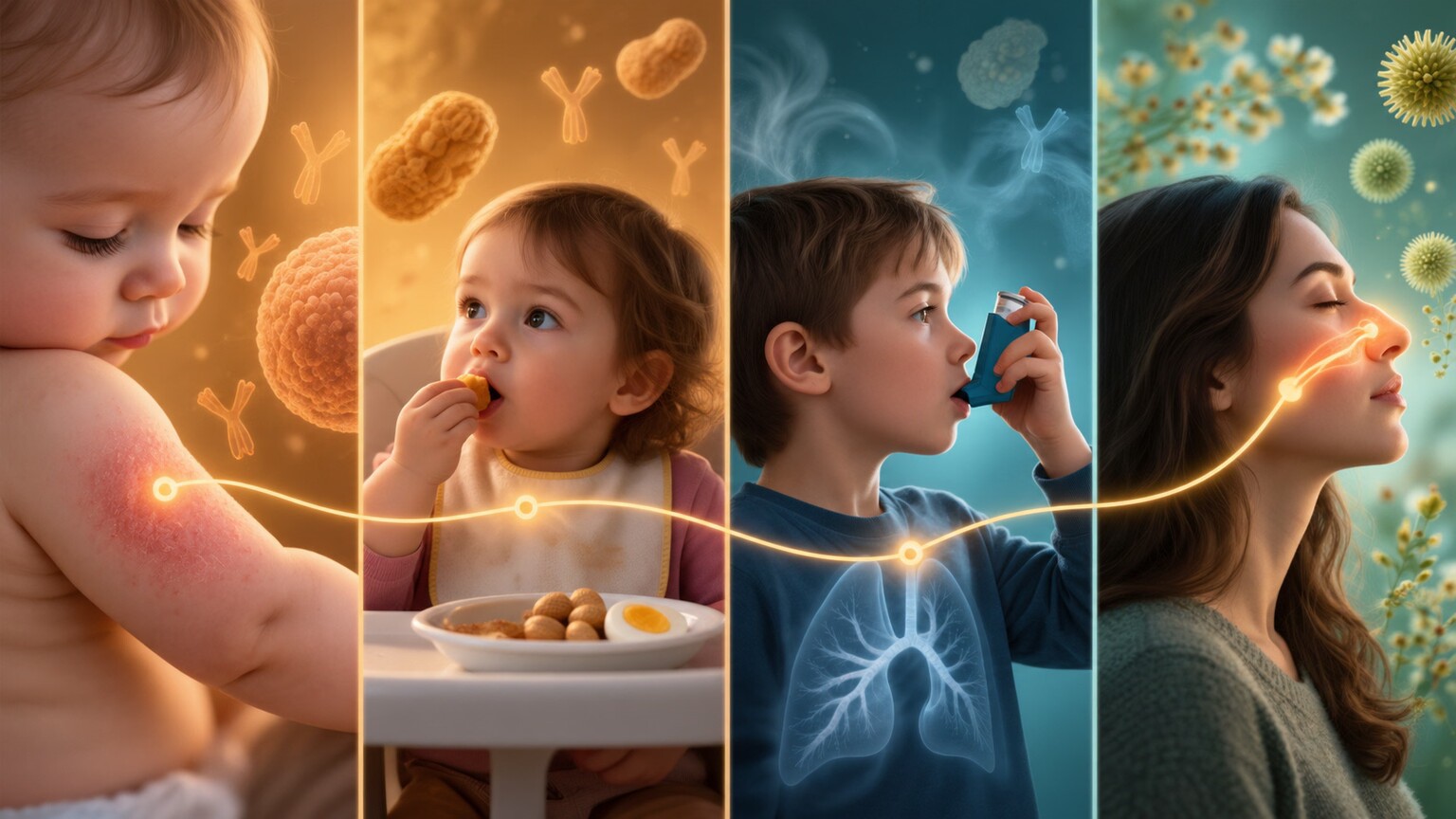
Figure 4. The atopic march describes a well-documented sequence in which eczema in infancy is often followed by food allergy, then asthma, and finally allergic rhinitis as a child grows older.
Allergic conditions very often don't ever appear in complete isolation from one another — they frequently follow a well-documented, predictable sequence called the atopic march, where a compromised skin barrier in infancy sets off a chain reaction of allergic sensitization that unfolds over years. It typically begins with eczema, a condition where the skin's protective barrier is measurably weaker than normal, allowing environmental proteins to penetrate the skin and encounter immune cells in a way that promotes allergic-type sensitization rather than tolerance. Food allergy frequently follows next, then asthma, and finally allergic rhinitis (chronic nasal allergy symptoms), each condition tending to emerge at a different, fairly predictable stage of childhood.
Understanding the atopic march reframes what can otherwise feel like a confusing pileup of unrelated diagnoses into a single, coherent immunological story: the same underlying tendency toward allergic-type immune responses is simply expressing itself through a different organ system at each life stage. This is also why aggressively treating eczema early in infancy, restoring the skin barrier as effectively as possible, has become an active area of research aimed at potentially interrupting the march before food allergy, asthma, or rhinitis ever get the chance to develop.
It's genuinely important to clearly understand that the atopic march really only describes a well-documented statistical tendency, not an inevitable, deterministic fate that every child with eczema is destined to follow step by step. Many children with mild eczema never go on to develop food allergy or asthma at all, and the march is best understood as identifying a population at meaningfully elevated risk for each subsequent step, useful for guiding monitoring and early intervention, rather than a prophecy guaranteed to play out identically in every individual case.
The specific mechanism connecting skin barrier dysfunction to later allergic disease has become considerably clearer in recent years, largely through research into a skin protein called filaggrin, which plays a central role in maintaining the skin's outer protective layer. Certain genetic variants that reduce filaggrin production are strongly associated with both eczema and a meaningfully higher risk of subsequently developing food allergy, giving researchers a concrete molecular thread connecting a skin problem to what might otherwise seem like an entirely unrelated food reaction happening months or years later. This filaggrin research is part of why some allergists now specifically ask about family history of eczema and skin barrier problems when evaluating an infant's overall allergy risk profile, rather than treating skin and food allergy as separate, disconnected concerns.
The march doesn't necessarily stop cleanly at allergic rhinitis in adolescence either — for some individuals, the same underlying allergic tendency continues expressing itself into adulthood through new sensitizations of exactly the kind discussed in the next section, meaning the march is perhaps better understood as an ongoing susceptibility that persists at some level throughout life, rather than a process with a hard, fixed endpoint in the teenage years.
New Adult-Onset Allergies: Why They Can Appear Seemingly Out of Nowhere

Figure 5. New allergic sensitization can develop at any age, including well into adulthood, once the immune system encounters a protein it hadn't previously been exposed to in a sensitizing way.
New allergies genuinely developing well into adulthood are considerably more common than most people assume, and they happen for a fairly intuitive underlying reason once you set aside the common assumption that allergies are strictly and exclusively a childhood phenomenon: sensitization requires a first meaningful exposure to a specific protein, and adults regularly encounter proteins they never meaningfully encountered as children. A move to a new region introduces entirely new local pollens. A new pet introduces a new set of animal proteins. Starting a new job in a bakery, a lab, or a hair salon introduces occupational allergens like flour dust, latex, or specific chemical compounds, entirely absent from a person's earlier life.
Hormonal shifts and changes in overall immune regulation across adulthood, particularly around pregnancy and perimenopause, have also been associated with new-onset allergic sensitization in some individuals, though the research connecting hormones directly to allergy development is still evolving and considerably less settled than the exposure-based explanations above. What's clear across the research is that there's no biological rule limiting IgE sensitization to childhood — the immune machinery capable of producing a new allergic response remains fully active for an entire lifetime.
Pet ownership genuinely deserves its own specific mention here as one of the more common, concrete triggers behind adult-onset sensitization, since acquiring a first pet as an adult — after having little or no meaningful exposure to that particular animal's dander and saliva proteins throughout childhood — creates exactly the kind of first-time, sustained exposure scenario that can lead to sensitization. This is part of why someone who grew up in a pet-free household can develop a genuine cat or dog allergy for the first time in their thirties or forties after finally getting their own pet, despite having occasionally been around other people's pets without incident earlier in life — the dose and duration of exposure in one's own home, day after day, is simply a different scale of contact than occasional, brief encounters.
Occupational allergies also represent yet another well-documented adult-onset category, arising specifically from repeated workplace exposure to a protein a person's immune system had never previously encountered in a sensitizing way. Bakers can develop a genuine allergy to the specific proteins in wheat flour dust after years of exposure, a condition sometimes called baker's asthma when it affects the lungs specifically. Healthcare workers historically developed latex allergy at meaningfully higher rates than the general population due to repeated glove exposure, a pattern that has become considerably less common since many healthcare settings shifted to latex-free gloves specifically in response to this recognized occupational risk. Hairdressers, laboratory workers handling animals, and bakers all represent recognized occupational groups where adult-onset sensitization to job-specific proteins is a well-established, studied phenomenon rather than an unusual anomaly.
Pollen-Food Syndrome: When an Old Pollen Allergy Creates a New Food Reaction

Figure 6. Birch pollen and raw apple share a structurally similar protein, which is why a long-standing birch allergy can eventually produce new mouth-tingling reactions to raw apple.
One of the genuinely more distinctive and unusual ways allergic sensitivities can shift over time is a condition called pollen-food syndrome, also sometimes referred to as oral allergy syndrome, where a long-standing pollen allergy eventually produces new symptoms to specific raw fruits and vegetables that share structurally similar proteins with that pollen. Someone with a birch pollen allergy, for example, can develop mild itching or tingling in the mouth after eating raw apple, peach, or hazelnut years after their pollen allergy was first diagnosed, because the immune system's existing anti-birch antibodies cross-react with a similarly shaped protein in these particular foods.
This pattern typically develops gradually, sometimes years after the original pollen sensitization, and it explains why someone can eat an apple safely for decades and then suddenly begin reacting — the food itself hasn't changed, but the underlying pollen allergy has, over time, matured into a broader cross-reactive pattern. Cooking usually resolves the problem entirely for pollen-food syndrome specifically, since the same heat-based protein unfolding discussed earlier with milk and egg also destroys the fragile, cross-reactive plant proteins responsible for this particular reaction, which is why baked apple or cooked hazelnut is typically well tolerated even when the raw form isn't.
Different regional pollens genuinely create different, well-documented food cross-reactivity patterns, which is a large part of why pollen-food syndrome looks noticeably different depending on precisely where in the world a given person actually lives. Birch pollen, common across much of the northern United States and Europe, cross-reacts with apple, peach, cherry, hazelnut, and carrot. Ragweed pollen, widespread across much of North America, more typically cross-reacts with melons, bananas, and zucchini. Grass pollen cross-reacts with tomato and, less commonly, certain other produce. Someone relocating between regions with different dominant pollens can, over time, develop an entirely different pollen-food cross-reactivity profile than the one they had in their previous location, layering yet another way geography specifically shapes how allergic sensitivity evolves across a lifetime.
It's also worth understanding why pollen-food syndrome typically causes milder, more localized symptoms — itching and tingling confined to the mouth and throat — compared to the systemic reactions sometimes seen with primary food allergies like peanut. The cross-reactive plant proteins responsible for pollen-food syndrome are generally less stable and less resistant to digestion than storage proteins like those in peanut, meaning they tend to break down quickly once swallowed and rarely make it far enough into the digestive process to trigger a more widespread reaction. This isn't a universal rule — a small subset of people do experience more significant reactions — but it explains the general pattern seen across most cases, and it's part of why pollen-food syndrome is generally managed differently, with far less emphasis on strict avoidance, than a primary food allergy like peanut typically requires.
Deliberately Changing a Sensitivity: What Oral Immunotherapy Actually Does
Not every meaningful shift in allergy sensitivity simply happens entirely on its own — oral immunotherapy is a structured, carefully supervised medical treatment specifically designed to deliberately retrain the immune system away from an allergic response, most commonly used for peanut allergy today. It works by giving a patient a tiny, carefully measured dose of the allergen, then gradually and incrementally increasing that dose over months under close medical supervision, allowing the immune system time to build a different, more tolerant type of response instead of the reactive IgE-driven one.
This process doesn't erase the original sensitization the way outgrowing a childhood allergy does — most patients who complete oral immunotherapy achieve what's called "desensitization" rather than true, lasting tolerance, meaning they can safely handle a meaningful dose of the allergen as long as they continue regular exposure, but the underlying sensitivity can return if that regular exposure stops for an extended period. This distinction between temporary desensitization and true, durable tolerance is one of the most clinically important nuances in modern allergy treatment, and it's a direct illustration of the same underlying principle running through this entire article: allergic sensitivity is an actively maintained state, not a permanent, unchangeable trait, and it can be intentionally shifted with the right sustained intervention.
A meaningfully smaller subset of patients who ultimately complete a full course of oral immunotherapy do go on to genuinely achieve what researchers specifically call "sustained unresponsiveness" — tolerating the allergen even after a deliberate pause in regular exposure, suggesting a genuine, more durable shift in the underlying immune response rather than a state that only holds up with constant reinforcement. Predicting in advance which patients will land in this more favorable category, versus the more common desensitization-only outcome, remains an active area of ongoing research, and it's part of why oral immunotherapy is generally framed to patients as a way to reduce the risk and severity of an accidental exposure reaction, rather than promised upfront as a guaranteed, permanent cure.
Sublingual immunotherapy, a closely related but genuinely distinct treatment approach using drops or dissolvable tablets placed directly under the tongue rather than swallowed whole, works through a broadly similar retraining principle and has become an established, well-studied treatment specifically for certain pollen and dust mite allergies, illustrating that this same deliberate-retraining concept extends well beyond food allergy alone into other categories of allergic sensitivity covered throughout this article.
What This Means for a Repeat Allergy Test That Looks Different
A specific IgE level that has genuinely dropped, risen, or disappeared entirely when compared against a previous test result is only rarely a simple laboratory error — it's usually an accurate reflection of exactly the kind of genuine immunological change this article has described. A falling number in a young child with a milk or egg allergy is often the earliest sign that natural resolution is underway, sometimes preceding the point where an oral food challenge would confirm it's safe to reintroduce the food under medical supervision. A rising number, or a new positive result for an allergen that was previously negative, can reflect a genuinely new sensitization, particularly relevant if it lines up with a recent move, a new pet, or a new job with an unfamiliar occupational exposure. And a number that's essentially unchanged across several years of retesting, especially for peanut, tree nut, or shellfish, is itself a meaningful and expected finding, consistent with exactly the kind of durable, stable sensitization those particular allergies are already known for.
It's worth remembering that the IgE number itself, whether rising or falling, is not a reliable stand-alone predictor of symptom severity or safety — a formal oral food challenge, conducted under medical supervision, remains the only way to confirm whether a change in lab numbers has actually translated into a genuine change in real-world reaction risk.
This is also precisely why practicing allergists generally recommend following a specific, deliberate retesting schedule rather than simply leaving the exact timing up to pure guesswork — typically every twelve to eighteen months for a child with a food allergy considered likely to resolve, timed to catch a meaningful downward trend without subjecting a child to unnecessary, overly frequent blood draws. For allergies considered less likely to resolve, like peanut, retesting is often spaced out further, reserved for situations where there's a specific clinical reason to reassess, such as a recent milder-than-expected accidental exposure that raises the question of whether the underlying sensitivity might be shifting.
Skin prick testing generally follows a broadly similar underlying logic to blood-based specific IgE testing specifically when it comes to tracking meaningful change over time, though the two don't always move in perfect lockstep with each other. A shrinking wheal size on repeat skin testing, alongside a falling blood IgE level, offers two independent pieces of evidence pointing the same direction, generally strengthening confidence that a genuine, meaningful change is underway rather than reflecting the normal minor fluctuation any single test can show between visits.
A Worked Example: One Person's Allergy Timeline Across Three Decades
Consider a child diagnosed with milk, egg, and peanut allergy at age two, all discovered after early exposure through solid foods, following the standard evaluation triggered by a reaction noticed at home. By age six, repeat testing shows the milk and egg IgE levels have dropped substantially, and a supervised oral food challenge confirms both foods can now be safely reintroduced — a textbook example of childhood allergy resolution following the heat-labile protein pattern described earlier in this article. The peanut allergy, by sharp contrast, remains essentially unchanged on every single retest performed throughout childhood and adolescence, entirely consistent with peanut's considerably more heat-stable, digestion-resistant storage proteins discussed above.
Fast forward to their late twenties: after relocating for work to a new region with an entirely unfamiliar local tree species, this same person develops a genuinely new birch pollen allergy, confirmed on testing only after an entire season of unexplained, persistent spring nasal symptoms that hadn't ever occurred before the move. Several years later still, now well into their mid-thirties, they notice a distinct, unmistakable tingling sensation in the mouth after eating a raw apple for the very first time — pollen-food syndrome emerging directly from that same, now well-established birch sensitization, exactly as described in detail earlier in this article. Across one lifetime, this single person's allergy profile has genuinely transformed three separate times, each shift traceable to a specific, well-understood biological mechanism rather than random chance.
Now picture this same exact person, in their early forties, adopting a cat for the very first time after years of living pet-free. Within several months, they begin noticing mild sneezing and itchy eyes whenever visiting friends with cats, eventually confirmed as a new cat allergy on testing — a fourth distinct shift, driven by the adult-onset sensitization mechanism covered earlier, from a first-time, sustained exposure to a protein their immune system had simply never encountered in a meaningful, repeated way before. Four separate allergy stories, spanning four different decades of life, four completely different underlying mechanisms — and yet every single one traces back to the same core biological principle this entire article has been building toward: allergic sensitivity is a living, ongoing process, actively shaped by exposure, age, and biology at every stage, never a single, fixed diagnosis handed down once and left unchanged for the rest of a person's life.
Frequently Asked Questions
Can adults outgrow allergies the same way children do?
Less commonly, but it does happen, particularly with milder sensitivities. The heat-labile milk and egg protein pathway that drives most childhood resolution is far less relevant to typical adult-onset allergies like pollen or occupational exposures.
Does a lower IgE number mean an allergy is definitely gone?
Not on its own. A falling IgE level is a meaningful, encouraging sign, but a supervised oral food challenge is the only way to confirm that a food can genuinely be reintroduced safely.
Why did I suddenly become allergic to a food I've eaten my whole life?
This is often pollen-food syndrome, where an existing pollen allergy gradually develops cross-reactivity with a structurally similar food protein, or a genuinely new sensitization from a change in exposure, health status, or hormones.
Is oral immunotherapy a permanent cure?
Usually not. Most patients achieve desensitization, meaning they can tolerate regular exposure to the allergen, but the underlying sensitivity can return if that regular exposure is stopped for an extended period.
What is the atopic march?
It's a documented pattern where eczema in infancy is often followed, in sequence, by food allergy, asthma, and allergic rhinitis as a child grows, reflecting an underlying allergic tendency expressing itself through different organ systems over time.
Conclusion
Allergy sensitivities change because the immune system's response to any given protein is an actively maintained, living process rather than a fixed trait set once and never revisited. Milk and egg often fade because their proteins fall apart with heat. Peanut, tree nut, and shellfish often persist because their proteins don't. New allergies appear whenever the immune system meets an unfamiliar protein for the first time, at any age. And treatments like oral immunotherapy show that this same process can, within limits, be deliberately guided. Every shift in your own allergy results over time has a real, specific explanation behind it — and understanding that explanation turns a confusing, seemingly inconsistent set of numbers into a coherent picture of exactly how your immune system has evolved.
The very next time an allergy test comes back looking noticeably different from what you remember, or from what a previous report once said, it's genuinely worth resisting the urge to treat that difference as a mistake or an anomaly. More often than not, it's simply your own immune system doing exactly what it's naturally built to do — continuing to respond, adapt, and recalibrate to the world it encounters, one single exposure at a time, for as long as you're alive.
Still Not Sure What Your Results Mean?
Upload your labs and get a complete, visual, plain-language interpretation of every biomarker — delivered to your inbox in under 15 minutes.
Get My ReportThis article is for educational purposes only and does not constitute medical advice. Always consult your healthcare provider regarding your specific lab results.