
Why Is My Specific IgE Elevated for a Food I Eat Regularly?
If your allergy panel came back showing an elevated specific IgE for a food you eat all the time with zero problems, the most likely explanation is something called sensitization without clinical allergy — your immune system has built antibodies against that food, but those antibodies aren't actually triggering a reaction in your body. This is one of the most common and most confusing findings in all of allergy testing, and it happens far more often than most people realize: research on food-specific IgE blood testing has found that roughly 50% to 60% of positive results don't correspond to a true, reaction-causing allergy when checked against the gold-standard test, an actual supervised food challenge. In other words, a positive number on a lab report and a real allergy are two different things, and the gap between them is wide enough that eating the food you supposedly react to, and having nothing happen, is expected and normal — not a fluke, not a lab error, and not something your body is "getting away with." The rest of this article walks through exactly why that gap exists, what's actually happening at the molecular level when this occurs, and what it means for what you should — and shouldn't — do next.
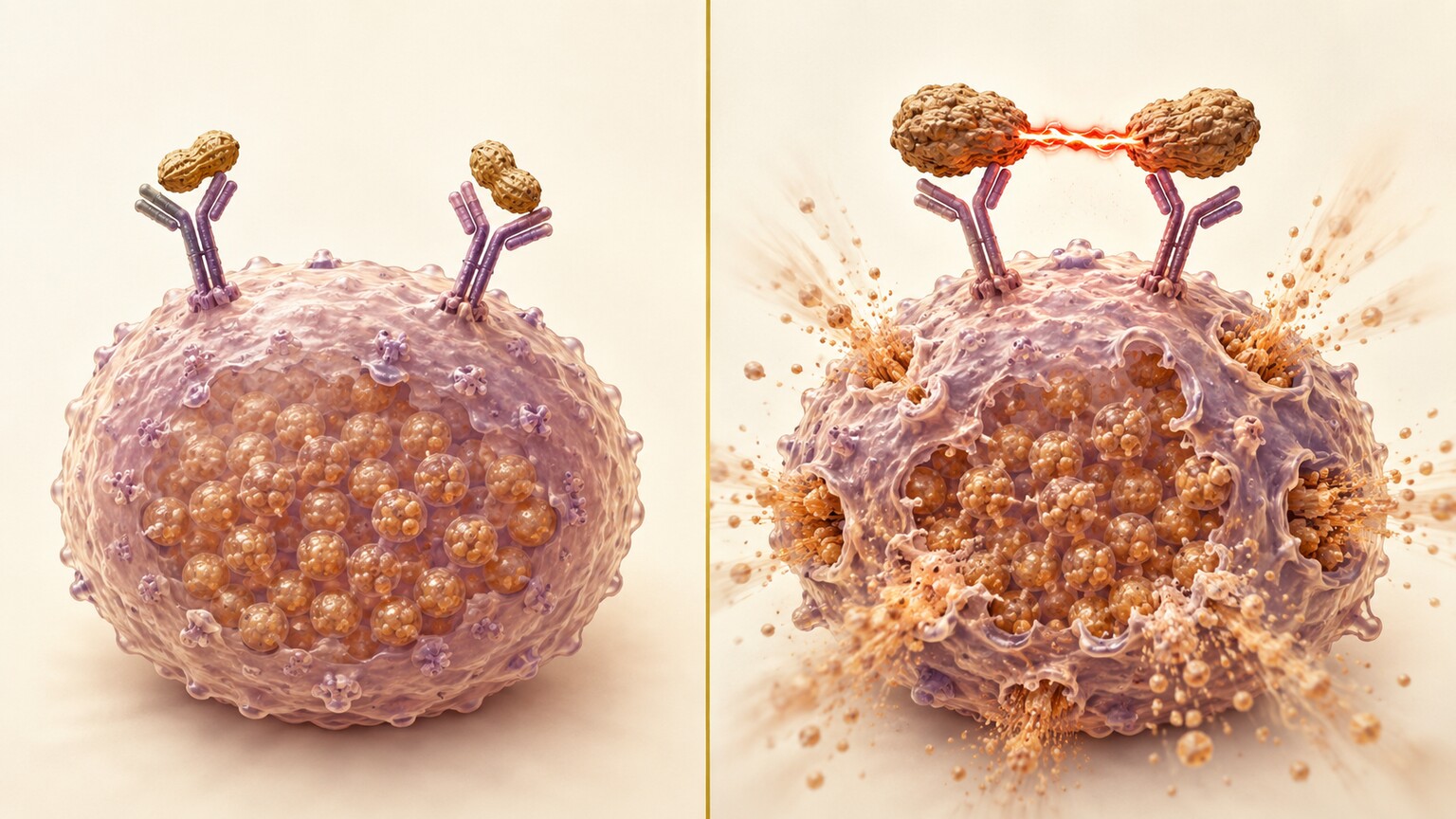
Figure 1. IgE antibodies can dock onto a mast cell's surface receptors without triggering degranulation, which is the biological basis of sensitization without clinical allergy.
What "Specific IgE" Actually Measures — and What It Doesn't
To understand why this happens, it helps to know exactly what a specific IgE blood test is checking for, because the name itself causes a lot of the confusion. IgE, short for immunoglobulin E, is one of five classes of antibodies your immune system makes — small Y-shaped proteins that float through your blood and latch onto specific targets, the same way a key fits a specific lock. Most of your antibodies are a different type, called IgG, which handle long-term immune memory against things like past infections and vaccines. IgE is different: it's the class of antibody your body evolved primarily to fight parasites, and it's also the antibody responsible for allergic reactions, because it has an unusual habit of parking itself on the surface of two particular types of immune cells — mast cells and basophils — like a loaded trigger waiting to be pulled.
A "specific IgE" test measures how much IgE your blood contains that is shaped to match one particular substance — in this case, a protein found in a specific food. When a lab reports "peanut IgE: 3.2 kU/L" or "egg white IgE: elevated," it is telling you, and only you, how much of that keyed antibody is circulating and available to dock onto the surface of your mast cells. What it is not telling you is whether those docked antibodies are actually causing anything to happen when you eat the food. That second part — the actual reaction — depends on an entirely separate biological step, and it's the step that determines whether you have a real allergy or just antibodies sitting quietly in the background. This distinction is the single most important thing to understand about any specific IgE result, and it's also the piece that gets left out most often when people see their own lab report for the first time.
Sensitization vs. Allergy — Why Having the Antibody Isn't the Same as Having the Reaction
In clinical immunology, doctors draw a hard line between two words that sound like synonyms in everyday conversation but mean very different things on a lab report: sensitization and allergy. Sensitization simply means your immune system has been exposed to a substance and has built IgE antibodies against it — nothing more. Allergy means those antibodies are actually causing a reaction when you're exposed to that substance again. Every person with a true food allergy is sensitized, but the reverse is not true: plenty of people are sensitized to a food without being allergic to it at all, and that population is large. Studies estimate that somewhere between 8% and 25% of the general population carries detectable food-specific IgE antibodies to at least one food, while true, clinically reactive food allergy affects a much smaller slice — around 6% to 8% of children and roughly 4% of adults in the United States. That gap between "has the antibody" and "actually reacts" is exactly where a result like yours lives.
Think of it the way a security system works in a building. Sensitization is like having a motion sensor installed and wired up — the hardware is there, armed, and technically capable of setting off an alarm. But an armed sensor only trips the alarm if something crosses its beam with enough force and in the right way. A moth fluttering past it might not register at all; a person walking directly through the doorway will set it off instantly. Your immune system's IgE antibodies work the same way: having them present and "wired up" on your mast cells is the sensitization. Whether eating the food actually "crosses the beam" strongly enough to trigger a reaction is a completely separate question, governed by how much allergen protein reaches those cells, how tightly and in what pattern the antibodies grab onto it, and how easily your particular mast cells are provoked into firing.
Curious what the rest of your allergy panel is telling you? Upload your results and get a complete, plain-language breakdown in under 15 minutes.
Analyze My ResultsThe Mast Cell Threshold — Why "Docked" Doesn't Always Mean "Fired"
The actual trigger for an allergic reaction happens on the surface of a mast cell, a type of immune cell stationed throughout your skin, airways, and gut lining, packed with granules full of histamine and other inflammatory chemicals — think of it as a cell carrying a bag of firecrackers, ready to detonate the moment the right signal arrives. IgE antibodies specific to a food attach to receptors on the mast cell's surface, essentially arming it. But arming the cell and firing it are two different events. For the mast cell to actually release its histamine — the step that produces hives, swelling, itching, or in severe cases, anaphylaxis — the food protein has to arrive in a specific way: it needs to bind and physically bridge two or more of those IgE antibodies together at once, a process called cross-linking. A single antibody grabbing a single protein molecule generally isn't enough. It's closer to needing two hands to pull a trigger rather than one; if the protein can't grab two neighboring antibodies simultaneously and pull them together, the cell stays quiet no matter how much IgE is sitting on its surface.
This is a big part of why the amount of IgE on a lab report doesn't map cleanly onto symptoms. A person can have a large number of antibodies "armed" and ready, but if the amount of allergen protein that actually reaches those cells during a normal meal is small, or if the protein's shape doesn't lend itself well to cross-linking multiple antibodies at once, the mast cell may never cross the threshold needed to fire. Eating the food regularly, in normal amounts, without ever supplying enough of the right kind of protein exposure to trip that threshold, is entirely consistent with carrying a positive — even a fairly high — specific IgE result while feeling completely fine every time you eat it.

Figure 2. Regularly eating a food without any symptoms, even with a positive specific IgE result, is a common and expected pattern in food sensitization.
Peanut is one of the best-studied examples of this exact scenario. Large birth-cohort and allergy-clinic studies have repeatedly found that a meaningful share of people with a positive peanut-specific IgE blood test — sometimes reported alongside a positive skin prick test too — go on to pass a supervised oral food challenge without any reaction at all, meaning they can eat peanut in a real-world quantity with no symptoms whatsoever, despite the antibody being clearly present in their blood. The same pattern shows up with milk, egg, wheat, soy, and tree nuts. None of this means the lab result was wrong or the testing method failed; the antibody genuinely is there. It simply means the antibody's presence, on its own, isn't the same piece of information as "this food will make you sick."
This also explains something that trips a lot of people up: how the same food, tested twice years apart, can show a rising number on paper while your actual eating experience never changes. Specific IgE levels can drift upward with ongoing low-level exposure to a food, particularly through skin contact or inhaled particles in addition to eating, without that rise ever translating into a lower threshold for a reaction. The number tracking upward on a report is real, but it is tracking the size of the "armed" antibody pool, not directly tracking how close you are to an actual clinical reaction.
Cross-Reactivity — When Your Immune System Confuses Two Different Proteins
A second major reason a food-specific IgE test can come back elevated for a food that never bothers you involves a phenomenon called cross-reactivity, and it's especially common with plant-based foods. Proteins in nature aren't unique inventions for every single species — many plants, and even some pollens, share proteins that are structurally very similar to one another, built from nearly the same three-dimensional shape even though they come from completely different organisms. Your immune system's antibodies recognize shape, not species. An IgE antibody that your body built specifically to recognize a protein in birch tree pollen, for example, can also recognize a very similarly shaped protein that happens to exist in apples, hazelnuts, celery, carrots, or peanuts — not because you're allergic to those foods, but because the antibody can't always tell the difference between two proteins that happen to look almost identical at the molecular level.
This specific pattern has an official name: pollen-food syndrome, sometimes called oral allergy syndrome. It's extremely common in people with seasonal pollen allergies, and it produces exactly the confusing lab pattern you may be looking at: a blood test shows a clearly positive, sometimes even strongly positive, specific IgE to a food like peanut, hazelnut, or apple — while the person has eaten that exact food regularly for years, often in its cooked or processed form, without a single reaction. The antibody is real and detectable; it's just aimed at a cross-reactive plant protein that behaves differently in the body than the protein responsible for classic, dangerous food allergy.

Figure 3. Birch pollen and foods like hazelnut, apple, and peanut share structurally similar proteins, which can cause an IgE antibody built against pollen to also flag as positive against the food.
The reason this matters so much for interpreting your own result is that the food protein responsible for this cross-reactive pattern usually belongs to a family of proteins that break down quickly when they're cooked, digested, or exposed to stomach acid. That fragility is the biological reason cross-reactive food sensitization rarely causes a serious reaction: by the time the protein has been chewed, swallowed, and hit your digestive tract, it has often already lost the exact three-dimensional shape your antibody was built to recognize, so it never reaches your mast cells intact enough to trigger cross-linking. This is a completely different situation from the food proteins responsible for genuine, dangerous food allergy, which brings us to one of the most useful advances in this area of testing.
Why the Route of Exposure Can Matter as Much as the Food Itself
One more piece of the puzzle helps explain why a person can end up sensitized to a food they've been safely eating for years: the immune system doesn't always meet a food for the first time through the mouth. Researchers now believe that how and where the body first encounters a food protein — not just whether it's eaten — plays a major role in whether that encounter produces tolerance or sensitization. This idea, sometimes called the dual allergen exposure hypothesis, holds that low-dose exposure to a food protein through broken or inflamed skin tends to favor the immune system building IgE antibodies against it, while regular exposure through the digestive tract, especially early and consistently, tends to favor tolerance instead. In practice, this means a baby with eczema, whose skin barrier is compromised and who is regularly around crumbs of peanut, egg, or wheat in the household environment without ever eating those foods directly, can end up building IgE antibodies against them through the skin route long before ever taking a first bite. Later, when that same food is finally introduced by mouth and tolerated without incident, the antibody built years earlier through skin exposure can still show up on a blood test, even though the food itself has never once caused a problem when eaten.
This also explains part of why people with a strong personal or family history of eczema, asthma, or seasonal allergies — collectively referred to as atopy — tend to show more of these confusing, sensitized-but-tolerant patterns on food IgE panels than people without that background. A skin barrier that's more permeable, sometimes due to inherited differences in a skin protein called filaggrin, allows more environmental protein to seep through and reach the immune system's antibody-producing cells, increasing the odds of sensitization happening through that route rather than the digestive one. None of this changes what to do about a specific result today, but it does help explain, on a deeper level, why "the antibody is there but the food is fine" is such a recognized and expected pattern in modern allergy medicine rather than a strange exception. It also underscores why current pediatric guidelines have shifted toward earlier, regular dietary introduction of allergenic foods in infancy — deliberately routing that first meaningful exposure through the gut, where tolerance is favored, rather than leaving it to chance through the skin.
Class 1 vs. Class 2 Food Allergens — Why Not Every Food Protein Behaves the Same Way
Allergists divide food allergens into two broad categories based on how they behave once they're inside your body, and understanding this split explains a huge amount of why some positive food IgE results matter clinically and others don't. Class 1 food allergens are typically storage proteins — dense, compact, chemically stable molecules that plants and seeds use to store nutrients. These proteins are built to survive: they resist heat, resist stomach acid, and resist the digestive enzymes trying to break them down. Because they arrive at your immune system's doorstep still fully intact, they're the proteins most capable of triggering the real cross-linking event on a mast cell that leads to a genuine allergic reaction — hives, swelling, vomiting, or worse. Class 1 allergens are also usually the primary sensitizer, meaning the immune system built its antibody directly against that exact food protein, not against a pollen look-alike.
Class 2 food allergens are a different story. These tend to be more delicate, structurally similar proteins — often part of a plant's own defense or growth system — that are far more fragile and easily destroyed by heat and digestion. As described above, these are usually the proteins responsible for pollen-food cross-reactivity. Because they fall apart before they can reliably reach and cross-link mast cell receptors in a meaningful way, reactions to Class 2 allergens tend to be mild when they happen at all, often limited to brief itching or tingling in the mouth right after eating the raw form of a food, and they frequently don't happen at all when the food is cooked. If your elevated specific IgE is aimed at a Class 2, cross-reactive protein rather than a Class 1 storage protein, that's a strong biological explanation for why eating the food regularly produces nothing.
Component-Resolved Diagnostics — Testing the Individual Protein, Not Just the Whole Food
For years, this was largely a theoretical distinction that allergists could explain but not directly test for — a standard specific IgE test measures your antibody response to an entire food extract, which is a mixture of dozens of different proteins all lumped together into one number. That's a major limitation, because it means a "peanut IgE" result can't tell you, on its own, whether your antibody is aimed at a dangerous storage protein or a harmless pollen look-alike. This is where a newer, more precise form of testing — called component-resolved diagnostics — has changed the picture significantly. Instead of testing your blood against the whole, mixed food extract, component testing isolates individual proteins within that food and measures your IgE response to each one separately.

Figure 4. Component-resolved testing can separate a stable storage protein like Ara h 2, which correlates with true peanut allergy, from a fragile, cross-reactive protein like Ara h 8.
Peanut is the textbook example, because its components are so well characterized. Ara h 2 is one of peanut's Class 1 storage proteins — stable, resistant to digestion, and strongly associated with real, reaction-causing peanut allergy on oral food challenge. Ara h 8, on the other hand, is peanut's PR-10 protein, structurally related to Bet v 1, the major birch pollen allergen — a fragile Class 2 protein that's a hallmark of cross-reactive, low-risk sensitization rather than true allergy. Two people can both show a positive "peanut IgE" on a standard test, and yet one of them is positive almost entirely because of Ara h 2, carrying real risk, while the other is positive almost entirely because of Ara h 8, carrying very little risk and often able to eat peanut, especially cooked or baked peanut, without any issue. Component testing is what makes that distinction visible on paper instead of leaving it as a guess. If your standard specific IgE for a food is positive and you eat that food regularly without symptoms, asking your allergist whether component-resolved testing is available and appropriate for that specific food is one of the most useful next steps you can take — it often turns an ambiguous number into a much clearer answer.
Cross-Reactive Carbohydrate Determinants — A Separate Source of Misleading Positives
There's a second, more technical reason a specific IgE test can come back positive without any real clinical meaning, and it has nothing to do with pollen at all — it involves a set of sugar structures called cross-reactive carbohydrate determinants, often abbreviated CCDs. These are small carbohydrate chains attached to many different plant and even insect proteins, and some people's immune systems build IgE antibodies against these particular sugar structures rather than against any specific food protein itself. Because the exact same carbohydrate structure appears, essentially unchanged, on proteins from dozens of unrelated plants, an antibody built against a CCD will register as "positive" on a standard IgE test for a huge number of different foods and pollens simultaneously, whether or not the person has ever had any reaction to any of them.

Figure 5. A single shared sugar structure, the cross-reactive carbohydrate determinant, can cause an IgE test to flag positive across many unrelated foods and pollens at once.
CCD-driven positives are considered one of the classic sources of clinically irrelevant results in food IgE testing, precisely because they tend to produce broad, sweeping panels of positives — a person might show low-to-moderate positive IgE against a long list of fruits, vegetables, tree pollens, and even insect venoms all at once, a pattern that would be biologically unusual for a real, food-specific allergy but is exactly what CCD sensitization looks like. If your report shows an elevated result to a food you eat regularly, and you also notice that several other, seemingly unrelated plant foods or pollens on the same panel are flagged as positive despite you having no reaction to any of them, CCD sensitization is a reasonable explanation worth raising with an allergist, since specific blood tests exist that can check for CCD reactivity directly and help clear up whether that's what's driving the pattern.
Why the Actual Number on Your Report Isn't a Reliable Predictor by Itself
It's tempting to look at a specific IgE result the way you might look at a cholesterol number — assuming a higher number always means "more of a problem." Food-specific IgE doesn't work that cleanly. Researchers have tried to establish IgE levels above which a person is likely — statistically, not certainly — to react on an oral food challenge, sometimes called predictive decision points, and they exist for a handful of well-studied foods like egg, milk, and peanut. But these decision points were built from population-level statistics and shift depending on age, the specific test platform used, and the individual food; they were never intended to replace an actual challenge for any one specific person, and even they come with meaningful overlap — some people above the statistical cutoff still tolerate the food, and some people below it still react.
What the number is genuinely useful for is trend-tracking within the same person over time, and for helping an allergist decide how confident they feel about skipping a supervised food challenge versus recommending one. A result that has been falling year after year in someone who has never reacted is one kind of story; the same falling trend combined with a history of actual reactions is a very different one. Context — your history of actually eating the food, any symptoms you've ever had, your age, and other testing — always outweighs the raw number sitting by itself on a page. This is exactly the kind of number that benefits from being read alongside everything else in your results rather than in isolation, which is part of why a plain-language, full-panel breakdown tends to be more useful than staring at a single line item.
What an Allergist Will Likely Do With a Result Like This
If you bring a result like this to an allergist — a positive specific IgE for a food you already eat regularly without any symptoms — the most likely next step isn't more blood work; it's a conversation about your actual eating history, followed potentially by an oral food challenge, which remains the true gold standard for diagnosing or ruling out a food allergy. During a supervised oral food challenge, you eat gradually increasing, measured amounts of the food in question in a clinical setting equipped to manage a reaction if one occurs, while trained staff monitor you closely the entire time. Because you're already eating this food at home without any issue, many allergists will feel comfortable simply confirming that history rather than repeating it formally in-office — but for foods with any ambiguity, or for younger children, a supervised challenge gives a definitive, first-hand answer that no blood test can fully replace.

Figure 6. An oral food challenge, where measured amounts of the food are eaten under medical supervision, remains the definitive way to distinguish sensitization from true allergy.
An allergist may also order, or you may already have, a skin prick test alongside the blood test. Skin testing and blood testing measure IgE through two different methods — one exposing a small amount of allergen directly to your skin and watching for a local wheal-and-flare reaction, the other measuring circulating antibody in a blood sample — and while they usually agree with each other, they don't always, and a mismatch between the two can itself be useful diagnostic information. Where available, component-resolved testing, discussed above, is increasingly the next logical step for exactly this scenario, since it can often explain the discrepancy without needing to put you through a formal challenge at all. Newer tools like the basophil activation test, which measures whether your basophils actually respond and release chemicals when exposed to the food protein in a lab setting rather than just checking whether the antibody is present, are also becoming more available in specialized allergy centers and can add another layer of clarity, particularly in ambiguous cases.
Should You Stop Eating the Food Just to Be Safe?
It's a natural instinct to want to play it safe and cut out a food the moment a lab report flags it, but for a food you're already eating regularly without any symptoms, doing that isn't automatically the safer choice — and it can sometimes work against you. Ongoing, tolerated exposure to a food is part of what keeps the immune system's tolerance mechanisms actively engaged; removing a food you've been safely eating doesn't reliably "protect" you from a reaction and, in some documented cases, has been associated with a food that was previously tolerated becoming harder to reintroduce later, precisely because regular exposure was part of what was keeping the reaction threshold high. This doesn't mean the number should be ignored — it means the decision about whether to change your diet belongs in a conversation with an allergist who can weigh your full history, not made alone based on one line of a lab report.
The one clear exception is if you notice any pattern change — new symptoms after eating the food that weren't there before, even mild ones like tingling, itching, stomach upset, or hives, especially if they show up more than once. That kind of change is worth bringing to a doctor promptly regardless of what any blood test says, because a developing reaction pattern in real life carries more weight than a stable lab number. Short of that, an elevated specific IgE to a food you're already eating without incident is generally not, by itself, a reason to eliminate that food from your diet.
Frequently Asked Questions
Could this be a lab error, or does an elevated result always mean something real?
The antibody itself is almost always real — modern specific IgE testing is a reliable, well-validated laboratory method, and a positive result genuinely reflects that your immune system has built IgE against that food's proteins. What varies is the clinical meaning of that antibody, not whether it exists. A "false positive" in this context usually doesn't mean the lab made a mistake; it means the antibody is present but isn't associated with an actual reaction, for one of the biological reasons described above.
Can this change over time — could I react to this food in the future even though I don't now?
It's possible, though for someone with a long, stable history of tolerating a food, it's not the most likely outcome. Sensitization patterns can shift, particularly in children whose immune systems are still developing, and particularly with ongoing seasonal pollen exposure in cross-reactive cases. This is exactly why any new or changing symptoms after eating a previously well-tolerated food are worth mentioning to a doctor, even if the food has never caused problems before.
Why would a doctor order this test in the first place if I wasn't having symptoms with the food?
Specific IgE panels are frequently ordered as part of a broader workup for unrelated symptoms — chronic eczema, unexplained hives, seasonal allergy symptoms, or a reaction to a different food — and a panel often tests many foods at once rather than just the one in question. It's very common for a food you eat safely every day to simply be included on a standard panel alongside the foods actually being investigated, which is part of why an incidental positive for a "safe" food shows up as often as it does.
Is component-resolved diagnostic testing something I need to specifically ask for?
In most cases, yes. It's not always the default test ordered, and availability can depend on the specific food and the lab or allergy center involved. If your standard specific IgE result for a well-tolerated food is confusing you, asking your allergist directly whether component testing exists for that particular food, and whether it would help clarify your result, is a reasonable and increasingly common request.
My baby has eczema and hasn't eaten this food yet, but tests positive — should we avoid introducing it?
This is a conversation to have directly with a pediatric allergist rather than deciding on your own, since current guidance generally favors early, deliberate introduction of allergenic foods, even in babies with eczema, often specifically because delaying introduction can allow skin-route sensitization to build without the counterbalance of tolerogenic exposure through eating. An allergist can advise on whether an in-office supervised first taste is the safer route for your specific situation.
Conclusion
An elevated specific IgE for a food you eat all the time without any trouble is one of the more common findings in allergy testing, and it almost always comes down to the same underlying idea: having the antibody and having the reaction are two separate biological events, and a standard blood test can only ever confirm the first one. Whether that's because your mast cells simply never receive enough of the right protein to cross a reaction threshold, because your antibody is actually aimed at a fragile, cross-reactive plant protein picked up from pollen exposure rather than the food itself, or because a shared carbohydrate structure is triggering a broad, low-relevance positive across an entire panel, the pattern of "positive test, no real-world symptoms" is well documented and well understood in the allergy literature. Your own eating history — years of a food causing nothing — carries real diagnostic weight, and in most cases it should be discussed with, not overridden by, a single number on a page. If anything about your results still feels unclear, an allergist who can walk through your full history alongside component-level testing, where available, is the most direct path to a confident answer.
Still Not Sure What Your Results Mean?
Upload your labs and get a complete, visual, plain-language interpretation of every biomarker — delivered to your inbox in under 15 minutes.
Get My ReportThis article is for educational purposes only and does not constitute medical advice. Always consult your healthcare provider regarding your specific lab results.