
Why Would a Doctor Check IgG Subclasses Specifically?
A standard immunoglobulin panel reports total IgG as one single number, which is usually all a doctor needs to know. But total IgG is really a combined sum of four distinct subtypes — IgG1, IgG2, IgG3, and IgG4 — and in specific situations, that single combined number can look entirely normal while hiding a genuine, clinically meaningful deficiency in just one of the four. Understanding why a doctor would move past the standard total and order a more detailed subclass breakdown tells you a great deal about what's actually being investigated. This article walks through the specific situations that lead to IgG subclass testing: recurrent infections that don't add up despite a normal total IgG, investigating suspected specific antibody deficiency, evaluating for common variable immunodeficiency, IgG4-related disease as an entirely different reason for ordering the same test, children with frequent sinus and ear infections, why a normal total IgG doesn't rule out a subclass-specific problem, how subclass testing fits into a broader immune evaluation, and what a low subclass result actually means for what happens next.
Why a Normal Total IgG Can Still Hide a Real Problem

Figure 1. Total IgG is a sum of four unequal subclasses; IgG1 alone typically makes up more than half the total, meaning a deficiency in a smaller subclass can hide almost completely behind a normal combined number.
The four IgG subclasses aren't present in equal amounts. IgG1 typically makes up more than half of total circulating IgG, with IgG2 contributing a substantial share, and IgG3 and IgG4 making up much smaller portions. Because of this uneven distribution, a person can have a genuinely, clinically significant deficiency in one of the smaller subclasses, particularly IgG2 or IgG4, while their total IgG still reads as comfortably normal, since the deficient subclass never contributed much to the total sum in the first place.
This straightforward mathematical reality is exactly why subclass testing exists as its own distinct, separately ordered test rather than something a standard immunoglobulin panel could ever automatically derive or calculate on its own without direct, dedicated measurement. A doctor who already has a specific, well-founded clinical reason to genuinely suspect a subclass-level problem — usually a real, documented pattern of recurrent infections that a comfortably normal total IgG simply doesn't manage to explain — goes on to order the more detailed breakdown specifically because that combined number has already come back reassuring and still hasn't actually answered the real question being asked.
Recurrent Infections That Don't Add Up

Figure 2. A pattern of unusually frequent, severe, or slow-to-resolve infections, especially sinus and respiratory infections, is the most common clinical trigger for ordering IgG subclass testing.
The single most common reason IgG subclass testing gets ordered is a pattern of infections that's genuinely, noticeably beyond what's typical — not simply "gets colds often," but recurrent sinus infections, ear infections, or pneumonia that happen more frequently, last longer, or respond more slowly to antibiotics than would be expected. When this specific pattern genuinely shows up in someone whose overall total IgG has already come back reassuringly normal on standard testing, subclass testing becomes the logical, sensible next step to pursue, since it's genuinely capable of revealing a real deficiency that the combined total number was, by its very mathematical structure, fully capable of hiding from view all along.
Doctors specifically look for a rough, well-known clinical pattern sometimes summarized loosely as "eight or more ear infections in a single year, two or more genuinely serious sinus infections in a year, two or more months spent on antibiotics with little to no real effect, or two or more separate pneumonias in one year" as a reasonable general threshold worth actively investigating further, though the exact specific numbers ultimately matter considerably less than the overall trend of infections clearly being more frequent and more severe than would be reasonably expected for that particular person's age, health, and everyday circumstances.
Curious what your own immunoglobulin panel is actually telling you? Upload your results and get a complete, plain-language breakdown in under 15 minutes.
Analyze My ResultsInvestigating Suspected Specific Antibody Deficiency

Figure 3. Specific antibody deficiency often involves a weak IgG2 response to the sugar-based capsules of certain bacteria, tested directly by measuring antibody levels before and after a pneumococcal vaccine.
Specific antibody deficiency is a condition where someone has a normal or near-normal total IgG and even normal subclass levels, but still fails to mount an adequate antibody response to a particular category of target: the polysaccharide (sugar-based) outer coatings found on certain bacteria, including the type responsible for many cases of pneumonia and sinus infections. IgG2 is genuinely the subclass most heavily involved in mounting an effective response to these particular polysaccharide antigens, which is exactly why IgG2 levels specifically are so often checked directly as part of thoroughly investigating this particular condition.
The actual diagnostic test for this condition goes a meaningful step further than simply measuring subclass levels at rest — it involves carefully measuring antibody levels against a specific panel of pneumococcal bacterial serotypes, both before and then again several weeks after a pneumococcal vaccine, specifically to see whether the immune system genuinely mounts an adequate, protective antibody response when it's directly and deliberately challenged in this controlled way. A genuinely weak vaccine response, combined with an already-established pattern of recurrent bacterial sinus and respiratory infections, is what actually confirms this specific diagnosis in the end, with subclass testing serving as just one supporting piece of that larger overall clinical picture rather than being the single, complete answer entirely on its own.
Evaluating for Common Variable Immunodeficiency

Figure 4. Common variable immunodeficiency involves broadly reduced antibody production across multiple immunoglobulin classes and subclasses, usually diagnosed in adolescence or adulthood after recurrent infections.
Common variable immunodeficiency, or CVID, is one of the more frequently diagnosed primary immunodeficiencies in adults, involving broadly reduced levels of IgG, and often IgA and IgM as well, alongside a genuinely impaired ability to mount effective antibody responses to infections and vaccines. IgG subclass testing plays a supporting role in this workup, since subclass patterns can help characterize exactly how the deficiency presents and, in some cases, hint at which specific underlying genetic or immune pathway is involved.
CVID is typically diagnosed considerably later in life than many other primary immunodeficiencies, often not until the teenage years or well into adulthood, and sometimes only after a person has already quietly endured years of recurrent infections that were previously, mistakenly attributed to simply being unlucky, run down, or having a generally weak immune system in a vague, undefined sense rather than a specific, identifiable condition. A confirmed CVID diagnosis changes ongoing management quite meaningfully once it's finally established, often leading directly to regular, scheduled immunoglobulin replacement therapy, which supplies the specific antibodies the body simply isn't reliably producing enough of on its own, considerably reducing the frequency and severity of future infections going forward.
IgG4-Related Disease: A Completely Different Reason to Order the Same Test

Figure 5. IgG4-related disease involves elevated, not deficient, IgG4 levels, driving chronic inflammation and tissue swelling in organs like the pancreas, salivary glands, or bile ducts.
Not every reason for checking IgG subclasses involves looking for a deficiency. IgG4-related disease is an entirely separate condition where the IgG4 subclass specifically is elevated, not low, and where elevated IgG4-producing cells infiltrate and cause chronic, often mass-forming inflammation in various organs, including the pancreas, salivary glands, bile ducts, kidneys, and lungs. Elevated IgG4 levels, when combined with characteristic, recognizable findings on both imaging studies and tissue biopsy, together support this specific diagnosis, one that can otherwise be genuinely mistaken for cancer given how convincingly it can present as discrete tissue masses in whichever organs happen to be affected.
This particular condition illustrates an important, genuinely easy-to-miss point about subclass testing more broadly: the exact same test can be ordered for entirely opposite clinical reasons depending on the surrounding picture — sometimes specifically to find a deficiency responsible for recurrent infections, and sometimes instead to find an outright excess actively driving chronic inflammatory organ disease elsewhere in the body. The specific subclass and the specific clinical question being asked shape how the exact same laboratory result gets interpreted entirely differently.
Children With Frequent Sinus and Ear Infections
Pediatric patients represent a specific population where IgG subclass testing comes up frequently, since recurrent ear infections and sinus infections are common enough in young children that distinguishing normal childhood illness frequency from a genuine underlying immune problem takes careful clinical judgment. IgG2 deficiency in particular is more often identified in children than in adults, sometimes resolving on its own as a child's immune system continues maturing, a pattern called transient hypogammaglobulinemia of infancy in some cases.
Because of this real possibility of natural, spontaneous resolution, a confirmed subclass deficiency identified in a young child doesn't automatically imply a lifelong, permanent condition — pediatric immunologists will often go ahead and recheck subclass levels periodically over time, since a genuine, meaningful share of childhood-identified deficiencies do eventually normalize as the child continues to get older, while a separate share persist and go on to require ongoing, longer-term management well into adulthood instead.
How Subclass Testing Fits Into a Broader Immune Workup
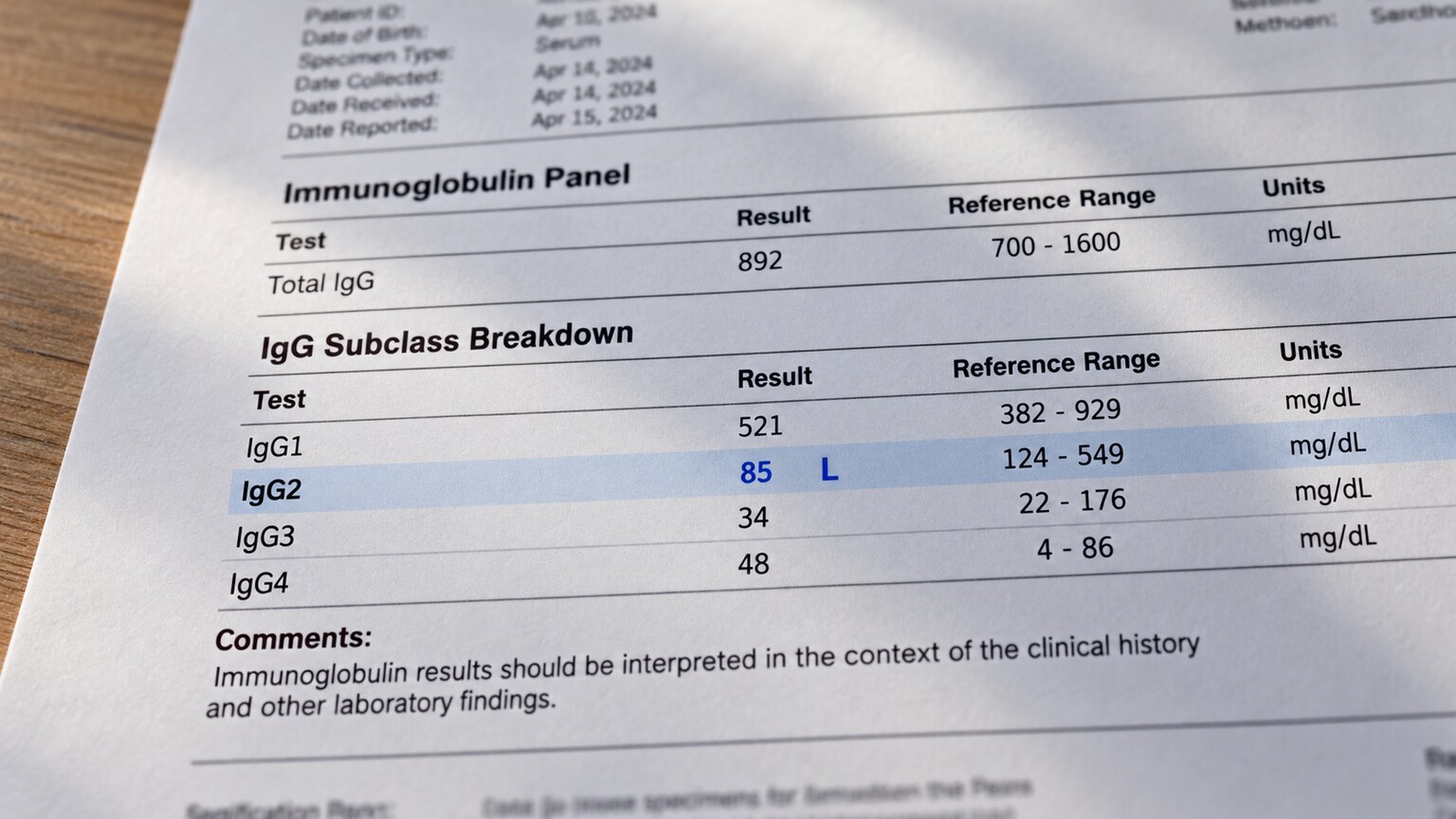
Figure 6. A subclass breakdown report can show a normal total IgG sitting directly beside one individually flagged low subclass, the specific pattern that makes this test worth ordering in the first place.
IgG subclass testing is rarely ordered as a standalone, first-line test. It typically follows an initial workup that already includes a complete blood count, a total immunoglobulin panel (IgG, IgA, and IgM), and a review of vaccine response history, once that initial workup hasn't fully explained a genuine pattern of recurrent infections. Subclass testing adds a more granular layer of detail once the broader picture has already raised a specific, reasonable suspicion worth pursuing further.
Additional testing frequently ordered alongside or shortly after subclass levels themselves includes measuring specific antibody responses to vaccines already previously received, T-cell function testing whenever a broader immune problem extending beyond antibodies alone is genuinely suspected, and, in certain cases, targeted genetic testing when one specific inherited immunodeficiency syndrome is being seriously considered as the underlying explanation. This layered, deliberately step-by-step approach reflects how immunodeficiency workups generally, methodically proceed in real clinical practice — starting out genuinely broad and general in scope, then gradually narrowing toward increasingly specific, more targeted tests as each individual result either satisfactorily explains the overall clinical picture, or instead rules out one possibility and clearly points the workup toward the next logical step.
What a Low Subclass Result Actually Means for Next Steps
A confirmed low IgG subclass, on its own, doesn't automatically require treatment. Many people who carry a mildly low subclass level, particularly IgG4, which naturally and quite normally runs low in a meaningful share of otherwise perfectly healthy people, never actually go on to develop clinically significant infections at all, and genuinely need no specific intervention whatsoever beyond ordinary, routine monitoring over time. Treatment decisions depend considerably more on the actual, full clinical picture in front of the doctor — the true severity and frequency of infections, and the specific results from the vaccine-response testing already described earlier in this article — than on the raw subclass number itself, viewed entirely in isolation from everything else.
When a subclass deficiency is ultimately confirmed to be genuinely clinically significant after proper evaluation, the available management options can range anywhere from simply treating individual infections more aggressively as they happen to occur, to daily prophylactic antibiotics specifically taken to help prevent infections before they even start in the first place, all the way to regular immunoglobulin replacement therapy reserved for the more severe, thoroughly well-documented cases. This is exactly why a low subclass result is best understood as just one meaningful piece within a much larger clinical puzzle, rather than a single isolated number that, entirely by itself, automatically dictates one fixed, predetermined treatment path regardless of anything else going on.
Why This Testing Often Involves an Immunologist Directly

Figure 7. Because interpreting subclass results requires weighing them against infection history and vaccine response, a referral to an immunologist often accompanies this specific testing.
Unlike a standard immunoglobulin panel, which a primary care doctor orders and interprets routinely, IgG subclass testing frequently prompts a referral to an allergist-immunologist, a specialist trained specifically in interpreting these more nuanced results within the full context of a person's infection and vaccination history. This isn't because primary care doctors can't order the test itself, but because correctly weighing a subclass result against everything else in the clinical picture — is this level actually low enough to matter, does the infection pattern genuinely support a diagnosis, is a vaccine challenge test needed — benefits from specialized training most primary care visits don't have time to fully provide.
This is exactly why receiving a referral to an immunology specialist alongside a subclass testing recommendation isn't automatically a sign that something is necessarily seriously wrong — it's much more a reflection of how genuinely nuanced interpreting these particular results actually is in practice, and a trained specialist is simply the right, appropriately equipped person to make sure a borderline or unusual result gets read correctly the first time, rather than either dismissed too quickly or over-treated unnecessarily.
Common Misconceptions About IgG Subclass Testing
One common misconception is that a normal total IgG result rules out any meaningful antibody problem. As covered throughout this article, the uneven distribution across the four subclasses means a genuinely significant deficiency in a smaller subclass can hide almost completely behind a reassuring total number.
A second misconception is that IgG subclass testing is always looking for a deficiency. IgG4-related disease demonstrates the opposite scenario directly, where an elevated, not low, subclass level is the actual finding being investigated, driving a completely different diagnostic and treatment pathway entirely.
A third misconception is that any measurably low subclass level automatically requires treatment. Many people, especially with mildly low IgG4, have no clinically significant consequences at all, and treatment decisions genuinely depend on the broader clinical picture, including actual infection history and vaccine response testing, not the subclass number viewed in isolation.
A Practical Comparison of the Main Reasons for Testing
Recurrent infections with a normal total IgG is the most common trigger, usually leading to testing for IgG2 given its role in bacterial polysaccharide responses. Suspected specific antibody deficiency layers a vaccine-challenge test on top of subclass levels to directly measure functional antibody response. CVID evaluation looks at subclasses alongside broadly reduced total IgG, IgA, and IgM together, typically in adolescents or adults. IgG4-related disease is the clear outlier on this list, since it's the one scenario looking for an elevated rather than deficient level, driving inflammatory organ disease rather than recurrent infection. Pediatric recurrent infections often involve IgG2 deficiency specifically, with a real chance of natural resolution as a child's immune system continues to mature. Recognizing which of these five scenarios applies to your own situation is usually the clearest way to understand what your doctor is actually looking for once subclass results come back.
Why the Timing of a Subclass Test Relative to Illness Matters
Unlike some routine lab values that can be checked at nearly any time with reasonably consistent results, IgG subclass levels can shift somewhat during and immediately after an acute infection, since the immune system is actively producing antibodies in response to whatever is currently being fought off. For this reason, doctors generally prefer to check subclass levels when someone is at their baseline, reasonably infection-free state, rather than in the middle of an acute illness, since a result drawn during active infection can be harder to interpret cleanly against a person's true resting baseline.
This is part of why subclass testing sometimes gets scheduled for a follow-up visit rather than during the same appointment where recurrent infections are first being discussed, particularly if the person happens to be actively sick at that exact visit. Waiting for a genuinely well interval between infections, when practical, gives a cleaner, more interpretable baseline reading than a value drawn in the middle of an active immune response.
How Age-Based Reference Ranges Complicate Interpretation
IgG subclass levels, like total immunoglobulins generally, change substantially over the course of childhood, since a newborn's antibody levels initially reflect antibodies transferred from the mother before birth, followed by a genuine dip as those maternal antibodies clear and the infant's own immune system gradually ramps up its own production over the first several years of life. Because of this, pediatric subclass reference ranges are structured by specific age brackets rather than using one flat range for every child regardless of age, and a result that would be flagged as low in an older child or adult might be entirely expected and normal in a much younger child still building up their own antibody production.
This age-dependent interpretation is exactly why a pediatric immunologist, rather than an adult-focused reference range, is best positioned to correctly interpret a young child's subclass result, and why comparing a child's raw number directly against an adult reference range without adjusting for age can produce a genuinely misleading, falsely alarming impression of a deficiency that isn't actually present once age is properly accounted for.
Why This Test Isn't Ordered for Every Frequent Cold
Given everything covered in this article, it's worth being direct about why IgG subclass testing isn't simply ordered for every person who feels like they catch colds more often than their friends. Ordinary viral upper respiratory infections, the common cold among them, are genuinely frequent in the general population, particularly in young children in daycare or school settings, and this kind of ordinary frequency doesn't reflect any immune deficiency at all — it largely reflects simple, repeated exposure to circulating viruses that have nothing to do with subclass-level antibody function in the first place.
What actually distinguishes a genuinely concerning pattern from ordinary childhood or seasonal illness frequency is less about the sheer number of infections and more about severity, whether infections are specifically bacterial rather than viral, whether they respond appropriately to standard treatment, and whether there's an accompanying pattern of failure to thrive, unusually severe complications, or infections in unusual locations. This distinction is exactly why a careful history, not simply a tally of "how many colds this year," is what actually determines whether subclass testing is a reasonable next step or an unnecessary test that wouldn't meaningfully change anything about a person's care.
Frequently Asked Questions
Can I have a normal total IgG and still have an immune deficiency?
Yes. Because IgG1 makes up the majority of total IgG, a deficiency in a smaller subclass like IgG2 or IgG4 can hide behind an otherwise normal combined total, which is exactly why subclass testing exists as a separate test.
Why is IgG2 specifically checked for recurrent sinus infections?
IgG2 is the subclass most heavily involved in responding to the sugar-based outer coatings of certain bacteria, including a common cause of sinus infections and pneumonia, making it particularly relevant when investigating recurrent bacterial respiratory infections.
Is a low IgG subclass always a lifelong condition?
Not necessarily, particularly in children. Some subclass deficiencies identified in childhood normalize naturally as the immune system matures, which is why pediatric subclass results are often rechecked periodically over time.
Why would elevated IgG4 be a concern instead of a deficiency?
IgG4-related disease involves elevated, not low, IgG4 levels, driving chronic inflammation and tissue masses in organs like the pancreas or salivary glands, a completely different condition from the deficiency-related reasons subclass testing is more commonly ordered for.
Does a low IgG subclass always mean I need immunoglobulin replacement therapy?
No. Treatment depends on the overall clinical picture, including infection severity and vaccine response testing, not the subclass number alone. Many people with a mildly low subclass need no specific treatment at all.
Why would my doctor want to repeat the subclass test before making a diagnosis?
A single result can be influenced by recent illness or normal lab variability. Doctors typically want a consistent, reproducible pattern across more than one properly timed test before confirming a persistent deficiency.
Can subclass deficiencies run in families?
Yes, in some cases. Certain gene deletions on chromosome 14, where the subclass-encoding genes are clustered, can cause a more clear-cut, inherited deficiency, sometimes prompting genetic testing for affected families.
Why does IgG3 deficiency look different from IgG2 deficiency?
IgG3 plays a bigger role in early antiviral response and activating complement, so its deficiency is more associated with mixed viral-bacterial infection patterns, compared to the more purely bacterial pattern typical of IgG2 deficiency.
Why IgG3 Deficiency Presents a Somewhat Different Picture
While IgG2 gets the most attention in discussions of recurrent bacterial sinus and respiratory infections, IgG3 deficiency deserves its own separate mention, since it presents a genuinely different clinical picture worth understanding on its own terms. IgG3 plays an outsized role in the body's early antiviral response and in activating a part of the immune system called the complement cascade, which helps directly destroy invading pathogens and recruit additional immune cells to a site of infection. Because of this specific role, IgG3 deficiency is more frequently associated with recurrent respiratory infections that have a mixed viral and bacterial pattern, rather than the more purely bacterial pattern more classically linked to IgG2 deficiency.
IgG3 also genuinely has the shortest half-life among all four subclasses, meaning it's cleared out of general circulation considerably more quickly than the other three, which is part of why some people with a mild IgG3 deficiency can still mount a reasonably adequate overall antibody response much of the time, with the deficiency becoming clinically apparent mainly during periods of unusually high demand, such as back-to-back infections in a short window. This nuance is exactly the kind of detail an immunologist weighs carefully when a subclass panel comes back with IgG3 specifically flagged as low, rather than treating every subclass deficiency as functionally identical regardless of which specific subclass is involved.
How Genetics Can Play a Role in Subclass Deficiencies
Some IgG subclass deficiencies have an identifiable genetic component, particularly when they occur alongside other immune abnormalities or run in a family pattern across multiple relatives. Certain specific gene deletions on a defined region of chromosome 14, where the genes actually encoding the different IgG subclasses sit physically clustered close together, can eliminate one or more specific subclasses entirely and completely, producing a considerably more clear-cut, structural genetic cause rather than the more common, less clearly defined deficiencies typically seen in isolation elsewhere.
When a subclass deficiency genuinely appears alongside other signs suggesting a broader, more significant genetic immune condition, or when it clearly runs in a family in a recognizable pattern suggestive of true inheritance, genetic testing may reasonably be recommended as a complementary step alongside the subclass panel itself, quite similar to how genetic testing gets recommended in various other clinical contexts once a specific, identifiable pattern genuinely raises that real possibility. Identifying one clear, well-defined genetic cause, whenever one genuinely exists, can also carry real family-wide relevance beyond the person originally tested, since close relatives may meaningfully benefit from directly knowing whether they too carry that exact same underlying genetic change.
Why Repeat Testing Is Often Recommended Before Confirming a Diagnosis
A single low IgG subclass result is rarely treated as a final, confirmed diagnosis on its own, since subclass levels can show meaningful variability between individual blood draws for reasons that don't necessarily reflect a genuine, persistent deficiency. Recent illness, certain specific medications, and simple, ordinary lab-to-lab variability in exactly how the test itself is run and calibrated can all meaningfully influence any single individual result on its own. Because of this, doctors typically recommend repeating a subclass panel at least once, usually several weeks to months after the initial result, before concluding that a deficiency is genuinely persistent rather than a temporary, situational finding.
This repeat-testing step genuinely mirrors a much broader pattern seen consistently across many different areas of lab medicine: a single abnormal result mainly opens up a question worth pursuing further, while a consistent, genuinely reproducible pattern shown across more than one properly and carefully timed test is really what actually confirms a reliable answer in the end. Understanding that a first subclass result genuinely might simply be the beginning of this longer confirmatory process, rather than some definitive, final answer delivered neatly in a single visit, helps set realistic, appropriate expectations for exactly how this particular kind of workup typically, gradually unfolds over the following weeks and months.
How Subclass Deficiency Differs From an Isolated IgA Deficiency
It's worth distinguishing IgG subclass deficiency from selective IgA deficiency, since the two are sometimes confused despite being genuinely different conditions with different clinical significance. Selective IgA deficiency, the most common primary immunodeficiency overall, involves a low or absent level of the IgA class specifically, and many people who genuinely carry this condition remain entirely asymptomatic throughout their whole lives, discovered only incidentally on unrelated bloodwork rather than through any real pattern of recurrent infections at all.
IgG subclass deficiency, by contrast, more consistently correlates with the kind of recurrent bacterial infection pattern that actually prompts the subclass testing described throughout this article in the first place. The two conditions can also genuinely coexist together within the same single person, and when they do occur together, the combination is generally associated with a somewhat higher chance of clinically significant infections than either individual finding alone would suggest, which is one more reason a full immunoglobulin panel, not subclasses in isolation, is typically part of the same initial workup.
What a Consultation With an Immunologist Actually Involves
For anyone facing a referral to an immunologist following an abnormal subclass result, understanding what that visit actually involves can make the whole process feel considerably less uncertain. A typical evaluation includes a detailed history covering the frequency, severity, and specific type of past infections, a review of vaccination history and, when needed, direct testing of vaccine response, a physical examination looking for signs consistent with chronic infection or an underlying immune condition, and a careful review of the actual lab values already collected, including how they compare to age-appropriate reference ranges.
Based on this complete evaluation, an immunologist typically falls into one of a few broad conclusions: the pattern doesn't actually meet criteria for a significant immune deficiency and simply needs reassurance and routine follow-up, the pattern is consistent with a mild deficiency that benefits from a specific, targeted management plan without requiring intensive treatment, or the pattern supports a more significant diagnosis requiring closer monitoring or active treatment such as immunoglobulin replacement therapy. Having this range of possible outcomes in mind going into a specialist visit can make an otherwise unfamiliar appointment feel considerably more predictable and less anxiety-inducing.
Why Insurance Coverage for Subclass Testing Can Vary
Because IgG subclass testing is more specialized than a standard immunoglobulin panel, insurance coverage for it can be less straightforward, and many insurers require documentation of a specific, established clinical indication — a genuine pattern of recurrent infections meeting recognized criteria, for instance — before approving coverage. This is similar to the kind of insurance authorization process that applies to several other more specialized genetic and immune tests, where a clear, documented clinical justification matters as much as simply having access to the test itself.
This is part of why a doctor recommending subclass testing will often specifically document the infection pattern, prior treatments tried, and reasoning behind the recommendation in the medical record, not just as good clinical practice on its own, but specifically to support the insurance approval process that frequently accompanies this particular category of testing.
Putting the Full Picture Together
Across every scenario covered in this article, the same underlying theme holds: IgG subclass testing exists specifically because the standard total IgG number, useful as it is for most purposes, simply isn't granular enough to answer every clinical question a doctor might genuinely need answered. Whether that question is "why does this person keep getting sinus infections despite a normal total IgG," "is this child's immune system still maturing or genuinely deficient," "does this pattern support a CVID diagnosis," or "is this organ inflammation actually being driven by an elevated IgG4 process," the subclass breakdown provides a layer of detail the combined total was never designed to capture on its own.
For anyone processing a recent subclass testing recommendation or an unexpected result, working backward through the scenarios in this article — was there a pattern of recurrent infections, a suspected deficiency, a broader immune evaluation, or an entirely different inflammatory concern — is usually the fastest way to understand not just what the numbers show, but why the test was ordered in the first place, which makes the eventual conversation with a doctor or immunologist considerably easier to navigate.
Conclusion
IgG subclass testing exists precisely because a single combined total IgG number can't always tell the complete story, whether that means a deficiency in one smaller subclass hiding behind an otherwise reassuring total, or an elevated IgG4 level driving an entirely different inflammatory disease process. Whether the trigger was a pattern of recurrent infections that didn't add up, a suspected specific antibody deficiency, an evaluation for common variable immunodeficiency, or investigation of IgG4-related disease, understanding the specific reason behind your own subclass testing is the clearest way to make sense of what the resulting numbers actually mean for your particular situation.
Still Not Sure What Your Results Mean?
Upload your labs and get a complete, visual, plain-language interpretation of every biomarker — delivered to your inbox in under 15 minutes.
Get My ReportThis article is for educational purposes only and does not constitute medical advice. Always consult your healthcare provider regarding your specific lab results.