
Why Is My ESR High Without Obvious Symptoms?
You feel completely fine. No fever, no pain, nothing that would make you think anything is wrong in your body. Then a routine blood test comes back and one line says your ESR is high, and suddenly you're staring at a number with no clue what it means or why your body would show a "problem" when you don't feel like anything is wrong at all. Here's the short, honest answer before we go any further: this happens all the time, it very often does not mean anything serious, and there's a real, understandable reason your body can quietly show this change on paper while you feel completely normal in real life. This article walks through exactly why that gap between "the test says something" and "my body feels fine" exists, what usually causes it, and how to know whether it's the harmless kind or the kind worth a closer look.
Curious what the rest of your lab results are telling you? Upload them and get a complete, plain-language breakdown in under 15 minutes.
Analyze My ResultsFirst, a Simple Picture of What ESR Actually Measures
ESR stands for erythrocyte sedimentation rate, and even though that name sounds complicated, the test itself is almost embarrassingly simple. A nurse draws a small tube of your blood, stands that tube straight up in a rack, and then just watches it for one hour. Inside the tube, your red blood cells slowly sink toward the bottom, the same way sand settles to the bottom of a glass of water if you stop stirring it. ESR is simply how far those red cells sank in that one hour, measured in millimeters.
On its own, the speed of that sinking sounds like it shouldn't tell a doctor anything useful. But here's the trick: certain proteins that your liver makes in larger amounts whenever your immune system is active — proteins like fibrinogen — act like a kind of glue. They make red blood cells stick together into little stacks, similar to a stack of coins instead of loose pennies scattered around. A stack of coins sinks through water faster than loose pennies do, because the stack is heavier for its size and cuts through more easily. So when your immune system is doing something, anything, that stack-forming glue increases, the red cells clump into stacks, and they sink faster — which is exactly what a "high" ESR number is reporting.
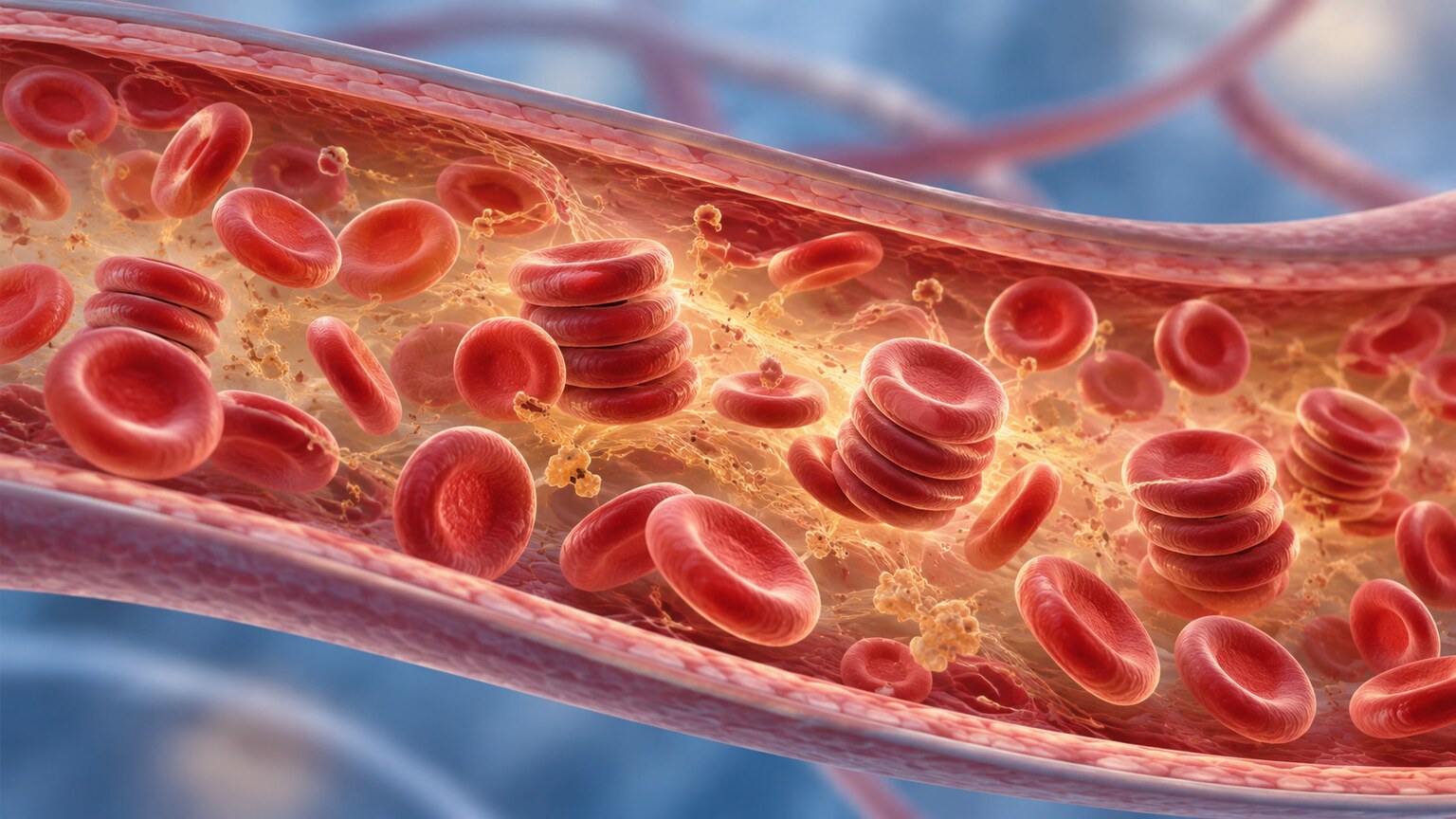
Figure 1. Rising fibrinogen makes red blood cells stack together like coins, a quiet internal change that produces no outward sensation at all.
This is the single most important fact for understanding why you can have a high ESR and feel nothing: the test is measuring a chemistry change in your blood, not measuring pain, fever, or anything you could physically sense happening. Your nerve endings don't have a way to detect "slightly more fibrinogen floating in your bloodstream." There's no sensor in your body for that. So a change that's real, measurable, and visible under a microscope can be completely invisible to you as a lived experience. That mismatch — real change, zero sensation — is not a flaw in the test or a sign your body is hiding something scary from you. It's just how this particular kind of internal chemistry works.
Why a Test Result Can Be Real While Your Body Feels Nothing at All
It helps to compare this to something everyone already understands: a smoke detector versus a fire. A smoke detector can pick up smoke particles in the air long before a fire is big enough for you to feel heat, see flames, or smell anything with your own nose. The detector is sensitive to something your senses simply aren't tuned to notice yet. ESR works similarly — it's sensitive to a subtle shift in your blood chemistry that's happening well below the threshold where your body would ever generate a symptom like pain, fatigue, or fever.
This also explains why the phrase "no obvious symptoms" matters so much in this article's title. It's not that nothing at all is different in your body — some process, however minor, is nudging that fibrinogen-style glue upward. It's that whatever that process is, it isn't big enough, or isn't located somewhere sensitive enough, to register as a feeling you'd notice. A tiny, low-grade change tucked away quietly doing its thing rarely announces itself the way a broken bone or a bad infection would.

Figure 2. Many high ESR results are discovered incidentally, during a routine physical or unrelated blood panel, rather than a test ordered because of symptoms.
This is exactly why so many people find out their ESR is high in the first place: not because a doctor was chasing down a mystery symptom, but because it showed up as one line item on a routine physical, a pre-surgery panel, a life insurance exam, or a general "let's check everything" blood draw. The test wasn't ordered because anyone suspected inflammation — it was included as a standard part of a broader panel, and it happened to come back outside the usual range. That context genuinely changes how worried you should be. An ESR that turns up on a routine screen in someone who feels perfectly well carries a very different weight than the same number ordered specifically because a doctor suspected an active disease process based on your symptoms.
Doctors actually have language for this distinction: a result found this way is called an "incidental finding," meaning it was discovered by accident while looking for something else, or looking for nothing in particular at all. Incidental findings on ESR are common enough that entire clinical guidelines exist just for how to handle them sensibly, precisely because reacting to every mildly elevated number with alarm would mean chasing a huge number of healthy people down unnecessary testing paths.
The Everyday, Non-Disease Reasons ESR Runs High
Before we even get into anything related to illness, it's worth knowing that a whole list of completely normal, non-disease situations can push ESR upward on their own, with zero symptoms attached, because they aren't sicknesses at all — they're just how a healthy body behaves in certain circumstances.
Age is the biggest one. As people get older, ESR tends to drift upward on its own, even in someone in excellent health, simply because the body's baseline levels of certain blood proteins shift gradually over the decades. A number that would be flagged as high in a 20-year-old can be a completely unremarkable, expected finding in someone in their 70s or 80s with nothing wrong at all. Sex matters too — women, on average, run a somewhat higher ESR than men at every age, for reasons tied to normal hormonal and blood composition differences, not disease.
Pregnancy is another major one, and it's a dramatic example of how far this can shift for entirely normal reasons: ESR can rise substantially during pregnancy because blood volume, plasma proteins, and red cell composition all change to support a growing baby, none of which has anything to do with inflammation or illness. Being overweight or obese is also independently linked to a somewhat higher baseline ESR, connected to a mild, low-level inflammatory signal that fat tissue itself produces even in someone who otherwise feels perfectly healthy. And having anemia — a lower-than-normal red blood cell count, from any cause — can raise ESR on its own by changing how the remaining red cells interact and settle in the tube, completely independent of any inflammatory process happening elsewhere.

Figure 3. When ESR is high with no reported symptoms, doctors typically start by asking targeted questions to rule out subtle, easy-to-miss signs before ordering more tests.
A recent minor illness can also linger on this test longer than you'd expect. If you had a cold, a stomach bug, or even a routine vaccine in the days or weeks before your blood was drawn, your immune system may still be winding down from that activity, and ESR can stay mildly elevated for a while after you've completely forgotten you were ever under the weather. Certain medications, and even smoking, have also been shown to nudge this number upward in people who are otherwise entirely healthy. None of these explanations require anything be "wrong" with you in any lasting sense — they're just examples of how sensitive this particular test is to ordinary, temporary, or lifelong variation in normal human biology.
It's also worth knowing that doctors don't just take your age and situation into account casually — most labs actually publish separate expected ranges for ESR based on age and sex specifically because this natural variation is so well documented, which is one more reason a number that looks "high" on a generic internet chart might not be high at all once it's compared to the correct reference range for you specifically.
When It's Something Quieter Than an Everyday Explanation
Once the everyday explanations above have been considered, there's a second category worth understanding honestly: sometimes a high ESR with no obvious symptoms is an early signal of something that simply hasn't produced noticeable symptoms yet, rather than something that never will. This is not meant to scare you — it's meant to explain why your doctor may still want to look a little closer even when you feel fine, and why that closer look is a reasonable, careful step rather than an overreaction.
Autoimmune conditions, where the immune system mistakenly treats part of your own body like a threat, can sometimes simmer quietly for a stretch of time before producing symptoms a person would actually notice, like joint pain or unusual fatigue. Certain infections, especially slow-developing ones tucked away somewhere in the body like a bone, a heart valve, or deep tissue, can also raise ESR gradually, days or weeks before they cause an obvious symptom like a fever spike or localized pain. Less commonly, some cancers, particularly ones involving blood cells or the lymph system, can be associated with a persistently high ESR before any other clue appears — which is one reason doctors take a truly unexplained, persistently high ESR seriously rather than dismissing it outright, especially in someone with risk factors like older age or unexplained weight loss.
The key word running through every one of these is "persistently." A single high result, found once, in someone who otherwise feels well, is a very different situation from a result that stays high on a second and third test weeks apart, with no everyday explanation like the ones covered above. Doctors lean heavily on that pattern over time, not on any single number in isolation, which is exactly the same principle that governs how a lot of other lab values are interpreted responsibly.
A Closer Look at the Quieter Possibilities, Named Specifically
It's worth naming a few of these quieter possibilities directly, in plain terms, rather than leaving them vague — vague fears are almost always scarier than specific, well-explained ones. Polymyalgia rheumatica is a condition, mostly seen in people over 50, that causes stiffness and aching in the shoulders and hips; in its very earliest stage, before the stiffness becomes noticeable enough to mention to a doctor, a high ESR can sometimes show up first. A closely related condition called giant cell arteritis affects the blood vessels supplying the head, and doctors take a very high ESR in an older adult seriously partly because catching this one early, before it affects eyesight, genuinely matters. Rheumatoid arthritis, an autoimmune condition where the immune system attacks the lining of joints, can also raise ESR in a slow, gradual way before joint swelling becomes obvious enough to notice day to day.
On the infection side, conditions like a smoldering bone infection (osteomyelitis) or certain heart valve infections (endocarditis) are known for being unusually quiet in their early stages, sometimes producing nothing more than a persistently high ESR for weeks before a fever or localized pain ever develops — which is exactly why doctors don't automatically dismiss a high, unexplained ESR in someone with a relevant recent history, like a prior joint replacement or dental procedure, even if that person feels completely fine today. And on the blood-cancer side, conditions like multiple myeloma or certain lymphomas involve the overproduction of specific proteins that are especially good at making red blood cells stack together, which is part of why an ESR that's extremely high — not just mildly elevated, but dramatically so — gets more attention than a modest bump, even without any other symptom present yet.
Reading a list like this can feel unsettling, so it deserves a direct, honest counterweight: every one of these conditions is, individually, uncommon, and every one of them, when caught this early through an incidental lab finding rather than through worsening symptoms, tends to have a better outcome specifically because it was caught early. The entire reason doctors bother investigating an unexplained, persistent high ESR at all is that doing so occasionally catches one of these processes at its quietest, most treatable point — not because the average person with a high ESR and no symptoms has one of these conditions. Statistically, the everyday explanations covered earlier in this article account for the overwhelming majority of cases; this section exists so that if further testing is ever recommended, you understand exactly what it's reasonably screening for, not so that you assume the worst about your own result.
"No Obvious Symptoms" Doesn't Always Mean "No Symptoms At All"
Here's a distinction that trips a lot of people up, and it's worth sitting with for a moment: there's a real difference between having truly zero symptoms and having symptoms so mild, so gradual, or so easy to explain away that you haven't connected them to anything. Fatigue that you've quietly blamed on a busy month at work. A slightly smaller appetite that you've chalked up to summer heat or stress. A few pounds of weight loss you assumed was from cutting back on snacks. Night sweats you figured were just a warm bedroom. Individually, every one of these feels like nothing worth mentioning — but a doctor working through an unexplained high ESR will often ask about exactly these kinds of small, easy-to-dismiss details, because sometimes the "no symptoms" picture changes the moment someone actually asks the right specific question.
This is not meant to send you searching your body for something to worry about — most of the time, when a doctor asks these questions, the honest answer really is "no, nothing like that," and the finding genuinely does turn out to be one of the harmless, everyday explanations above. It's simply worth understanding that "asymptomatic" is a starting assumption your doctor will double-check with a few careful questions, not something either of you can be fully certain about from the lab result alone.
Does the Actual Number Matter, Even Without Symptoms?
Yes, and this is one of the most practically useful things to understand from this entire article. ESR is reported in millimeters per hour, and roughly speaking, the higher the number climbs above what's normal for your age and sex, the more seriously it tends to be taken — regardless of whether you feel anything.
A mild elevation, sitting just modestly above the top of the normal range, found once on a routine panel with no symptoms and an obvious everyday explanation like recent illness, older age, or pregnancy, is generally treated as low-concern and often just gets rechecked later to confirm it settles back down on its own. A very high result — the kind that lands far above the normal range, sometimes several times higher — is a different situation. That degree of elevation is much less likely to be fully explained by ordinary, harmless variation alone, and it's the kind of number that tends to prompt a more thorough workup even in someone who insists they feel completely fine, precisely because the size of the number itself is doing a lot of the talking. In other words, "how high" and "any symptoms at all" work together, not separately, when your doctor is deciding how urgently to look further.

Figure 4. The more of these sticky plasma proteins — fibrinogen and immune globulins — circulating in the blood, the faster red cells clump and settle, independent of how the person feels.
It also helps to know that the specific proteins driving this effect matter. Fibrinogen is the main one during short-term, active immune responses, but antibodies themselves — the proteins your immune system makes to fight things off, medically called immunoglobulins — can also coat red blood cells and encourage that same stacking effect when they're circulating in larger-than-usual amounts over a longer stretch of time. This is part of why chronic, slow-building processes and short bursts of recent illness can both raise ESR through slightly different versions of the same underlying "stickier blood" mechanism, even though they feel nothing alike from the inside.
What Your Doctor Actually Does With an Unexplained High ESR
When a high ESR shows up with no reported symptoms, most doctors follow a fairly predictable, sensible sequence rather than jumping straight to an aggressive workup. The first step is almost always a conversation — going back through your recent history for anything that could explain it on its own: a recent cold, a new medication, a change in weight, whether you could be pregnant, your age and sex compared against the lab's specific reference range. A surprising number of "unexplained" results get explained right here, in conversation, without a single additional test.
If nothing obvious turns up, a very common next step is simply repeating the test after some weeks have passed. Because ESR reacts to short-term changes in blood chemistry, a temporary bump from a minor illness or a one-off lab variation often settles back into the normal range entirely on its own by the time it's rechecked — and if it does, that alone is usually enough reassurance to close the question without further testing. Doctors will also frequently pair ESR with CRP, a related inflammation marker that responds faster and settles faster than ESR does; if CRP is normal while ESR stays elevated, that pattern itself is a useful clue pointing toward one of the everyday, non-disease explanations discussed earlier rather than an active inflammatory process.

Figure 5. A simple repeat test weeks later is often all that's needed, since many isolated elevations resolve on their own once a temporary trigger has passed.
Only when a high number persists across repeat testing, climbs even higher, or is paired with one of the subtler symptoms discussed earlier does a doctor typically move toward more specific testing aimed at particular causes — targeted blood work, imaging of a specific area, or a referral to a specialist like a rheumatologist for autoimmune concerns. This staged approach exists precisely because jumping straight to extensive testing on every mildly elevated, symptom-free result would put a lot of healthy people through unnecessary tests, scans, and worry for a number that was always going to normalize on its own.
Your age, your personal and family medical history, and any risk factors you already carry all shape exactly where your own doctor draws that line between "let's just recheck it" and "let's look closer now" — which is exactly why the same ESR number can lead to two different, equally correct next steps in two different people.
How This One Number Fits Into Your Whole Blood Panel
ESR is almost never read completely by itself in modern practice, and understanding what it's usually grouped with helps explain why doctors don't panic over one isolated number. A complete blood count, often ordered on the very same visit, checks whether you're anemic, since anemia alone can push ESR upward independent of any inflammation, as covered earlier. Ferritin, a protein that reflects your body's iron stores, also tends to rise alongside inflammation and can help confirm whether something real is going on or whether the ESR bump is more likely tied to a separate, simpler cause like low iron. And as already mentioned, CRP is checked because it moves faster than ESR in both directions — rising within hours of a trigger and falling back down within days once that trigger resolves — so comparing the two can reveal whether you're looking at the tail end of something already fading (high ESR, normal CRP) or something still actively happening right now (both elevated).
Basic metabolic markers, liver enzymes, and a general physical exam often round out this picture, not because your doctor suspects any one specific thing, but because a slightly wider net at this stage is what allows a high ESR to be interpreted correctly rather than in isolation. This is also exactly why bringing your full set of recent lab results to any conversation about a high ESR is so useful — a number that looks alarming completely on its own frequently makes much more sense, and often stops looking alarming at all, once it's viewed next to two or three other values drawn from the exact same blood sample.
A Practical Way to Think About Whether to Worry
Put together, a genuinely low-concern picture usually looks like this: the elevation is mild, it was found incidentally rather than because of a specific worry, there's a plausible everyday explanation like recent illness, age, pregnancy, or weight, and a careful review of your recent history doesn't turn up any of those easy-to-dismiss subtle symptoms mentioned earlier. That combination describes the majority of "high ESR, no symptoms" situations doctors see, and it's exactly the kind of result that tends to resolve quietly on a repeat test.
A picture that deserves a closer look, on the other hand, usually involves at least one of the following: a very high number rather than a mild one, a result that stays elevated or keeps climbing across more than one test, no plausible everyday explanation after a real conversation about your history, or the discovery of even one of those subtle, easy-to-overlook symptoms once someone actually asks the right question. None of these facts alone means something is seriously wrong — they simply describe the situations where doctors reasonably choose to look a little further rather than waiting and rechecking, which is a sensible, proportionate response rather than an alarming one.

Figure 6. Most isolated, symptom-free elevations resolve quietly by the time of a follow-up visit, closing the question without ever needing further testing.
It's worth remembering, too, that ESR was never designed to work as a stand-alone diagnostic test for any specific disease — it's what's sometimes called a nonspecific marker, meaning it can rise for dozens of completely different reasons, and it can't by itself tell your doctor which one applies to you. That's actually good news in this context: it means a single high ESR carries far less individual weight than a specific, targeted test would, and it's exactly why doctors always interpret it together with your history, your exam, and often other blood work, rather than reacting to that one number in isolation.
If you're the kind of person who likes having a mental script for the doctor's visit, here's a simple one: describe exactly how you feel, including anything small you might otherwise leave out (energy levels, appetite, sleep, any unexplained weight change), mention anything recent that could explain it (a cold, a new medication, pregnancy), and ask directly whether a repeat test in a few weeks makes sense before anything more involved. That conversation alone resolves the overwhelming majority of these situations.
Frequently Asked Questions
Can a high ESR with no symptoms just go away on its own?
Yes, very often. If the elevation was caused by a temporary trigger like a recent minor illness, a vaccine, or normal lab variation, it commonly settles back into the normal range on its own by the time it's rechecked weeks later, with no treatment needed at all.
How high does ESR need to be before doctors get concerned even without symptoms?
There's no single universal cutoff, but very high results — well above the normal range for your age and sex, especially values several times higher than expected — are taken more seriously than a mild elevation, and are less likely to be fully explained by harmless everyday causes alone.
Should I ask for more tests right away if my ESR is high but I feel fine?
Not necessarily. A common, reasonable first step is simply repeating the ESR test after several weeks, especially if there's a plausible everyday explanation like recent illness, age, or pregnancy. More testing is typically reserved for results that stay high, keep climbing, or come with no clear explanation.
Can weight or age alone explain a high ESR?
Yes. Both older age and having a higher body weight are independently associated with a naturally higher baseline ESR, even in someone with no illness at all, which is exactly why labs publish separate expected ranges based on age and sex.
Is a high ESR with no symptoms ever a sign of something serious like cancer?
It can be, in rare cases, particularly if the number is very high and persists over time — but this is uncommon, and the vast majority of symptom-free high ESR results turn out to have an everyday or temporary explanation. Doctors weigh this possibility alongside your age, history, and how the number behaves on repeat testing, not from a single result alone.
Why did my ESR come back high when my CRP was completely normal?
This pattern is common and usually reassuring. CRP rises and falls quickly, often within hours to days, while ESR moves and settles more slowly, sometimes staying elevated for weeks after whatever triggered it has already resolved. A normal CRP alongside a high ESR often means you're simply seeing the slow "tail end" of something that has already passed, rather than an active process happening right now.
A Short Glossary of the Words You'll Actually Hear
ESR (erythrocyte sedimentation rate) is the speed at which red blood cells settle to the bottom of a test tube over one hour, used as an indirect signal of immune system activity. Fibrinogen is a blood protein made by the liver that increases during immune activity and makes red cells stick together into stacks. An incidental finding is a lab result discovered by accident on a routine test, not because it was specifically being looked for. CRP (C-reactive protein) is a related, faster-responding inflammation marker often checked alongside ESR for comparison. And "nonspecific" describes any test result, like ESR, that can be caused by many different things and therefore can't point to one exact diagnosis on its own.
Together, these five ideas explain almost everything a doctor means when they talk through a high, symptom-free ESR result with you — that it's a general-purpose alarm-adjacent signal, sensitive but not specific, best interpreted through repetition and context rather than reacted to on its own.
A Direct Word If You're Anxious Reading This Right Now
If you landed on this page because your own ESR came back high and you feel completely fine, here is the most honest, direct thing to take away: feeling fine is genuinely meaningful information, not something to dismiss just because a number on a page says otherwise. The great majority of people in exactly your situation turn out to have one of the everyday, harmless explanations covered in this article, and the standard next step — a calm conversation with your doctor, and often a simple repeat test in a few weeks — is specifically designed to sort that out without drama or unnecessary alarm. A test result finding something your body itself hasn't flagged as a problem is not the same thing as your body hiding a disaster from you; it's simply a very sensitive instrument picking up something small, most of the time something entirely explainable, well before you'd ever have any reason to notice it yourself.
It can also help to remember that this exact scenario — a single unexpected number on an otherwise routine panel — happens to enormous numbers of healthy people every single day, in every doctor's office, all over the world. Lab testing has gotten broader and more sensitive over the years, which means it now regularly picks up small, real, but ultimately harmless variations that simply weren't visible to medicine a generation ago. Being caught by one of these sensitive nets isn't bad luck or a sign your body is uniquely troubled; it's what happens whenever a very sensitive tool is pointed at a very complicated, constantly shifting system like the human body. Give the process — the conversation, and if needed, the repeat test — the same amount of trust you'd give a smoke detector that occasionally beeps at nothing more than a bit of cooking steam. That's usually exactly what's happening here too.
Conclusion
A high ESR with no obvious symptoms feels contradictory at first — how can something be wrong with your blood chemistry while your body insists everything is fine? But once you understand what ESR is actually measuring, the contradiction disappears: it's a test of subtle protein changes in your blood, not a test of pain, fatigue, or how you feel day to day, and plenty of those changes are simply too small or too slow to ever produce a symptom you'd notice. Most of the time, an elevated result found this way traces back to something completely ordinary — your age, your sex, a recent minor illness, pregnancy, or your weight — and settles right back down on a repeat test with no drama at all. The cases that deserve a closer look are the ones where the number is unusually high, stays elevated over time, or comes with even a small symptom you hadn't connected to anything, and your doctor is well equipped to sort through exactly which situation you're in with nothing more dramatic than a good conversation and, if needed, a second blood draw down the road.
Still Not Sure What Your Results Mean?
Upload your labs and get a complete, visual, plain-language interpretation of every biomarker — delivered to your inbox in under 15 minutes.
Get My ReportThis article is for educational purposes only and does not constitute medical advice. Always consult your healthcare provider regarding your specific lab results.