
Why Do Creatinine Levels Vary by Age and Sex?
Yes — both age and sex have a real, well-documented effect on what counts as a "normal" creatinine level, and the reason has almost nothing to do with how well your kidneys are working from one person to the next. Creatinine, a waste product your muscles generate around the clock, gets filtered out of your blood by your kidneys at a fairly predictable rate — which means the number on your lab report is shaped just as much by how much muscle you carry as it is by how well your kidneys are filtering. Men typically run higher than women because they typically carry more muscle mass, not because their kidneys work any differently. Age tells a more complicated story: kidney filtering capacity naturally declines somewhat as people get older, which would push creatinine up, but muscle mass also naturally declines with age, which pushes creatinine back down — and those two changes can partly cancel each other out, sometimes hiding a meaningful drop in kidney function behind a creatinine number that still looks unremarkable. Understanding both of these effects is what separates a lab value you can actually interpret from one that just sits on a page looking mysterious.
What Creatinine Actually Is, and Where It Comes From
To make sense of why creatinine moves around by age and sex, it helps to know exactly what the test is measuring in the first place, because it isn't a direct measurement of your kidneys at all — it's a measurement of a waste product, and your kidneys only show up in the story as the organ responsible for clearing it out. Every time a muscle in your body contracts, it draws on a stored, ready-to-use energy reserve called creatine phosphate, a compound your muscle cells keep on hand specifically so they don't have to wait for a longer energy-production process to catch up during a quick burst of effort — think of it as the muscle's equivalent of keeping a phone charger already plugged in rather than searching the house for one the moment the battery dies. As creatine phosphate gets used and recycled, a small, steady fraction of it breaks down irreversibly into a related compound called creatinine, which serves no further purpose in the body and is simply released into your bloodstream to be disposed of.
That disposal job belongs almost entirely to your kidneys. Blood is filtered continuously through roughly a million tiny filtering units in each kidney called nephrons, and the very first stage of that filtering, at a structure called the glomerulus, works essentially like a sieve — small molecules like creatinine pass through into the urine, while larger, still-useful components of blood, like proteins and blood cells, are held back and returned to circulation. Because creatinine is produced by muscle at a fairly constant, predictable rate and removed by the kidneys at a rate that closely tracks how well those glomeruli are filtering, doctors use the blood level of creatinine as a practical stand-in for kidney function — when the kidneys are filtering well, creatinine gets cleared out about as fast as it's made, and the level in your blood, technically measured in the clear liquid portion of blood called serum, stays low and steady. When filtering slows down, creatinine has nowhere to go and starts to accumulate, which is the basic logic behind why a high creatinine level usually points toward reduced kidney function.
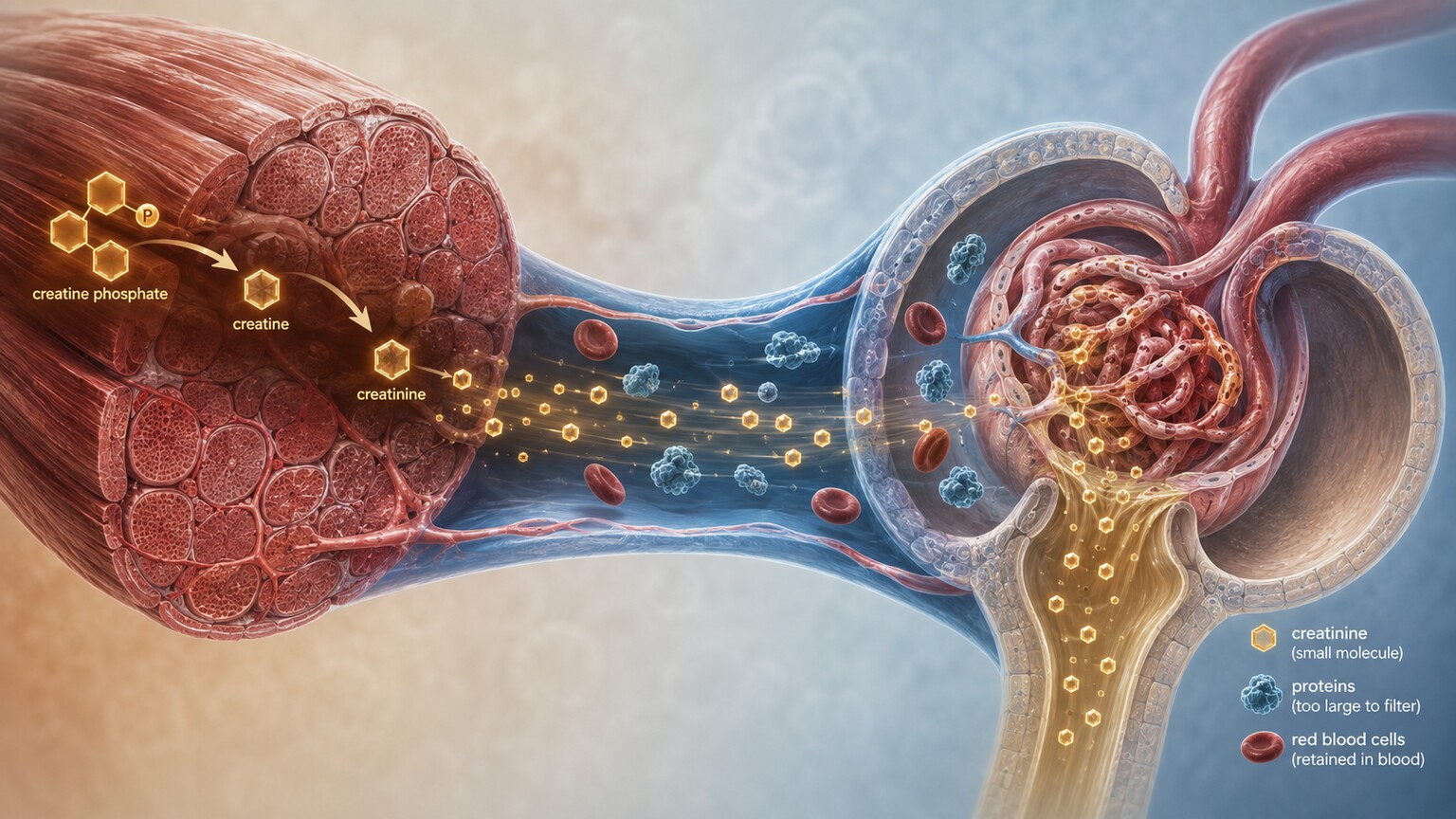
Figure 1. Creatine phosphate stored in skeletal muscle breaks down into creatinine at a steady rate, which the kidneys then filter out of the bloodstream almost entirely through the glomeruli.
The part of this system that trips people up is the production side of the equation, not the filtering side — and it's the entire reason this article exists. A creatinine level is really the result of two things happening at once: how much creatinine your muscles are pumping out, and how efficiently your kidneys are clearing it away. Two people can have identical, perfectly healthy kidneys and still land on very different creatinine numbers, simply because one of them is generating more creatinine to begin with. That's not a flaw in the test — it's just math, and it's exactly why "normal" has never been a single fixed number for this particular lab value the way it might be for, say, blood sodium.
The way a lab actually measures this number matters a little too, though it rarely changes the year-to-year pattern that matters for interpretation. Many laboratories still rely on a version of a chemical reaction discovered by German chemist Max Jaffe back in 1886, in which creatinine reacts with picric acid under alkaline conditions to produce a colored compound whose intensity a machine called a spectrophotometer can measure precisely. Because a handful of other substances circulating in blood, including glucose and certain drugs, can occasionally interfere with this reaction and nudge the result slightly higher than the true value, many modern labs instead use a newer enzymatic method that reacts more specifically with creatinine itself and avoids most of that interference. Either method gives a reliable, clinically useful result for tracking creatinine over time, but it's one more small reason a single isolated number, from a single lab, on a single day, is never quite as informative as a consistent pattern measured the same way over months or years.
Already have a creatinine number from a recent lab test, but not sure whether it's actually normal for someone your age and sex? Just plug it in and see instantly.
🧮 Try the Free CalculatorThe Normal Range Split by Sex — What the Numbers Actually Look Like
Every major lab in the United States prints two different reference ranges for creatinine, one for men and one for women, sitting right next to each other on the same report — and that split isn't a formality or a leftover convention, it's a direct acknowledgment of the muscle-mass math described above. On a typical standard chemistry panel, adult men usually fall somewhere between about 0.7 and 1.3 milligrams per deciliter (mg/dL, the standard American unit for this test, equivalent to roughly 62 to 115 micromoles per liter internationally), while adult women typically fall between about 0.6 and 1.1 mg/dL. That gap of a few tenths of a point might look small written out, but as a percentage of the overall range it's a meaningful, consistent, and well-documented difference that shows up across essentially every population that's ever been studied.
| Population | Typical Normal Range | Notes |
|---|---|---|
| Adult men | 0.7 – 1.3 mg/dL | Reflects a typically higher average muscle mass |
| Adult women | 0.6 – 1.1 mg/dL | Reflects a typically lower average muscle mass |
| Children (roughly 3–18 years) | ~0.3 – 0.7 mg/dL, rising with age | Tracks growth in muscle mass through childhood and adolescence |
| Pregnant women | Often 0.4 – 0.8 mg/dL | Lower than the standard adult range due to increased kidney blood flow |
It's worth being explicit about what this split is not saying, because it's easy to misread. It is not saying that a woman's kidneys are somehow held to a stricter or more sensitive standard than a man's, and it's not saying anything at all about whose kidneys work better. The split exists purely to correct for the fact that, on population averages, adult men carry more skeletal muscle mass than adult women — generally estimated at something like 10 to 15 percentage points more muscle as a share of total body weight, though this obviously varies enormously by individual. More average muscle mass means more average daily creatinine production, which means a higher creatinine level is expected and normal at the exact same level of kidney function. A man and a woman with identical, perfectly healthy kidneys, filtering blood at the exact same rate, would still be expected to produce two different creatinine numbers, purely because of this production-side difference — which is precisely why comparing your own creatinine number directly to a friend's, a spouse's, or a family member's of the opposite sex almost never tells you anything useful.
Why Men Typically Run Higher: The Muscle-Mass Mechanism

Figure 2. Testosterone released during and after puberty drives a lasting increase in skeletal muscle mass in males, which is the direct source of the higher average creatinine seen in men.
The muscle-mass gap between men and women doesn't appear randomly — it's driven almost entirely by one hormone: testosterone. Testosterone is a potent anabolic signal, meaning it actively promotes the building of new muscle protein, and starting at puberty, the much higher circulating testosterone levels typical in males switch on a sustained, years-long period of muscle growth that easily outpaces what happens in a body with the lower testosterone levels typical in females. This isn't a subtle effect — it's one of the most well-established findings in exercise physiology and endocrinology, and it's the same basic hormonal mechanism strength coaches and sports scientists point to when explaining why, on average, adult men can build and carry more muscle mass than adult women even when training programs, diet, and effort are matched closely between them.
More total muscle mass simply means more creatine phosphate turning over into creatinine on any given day, spread across every muscle in the body rather than concentrated in one place — the biceps, the thighs, the back, even the diaphragm that helps you breathe, all of it contributes a little. This is also why creatinine tracks reasonably well with body composition even within one sex: a heavily muscled man will typically run a higher creatinine than a slighter, less muscular man of the same age, even if both of their kidneys are functioning identically, and the same pattern holds true comparing a very muscular woman to a smaller-framed woman. The sex-based reference range captures the population-level average of this effect, but it's really a stand-in for the underlying variable that actually matters, which is muscle mass itself, not sex as a category on its own.
When Does the Gap Appear? Puberty, Testosterone, and Childhood Creatinine
If the sex difference in creatinine is driven by testosterone-fueled muscle growth, it follows that the gap shouldn't exist yet in early childhood — and it doesn't. Reference ranges for creatinine in young children are not split by sex at all in most pediatric labs, because before puberty, boys and girls have broadly similar muscle mass relative to their body size, and their creatinine levels track together closely as a result. What does change dramatically in childhood is age itself: a toddler's creatinine sits far lower than a teenager's, not because of anything wrong, but simply because a toddler's total muscle mass is a small fraction of what it will eventually become. A rough, commonly cited pattern is a creatinine somewhere around 0.2 to 0.4 mg/dL in early childhood, climbing gradually and steadily through the school-age years as the body grows, then climbing more quickly during the adolescent growth spurt.
The sex-based split typically begins to show up on lab reports starting somewhere in the early-to-mid teenage years, right around when puberty's hormonal changes start producing a real, measurable divergence in muscle mass between boys and girls — which is also, not coincidentally, around the same age many pediatricians start using adult-style reference ranges rather than pediatric ones. A teenage boy's creatinine can rise noticeably over the course of just a year or two during a growth spurt, purely as a reflection of rapidly increasing muscle mass, and this is a completely expected, healthy pattern rather than a sign that something has changed with his kidneys. Parents comparing a teenager's new lab result to an old one from a few years earlier sometimes find the increase alarming without this context, when in reality it's one of the more predictable, well-documented patterns in all of pediatric lab medicine.
Two Forces Pulling in Opposite Directions: Aging Kidneys and Aging Muscles
Age is where creatinine interpretation gets genuinely more complicated than sex, because instead of one clean, one-directional effect, aging sets two separate biological changes in motion that pull the number in opposite directions at the same time. The first is a decline in kidney filtering capacity itself. Even in people who never develop any diagnosed kidney disease, the kidneys' filtering capacity — a value doctors track as the glomerular filtration rate, or GFR, essentially a measure of how many milliliters of blood the kidneys can fully filter each minute — tends to drift downward gradually over the course of adult life, with many studies estimating an average decline of roughly 1 milliliter per minute per year starting somewhere around age 30 to 40. This isn't considered a disease process on its own; it's treated as a normal, expected part of the aging kidney, similar in spirit to gradual changes seen in other organs over decades of use. All else being equal, a slower-filtering kidney means creatinine has a harder time getting cleared, which would be expected to nudge the number upward as a person gets older.
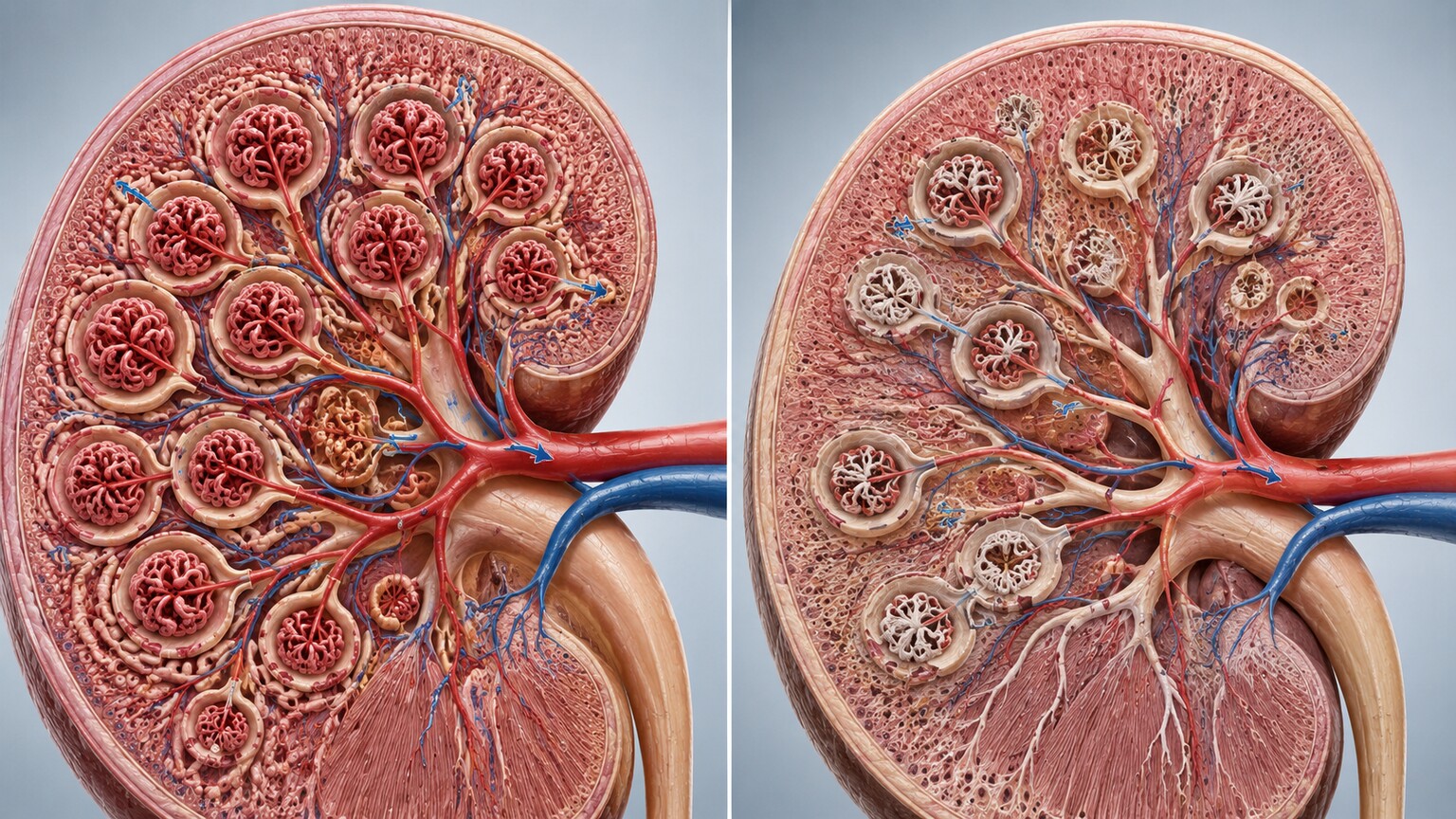
Figure 3. A young kidney contains roughly a million filtering units called nephrons, while an aging kidney gradually loses functioning glomeruli and filtration capacity even without overt disease.
The second force moves in exactly the opposite direction: aging bodies also tend to lose muscle mass, a process that has its own name in medicine — sarcopenia — and gets its own full treatment in the next section. Less muscle mass means less creatinine being produced in the first place, which would be expected to push the number downward, working directly against the filtering decline described above. When both of these changes happen to the same person at a similar pace, which is common, they can partially or even fully cancel each other out on paper. The practical result is one of the more important and most underappreciated pitfalls in interpreting lab work in older adults: a 75-year-old with meaningfully reduced kidney filtering capacity can post a creatinine result that looks perfectly ordinary, simply because they've also lost enough muscle mass to keep the number from rising the way it would in a younger person with the same degree of kidney decline.
Sarcopenia: The Quiet Muscle Loss That Can Mask Declining Kidney Function

Figure 4. Sarcopenia, the gradual, age-related loss of skeletal muscle mass, reduces the body's creatinine output independently of how well the kidneys are still filtering blood.
Sarcopenia is the medical term for the gradual, largely involuntary loss of skeletal muscle mass and strength that comes with aging, and it's a far more universal process than most people realize — most research places the rate of loss at somewhere around 3 to 8 percent of muscle mass per decade starting as early as someone's thirties, with the pace accelerating measurably after age 60. It happens for a tangle of overlapping reasons: hormone levels including testosterone and growth hormone decline with age, physical activity often drops off compared to earlier decades of life, the nerves that signal muscles to contract become somewhat less efficient over time, and the body's ability to repair and rebuild muscle tissue after everyday wear slows down. None of this requires an illness to be present — it's simply a feature of how the human body ages, though it happens faster in people who are sedentary, chronically ill, or dealing with poor nutrition.
For the purposes of reading a creatinine result, the key consequence of sarcopenia is straightforward: less muscle tissue means less creatine phosphate turning over into creatinine each day, so an older adult with significant sarcopenia will naturally produce and release less creatinine than they did decades earlier, even if nothing at all has changed about their kidneys. This is precisely why doctors and researchers treat an older adult's "normal-looking" creatinine with a healthy amount of caution rather than automatic reassurance, and it's the specific reason a whole separate class of calculations, covered next, was developed to correct for exactly this blind spot.
Why eGFR Formulas Build Age and Sex Right Into the Math
Because a raw creatinine number, on its own, conflates two different variables — kidney filtering and muscle mass — researchers have spent decades building mathematical formulas designed to strip the muscle-mass influence back out and estimate the number doctors actually care about: the glomerular filtration rate itself, usually reported on a lab slip as eGFR, for estimated GFR. Every major version of this formula uses a person's age and sex as required input variables, alongside their creatinine result, specifically because both are reliable, easily obtained stand-ins for how much muscle mass a person is likely to have, which lets the formula adjust the raw creatinine number up or down before producing its final estimate.
The first widely used version, the Cockcroft-Gault equation published in 1976, combined age, body weight, sex, and creatinine into a single calculation and represented a genuine breakthrough at the time, turning a single lab value into something resembling an actual functional estimate of kidney performance. It was followed in 1999 by the MDRD equation, developed from a large clinical trial studying chronic kidney disease, which dropped the need for body weight and instead relied on age, sex, and, at the time, a race-based coefficient — a piece of the formula that has since been widely reconsidered and removed from current versions after broader conversations across the medical and scientific community about whether race, as a social rather than biological category, was ever an appropriate stand-in for muscle mass or physiology in the first place. The current standard in most American labs today is the CKD-EPI equation, refined most recently in 2021 specifically to remove that race-based adjustment while preserving accuracy, using only age, sex, and creatinine as its inputs.
The upshot for anyone reading their own lab report is this: if your report includes an eGFR number alongside your creatinine, that eGFR has already done the age-and-sex correction described throughout this entire article on your behalf, converting your raw creatinine into a number that's far more directly comparable across different people regardless of how much muscle they carry. A creatinine of 1.0 mg/dL might correspond to an excellent eGFR in a heavily muscled 25-year-old man and a concerning eGFR in a frail, sarcopenic 80-year-old woman — the exact same raw number, two very different underlying levels of kidney function, and the eGFR is what actually captures that difference rather than the creatinine alone.
For situations where muscle mass is especially likely to distort a creatinine-only estimate — someone very muscular, someone very frail, or someone whose body composition is otherwise unusual for their age and sex — many labs now offer a second version of the eGFR calculation that combines creatinine with cystatin C, the muscle-mass-independent marker mentioned earlier, into a single blended estimate. Because cystatin C is produced at a steady rate by nearly all the body's cells rather than specifically by muscle, adding it into the equation dilutes the influence of muscle mass and tends to produce a more accurate estimate in exactly the people where creatinine alone is most likely to mislead. This combined creatinine-cystatin C equation isn't run automatically on every routine panel, but it's a reasonable, specific thing to ask a doctor about if your body composition is unusual enough that you're not confident a creatinine-only eGFR is telling the full story.
A Special Case: Pregnancy Changes Creatinine Independent of Age
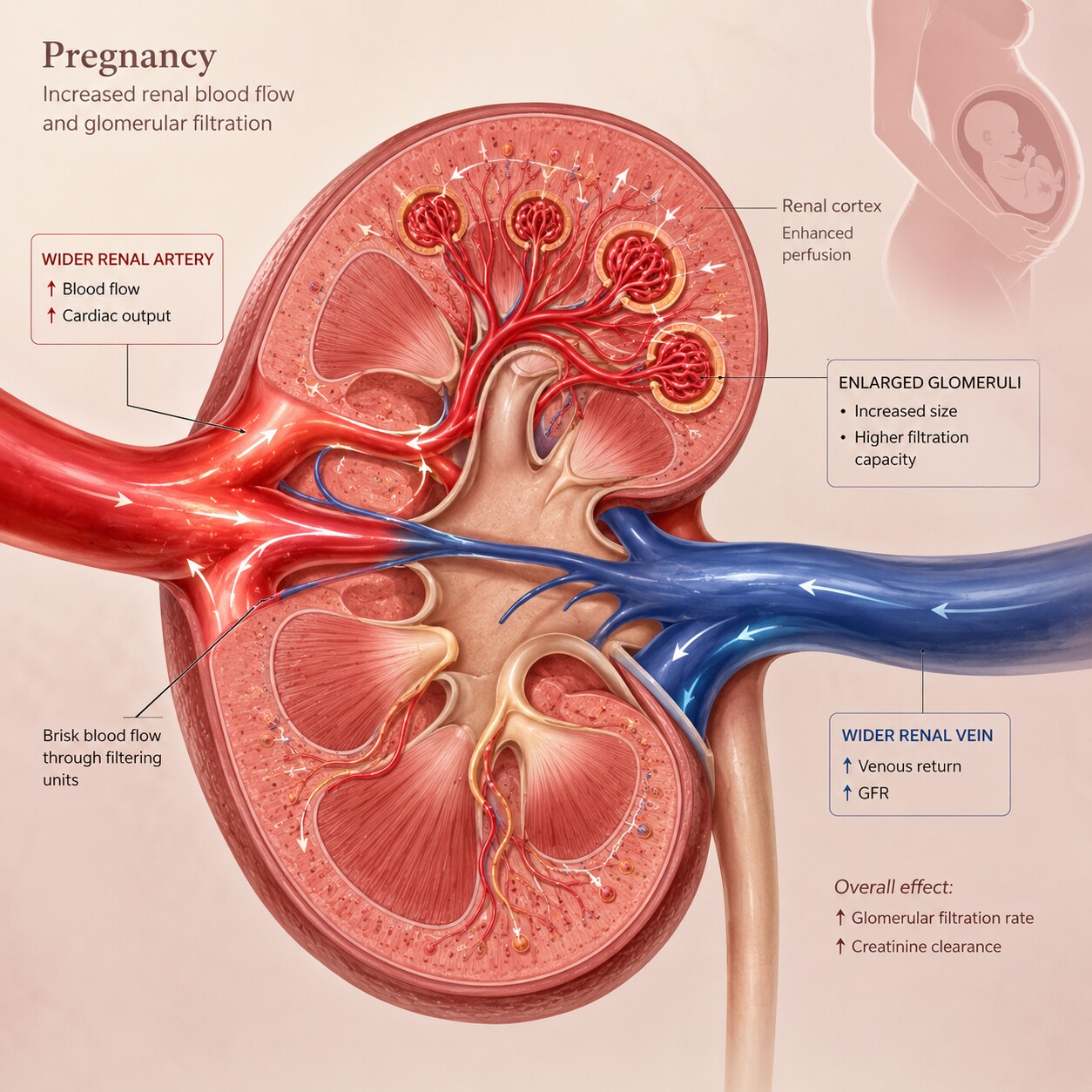
Figure 5. Pregnancy increases renal blood flow and glomerular filtration rate by roughly 50 percent, which is why a creatinine level considered normal outside of pregnancy can signal reduced kidney function during it.
Pregnancy deserves its own separate mention because it moves creatinine in a direction that has nothing to do with either of the two mechanisms described so far — it isn't about muscle mass and it isn't about ordinary aging, it's about a dramatic, temporary change in how the kidneys themselves operate. Starting early in pregnancy, a woman's cardiac output and total blood volume both rise substantially to support the growing fetus and placenta, and blood flow to the kidneys rises right along with it. This translates into a real, measurable increase in glomerular filtration rate, commonly cited at somewhere around 40 to 50 percent above pre-pregnancy levels by the second trimester — meaning the kidneys are, quite literally, filtering blood faster and more efficiently than they were before conception.
A faster-filtering kidney clears creatinine out of the blood more efficiently, which pulls the number down rather than up — the opposite direction from what aging or reduced kidney function would produce. As a result, a healthy pregnant woman's creatinine typically runs lower than the standard non-pregnant adult female range, often somewhere around 0.4 to 0.8 mg/dL rather than the usual 0.6 to 1.1 mg/dL. This matters clinically in a way that's easy to miss: a creatinine result of, say, 0.9 mg/dL would be unremarkable on a standard adult female reference range, but in a pregnant woman it can actually represent a meaningful reduction in kidney function relative to where her own body should be during pregnancy, which is one of the reasons obstetric providers pay close attention to creatinine trends across pregnancy rather than judging a single result against a generic, non-pregnancy-specific range.
Other Everyday Factors That Layer on Top of Age and Sex
Age and sex explain the biggest, most consistent share of the natural variation in creatinine, but they're far from the only factors nudging the number around, and it's worth knowing about a few of the more common ones so an unexpected result doesn't cause unnecessary alarm. Diet is one of the more immediate influences: cooked meat, especially well-done or grilled meat, contains both creatine and preformed creatinine that gets absorbed directly through the gut, and eating a large meat-heavy meal can produce a real, measurable, temporary bump in blood creatinine within just a few hours, typically fading back down well within a day. This is exactly why many lab guidelines suggest avoiding a large serving of red meat the night before a fasting blood draw if a precise creatinine or eGFR reading matters for a specific medical decision.

Figure 6. Cooked meat contains preformed creatinine and creatine that the gut absorbs directly, producing a temporary rise in blood creatinine within hours of a meal.
Hydration status is another short-term influence worth knowing, though its effect is more indirect: significant dehydration reduces blood flow to the kidneys and can cause a mild, temporary rise in creatinine that typically resolves once fluid balance is restored, which is part of why a single unusually high reading, especially after a bout of illness, heavy sweating, or limited fluid intake, is often best confirmed with a repeat test rather than treated as a permanent finding on its own. Intense, unaccustomed exercise, particularly the kind involving a lot of muscle breakdown like a first hard weightlifting session in months or an unusually long run, can also cause a short-lived rise in creatinine as muscle tissue undergoes normal turnover and repair, independent of any change in kidney function.
Creatine supplements, popular among bodybuilders and strength athletes, deserve a specific mention because they can meaningfully and durably raise creatinine even in someone with completely normal kidneys, since supplemental creatine adds directly to the same pool that eventually breaks down into creatinine — a pattern that has occasionally led to unnecessary kidney concern in healthy, heavily muscled athletes whose creatinine looks elevated purely because of their supplement routine and training-driven muscle mass, not because of any problem with how their kidneys are filtering. On the opposite end of the spectrum, conditions and situations involving significant muscle loss beyond ordinary aging — long-term paralysis, advanced muscular dystrophy, or limb amputation, for example — can push creatinine unusually low, sometimes low enough that doctors turn to an alternative marker called cystatin C, a protein produced by nearly all the body's cells at a steady rate regardless of muscle mass, specifically because it isn't affected by this same production-side variability the way creatinine is.
It's also worth separating muscle mass from body size in general, since the two get conflated fairly often. A larger person who carries more body fat but not necessarily more muscle will not have a meaningfully higher creatinine on that basis alone, because fat tissue doesn't generate creatinine the way muscle does — creatinine tracks specifically with lean muscle mass, not overall weight or body mass index. This is why two people of the same height and weight, one carrying that weight mostly as muscle and the other mostly as fat, can have noticeably different creatinine levels despite an identical number on the scale, and it's a useful distinction to keep in mind if a creatinine result ever seems out of step with someone's general body size.
How to Actually Read Your Own Number
Put all of this together, and the practical takeaway is fairly simple, even though the biology behind it took a while to unpack: a creatinine number only means something once it's placed next to the right comparison, and the right comparison starts with your own sex and roughly your own age, not a single universal cutoff and definitely not someone else's number. Comparing your creatinine to your spouse's, a sibling's of a different sex, or a much younger or older relative's tells you very little on its own, because you're comparing two different muscle-mass baselines as much as two different kidneys.
If you're an older adult, it's worth specifically asking your doctor for your eGFR alongside your raw creatinine, and paying attention to that number rather than the creatinine alone, precisely because the eGFR calculation has already done the age-and-sex correction described throughout this article. A creatinine that looks flat and unremarkable over several years of annual checkups can still hide a real, gradual decline in kidney function if it's happening in step with ordinary age-related muscle loss — which is exactly the blind spot eGFR was built to close. And if you fall into one of the specific situations covered above — very heavy muscle mass from serious strength training, a recent creatine supplement habit, significant recent muscle loss from illness or inactivity, or pregnancy — it's worth mentioning that context to whoever is interpreting your results, since it can meaningfully change what a given number should be expected to look like in your particular case.
It also helps to think in trends rather than single snapshots whenever you have more than one result to compare. Because your own muscle mass tends to stay fairly stable from one year to the next outside of major life changes — a new training routine, a serious illness, a pregnancy — your own personal baseline creatinine is often a more meaningful comparison point than any generic reference range printed on the report. A gradual, sustained rise across several consecutive annual results, even while each individual value technically stays "in range," can be a more informative early signal than waiting for a single result to cross the printed cutoff, which is part of why doctors managing anyone with early kidney concerns tend to track the number over time rather than reacting to it in isolation.
Frequently Asked Questions
Is it normal for my creatinine to be higher than my wife's, even though we're both healthy?
Yes, this is expected and doesn't reflect anything about either of your kidney function on its own. Adult men typically carry more muscle mass than adult women on average, and muscle mass is the primary source of creatinine production, so a somewhat higher creatinine in a healthy man compared to a healthy woman of similar age is the normal, expected pattern rather than a red flag.
My teenage son's creatinine went up noticeably from his last checkup a few years ago. Should I be concerned?
In most cases, no. Creatinine rises steadily through childhood and adolescence as muscle mass increases with growth, and it can climb fairly quickly during a growth spurt, especially in boys as testosterone drives a period of rapid muscle development. This pattern is well documented and expected; a pediatrician can confirm the result fits your son's age and growth pattern if you'd like reassurance.
My 78-year-old mother's creatinine came back in the normal range. Does that mean her kidneys are fine?
Not necessarily. In older adults, age-related muscle loss (sarcopenia) can lower creatinine production at the same time that kidney filtering capacity is naturally declining, and the two effects can cancel out on paper. Asking for her eGFR, which factors in age and sex, gives a more reliable picture of her actual kidney function than the raw creatinine number alone.
Can eating a big steak the night before a blood test actually change my creatinine result?
Yes. Cooked meat, especially well-done or grilled meat, contains creatine and preformed creatinine that the gut absorbs directly, and a large meat-heavy meal can cause a measurable, temporary rise in blood creatinine within a few hours. Many labs recommend avoiding a large serving of red meat the night before a fasting blood draw if a precise result matters.
Why is my creatinine lower now that I'm pregnant than it was before?
This is a normal and expected pregnancy-related change, not a concern on its own. Pregnancy increases blood flow to the kidneys and glomerular filtration rate by roughly 40 to 50 percent, which clears creatinine out of the blood more efficiently and typically lowers it below the standard non-pregnant reference range.
Do vegetarians and vegans typically have lower creatinine?
Slightly, in some cases. Because a small portion of blood creatinine comes from preformed creatinine and creatine absorbed directly from meat, people who eat little or no meat can run modestly lower than heavy meat-eaters with similar muscle mass. The effect is generally small compared to the impact of actual muscle mass and is not considered a sign of a health problem.
I lift weights seriously and take a creatine supplement. Should I be worried that my creatinine runs high?
Usually not, but it's worth mentioning to your doctor. Both a high muscle mass and a creatine supplement routine can push creatinine above the standard reference range with no actual reduction in kidney function behind it. If there's ever doubt, an eGFR calculated with cystatin C, which isn't influenced by muscle mass or creatine intake, can help confirm that your kidneys are filtering normally.
Conclusion
Creatinine has never been a single, universal number the way something like body temperature is, and trying to read it that way is where most of the confusion around this test comes from. It's the product of two separate processes running at once — how much your muscles are producing and how efficiently your kidneys are clearing it — and both of those processes shift in known, well-documented ways across sex and across a lifetime. Men generally run higher than women because they generally carry more muscle, not because of any difference in kidney health. Age moves the number in two opposing directions simultaneously, as declining kidney filtration pushes it up while declining muscle mass pushes it back down, which is exactly why an older adult's ordinary-looking creatinine deserves a second look through the lens of eGFR rather than automatic reassurance.
None of this makes the test less useful — if anything, understanding what's actually driving your number is what turns it from a mysterious figure on a page into something you can genuinely interpret. If your own result has you unsure whether it truly fits your age, sex, and health picture, that's exactly the kind of context worth bringing to your doctor, or working through with a tool built to explain lab results in plain language.
Still Not Sure What Your Results Mean?
Upload your labs and get a complete, visual, plain-language interpretation of every biomarker — delivered to your inbox in under 15 minutes.
Get My ReportThis article is for educational purposes only and does not constitute medical advice. Always consult your healthcare provider regarding your specific lab results.