
Understanding the Connection Between Uric Acid and Metabolic Syndrome
If you've ever seen a lab panel come back with a mildly elevated uric acid number sitting right next to high triglycerides, a low HDL cholesterol, a fasting glucose creeping toward the prediabetes range, and blood pressure that's a little higher than it used to be, you've stumbled onto one of the more consistent patterns in laboratory medicine. Metabolic syndrome isn't one disease — it's a cluster of five specific measurements that, when three or more show up together in the same person, mark a meaningfully higher long-term risk for heart disease, stroke, and type 2 diabetes. Uric acid, the waste product measured on so many routine metabolic panels, isn't officially one of those five measurements. And yet, decades of research keep finding it sitting quietly inside the exact same metabolic disturbance, showing up disproportionately often in people who meet the criteria and far less often in people who don't. Understanding why means looking past uric acid as an isolated, standalone number and toward the handful of shared biological pathways — insulin, visceral fat, and a specific type of sugar called fructose — that tie it to everything else on that panel.

Figure 1. Metabolic syndrome is defined by five separate measurements — waist circumference, blood pressure, fasting glucose, triglycerides, and HDL cholesterol — not by any single test result.
Curious how your own panel — uric acid included — fits together as a whole picture? Upload your results and get a complete, plain-language breakdown in under 15 minutes.
Analyze My ResultsWhat Exactly Is Metabolic Syndrome? The Five-Criteria Definition
Metabolic syndrome is best understood as a dashboard of warning lights rather than a single diagnosis. The most widely used version of the definition, developed through a joint effort by several major cardiology and diabetes organizations, lists five specific measurements: waist circumference above roughly 40 inches in men or 35 inches in women (a practical stand-in for excess fat stored around the abdominal organs rather than under the skin elsewhere on the body); triglycerides, a type of fat carried in the blood, at or above 150 mg/dL; HDL cholesterol — often called the "good" cholesterol because it helps carry excess cholesterol back to the liver for disposal — below 40 mg/dL in men or 50 mg/dL in women; blood pressure at or above 130/85 mmHg, or already being treated for high blood pressure; and fasting blood glucose at or above 100 mg/dL, or already being treated for elevated blood sugar. Meeting any three of these five criteria is enough to receive a metabolic syndrome label, regardless of which specific three they are.
That "any three of five" structure is deliberate, and it's part of why metabolic syndrome can feel like a slippery concept compared to a single-number diagnosis like high cholesterol. Two people can both carry the label while sharing only one criterion in common — one might have obesity, high triglycerides, and high blood pressure, while another has normal weight but elevated glucose, low HDL, and high blood pressure. What unites them isn't the specific combination, but the fact that several different systems in the body — how fat is stored, how blood vessels regulate pressure, how sugar is cleared from the bloodstream, how fat is packaged and transported — have all started drifting in the same unhealthy direction at once. In the United States, national health survey data have consistently found that roughly one in three adults meets the criteria for metabolic syndrome, a proportion that climbs substantially with age and with excess body weight, making it one of the more common — and more commonly under-recognized — patterns in adult health.
It's also worth knowing that the exact numbers above aren't universally fixed across every medical organization. The definition used in this article, from the National Cholesterol Education Program's Adult Treatment Panel III, is the version most commonly cited in the United States, but the International Diabetes Federation uses a slightly different structure that requires abdominal obesity as a mandatory starting criterion (rather than one of five interchangeable options) and adjusts the waist circumference thresholds by ethnicity, reflecting research showing that the same waist measurement can correspond to different levels of internal visceral fat and metabolic risk across different population groups. In everyday practice, these differences rarely change the practical takeaway for an individual patient — a doctor interpreting a lab panel is looking at the same underlying pattern of abdominal fat, blood pressure, blood sugar, and lipid abnormalities regardless of which specific society's cutoffs are technically being applied.
Why Isn't Uric Acid One of the Five Criteria — and Why Does It Keep Showing Up Anyway?
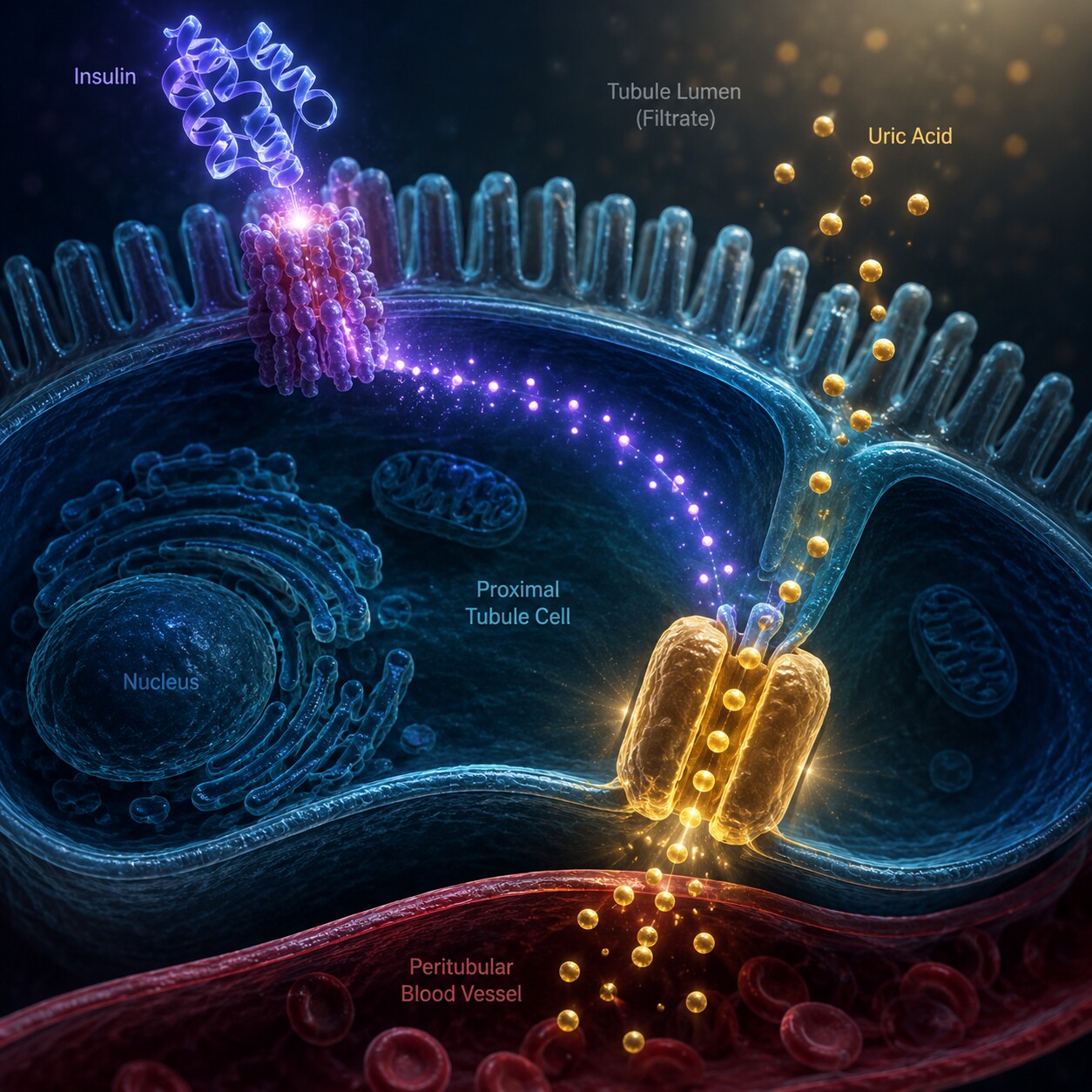
Figure 2. Insulin acts directly on transport proteins in the kidney's proximal tubule, prompting more uric acid to be reabsorbed into the blood instead of passed out in urine.
Uric acid was left off the official checklist mainly for historical and practical reasons — the five criteria above were chosen because each one, on its own, is an established, independently validated risk factor for heart disease with decades of outcome data behind it, and the goal was to keep the definition to a short, actionable list. Uric acid simply wasn't part of the original evidence base those five were built on. But when researchers have gone looking for it anyway, the association has turned out to be remarkably consistent: studies using large national health datasets have repeatedly found hyperuricemia (the clinical term for a uric acid level above the typical reference range) in well over half of people who meet full metabolic syndrome criteria, compared with a much smaller share of people who meet none of the five markers — and the more of the five criteria a person has, the more likely their uric acid is to be elevated too, in a clear stepwise pattern rather than an all-or-nothing jump.
The central mechanism behind that pattern runs through insulin, the hormone your pancreas releases after eating to help cells absorb glucose (blood sugar) for energy. In insulin resistance — a state where cells stop responding normally to insulin's signal, forcing the pancreas to pump out more and more of it just to keep blood sugar in a normal range — that excess circulating insulin does something you wouldn't necessarily expect: it acts directly on the kidneys. Specifically, insulin increases the activity of transport proteins in the kidney's proximal tubule, the section of the kidney's filtering unit responsible for reclaiming useful substances from the fluid that will eventually become urine. Two of these transporters, known in the research literature as URAT1 and GLUT9, are largely dedicated to pulling filtered uric acid back into the bloodstream rather than letting it pass out of the body. When insulin levels run chronically high — which happens years before blood sugar itself ever crosses into diabetic territory — these transporters work overtime, and measurably more uric acid gets reabsorbed instead of excreted. This is a big part of why hyperuricemia often shows up early in the development of insulin resistance, sometimes before glucose, blood pressure, or triglycerides have moved far enough to register on their own.
The Fructose–Liver Fork: One Pathway, Two Metabolic Problems
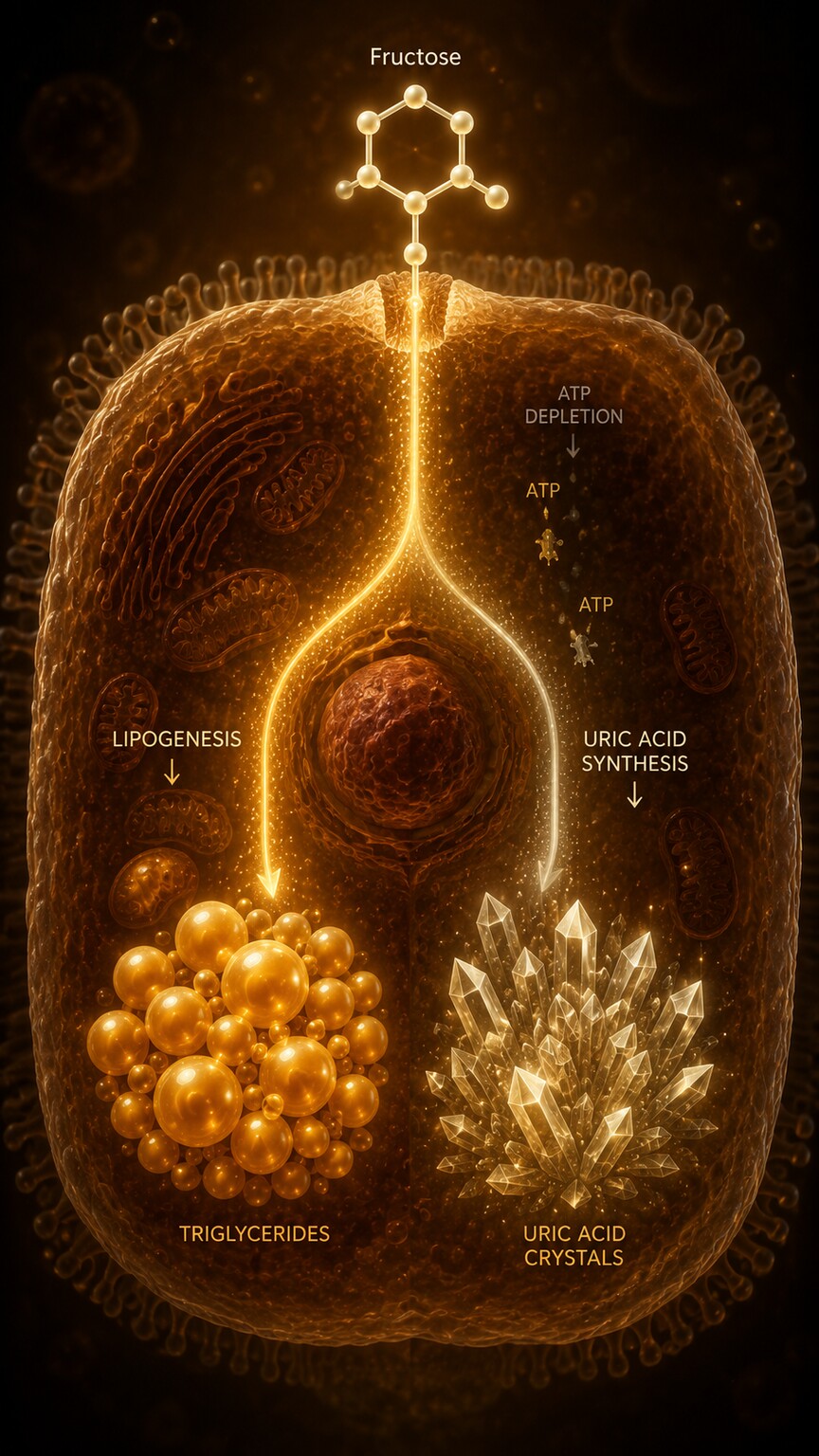
Figure 3. Inside a liver cell, fructose metabolism splits into two simultaneous outputs — new triglycerides on one branch and new uric acid on the other — from the same starting molecule.
Insulin resistance explains a large share of the uric acid–metabolic syndrome overlap, but it doesn't explain all of it, and that's where a specific dietary sugar becomes central to the story. Fructose — the sugar found naturally in fruit, but present in far larger, more concentrated amounts in sodas, fruit juices, and high-fructose corn syrup — is processed almost entirely by the liver, unlike glucose, which nearly every cell in the body can use directly. Inside liver cells, an enzyme called fructokinase begins breaking fructose down so quickly, and with so little internal regulation, that it rapidly depletes the cell's available supply of ATP, the molecule cells rely on as an immediate energy currency. That sudden ATP drop triggers two things at once, from the very same starting event: first, the cell activates a backup pathway to recycle what's left of its energy molecules, and that pathway dead-ends in the production of new uric acid; second, the liver responds to the incoming fructose by ramping up a separate process called de novo lipogenesis, which converts sugar into new fat molecules — specifically triglycerides — for storage or export into the bloodstream.
In other words, a single sugar molecule entering a single liver cell can simultaneously become a driver of two of metabolic syndrome's five official criteria (rising triglycerides, and, over time, the insulin resistance that fat accumulation itself worsens) and a driver of uric acid, all from one shared starting point rather than two unrelated processes that simply happen to coincide. This helps explain a pattern researchers have documented repeatedly in population studies: people who drink sugar-sweetened beverages regularly tend to show elevated triglycerides and elevated uric acid together, more often than either marker shows up alone, and the association holds up even after accounting for total calorie intake and body weight. It's also why whole fruit, despite containing the same sugar, produces a far gentler version of this effect — the fiber and water in whole fruit slow digestion enough that fructose reaches the liver gradually rather than in the concentrated burst a sugary drink delivers in a few swallows.
Visceral Fat: An Active Amplifier, Not Just Extra Weight
Waist circumference earns its spot on the metabolic syndrome checklist because it's a reasonably good external proxy for something happening deep inside the abdomen: the accumulation of visceral fat, the fat that surrounds internal organs like the liver, intestines, and pancreas, as opposed to the subcutaneous fat that sits just under the skin elsewhere on the body. For a long time, fat tissue was thought of as a fairly passive energy-storage depot — essentially inert padding. Research over the past two decades has overturned that picture almost completely. Visceral fat behaves more like an active endocrine organ, continuously releasing inflammatory signaling molecules called cytokines, including TNF-alpha and IL-6, directly into the bloodstream that drains toward the liver. These cytokines interfere with insulin's ability to bind to its receptors on cells throughout the body, worsening insulin resistance independently of diet in the same moment it's being driven by diet.
Visceral fat tissue also expresses its own local supply of xanthine oxidase, the same enzyme responsible for the final step of uric acid production elsewhere in the body, meaning a person carrying significant visceral fat isn't just experiencing indirect, insulin-mediated effects on uric acid — some of the excess production may be happening inside the fat tissue itself. This is part of why waist circumference correlates with uric acid levels even in people whose weight, by the scale alone, wouldn't be considered unusual; body composition and where fat is stored appear to matter as much as total body weight for this particular relationship. It's also why losing visceral fat specifically — through a combination of diet and regular physical activity rather than weight loss from any source — tends to move uric acid, triglycerides, and insulin sensitivity together, rather than affecting just one marker in isolation.
Fatty Liver Disease: The Organ Where Both Problems Overlap Most Directly
The liver is easy to take for granted because it works quietly in the background, filtering the blood, processing nutrients absorbed from food, and manufacturing many of the proteins and fats the rest of the body depends on. When that processing load includes a steady diet of excess sugar, alcohol, or simply more calories than the body needs, the liver begins storing some of that excess as fat directly inside its own cells — a condition now most often called metabolic dysfunction-associated steatotic liver disease, still widely known by its older name, non-alcoholic fatty liver disease. It's extremely common in people who meet metabolic syndrome criteria, and it sits at almost the exact intersection of everything discussed so far: the same fructose overload that raises triglycerides and uric acid together also drives fat accumulation inside liver cells, and a liver already burdened with excess fat tends to process incoming sugar even more aggressively, in something of a self-reinforcing loop.
The relationship between uric acid and fatty liver disease may run in both directions rather than just one. Beyond being a downstream product of the same fructose pathway, some research — largely from cell and animal studies, though supported by observational data in humans — suggests uric acid itself may actively promote fat storage inside liver cells and interfere with the ability of blood vessel linings to respond normally to insulin, effects that would make uric acid not merely a bystander riding along with fatty liver disease but an active contributor to it. That specific question — whether uric acid meaningfully causes liver fat accumulation and insulin resistance, or mostly just reflects a liver and metabolism that are already struggling for other reasons — remains a genuinely open area of research, and reputable scientists differ on how much causal weight to place on uric acid itself versus the pathways that raise it. From a practical standpoint, though, the distinction changes very little: fatty liver disease, elevated triglycerides, and elevated uric acid tend to travel together closely enough that finding one is a reasonable prompt to ask a doctor about screening for the others.
Blood Pressure's Own Link to Uric Acid
Blood pressure deserves its own explanation within this cluster, because uric acid's relationship to it doesn't rely solely on insulin or fructose. Uric acid appears to have a direct effect on the cells lining the inside of blood vessels, called the endothelium, by reducing their production of nitric oxide — a molecule that normally signals blood vessels to relax and widen. With less nitric oxide available, blood vessels stay more constricted than they otherwise would, which raises resistance to blood flow and, over time, blood pressure itself. Some of the more compelling evidence for this specific mechanism, interestingly, comes from research in adolescents rather than adults: several studies have found that elevated uric acid measured in otherwise healthy teenagers predicts a higher risk of developing high blood pressure years later, in a population largely free of the confounding effects of long-standing diabetes or decades of accumulated cardiovascular disease that make cause-and-effect harder to untangle in older adults.
This vascular effect is thought to work somewhat independently of the insulin- and fructose-driven pathways described earlier, which is part of why researchers have taken it seriously as a potential direct contributor to metabolic syndrome's blood pressure criterion, rather than uric acid simply riding along as an innocent bystander in this particular case. It's worth being careful with that word "independently," though — in real life, a person with high uric acid from a sugar-heavy diet is also very likely dealing with the insulin resistance and visceral fat described above at the same time, so untangling exactly how much of their blood pressure is coming from each individual mechanism isn't something a routine lab panel can answer. What matters practically is simpler: elevated uric acid and elevated blood pressure showing up together is common enough, and biologically plausible enough, that it's a pattern worth mentioning to a doctor rather than treating as two unrelated coincidences.
Shared Genetic Ground: Why This Runs in Families
Diet and body weight explain a great deal of the overlap between uric acid and metabolic syndrome, but genetics contribute a real, measurable piece as well — and increasingly, research suggests some of that genetic contribution is shared rather than separate. Large genome-wide association studies, which scan the DNA of tens of thousands of participants looking for genetic variants linked to a particular trait, have identified several genes — including SLC2A9 and ABCG2, both involved in how the kidneys handle uric acid — that also show weaker but detectable associations with insulin resistance and triglyceride levels in the same populations. This doesn't mean a single gene causes both conditions outright; the effect sizes involved are generally modest. But it does mean that some of the tendency for uric acid and metabolic syndrome to run together in certain families may be baked in at the genetic level, on top of whatever is happening with diet and lifestyle in any given year.
This matters most for interpretation, not for action — a strong family history of gout, early heart disease, or type 2 diabetes doesn't call for a different set of lifestyle habits than anyone else would benefit from, but it is useful context for a doctor to have. Two people with genuinely identical diets and body weights can land on meaningfully different points across every marker in this article, and family history is one of the more efficient ways to explain part of that gap without needing specialized genetic testing that most primary care visits wouldn't otherwise order.
Does High Uric Acid Cause Metabolic Syndrome — or Is It Mostly a Bystander?
Given how consistently uric acid and metabolic syndrome show up together, it's a fair question to ask which one is driving the other — and the honest answer is that the research community hasn't fully settled it. One of the more rigorous tools scientists have used to test causality directly is called Mendelian randomization, a method that takes advantage of the fact that genetic variants are assigned essentially at random at conception, before lifestyle, diet, or disease can influence them. By comparing people who happen to carry genetic variants associated with naturally higher uric acid against those who don't, researchers can ask whether higher uric acid itself — separate from diet, weight, or any other confounding factor — predicts worse outcomes on blood pressure, insulin resistance, or other metabolic syndrome components.
The results of these studies have been genuinely mixed, and somewhat humbling for the idea that uric acid is a primary driver. Several well-designed Mendelian randomization analyses have failed to find a strong independent causal signal between genetically elevated uric acid and blood pressure or insulin resistance, suggesting that in at least some of these relationships, uric acid may be more of a passenger — a marker that rises alongside the true underlying drivers of fructose overload, visceral fat, and insulin resistance — rather than a cause in its own right. Other studies, particularly those looking at fatty liver and vascular function specifically, have found signals more consistent with a direct causal contribution. Taken together, the most defensible summary at this point is that uric acid is very likely both: a reliable marker of the same underlying metabolic disturbance in nearly everyone who has it, and, in at least some of the specific pathways described in this article, an active contributor in its own right rather than a purely passive bystander. Ongoing research using larger datasets and better genetic tools continues to refine exactly where that line falls.
What This Cluster Looks Like During an Actual Checkup

Figure 4. Waist circumference is measured directly, in person, because it reflects visceral fat far more accurately than body weight or BMI alone.
In practice, this connection rarely announces itself as a single alarming lab value — it tends to show up gradually, as a pattern across several numbers collected over routine visits rather than one dramatic result. A typical presentation might include a uric acid level sitting just above the standard reference range, triglycerides drifting upward over a couple of years, HDL cholesterol on the lower edge of normal, blood pressure that's crept from comfortably normal to borderline, and a waist measurement that's grown an inch or two without necessarily a large change on the bathroom scale. No single one of these findings, on its own, is usually treated as an emergency, and a mildly elevated uric acid level with nothing else abnormal is not, by itself, evidence of metabolic syndrome or any other serious problem.
What tends to change a clinician's level of attention is exactly this kind of pattern recognition — seeing uric acid nudge upward at the same visit where triglycerides or blood pressure have also moved, rather than any one number in isolation. Because uric acid is included on so many standard metabolic and kidney panels already, it often ends up being one of the earlier threads a doctor notices, even though it isn't one of the five official diagnostic criteria. That's a reasonable, evidence-based reason to bring it up directly at an appointment — not as a cause for alarm, but as a prompt to look at the fuller picture (waist measurement, blood pressure, a fasting lipid panel, and fasting glucose or HbA1c) together, rather than waiting for any single criterion to cross its own threshold on its own timeline.
What Actually Helps: The Overlapping Interventions

Figure 5. Because sugar-sweetened beverages drive both triglycerides and uric acid through the same liver pathway, reducing them tends to move both markers at once.
The encouraging side of this whole connection is that because so few shared pathways are doing most of the work, a fairly short list of changes tends to move several markers at once rather than requiring five separate, unrelated interventions. Reducing sugar-sweetened beverages — sodas, sweetened teas, and fruit juices in particular — has the most direct line to the fructose-liver pathway described earlier, and research has repeatedly shown measurable improvements in both triglycerides and uric acid within weeks of cutting back, well before any significant weight change occurs. This doesn't require eliminating sugar entirely or treating occasional dessert as forbidden; the strongest, most consistently replicated effects in research come specifically from concentrated liquid sugar consumed regularly, not from sugar in food generally.
Regular physical activity works through a genuinely different mechanism than diet, primarily by improving how sensitively muscle cells respond to insulin, which reduces the circulating insulin levels that drive the kidney's urate-reabsorption transporters described earlier. Both aerobic exercise (walking, cycling, swimming) and resistance training (using weights or body resistance to build muscle) have shown benefit in research, and combining the two tends to outperform either alone. Weight loss, when it happens as a byproduct of these sustainable changes rather than through very aggressive, rapid calorie restriction, tends to improve every marker in this cluster together — visceral fat especially, since it's typically among the first fat stores to shrink with a calorie deficit. One nuance worth flagging: very rapid weight loss or strict fasting can, somewhat counterintuitively, cause a temporary uric acid increase in the first couple of weeks through a separate mechanism involving ketone bodies competing with uric acid for the same kidney transporters — a short-lived effect that resolves on its own and shouldn't discourage a steady, sustainable approach to weight loss.
Hydration, Alcohol, and Sleep
Consistent hydration throughout the day supports the kidney's ability to clear uric acid efficiently, since concentrated urine encourages more of it to be reabsorbed rather than excreted — the same principle behind why a hot, under-hydrated day can produce a short-term uric acid spike on its own. Alcohol, particularly beer, contributes to this cluster through more than one channel at once: it supplies its own purine load, competes with uric acid for kidney excretion through a shared pathway involving lactate, and contributes calories that can worsen visceral fat and triglycerides over time — which is part of why moderating alcohol intake tends to show up as a recurring, evidence-backed recommendation across nearly every condition discussed in this article. Sleep quality matters more than many people expect as well: obstructive sleep apnea, in which breathing repeatedly stops and starts during sleep, has been independently linked to both insulin resistance and elevated uric acid, likely related to the repeated drops in blood oxygen that occur with each pause in breathing, making unexplained daytime fatigue or loud snoring worth mentioning to a doctor alongside any of the lab findings discussed here.
When Medication Enters the Conversation
For some people, lifestyle changes alone aren't enough to bring every marker into a comfortable range, and that's a conversation for a doctor to lead rather than something to self-manage. A doctor may consider medications that address insulin resistance directly, blood pressure medications chosen with an eye toward their effect on uric acid (since some, like certain diuretics, can raise it as a side effect while others are more neutral), or, in specific circumstances such as recurrent gout attacks or uric acid kidney stones, medications aimed specifically at lowering uric acid itself. Which combination makes sense depends on the full picture — family history, other health conditions, and personal risk tolerance — and is genuinely a decision best made together with a healthcare provider rather than from a general framework like this one.
Frequently Asked Questions
Can someone have metabolic syndrome without ever having high uric acid or gout?
Yes. Uric acid is not one of the five official diagnostic criteria, and plenty of people meet metabolic syndrome criteria — through combinations like high blood pressure, high triglycerides, and abdominal obesity — while keeping a uric acid level well within the normal range. The association is strong at a population level, but it isn't universal in every individual case.
My uric acid is high but I don't have any of the five metabolic syndrome criteria. Does that mean I'm in the clear?
Not necessarily, but it's a reasonable, less urgent starting point. Isolated high uric acid can come from diet, dehydration, certain medications, or genetics alone, without any accompanying metabolic disturbance. It's still worth mentioning to a doctor, particularly if there's a family history of gout, kidney stones, or early heart disease, since it may be an early signal worth monitoring rather than something requiring immediate treatment.
If I start a medication that lowers uric acid, will it also improve my triglycerides or blood pressure?
Not reliably, and this is a question worth asking a doctor directly rather than assuming. Because uric acid may act more as a marker than a direct cause in several of these pathways, medications that specifically lower it (like allopurinol) don't consistently improve the other metabolic syndrome criteria in research. Lifestyle changes that address the shared root causes — fructose intake, visceral fat, and insulin resistance — tend to move more markers at once than treating uric acid in isolation.
Because so much of this connection traces back to a small number of shared pathways, small and sustainable changes tend to be more reliably effective than trying to fix any single number in isolation. Cutting back on concentrated liquid sugar, staying consistently hydrated, moving regularly, moderating alcohol, and getting evaluated for sleep issues if they're present all pull on the same few threads running underneath uric acid, triglycerides, blood pressure, glucose, and waist circumference at once — which is a big part of why doctors so often recommend the same handful of habits regardless of which specific lab value brought a patient in the door in the first place.
The Downstream Risk When the Cluster Goes Unaddressed
Most of this article has focused on mechanisms — the quiet, often invisible biochemistry connecting uric acid to the rest of metabolic syndrome. It's worth spending a moment on why any of this matters beyond the lab report itself. Left unaddressed over years rather than months, the combination of elevated uric acid and metabolic syndrome doesn't just sit passively on paper; each condition appears to raise the stakes of the other. People with both hyperuricemia and metabolic syndrome face a meaningfully higher risk of eventually developing gout, the intensely painful joint condition caused by needle-shaped uric acid crystals forming inside a joint, than people with either condition alone. The same visceral fat and insulin resistance driving the metabolic side of the equation also make the kidneys less efficient at clearing uric acid, which over time raises the odds of uric acid crystallizing not just in joints but inside the kidneys themselves, forming a specific type of kidney stone distinct from the more common calcium-based stones.
The cardiovascular stakes compound in a similar way. Metabolic syndrome alone roughly doubles long-term risk for heart disease and stroke compared with having none of its five criteria, and several large cohort studies have found that adding hyperuricemia on top of an existing metabolic syndrome diagnosis further increases that risk beyond what the five official criteria predict on their own — consistent with the idea, discussed earlier, that uric acid contributes something of its own to blood vessel health rather than being an entirely inert bystander. Chronic kidney disease adds a final layer to this cycle: as kidney function gradually declines, for any reason, the kidneys become less able to clear uric acid, which raises uric acid further, which in some research appears to accelerate kidney function decline a bit more in turn — a slow, self-reinforcing loop rather than a one-time event. None of this is meant to be alarming for someone who has just noticed one mildly elevated number on a single lab report; it's simply the reason clinicians take the combination seriously enough to look at the whole picture rather than waiting for any one piece to become severe on its own.
Conclusion
Uric acid's absence from the official metabolic syndrome checklist has never meant it's unrelated to it — if anything, the research points the other way, showing a marker that's tangled up with nearly every part of the syndrome's underlying biology. Insulin resistance pushes the kidneys to hold onto more uric acid than they otherwise would. A shared liver pathway lets a single sugar molecule become both a triglyceride and a uric acid at the same time. Visceral fat behaves as an active contributor rather than passive storage, adding its own inflammatory and uric-acid-producing effects on top. And genuine, if still not fully settled, research suggests uric acid may do more than simply ride along — it may actively worsen fatty liver disease and blood vessel function in at least some of the people who have it. None of this means a single elevated uric acid result is something to panic over. It means it's a legitimate, evidence-based reason to look at the rest of the metabolic picture — waist size, blood pressure, blood sugar, and lipid panel — together with a healthcare provider, rather than treating any one number as the whole story.
Still Not Sure What Your Results Mean?
Upload your labs and get a complete, visual, plain-language interpretation of every biomarker — delivered to your inbox in under 15 minutes.
Get My ReportThis article is for educational purposes only and does not constitute medical advice. Always consult your healthcare provider regarding your specific lab results.