
Why Do Uric Acid Levels Rise During Fasting or Rapid Weight Loss?
Yes — fasting and rapid weight loss can genuinely raise uric acid, a waste product your body normally clears through your kidneys, and this surprises a lot of people because losing weight is supposed to be the thing that brings uric acid down over time. The two facts aren't actually in conflict; they're just operating on different timelines. In the short term, going without food for an extended stretch, following a very-low-calorie diet, or losing weight unusually fast triggers a handful of overlapping changes in your body chemistry: your liver starts producing molecules called ketones that compete directly with uric acid for the same exit route out of your kidneys, your own muscle and fat tissue begins breaking down and releasing the raw material uric acid is made from, and a good portion of "fast" weight loss early on is actually water leaving your body, which concentrates whatever uric acid remains in a smaller volume of blood. Put together, these effects can push uric acid up noticeably within days, and in people already prone to it, this exact scenario is a well-documented trigger for a gout flare — the sudden, intense joint pain that high uric acid can cause.
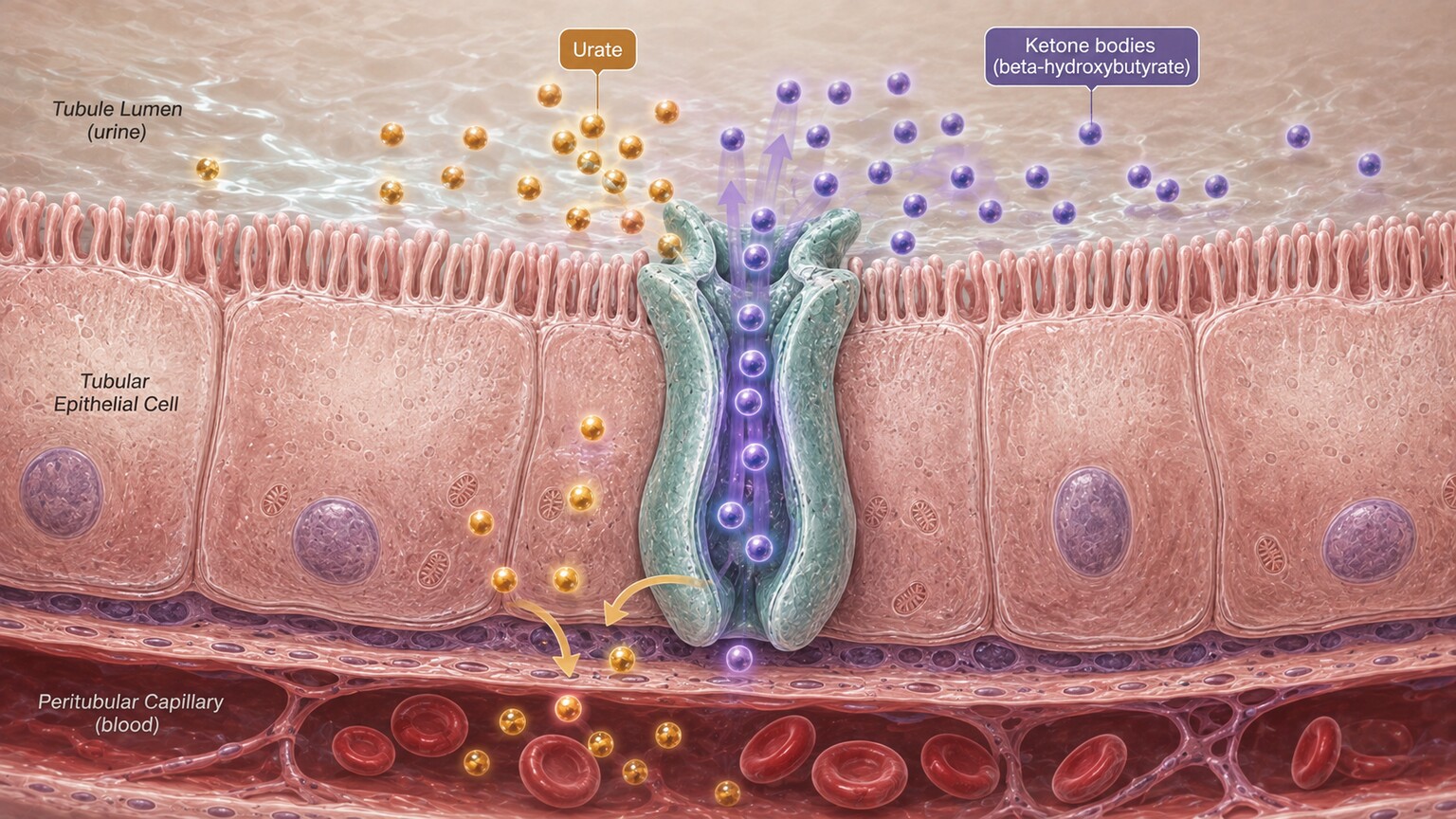
Figure 1. Beta-hydroxybutyrate and other ketone bodies compete with urate for the same transporter in the kidney's proximal tubule, reducing how much uric acid gets excreted into urine.
Curious what the rest of your kidney panel is telling you beyond uric acid? Upload your results and get a complete, plain-language breakdown in under 15 minutes.
Analyze My ResultsWhat Uric Acid Actually Is, and Where It Comes From
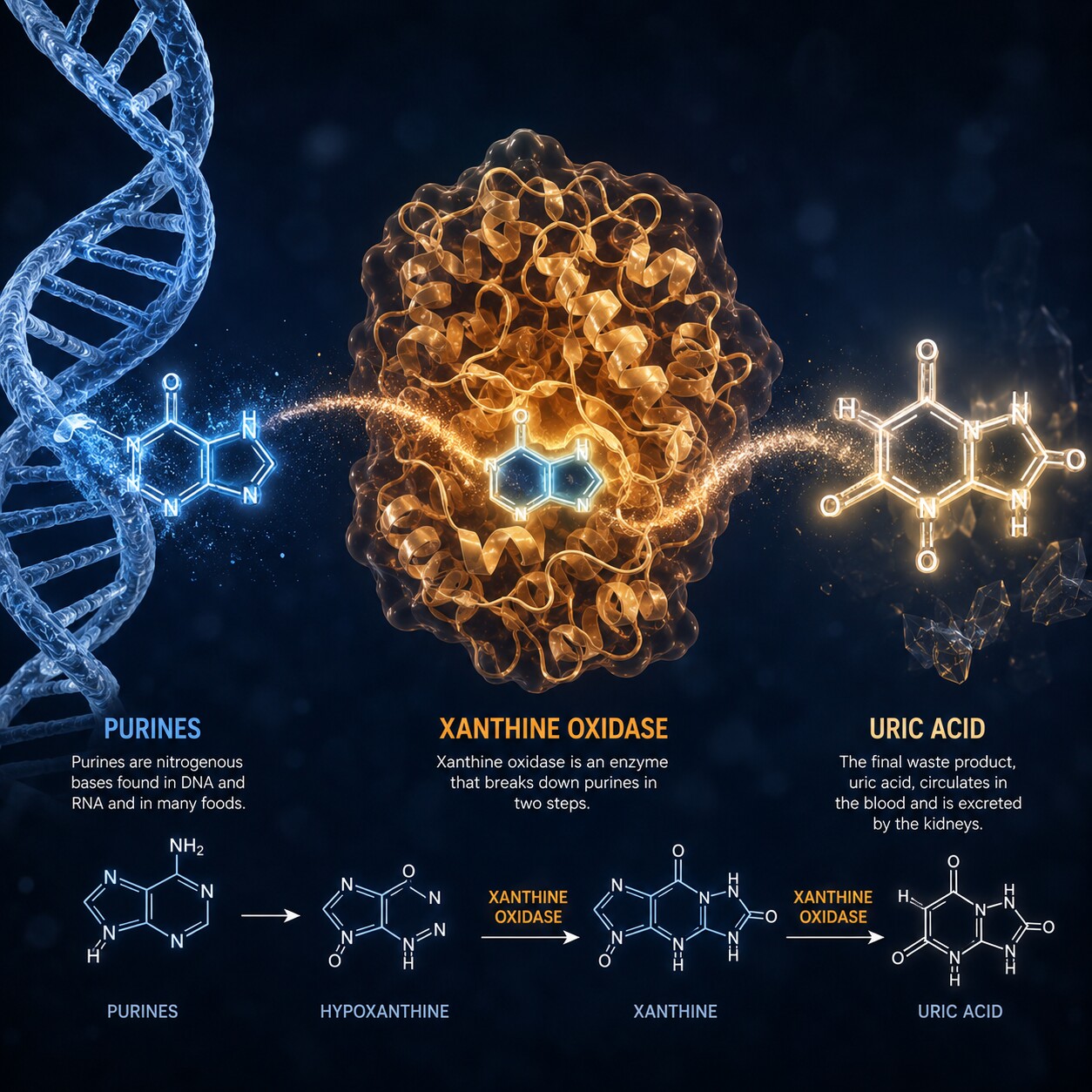
Figure 2. Purines from both diet and the body's own cell turnover are broken down through the enzyme xanthine oxidase into uric acid, a waste product humans cannot break down any further.
Uric acid is what's left over after your body finishes breaking down purines — a category of molecules that are part of the genetic material (DNA and RNA) inside every one of your cells, and that also show up in certain foods like organ meats, anchovies, and beer. Every day, your cells naturally die off and get replaced as part of normal turnover, and every time that happens, the purines inside those old cells get dismantled. An enzyme called xanthine oxidase carries out the final steps of that breakdown, and uric acid is the end product it produces. Most mammals have a backup enzyme called uricase that breaks uric acid down even further into something easier to flush away, but humans lost the working version of that enzyme somewhere in our evolutionary past. That's a big part of why uric acid tends to run higher in humans than in most other animals, and why our bodies rely entirely on the kidneys and gut to clear it out rather than breaking it down chemically first.
Roughly two-thirds of the uric acid your body makes each day gets filtered out through your kidneys and leaves in your urine, while the remaining third is broken down by bacteria in your gut and eliminated that way. Under normal conditions, this is a steady, well-balanced system: your body makes a fairly predictable amount of uric acid from ordinary cell turnover and diet, and your kidneys and gut clear out a matching amount, keeping the level in your blood inside a stable range. Fasting and rapid weight loss disrupt both sides of that balance at once — increasing how much uric acid your body generates while simultaneously making it harder for your kidneys to clear it away — which is exactly why the combination has such a noticeable effect.
It's worth understanding why the body bothers regulating this so tightly in the first place. Uric acid doesn't dissolve especially well in fluid, particularly cooler fluid, and blood carries it very close to the upper limit of what it can hold in solution at normal body temperature. That's a precarious position by design flaw more than intention — it leaves relatively little margin before uric acid starts coming out of solution the way sugar crystallizes out of an oversaturated syrup. When that margin gets crossed, uric acid can form sharp, needle-shaped crystals, and joints — cooler than your body's core and lower in blood flow, especially in the extremities like the big toe — are exactly where those crystals are most likely to form and settle. That's the direct physical basis for gout, and it's why a number that sounds abstract on a lab report has such a concrete, painful real-world consequence when it climbs too high or moves too fast.
How Your Kidneys Normally Clear Uric Acid From Your Blood
To understand why fasting throws this system off, it helps to know a little about how your kidneys handle uric acid on an ordinary day. Blood constantly passes through tiny filtering units in your kidneys, and nearly all the uric acid in that blood gets filtered out into the very beginning of the urine-forming process. But here's the part most people don't realize: your kidneys then reabsorb almost 90 percent of that filtered uric acid straight back into your bloodstream, and only actively push out a smaller, carefully regulated portion through a separate secretion step further along the same tubule. The net amount that actually ends up in your urine is the result of this filter-reabsorb-secrete sequence working in balance, not a simple one-way filtering process.
The reabsorption and secretion steps both depend on specialized transporter proteins embedded in the wall of the kidney tubule — think of them as revolving doors built into the tubule's lining, each shaped to grab onto a specific type of molecule and move it across the wall in one direction or another. One transporter in particular, often referred to in research as URAT1, is largely responsible for pulling uric acid back into the blood during reabsorption. Other transporters handle the active secretion step that pushes some uric acid back out into the urine. This entire system evolved to fine-tune uric acid levels precisely — but it turns out these same transporter doorways aren't exclusive to uric acid alone, and that shared access is exactly where fasting causes trouble.
This shared-transporter design isn't unique to fasting, either — it's actually the same underlying reason several other common situations are known to raise uric acid, which helps put the fasting mechanism into a broader, more familiar context. Alcohol, for instance, gets converted in the liver into lactic acid, and lactic acid competes for the same secretion transporters uric acid relies on, which is a major reason heavy drinking is so strongly linked to gout flares. Certain diuretic medications used to treat high blood pressure work partly by affecting how the kidney handles sodium and water, and as a side effect, several of them also reduce how much uric acid gets secreted, which is why people starting a new diuretic are sometimes monitored for rising uric acid. Recognizing that fasting-related ketones fit into this same general pattern — a competing molecule crowding uric acid out of a shared exit route — makes the mechanism feel less like an isolated fasting quirk and more like one example of a recurring theme in kidney physiology.
The Core Mechanism: Why Ketones Block Uric Acid From Leaving Your Body
When you go without food for an extended period — whether that's intentional fasting, a very-low-calorie diet, or simply severe calorie restriction during rapid weight loss — your liver shifts into a backup fuel-production mode once its stored sugar (glycogen) runs low, typically within the first day or so. It starts converting fat into molecules called ketone bodies, mainly beta-hydroxybutyrate and acetoacetate, which your brain and muscles can burn for energy instead of glucose. This is a completely normal, well-understood survival adaptation, and it's the same metabolic shift that happens on a strict ketogenic diet.
The problem for uric acid is a case of bad timing and shared infrastructure. The organic anion transporters in your kidney tubules that handle uric acid secretion also handle the secretion of ketone bodies, since both are similarly shaped, negatively charged organic molecules as far as the transporter protein is concerned. When ketone levels in your blood rise sharply during fasting, they flood those shared transporters and effectively crowd uric acid out of its usual exit route — a phenomenon researchers describe as competitive inhibition, the same basic concept as two people trying to squeeze through one revolving door at once and both moving slower as a result. With less uric acid able to make its way into the urine, more of it stays in the bloodstream, and your measured level climbs even though your kidneys themselves are perfectly healthy.
This exact mechanism is why fasting-induced increases in uric acid tend to track closely with how deep into ketosis someone is. Someone in the earliest stages of a fast, before ketone production has ramped up much, usually sees only a small change. Someone several days into a strict water-only fast or a very aggressive low-calorie, low-carbohydrate diet, with ketone levels running high, tends to see a considerably larger rise — sometimes doubling their baseline uric acid level in studies that have measured this directly.
Why a Rapid Change in Either Direction Can Trigger a Flare
One detail that surprises a lot of people is that it isn't only a rise in uric acid that can set off a gout flare — a sudden drop can trigger one too, and understanding why ties back directly to the crystal-formation idea mentioned earlier. Existing uric acid crystals that have been sitting quietly in and around a joint, often for years without causing any symptoms, are coated with a thin layer of proteins that helps keep the body's immune system from reacting to them. A rapid change in blood uric acid levels — in either direction — can disturb that protective coating and expose bare crystal surface to nearby immune cells, which respond as though something new and foreign has suddenly appeared. That immune response, not the crystals themselves sitting there quietly, is what actually produces the intense pain, swelling, and redness of a gout flare.
This is exactly why the rate of change matters as much as the absolute number during fasting or rapid weight loss. A gradual rise in uric acid over months, even up to a fairly high level, often causes no symptoms at all in some people, while a sharp swing over just a few days — the kind fasting produces through the mechanisms described in this article — is disproportionately likely to disturb existing crystal deposits and provoke a flare, even in someone whose peak uric acid level during the fast doesn't look dramatically abnormal on paper. It's part of why gout flares are also well known to happen during the early days of starting urate-lowering medication, when levels are dropping quickly for a therapeutic reason — the same rapid-change principle, just running in the opposite direction.
Why Breaking Down Your Own Tissue Releases Extra Purines
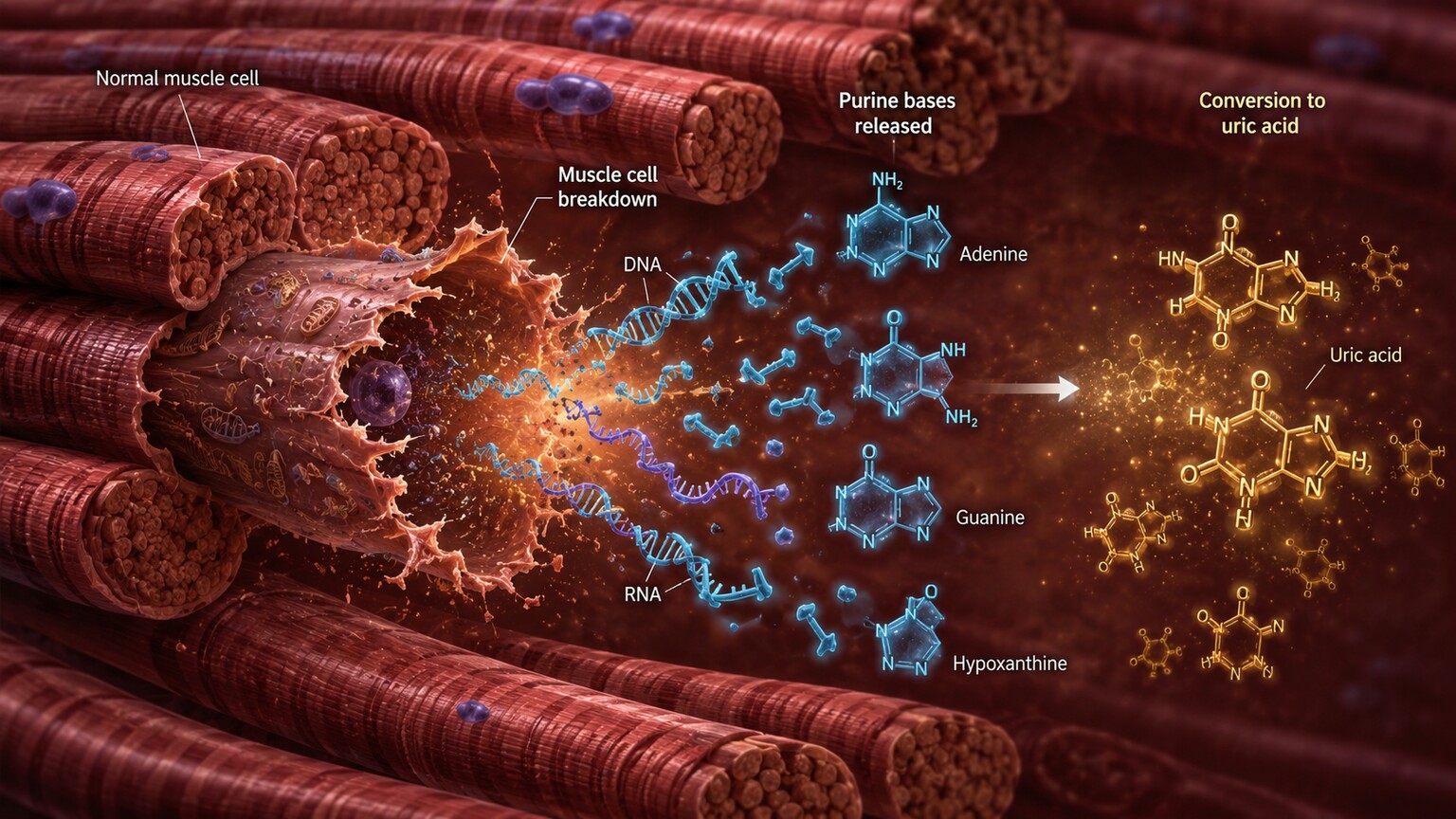
Figure 3. As muscle and fat cells are broken down for energy during rapid weight loss, the purines released from their genetic material add directly to the body's uric acid load.
Ketone competition is only half of the story. The other major driver is that rapid weight loss, almost by definition, involves your body breaking down its own tissue for fuel faster than it normally would — a process called catabolism. When fat cells are broken down quickly, and especially when muscle tissue is broken down alongside them (which happens more than people expect during very aggressive calorie restriction), the cells being dismantled release their internal contents, including the DNA and RNA packed inside their nuclei. Those nucleic acids are, again, built from purines, and every cell your body breaks down for energy adds a fresh supply of purine raw material that eventually gets converted into more uric acid.
This is a genuinely different mechanism from the ketone-competition problem described above — one is about your kidneys struggling to get rid of uric acid, while this one is about your body actually manufacturing more of it in the first place. During ordinary, gradual weight loss achieved through a moderate calorie deficit, this extra tissue turnover is fairly minor and easy for the kidneys to keep pace with. During rapid weight loss — the kind associated with very-low-calorie diets, extended fasting, or the first weeks after bariatric surgery — the sheer speed of tissue breakdown can meaningfully outpace what the kidneys can clear, especially while those same kidneys are simultaneously being asked to compete with rising ketone levels for the same excretion pathway.
Dehydration and the Water-Weight Effect on Uric Acid
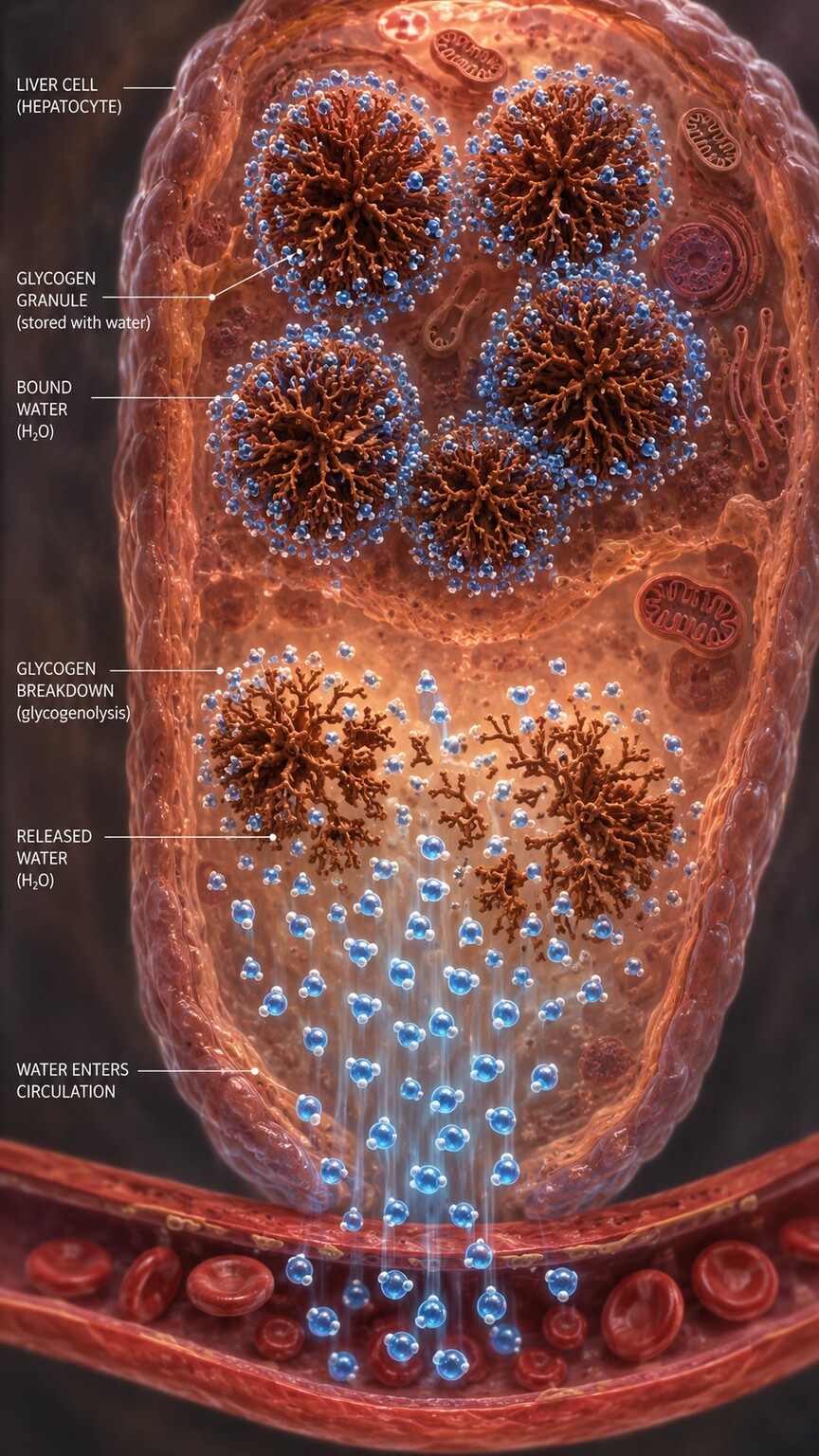
Figure 4. Because glycogen is stored bound to water at a ratio of roughly three to four grams of water per gram of glycogen, the first pounds lost during a fast are largely water, concentrating uric acid in a smaller blood volume.
There's a third contributor that has nothing to do with purines or ketones directly, and it explains why rapid weight loss specifically — not just any weight loss — tends to raise uric acid the most. Your body stores a backup supply of sugar called glycogen in your liver and muscles, and each gram of that stored glycogen is bound together with roughly three to four grams of water. When you stop eating or drastically cut calories, your body burns through its glycogen reserves within the first day or two, releasing all that bound water in the process. This is the well-known reason people lose several pounds so quickly in the first few days of a strict diet or fast — most of it is water, not fat.
That released water still has to go somewhere, and much of it ultimately gets excreted through increased urination, meaning your total blood volume can drop measurably over that same short window. When blood volume shrinks while the amount of dissolved uric acid stays roughly the same (at least initially), the uric acid becomes more concentrated in a smaller volume of fluid — the same basic concentration effect that happens with any form of significant fluid loss. Combined with reduced fluid intake, which is common during strict fasting protocols or when someone simply isn't drinking as much while focused on not eating, this concentrating effect can meaningfully stack on top of the ketone-competition and tissue-breakdown mechanisms described above, pushing the final number even higher.
The Paradox: Why Weight Loss Usually Lowers Uric Acid, But Losing It Fast Can Raise It
This is the part that trips people up, so it's worth explaining clearly with a timeline in mind rather than treating it as a contradiction. Over the long run — weeks to months — carrying less excess body fat is genuinely associated with lower uric acid levels, and this is well established in research on obesity and metabolic health. Fat tissue itself contributes to uric acid production, and excess weight is linked to changes in how the kidneys handle uric acid that tend to push levels upward. Sustainable, gradual weight loss reverses both of those effects over time, which is one of the reasons doctors recommend weight management for people with a history of gout or chronically elevated uric acid.
The short-term picture during the active process of losing weight quickly is a completely different phase, governed by the mechanisms described in the previous three sections — ketone competition, accelerated tissue breakdown, and water loss — all of which act on a timescale of days, not months. In other words, uric acid can rise sharply during the first days to weeks of an aggressive diet or fast, even though the eventual destination, once the weight has stabilized at a lower point and the body is no longer in an intense catabolic or ketotic state, is typically a lower baseline uric acid level than before the diet started. Think of it less as weight loss "causing" high uric acid and more like a temporary detour that happens on the way to a genuinely better long-term destination — a detour that matters because it can trigger real symptoms in the meantime, which the next section covers in more detail.
What Fasting and Very-Low-Calorie Diet Research Actually Shows
This isn't a fringe or poorly studied phenomenon — fasting-induced hyperuricemia (the clinical term for a fasting-related rise in uric acid) has been documented in medical literature going back decades, including in some of the earliest formal studies of therapeutic fasting for weight loss conducted in the 1960s and 1970s. Those studies, along with more recent research on very-low-calorie diets and intermittent fasting protocols, consistently find that uric acid rises within the first several days of significant calorie restriction, often peaking somewhere in the first one to two weeks before beginning to plateau or even decline somewhat if the fast or diet continues long enough for the body to adapt.
Bariatric surgery research has added another important piece to this picture. Studies following patients through the first weeks after weight-loss surgery — a period marked by extremely rapid fat loss, very low calorie intake, and significant ketosis — have documented measurable spikes in uric acid and a corresponding rise in gout flares during that exact early recovery window, even in patients with no prior history of gout. This has led several bariatric surgery programs to specifically counsel patients about gout risk in the weeks immediately following surgery and, in some cases, to consider preventive medication for patients with an existing gout history. The consistency of these findings across fasting studies, low-calorie diet trials, and bariatric surgery follow-up is part of why this mechanism is now considered well-established clinical knowledge rather than an unusual or unexplained lab finding.
Who's Most at Risk of a Fasting-Related Uric Acid Spike
Not everyone who fasts or loses weight quickly will notice this effect, and the people most likely to feel it in a tangible way — through an actual gout flare rather than just a number on a lab report — tend to share a few characteristics. Anyone with a personal history of gout or previously elevated uric acid is at the top of that list, since they're already closer to the threshold where uric acid crystals can form in a joint; a fasting-related spike on top of an already-elevated baseline is far more likely to cross that threshold than the same spike would be in someone starting from a low baseline. Men are affected more often than women, largely because baseline uric acid tends to run higher in men throughout most of adult life, a difference partly driven by estrogen's effect on how efficiently the kidneys clear uric acid.
People undertaking particularly aggressive interventions — strict water-only fasting, very-low-calorie diets providing under roughly 800 calories a day, or the immediate post-operative period after bariatric surgery — face a higher risk than people losing weight more gradually, simply because the ketone and tissue-breakdown mechanisms scale with how severe and how fast the calorie restriction actually is. Existing kidney impairment also raises the stakes, since kidneys already working with reduced capacity have less room to absorb the added burden of competing ketone secretion. Alcohol use during a fasting or weight-loss period compounds the risk further, since alcohol independently raises uric acid through its own separate mechanisms and adds to whatever the fasting itself is already doing.
Genetics plays a quieter but meaningful role as well. Some people carry variations in the genes that code for URAT1 and related transporter proteins that make their kidneys naturally less efficient at clearing uric acid even under ordinary conditions — often the same people who tend to run a higher baseline uric acid their whole lives, sometimes with a family history of gout running through several generations. For this group, the added transporter competition from fasting-related ketones lands on a system that already has less spare capacity to begin with, which is part of why a family history of gout is worth mentioning to a doctor before undertaking an aggressive fast or diet, even if you personally have never had a flare.
How Long Does This Last, and Does It Reverse on Its Own?
For most people, a fasting-related uric acid rise is temporary and tracks closely with how long the fasting or aggressive calorie restriction continues. Research on short-term fasts generally shows uric acid beginning to climb within the first one to three days, often peaking somewhere in the first one to two weeks of sustained calorie restriction, and then gradually leveling off if the fast or diet continues at the same intensity — the body partially adapts over time even without any change in eating pattern. Once normal eating resumes, whether that's breaking a fast or transitioning off a very-low-calorie diet onto a more moderate one, uric acid typically comes back down over the following days to a couple of weeks, as ketone production drops, tissue breakdown slows, and fluid balance normalizes.
There's an interesting wrinkle worth knowing about here: the act of refeeding after a prolonged fast can, in some cases, trigger its own separate uric acid fluctuation and even a distinct gout flare risk during the transition, part of the broader set of metabolic shifts sometimes referred to as refeeding syndrome. This means the story isn't always a simple straight line back down to baseline — some people see a temporary bump around the time they resume normal eating before things fully settle. For the significant majority of people doing a well-managed fast or supervised weight-loss program, though, uric acid returns to its pre-fast baseline or, given enough time for the person to stabilize at their new, lower weight, ends up somewhat lower than where it started.
What a High Result During a Diet or Fast Actually Means
If you've had blood work done while actively fasting, following a strict diet, or in the middle of rapid weight loss, and your uric acid came back elevated, the timing itself is genuinely important context — arguably as important as the number. A result drawn during this kind of metabolic stress doesn't necessarily reflect what your uric acid looks like under ordinary, stable conditions, and it's a reasonable, informed question to ask whoever ordered the test whether they'd like to interpret it with that context in mind or consider rechecking it once you're eating normally again. This is similar in spirit to how a dehydrated blood draw can temporarily skew other lab values — the number is real, but the story behind it matters for deciding what, if anything, needs to be done about it.
That said, a fasting-related explanation isn't a reason to ignore the result outright, especially if it's substantially elevated or if you're experiencing any joint pain, swelling, or redness, particularly in the big toe, ankle, or knee — the classic locations for a gout flare. Those symptoms warrant prompt attention regardless of what's causing the underlying uric acid rise, since an acute gout flare is treated the same way whether it was triggered by fasting, diet, genetics, or something else entirely. The fasting context mainly helps explain why the number moved, and helps guide a sensible next step — often simply rechecking the level once eating patterns have normalized — rather than assuming a new, permanent metabolic problem has appeared out of nowhere.
Reducing Your Gout Flare Risk While Losing Weight

Figure 5. Adequate hydration during a fast or very-low-calorie diet helps the kidneys keep clearing uric acid despite reduced food and fluid intake.
None of this science is a reason to avoid weight loss — quite the opposite, since sustained weight loss is genuinely good for long-term uric acid control and overall health. It's simply a reason to be thoughtful about pace and preparation, particularly for anyone with a personal or family history of gout. Choosing a more moderate, gradual rate of weight loss over an extremely aggressive one meaningfully reduces how intensely the ketone-competition and tissue-breakdown mechanisms kick in, since both scale with how severe and how fast the calorie deficit actually is.
Staying well hydrated throughout a fast or aggressive diet directly counters the water-loss concentration effect described earlier and supports your kidneys in continuing to clear whatever uric acid your body is producing. For anyone with a known gout history who is planning a significant fast, a very-low-calorie diet, or bariatric surgery, discussing this specific risk with a doctor beforehand is a reasonable step — some people in that situation are given preventive gout medication to cover the higher-risk window, a strategy that's become increasingly common in bariatric surgery programs once this pattern became well recognized. Limiting alcohol during this period and easing back into normal eating gradually, rather than abruptly, rounds out a sensible approach to minimizing the chances that a genuinely beneficial weight-loss effort gets derailed by a painful, avoidable gout flare along the way.
Medically supervised very-low-calorie diet programs, the kind sometimes used before bariatric surgery or for significant short-term weight loss under a doctor's guidance, typically build in exactly this kind of awareness already — periodic blood work that includes uric acid, clear guidance on fluid intake targets, and a structured, gradual approach to reintroducing food afterward rather than an abrupt return to normal eating. That structure exists precisely because clinicians managing these programs have seen the fasting-uric-acid pattern play out often enough to plan around it proactively. If you're considering a comparable approach on your own, outside of a formal supervised program, borrowing those same basic habits — checking in with a doctor beforehand, staying deliberate about hydration, and transitioning back to regular eating over several days rather than in one sitting — carries over most of the same protective benefit.
Frequently Asked Questions
How much can uric acid actually rise during a fast?
It varies by individual and by how strict the fast is, but studies of short-term fasting and very-low-calorie diets have documented increases of roughly 10 to 30 percent within the first week, with some cases of strict water-only fasting or aggressive post-bariatric-surgery diets showing considerably larger increases, occasionally doubling baseline levels in people who go into deep ketosis quickly.
Should I stop a fast or diet if my uric acid comes back high?
That's a decision to make with whoever is supervising your fast or diet, factoring in your symptoms and history. A mild elevation without any joint pain is often simply monitored, while joint pain, swelling, or redness — especially in the big toe, ankle, or knee — warrants prompt medical attention regardless of the cause, and may be a reason to pause an aggressive dietary approach.
Does intermittent fasting cause the same effect as a multi-day fast?
Typically to a much smaller degree. Short daily fasting windows of 12 to 16 hours generally don't produce the same depth of ketosis or tissue breakdown as an extended multi-day fast or a very-low-calorie diet, so the uric acid effect tends to be minimal for most people practicing common intermittent fasting patterns, though individual responses can vary.
Will my uric acid go back to normal once I stop fasting or finish losing weight quickly?
For most people, yes. Uric acid generally returns toward its pre-fast baseline within days to a couple of weeks of resuming normal eating, as ketone production drops and fluid balance normalizes. Once weight has fully stabilized at a lower level, many people end up with a somewhat lower long-term uric acid baseline than before they started, reflecting the beneficial long-term relationship between lower body weight and uric acid.
Can a rapid drop in uric acid from starting gout medication cause a flare too?
Yes, and the underlying reason is closely related to what makes fasting risky. A fast drop in uric acid, the way starting urate-lowering medication can produce, can disturb the protective coating on existing crystal deposits in a joint just as a fast rise can, triggering a flare even though the medication is working exactly as intended. This is why doctors often start gout medication at a low dose and increase it gradually rather than dropping uric acid sharply all at once.
Conclusion
A rise in uric acid during fasting or rapid weight loss isn't a sign that something has gone wrong with your kidneys or that weight loss is somehow bad for you — it's the predictable, well-documented result of ketone bodies competing with uric acid for the same kidney transporters, your own tissue releasing extra purines as it breaks down for fuel, and water loss temporarily concentrating whatever uric acid remains in your blood. These effects are real, they can trigger an actual gout flare in people already prone to one, and they're worth knowing about before starting an aggressive fast or very-low-calorie diet — but they're also temporary, and they don't erase the genuine long-term benefit that stable, sustained weight loss has on uric acid and overall health. If you're planning a significant fast or rapid weight-loss program and have any history of gout, bringing that up with a doctor ahead of time is a simple step that can help you get the benefits of weight loss without the unwelcome detour through joint pain along the way.
It's also worth remembering that none of these mechanisms mean fasting or aggressive dieting is inherently unsafe for the average healthy person without a gout history — the vast majority of people who fast or diet aggressively never experience a symptomatic flare, even when their uric acid does rise measurably on paper. The goal of understanding this science isn't to create new anxiety around dieting; it's to make sense of a lab result that would otherwise look confusing, and to give the smaller group of people who are genuinely at higher risk the specific, practical information they need to plan around it.
Still Not Sure What Your Results Mean?
Upload your labs and get a complete, visual, plain-language interpretation of every biomarker — delivered to your inbox in under 15 minutes.
Get My ReportThis article is for educational purposes only and does not constitute medical advice. Always consult your healthcare provider regarding your specific lab results.