
How to Translate Your Blood Test Results Into Plain English
You open the patient portal expecting an answer and instead get a wall of abbreviations, a column of numbers, a few letters that look like typos, and a note buried at the bottom that says "abnormal" without saying why. That reaction — the mix of relief that the results are finally in and confusion about what any of it actually means — is close to universal, and it's not a sign you're missing something everyone else already knows. Lab reports were designed by and for people who read hundreds of them a week, not for the person seeing their own for the first time. What follows is a practical, repeatable way to translate any blood test report into plain English yourself, piece by piece, whether it's a basic metabolic panel or a twenty-line printout your doctor's office handed you on your way out.
Why Your Lab Report Reads Like a Foreign Language
Every industry develops its own shorthand once the people using it talk to each other every day, and clinical medicine is no exception. A phlebotomist, a lab technician, and your doctor all need to move fast between patients, so the report is optimized for speed of recognition by someone who already knows what "MCV" or "ALP" stands for — not for clarity to a first-time reader. That's genuinely all it is: a document written in a specialized shorthand, not a secret code designed to keep you out. Once you know that the confusion is a design choice rather than a personal failing, the whole page gets a lot less intimidating to sit down with.

The good news is that the shorthand itself is small and finite. There are really only a handful of moving pieces on any report — the name of the test, your number, the unit that number is measured in, whether it's flagged, and the range it's being compared against — plus a limited set of word-building blocks that repeat across almost every test name you'll ever see. Learn those two things and you can translate a report you've never seen before, for a test you've never heard of, without memorizing a textbook.
Start With the Grid, Not the Numbers
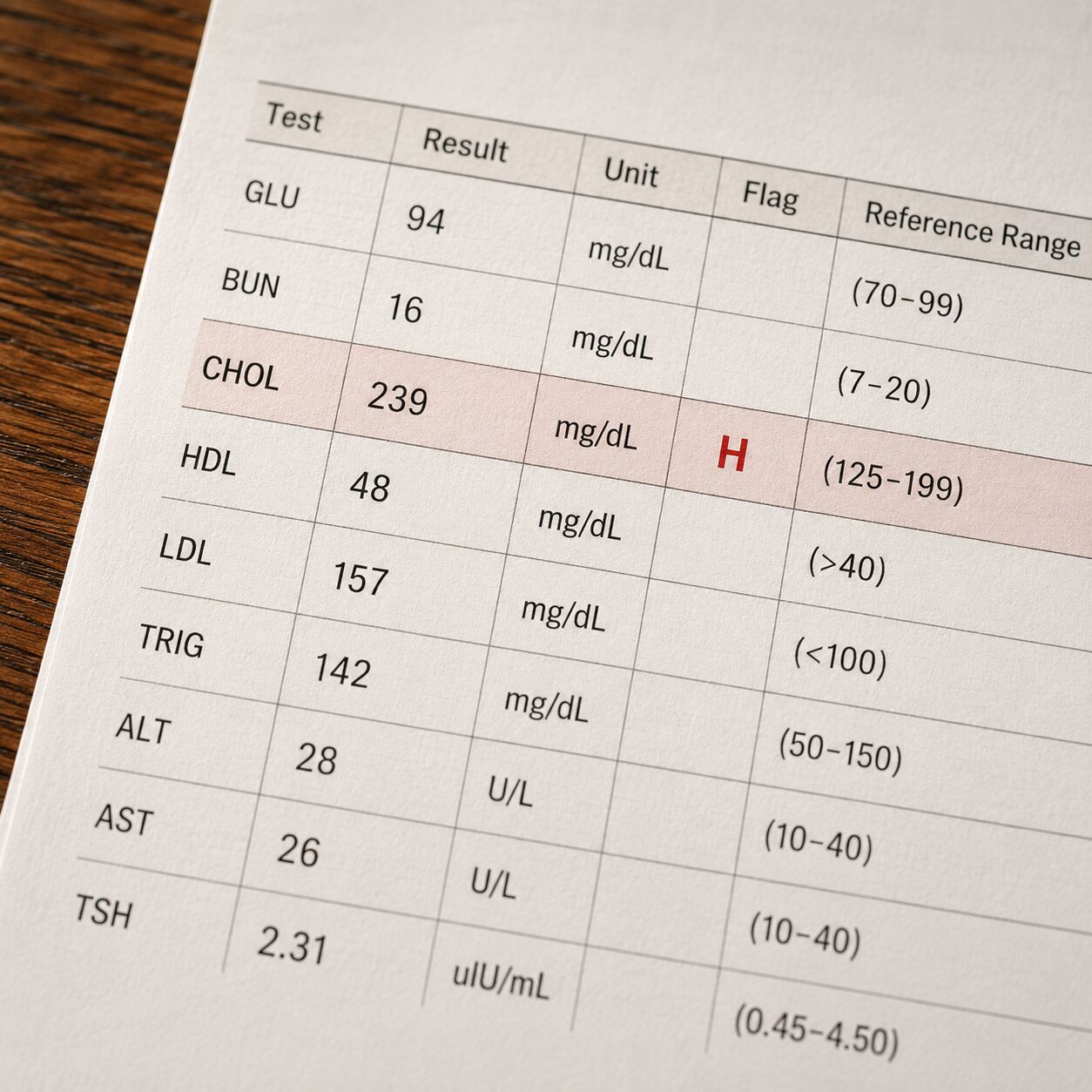
Before you try to decode a single abbreviation, it helps to see the report the way it was actually built: as a grid, not a paragraph. Almost every lab, regardless of which company ran your blood, arranges each row the same five ways. First comes the test name, usually abbreviated. Next to it sits your result — the actual number your blood produced. Right after that is the unit, a small tag like "mg/dL" or "mmol/L" that tells you what kind of number you're looking at, the same way "miles" versus "kilometers" changes what a distance means. Then there's a column for flags — a letter or symbol that only appears when something falls outside the expected window. And finally, the reference range: the span of values a lab considers typical for a healthy person, shown either as a pair of numbers or a short "low–high" bracket.
Once you can point to each of those five things on your own report, you've done the hardest part of translation without decoding a single word. Everything else is just filling in what the abbreviation in that first column actually stands for, and comparing your number to the range sitting next to it.
What the Letters Actually Mean: Decoding Flags
The flag column is usually what triggers the panic, so it's worth demystifying first. An "H" simply means your result landed above the reference range; an "L" means it landed below it. Some labs use an asterisk, a bolded number, or a colored dot instead of a letter, but they're all doing the same job — marking a value that fell outside the statistical window the lab is comparing you against. A small but genuinely important detail: reference ranges are usually built so that roughly 95% of healthy people fall inside them, which mathematically guarantees that about 1 in 20 perfectly healthy results will land outside the line on any given test, for no concerning reason at all. A flag is a prompt to look closer, not a verdict.
A second tier of flag — sometimes labeled "critical," "panic," or shown in red — is different and does warrant more urgency, since it marks a value far enough outside normal that a lab is required to notify the ordering provider directly, often by phone, the same day. If your report shows this kind of flag, your doctor's office has almost certainly already been alerted, even before the number reaches your own patient portal.
The One Trick That Unlocks Almost Every Medical Term

Medical terminology looks impossible mostly because it's unfamiliar, not because it's actually complicated. Most lab-related words are built from a small set of Latin and Greek pieces that get reused constantly, the same way "un-," "-able," and "-ly" get bolted onto ordinary English words to build new ones. Learn a dozen of these pieces and you can take apart terms you've never seen before, the same way knowing that "tele-" means "far" lets you guess at "telephone" and "television" without having memorized either word individually.
A few of the most useful pieces to know: "hyper-" means too much or too high, and "hypo-" means too little or too low — so hyperglycemia is simply too much sugar in the blood, and hypokalemia is too little potassium in the blood. The suffix "-emia" itself means "in the blood," which is why so many test-related words end in it. "Hepat-" refers to the liver, "nephro-" or "ren-" refers to the kidneys, and "cardio-" refers to the heart. "-Uria" means "in the urine," "leuko-" means white, and "erythro-" means red — which is why white blood cells are called leukocytes and red blood cells are called erythrocytes. Put those pieces together and a term like "hepatomegaly" stops being intimidating: liver (hepat-) plus enlargement (-megaly).
- hyper- / hypo- — too much / too little
- -emia — a condition found in the blood
- -uria — a condition found in the urine
- hepat(o)- — relating to the liver
- nephro- / ren- — relating to the kidneys
- cardio- — relating to the heart
- leuko- / erythro- — white / red (as in white or red blood cells)
- -globin — a protein that carries something, as in hemoglobin
A Starter Glossary: Translating the Abbreviations You'll Actually See
Word roots handle unfamiliar terms, but a handful of abbreviations show up so often that it's worth just knowing them outright. Here's what appears on most routine panels, translated directly:
- WBC — white blood cells; your infection-fighting cell count.
- RBC — red blood cells; the cells that carry oxygen through your body.
- Hgb (Hemoglobin) — the actual protein inside red blood cells that grabs and carries that oxygen.
- Hct (Hematocrit) — the percentage of your blood that's made up of red blood cells.
- Plt (Platelets) — the cell fragments that plug small cuts and stop bleeding.
- Glucose — your blood sugar at the moment of the draw.
- BUN — a waste product your kidneys filter out; short for blood urea nitrogen.
- Creatinine / eGFR — two different ways of measuring how well your kidneys are filtering waste from your blood.
- Na, K, Cl, CO2 — sodium, potassium, chloride, and carbon dioxide; the electrolytes that keep your muscles, nerves, and fluid balance running.
- ALT, AST — liver enzymes; higher-than-usual numbers can mean liver cells are under some kind of strain.
- LDL / HDL — the "bad" and "good" forms of cholesterol carried through your bloodstream.
- TSH — the signal your brain sends to your thyroid gland, telling it to make more or less hormone.
- A1C — your average blood sugar over roughly the past three months, more like a report card than a single pop quiz.
Why the Same Result Can Look Different on Two Reports
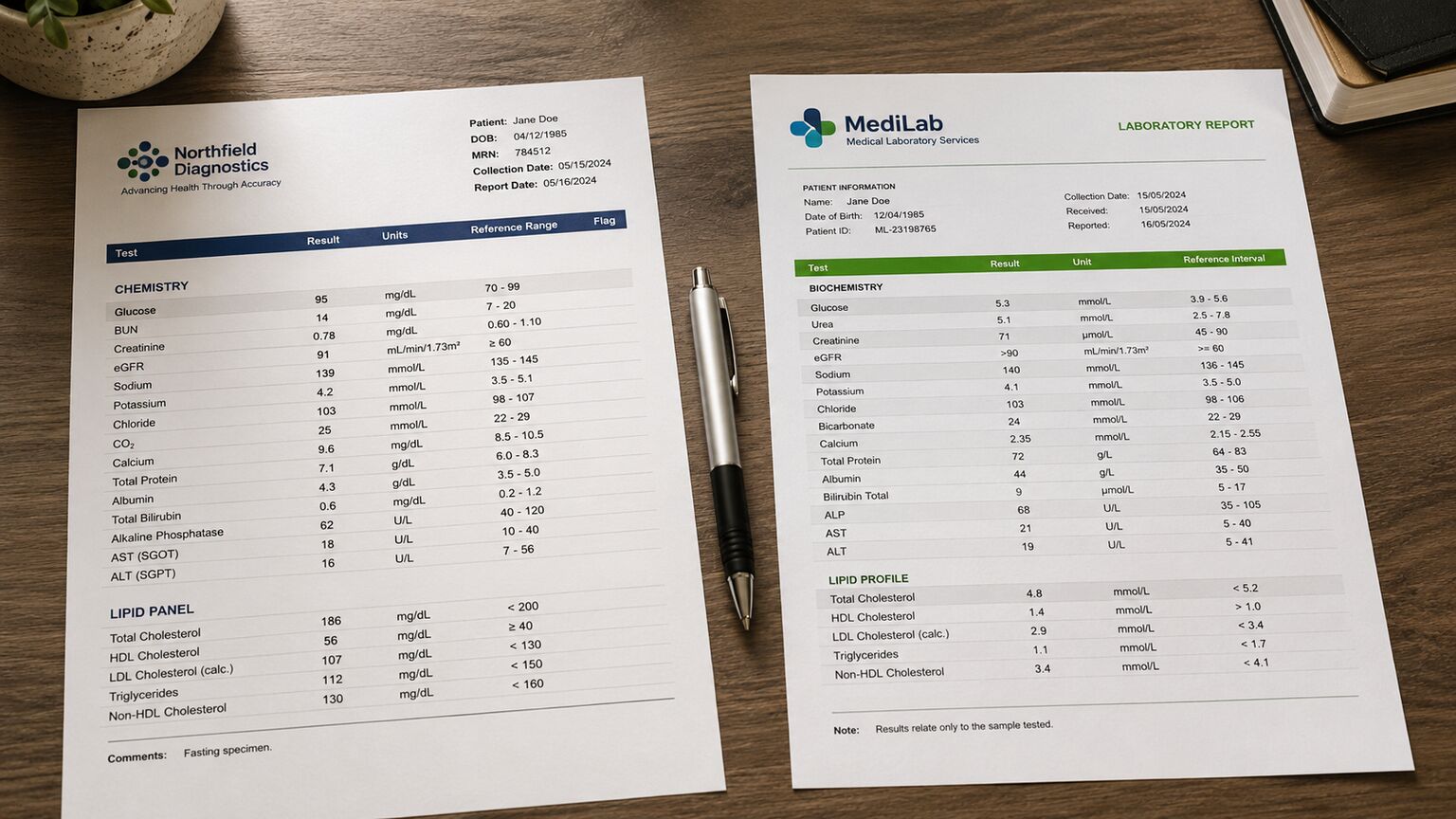
If you've ever compared a result from your doctor's office against a number from a different lab, or against something you found on a health app built outside the U.S., you may have noticed the same test showing wildly different-looking numbers. That's almost never an error — it's usually a difference in units. The United States commonly reports certain tests in mg/dL, while most of the rest of the world uses mmol/L for the same substance, and the two scales don't share the same numbers even though they're measuring identical amounts of the same thing. A glucose reading of 100 mg/dL and 5.6 mmol/L can both be perfectly normal, describing the exact same blood sugar level in two different units.
Reference ranges themselves can also shift slightly between labs, because each one calibrates its own instruments and calculates its "typical" range from its own local population of patients. Neither range is more "correct" than the other — always compare your result against the range printed on that specific report, not against a range you remember from a different one.
Curious what the rest of your blood work is telling you? Upload your results and get a complete, plain-language breakdown in under 15 minutes.
Analyze My ResultsA Simple 5-Step Method to Translate Any Report Yourself
With the grid, the flags, and the word-building blocks in hand, translating a report becomes a repeatable process rather than a guessing game. Here's the order that actually works, test by test:
- Step 1 — Find the five columns. Locate the test name, your result, the unit, the flag column, and the reference range before you read anything else. This orients you to the shape of the page.
- Step 2 — Note what's flagged, without reacting yet. Circle or highlight every H, L, or asterisk. You're building a list of what to look into, not diagnosing anything yet.
- Step 3 — Break the test name into parts. Use the word-root list above to translate the abbreviation into what it's actually measuring and, loosely, in what part of the body.
- Step 4 — Check the unit and the range on that specific report. Confirm you're reading the range printed next to your result, not one from memory or a different source.
- Step 5 — Compare to your last report if you have one. A single mildly flagged value matters far less than a consistent trend moving in one direction across several tests over time.
Doing this for a full panel takes maybe ten minutes the first time and considerably less once the abbreviations start to feel familiar. By the end, you'll have a plain-English sense of what each row is measuring and a short, specific list of anything worth asking your doctor about directly.
When a Flagged Result Needs a Call Today, and When It Can Wait

Translating a result into plain English is different from deciding what to do about it, and it's worth being honest about where that second line sits. A single value flagged mildly outside its range, with no unusual symptoms and no critical marker attached, is generally something your doctor will address at your next scheduled conversation rather than flag for a same-day call — this is the most common scenario by far, but your doctor's office is the one who should confirm that in your specific case. Genuinely critical or "panic" flags are different: as covered earlier, labs are required to alert the ordering provider directly when a value crosses that threshold, so in most cases your doctor's office is already aware before you've even opened the portal yourself.
The one situation that does warrant reaching out sooner rather than later is when a flagged number lines up with new or worsening symptoms you're actually feeling — chest discomfort alongside a flagged cardiac marker, for instance, or unusual fatigue alongside a very low red blood cell count. In that case, the symptom is the reason to call, with the lab result adding useful context for whoever picks up the phone. When in doubt, calling and asking is always the reasonable choice; no nurse line has ever been annoyed by a patient double-checking a number they didn't understand.
Mistakes to Avoid When Translating Your Own Results
- Googling one isolated number. Search engines have no idea what the rest of your panel, your history, or your symptoms look like, and generic search results are built for the population average, not for you specifically.
- Treating every flag as equally serious. A value 2% outside the range and a value 200% outside the range both get an "H," but they are not remotely the same situation.
- Comparing numbers across different units without converting them. A "high" number in one unit system can be a completely normal number in another.
- Ignoring the trend in favor of the single snapshot. One flagged test tells you far less than three flagged tests moving the same direction over six months.
Frequently Asked Questions
Does an "H" or "L" flag automatically mean something is wrong?
No. Reference ranges are built so that a small percentage of healthy people naturally fall outside them on any given test. A flag means "worth a closer look," not "confirmed problem."
Why do two labs show different reference ranges for the exact same test?
Each lab calibrates its own equipment and calculates its "typical" range from its own local patient population, so small differences between labs are normal. Always compare your result to the range printed on that specific report.
Do I need to memorize medical terminology to understand my own labs?
No. A small set of reusable word roots and prefixes — like "hyper-," "-emia," and "hepat-" — covers most of what you'll ever encounter, the same way a handful of English prefixes and suffixes let you decode unfamiliar everyday words.
Is it normal to have one or two flagged values on an otherwise healthy report?
Yes, very commonly. Isolated, mild flags with no symptoms and no critical marker are extremely common and often disappear on a repeat test. A consistent trend across multiple tests is far more meaningful than a single flagged value.
Can an online tool translate my entire report for me instead of doing it line by line?
Yes — that's exactly the gap a service like LabsFive is built to close, turning a full report into a plain-language breakdown of every value at once rather than one abbreviation at a time.
Conclusion
A lab report only feels unreadable because it's written in a professional shorthand nobody ever taught you — not because the information itself is out of reach. Learn the five-column grid, a dozen word roots, and a short glossary of the abbreviations that repeat across almost every panel, and you can walk into your next report with a real plan instead of a search bar. And if you'd rather skip the manual translation entirely, that's precisely what LabsFive was built for: upload any report and get every single value explained in plain language, with nothing left abbreviated, in under 15 minutes.
Still Not Sure What Your Results Mean?
Upload your labs and get a complete, visual, plain-language interpretation of every biomarker — delivered to your inbox in under 15 minutes.
Get My ReportThis article is for educational purposes only and does not constitute medical advice. Always consult your healthcare provider regarding your specific lab results.