
What Questions Should I Ask My Doctor About My Lab Results?
You've got the results, you've got the appointment on the calendar, and yet somehow the conversation still ends with you back in the car thirty seconds later thinking, "wait, I meant to ask about that flagged number." It happens constantly, and it isn't a personal failing — it's what happens when a genuinely important conversation gets squeezed into a genuinely short window of time, on a topic full of unfamiliar vocabulary, discussed by someone who talks about lab values for a living and may not realize how unfamiliar all of it sounds from the other side of the desk. The good news is that a handful of specific, well-chosen questions can do more work than a long list of vague ones. Below is a research-backed set of exactly what to ask, why each question matters, and how to make sure you actually get to ask it — and get an answer you'll still remember once you're back in the car.
Why This Conversation Is Harder Than It Feels
It isn't in your head: the deck is genuinely stacked against a thorough conversation about your results. Studies tracking real primary care visits have found that doctors interrupt patients after a median of just 11 seconds of talking, and that interruption happens in roughly 63% of primary care visits and 80% of specialty visits. The total face time with a physician often lands somewhere between 7 and 18 minutes, and a meaningful chunk of that gets used on the rest of the visit before results even come up. On top of that, research on health literacy has found that patients tend not to ask questions unless they're explicitly invited to — and that even people who don't fully understand what they're hearing will often stay quiet rather than admit it, out of a very human instinct to avoid seeming like they should already know.
What happens after the appointment tends to compound the problem. Research on patient recall has found that people remember, on average, only about half of the decisions and recommendations discussed during a medical visit — and when information is only given verbally, with nothing written down, recall can drop as low as 14%. Anxiety, a longer list of things being discussed at once, and simply being handed a lot of new information in a short window all make this worse, not because patients aren't paying attention, but because that's how memory works under those conditions. A survey from Wolters Kluwer Health also found that while the large majority of patients say they'd use written educational materials if their provider offered them, only a little over a third actually get that chance during a typical visit.
None of this means the conversation is doomed. It means the questions that make it into that short window need to be chosen on purpose, not left to whatever you happen to remember once you're sitting across from your doctor — and the answers need to be captured somewhere more durable than memory alone.
Before the Appointment: What to Bring and Prepare

The single highest-leverage thing you can do happens before you ever sit down with your doctor: write your questions down. Not mentally rehearsed — actually written, on paper or in your phone, in the order that matters most to you. If your appointment is genuinely short, the doctor may only get through your first two or three questions, so lead with the one you'd be most upset to leave without answering.
It also helps to bring the report itself, along with any prior results you have for the same test, even if your doctor's office technically already has them on file. Systems don't always sync perfectly between labs, hospitals, and primary care offices, and having the physical or digital copy in your hand means you can point directly at the number you're asking about instead of describing it from memory. If anything has changed since your last visit — a new supplement, a new medication, a change in symptoms, even a significant change in diet or exercise — jot that down too, since your doctor genuinely can't factor in information they don't have.
One more habit worth building, whether the visit is in person or over video: ask, before you hang up or walk out, whether you can get a written after-visit summary of what was just discussed. Most clinics can generate one directly from the patient portal, and having it in writing matters more than it might seem — it's the difference between trying to reconstruct a rushed explanation from memory later that night and simply reading back exactly what was said.
The Five Questions a Physician Says You Should Never Skip
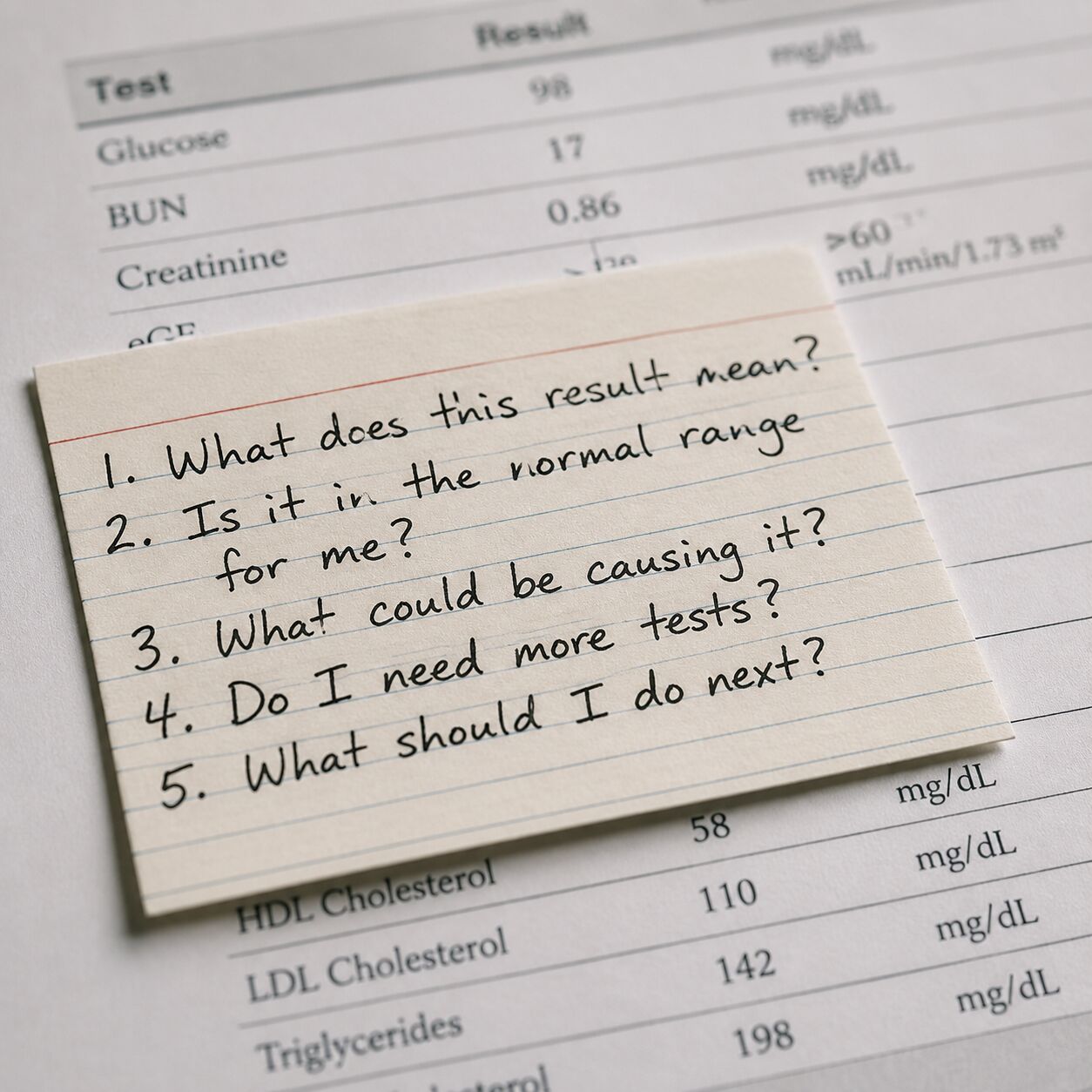
Physicians who write about this topic tend to converge on a similar short list, because these five questions cover almost everything a patient actually needs to walk away with. Ask them in whatever order fits your conversation, but try not to leave without getting an answer to each one:
- "Is it changing?" A single number rarely tells the full story on its own. A value that's technically still inside the normal range but has been drifting steadily for a year is a very different situation than the same number holding steady for a decade, and comparing against your own history is often more useful than comparing against the general population.
- "What does this mean for me, specifically?" Reference ranges are built from large population studies, not from your individual medical history, baseline, or medication list. The same number can mean something different for you than it would for a stranger with a different health profile.
- "Why might this be off?" An abnormal flag doesn't automatically mean disease. Dehydration, a recent meal, an intense workout the day before, or a new supplement can all nudge a result outside its usual range without anything being medically wrong.
- "Do we need to check it again?" One data point can be a fluke. A repeat test, sometimes just a few weeks later, is often the fastest way to find out whether an abnormal value is a real, ongoing pattern or a one-time blip.
- "What do I actually need to do about this?" This is the question that turns a conversation into a plan — whether that plan is a lifestyle change, a new medication, more testing, or genuinely nothing at all beyond routine monitoring.
A Simple Three-Question Framework for Any Result
If five questions still feels like too much to hold onto in a rushed visit, health literacy researchers have long promoted an even shorter version, widely known as "Ask Me 3," built specifically to help patients leave any medical conversation with the essentials intact. Adapted for a lab-results conversation, it comes down to three prompts: What is this result actually telling you about my health? What, if anything, do I need to do next? And why does that matter for me personally? Those three questions, asked in that order, tend to naturally pull out everything else — the "why" question in particular often prompts a doctor to explain context you wouldn't have thought to ask about directly.
Could the Number Itself Be Wrong? Questions About Accuracy
It's a fair and important question, and one doctors are used to hearing: is there a chance this result is simply inaccurate? Every lab test has some margin of error, and both false positives and false negatives happen, more often with certain tests than others. If a result seems to genuinely contradict how you feel or your known health history, it's entirely reasonable to ask your doctor directly whether the test could be repeated, or whether a different, more specific test might confirm or rule out what the first one suggested. This is especially worth asking about when a result is only mildly outside its range, since values that are just barely flagged are the ones most likely to be affected by lab-to-lab variation or a temporary factor rather than a genuine health change.
It's also worth asking directly what would happen if the test were simply run again tomorrow — would you expect a similar number, or could it reasonably land somewhere else entirely? Doctors think in terms of a value's natural variability even when they don't always say so out loud, and asking them to put a rough boundary around that variability (even an approximate one) gives you a much better sense of whether the specific number you're looking at is meaningfully abnormal or well within the range of normal day-to-day fluctuation for that particular test.
Questions Worth Asking When Family History Is Part of the Picture
A number that would be unremarkable in isolation can carry more weight when a parent, sibling, or grandparent had the same condition, and this is a connection your doctor can only make if the conversation actually goes there. It's worth asking plainly: does my family history change how you're reading this particular result? If a relative was diagnosed with something related at a notably young age, that detail specifically is often more clinically meaningful than the diagnosis alone, so it's worth mentioning even if it feels like a small detail. For results that touch on hereditary conditions — certain cancers, cardiovascular disease, and some metabolic or thyroid conditions among them — it's also reasonable to ask whether your family history is significant enough to warrant genetic counseling or more targeted screening than what a routine panel already covers, and whether earlier or more frequent testing might make sense for you specifically because of it.
Ask About Medications and Supplements That Could Be Skewing Your Results

This is one of the most overlooked questions, and it can genuinely change how a result should be interpreted. High-dose biotin supplements — the kind marketed for hair, skin, and nails, often at doses of 5 milligrams or more — are a well-documented cause of falsely abnormal readings on several common tests, including thyroid panels (TSH, T3, T4), cortisol, sex hormones, troponin, vitamin D, and PSA. Most guidance suggests pausing high-dose biotin for five to seven days before testing, but only under your doctor's direction. Vitamin C in high doses can throw off certain glucose readings, particularly on point-of-care meters. Common herbal supplements like echinacea, green tea extract, and concentrated turmeric or curcumin have been associated with elevated liver enzyme readings (ALT and AST) even in people with otherwise healthy livers. And starting or stopping vitamin K can shift INR results enough that your dosing schedule for certain blood thinners may need to be adjusted.
The rule of thumb worth asking about directly: tell your doctor about every supplement and over-the-counter product you take, not just prescription medications, and ask plainly whether anything on that list could be responsible for an unexpected result before assuming the number reflects a real health change. And never stop a prescribed medication on your own in an attempt to "fix" a lab value — that decision belongs with your doctor.
Questions About What Happens Next
Once you understand what a result means and why it might look the way it does, the conversation should end with a concrete plan, not a vague sense that everything is probably fine. Useful questions here include: What specifically are we watching for going forward? What would need to happen — what threshold or change — before this becomes something we treat rather than just monitor? Is this something a specialist should be involved in, or is this squarely within what a primary care doctor manages? And practically: when should I expect to hear back if anything from today's visit needs a follow-up call, versus when should I assume no news is good news?
If a referral does come up, it's worth asking a couple of practical follow-through questions on the spot rather than after the fact: will your office send the referral, or is that something I need to initiate myself, and roughly how soon should I expect to be contacted to schedule it? Referrals that quietly stall between offices are a common and avoidable source of delay, and asking who owns the next step — you or the clinic — is a small question that prevents a result from simply falling through the cracks.
Curious what the rest of your blood work is telling you before your next appointment? Upload your results and get a complete, plain-language breakdown in under 15 minutes.
Analyze My ResultsIf You Already Saw Your Results Before Your Doctor Did

Patient portals now routinely release lab results before a doctor has had a chance to review and call about them, which means it's increasingly common to walk into an appointment already having read — and possibly worried about — a number your doctor hasn't discussed with you yet. If that's your situation, it's worth saying so directly at the start of the visit: "I saw this result in the portal before you called, and I've been thinking about it since." That single sentence does two useful things. It tells your doctor exactly where to start instead of re-explaining something you already know, and it gives you permission to ask the more specific, already-informed questions you've likely been forming since you first saw the number, rather than starting the conversation from zero.
Questions Doctors Wish Patients Asked More Often

A few questions get asked far less often than they should, mostly because patients don't realize they're allowed to ask them. "What would make you concerned enough to call me directly?" gives you a genuinely useful benchmark for how seriously to take a mild flag versus a real red flag. "Is there anything in my family history that changes how you're reading this result?" invites your doctor to connect a number to context they may not have volunteered unprompted. And "can you write that down, or is there something I can read later?" is a perfectly reasonable request — a large share of what gets said in a medical visit is forgotten within minutes, and a written note or an after-visit summary gives you something to actually refer back to once you're home and the adrenaline of the appointment has worn off.
Mistakes That Waste Your Limited Time With the Doctor
- Leading with the least important question. If the visit gets cut short, you want your best question to have already been asked, not queued up last.
- Asking about every single value on a twenty-line panel. Focus your questions on what's actually flagged or genuinely surprised you — a doctor can't meaningfully cover thirty data points in a ten-minute conversation.
- Not writing down the answer. Given how much of a spoken explanation gets forgotten within hours, treat the answer as seriously as the question — jot down even a two-word summary in the moment rather than trusting yourself to remember it later.
- Assuming silence means "normal." If your doctor moves past a result without comment, it's fine to ask directly whether that one needs any discussion at all.
- Waiting for a callback instead of using the portal. If a new question occurs to you after you've already left, most patient portals support a secure message to your care team — you don't have to wait for your next scheduled visit to get a follow-up answered.
Frequently Asked Questions
What's the single most important question to ask about an abnormal result?
If you can only ask one thing, ask what it means specifically for you and what you actually need to do next. That combination turns an abstract number into a concrete plan.
Is it rude to ask my doctor to explain something again?
No. Asking for a repeat explanation, or for something to be said in plainer language, is one of the most common and welcomed requests doctors receive. It's far more useful to your care than nodding along without understanding.
Should I ask about a result even if my doctor doesn't bring it up?
Yes. A result not being mentioned usually does mean it's unremarkable, but it's reasonable to ask directly and get that confirmed rather than assume.
What if I don't have time to ask everything during a short appointment?
Prioritize your written list so the most important question comes first, and ask directly whether the remaining questions can be answered through a patient portal message or a follow-up call.
Should I mention supplements or over-the-counter products even if my doctor didn't ask?
Yes, always. Supplements like high-dose biotin, vitamin C, and certain herbal products can measurably affect specific lab results, and your doctor can only account for that if they know you're taking them.
Why do I forget so much of what my doctor tells me right after the appointment?
It's a well-documented, universal pattern rather than a memory problem specific to you — research on patient recall has found people remember roughly half of what's discussed in a typical visit, and that number drops further when the information is only given verbally. Asking for a written after-visit summary, or taking your own notes during the conversation, is the most reliable fix.
Conclusion
A short appointment doesn't have to mean an unclear one. Walking in with a written, prioritized list of specific questions — grounded in what your result actually means for you, whether it might be off for a benign reason, what your family history adds to the picture, and what happens next — turns a rushed few minutes into a genuinely useful conversation, and writing down the answers is what makes that conversation actually stick once you're back in the car. And if you'd rather walk in already understanding every value on your report instead of guessing which ones deserve a question, that's exactly what LabsFive is built for: upload your labs and get a complete, plain-language explanation of every result in under 15 minutes, so the questions you bring to your doctor are the ones that actually matter.
Still Not Sure What Your Results Mean?
Upload your labs and get a complete, visual, plain-language interpretation of every biomarker — delivered to your inbox in under 15 minutes.
Get My ReportThis article is for educational purposes only and does not constitute medical advice. Always consult your healthcare provider regarding your specific lab results.