
The Metabolic Fork Fasting Triggers in Your T3 Conversion
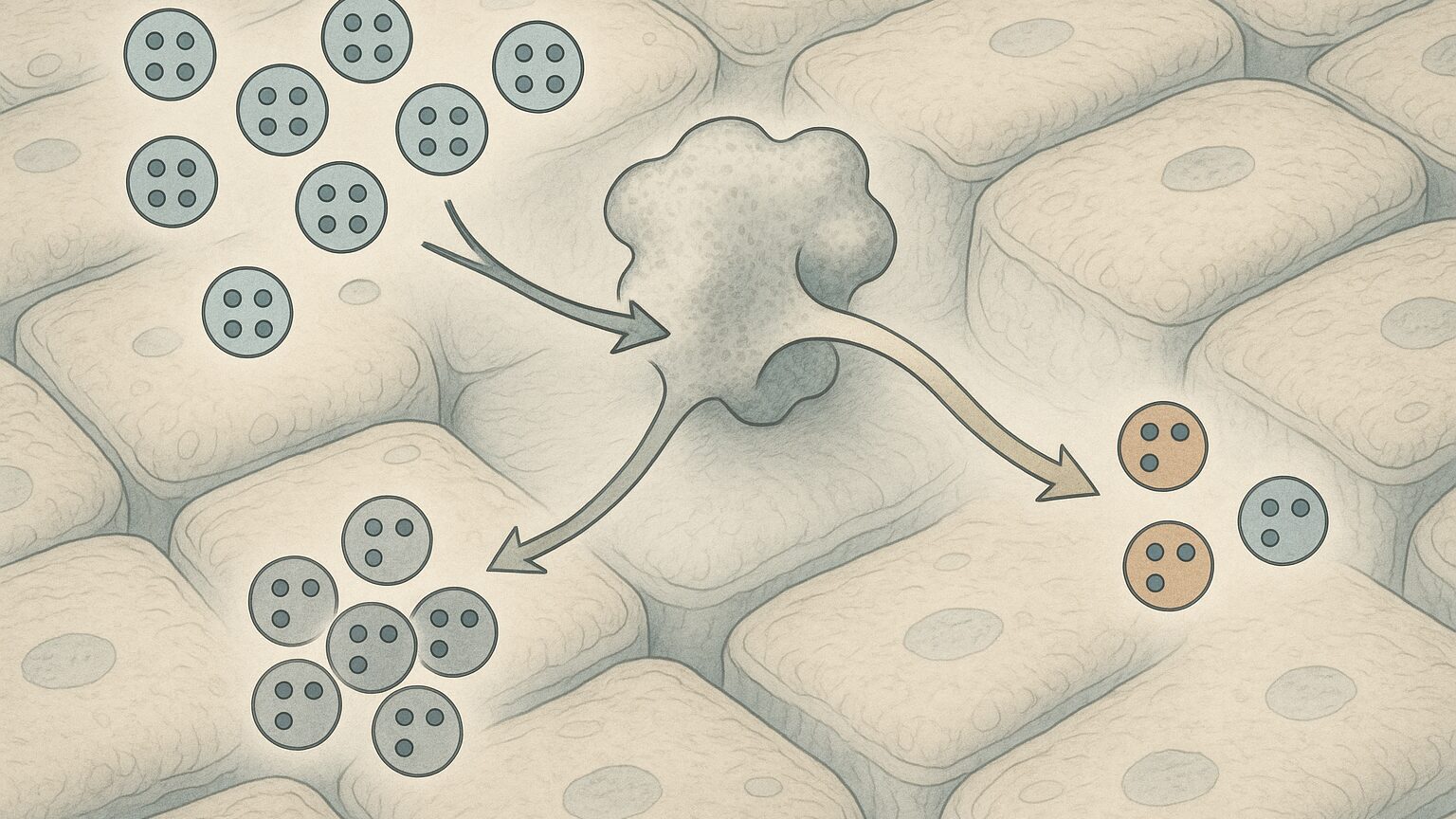
There's a specific fork in the road inside your liver that fasting flips, and this article is about that fork specifically, not a general rundown of thyroid-diet interactions. T3, short for triiodothyronine, is the active form of thyroid hormone that actually drives your metabolism, and it's built from a precursor hormone at a junction where an enzyme can send it down one of two paths: the active route, or an inactive dead-end called reverse T3. When food is scarce, your body deliberately pushes more traffic down that inactive path to conserve energy — a real, adaptive response, not a malfunction, and the specific mechanism this article traces in detail. Separately, and through an entirely different route that has nothing to do with your actual thyroid, a common supplement most people don't think twice about can distort the same test result. Untangling which of those two situations applies to your own number is exactly what this article is for.
Curious what the rest of your urinalysis is telling you? Upload your results and get a complete, plain-language breakdown in under 15 minutes.
Analyze My ResultsWhy T3 Reacts to Food Faster Than the Rest of Your Thyroid Panel
Your thyroid gland mostly manufactures and releases one hormone, called thyroxine or T4, which acts as a kind of raw material circulating through your bloodstream. Most of the T3 your body actually uses isn't made in the thyroid at all — it's converted from that circulating T4 by an enzyme working mainly in your liver, kidneys, and muscle tissue, a step that happens outside the thyroid gland entirely. That conversion step is the part that's sensitive to your day-to-day energy status, because it's essentially your body's throttle for how "revved up" your metabolism should be. TSH, the hormone your pituitary gland releases to tell your thyroid how hard to work, changes slowly, over weeks, in response to genuine thyroid disease. T3 can shift within a day or two in response to something as ordinary as a sharp drop in calories, because adjusting that one conversion step is a fast, low-effort way for your body to dial metabolism up or down without needing to rebuild an entire hormonal system from scratch.
What Actually Happens to T3 When You Fast
When calorie intake drops sharply — through prolonged fasting, a crash diet, or an illness that suppresses appetite — your body responds in a very specific, well-documented way. The enzyme responsible for turning T4 into active T3 slows down, so less T3 gets made. At the same time, more of that T4 gets funneled into a different, biologically inactive cousin molecule called reverse T3, which looks similar on a molecular level but doesn't do anything metabolically — think of it as a decoy that occupies the same parking spot without ever starting the engine. Researchers have also found that dropping blood levels of leptin, a hormone released by fat tissue that normally signals "we have enough energy stored," plays a direct role in this shift by quieting the brain signals that would otherwise keep thyroid hormone production running at full pace. The entire pattern is sometimes referred to in clinical literature as low T3 syndrome, and it's considered an adaptive, protective response to conserve energy during scarcity — not a sign that your thyroid gland itself is failing. It's your body being resourceful, not broken.

This naturally raises the question of whether the routine overnight fast you're asked to do before a blood draw could be doing the same thing to your results — and the honest answer is no, not in any meaningful way. The low T3 pattern described above shows up after roughly 24 to 72 hours of significant calorie restriction, not after skipping breakfast for eight to twelve hours. A handful of studies looking specifically at eating before thyroid testing found that food intake causes only mild, short-lived shifts, mostly in TSH rather than T3, and that fasting isn't actually required for a standard thyroid panel at all. If your lab specifically asked you to fast, it's more likely because your visit also included a cholesterol or glucose panel that does require it, not because your T3 number depends on it. Where timing genuinely matters more is the hour of day — TSH tends to run highest first thing in the morning, so if you're tracking your numbers over time, having blood drawn around the same time of day each visit makes your results easier to compare fairly.
Low-Carb and Ketogenic Diets Can Lower T3 on Their Own
Here's where diet composition, separate from total calories, enters the picture. Classic research on this dates back decades: when researchers held total calorie intake steady but reduced carbohydrate intake in stages, T3 levels dropped in step with the carbs, even though the person was eating the exact same number of calories the whole time. One frequently cited study found T3 fell from roughly 91 to 86 to 69 nanograms per deciliter as carbohydrate intake was progressively cut, despite calories never changing. A separate trial comparing high-carb, moderate, and very-low-carb intakes in healthy men found the very-low-carb approach dropped T3 and raised reverse T3, while the high-carb approach left thyroid hormones essentially untouched. In other words, it's specifically the carbohydrate — not the calorie deficit alone — sending a strong "conserve energy" signal to that T4-to-T3 conversion step.

What this means for someone actually following a ketogenic or very-low-carb diet is genuinely debated among researchers. Some argue that a lower T3 reading on a well-formulated low-carb diet reflects your tissues becoming more efficient and sensitive to thyroid hormone, needing less of it to do the same job, rather than a problem developing. Supporting that view, published human trials of low-carb and ketogenic eating haven't reported new cases of clinical hypothyroidism as a direct result of the diet itself. Other researchers are more cautious, pointing out that a sustained drop in active hormone could still mean your thyroid's overall output capacity is being throttled back, whatever the underlying intention. The practical takeaway either way: if you eat low-carb and your T3 comes back on the lower side, that's a very plausible, non-alarming explanation worth mentioning to whoever ordered your labs, rather than something to assume points to thyroid disease on its own.
Nutrient Gaps That Can Genuinely Blunt T3 Production
Two nutrients deserve specific mention because they're direct raw materials for this whole system, not just general "eat healthy" advice. Iodine is the literal building block your thyroid uses to construct both T4 and T3 in the first place — without enough of it, hormone production slows at the source. Selenium plays a more specific role: the enzyme that converts T4 into T3 is what's called a selenoenzyme, meaning it structurally requires selenium to function at all. Research has repeatedly shown that people with low selenium status tend to have a higher ratio of T4 to T3, exactly what you'd expect if the conversion step were running short-handed. Selenium deficiency is uncommon in the United States thanks to selenium-rich soil in most farming regions, but it becomes more relevant in people with restrictive diets, malabsorption conditions, or those living in regions with selenium-poor soil. Neither deficiency needs to be dramatic to show up on a lab report — it's one more reason a single low T3 result deserves context rather than panic.
The Biotin Trap: When a Supplement Fools the Test, Not Your Thyroid
Everything described so far involves your body genuinely making less T3. Biotin interference is different — it's a laboratory artifact where your actual hormone levels haven't changed at all, but the test reports a distorted number anyway. Most thyroid tests, including T3, work using a lab technique called an immunoassay, which relies on a chemical pairing between biotin and a protein called streptavidin to help detect the hormone. If you're taking a high-dose biotin supplement — commonly sold for hair, skin, and nail health, often at doses of several thousand micrograms — the excess biotin already circulating in your blood competes with that chemical pairing and throws off the reading. The FDA issued a formal warning about this in 2017, and the typical pattern it produces is a falsely elevated T3 and T4 alongside a falsely low TSH, a combination that can look exactly like an overactive thyroid on paper even though nothing has actually changed hormonally. Routine multivitamins with modest biotin amounts generally aren't a problem; it's specifically the standalone high-dose biotin supplements that cause this. The American Thyroid Association's practical advice is straightforward: stop biotin supplements for at least two days before a thyroid blood draw, and always tell whoever orders your labs what supplements you're taking.

The clearest way to tell these two situations apart is the direction the numbers move. True fasting-related or low-carb-related suppression of thyroid hormone lowers T3 and T4 together, while biotin interference tends to falsely raise T3 and T4 while falsely lowering TSH — an almost opposite fingerprint. If your results don't fit either pattern cleanly, that's exactly the kind of nuance worth flagging to your provider rather than trying to self-diagnose from a single number.
How Quickly T3 Recovers Once You Start Eating Again
The good news is that this entire system reverses quickly once food becomes available again — it's a thermostat, not a switch that gets stuck. Research on refeeding after a fast found that giving someone as little as 50 grams of carbohydrate, roughly the amount in a couple of slices of bread, was enough to start reversing the fasting-related changes within hours. Free T3, the more clinically relevant "unbound" portion of the hormone, showed measurable increases within about four hours of refeeding, with fuller recovery generally seen by the 24-hour mark depending on how long the fast lasted beforehand. This is also a big part of why a single low T3 reading taken during a genuinely low-calorie stretch — a stomach bug, a crash diet, pre-surgical fasting — often isn't repeated once normal eating resumes, and why providers frequently recommend retesting after a period of stable, adequate eating rather than reacting to one isolated number.
Frequently Asked Questions
Do I need to fast before a T3 blood test?
No — a standard thyroid panel, including T3, doesn't require fasting, and research shows eating beforehand causes only minor, short-lived shifts, mostly in TSH rather than T3. If your provider asked you to fast, it's more likely because your visit also included a test like cholesterol or glucose that does require it. What matters more is testing around the same time of day if you're comparing results over time, since TSH naturally runs higher in the morning.
Can a low-carb or keto diet permanently lower my T3?
It can lower measured T3 for as long as you stay on a very low-carb intake, since carbohydrate specifically — not just calorie deficit — signals your body to slow the conversion of T4 into T3. Whether this reflects a harmless adaptation or something worth monitoring is still debated among researchers, but published trials haven't linked well-formulated low-carb or ketogenic diets to new cases of clinical hypothyroidism.
How do I know if my T3 result is from fasting or from a biotin supplement?
Look at the direction of the shift. True diet or fasting-related suppression tends to lower both T3 and T4 together. Biotin interference does close to the opposite — it typically produces a falsely elevated T3 and T4 alongside a falsely low TSH. If you take a high-dose biotin supplement, stopping it for at least 48 hours before testing and mentioning it to your provider is the most reliable way to rule this out.
Conclusion
T3 is genuinely one of the more diet-sensitive numbers on a standard lab report, but almost every way it moves has a specific, explainable cause — an adaptive drop during real caloric restriction, a carbohydrate-specific effect on low-carb diets, a nutrient shortfall in iodine or selenium, or a lab artifact from high-dose biotin that has nothing to do with your thyroid at all. A routine overnight fast before a blood draw isn't one of those causes. If your T3 comes back outside the expected range, the most useful next step isn't guesswork — it's sharing exactly what you've been eating, whether you've been under-fueling, and what supplements you're taking, so whoever reviews your results can tell a real thyroid shift from a temporary, explainable one.
Still Not Sure What Your Results Mean?
Upload your labs and get a complete, visual, plain-language interpretation of every biomarker — delivered to your inbox in under 15 minutes.
Get My ReportThis article is for educational purposes only and does not constitute medical advice. Always consult your healthcare provider regarding your specific lab results.