
Why Is My T3 Level Elevated While TSH Is Normal?
Seeing a high T3 result sitting right next to a TSH that's printed as "normal" feels like a contradiction — shouldn't a stressed thyroid make everything look abnormal at once? Not necessarily. Your thyroid system doesn't report a single number; it runs on a feedback loop between your brain and your neck gland, and that loop doesn't always move all its pieces in sync, or at the same speed. An elevated T3 with a normal TSH can be an early warning sign of a thyroid that's just starting to run hot, a temporary lab-test glitch caused by something as ordinary as a biotin gummy, or a handful of other, more specific explanations in between. None of them can be sorted out from the number alone — but understanding what each one actually looks like, and why the loop can decouple this way in the first place, is what turns a confusing pair of results into a clear next step.
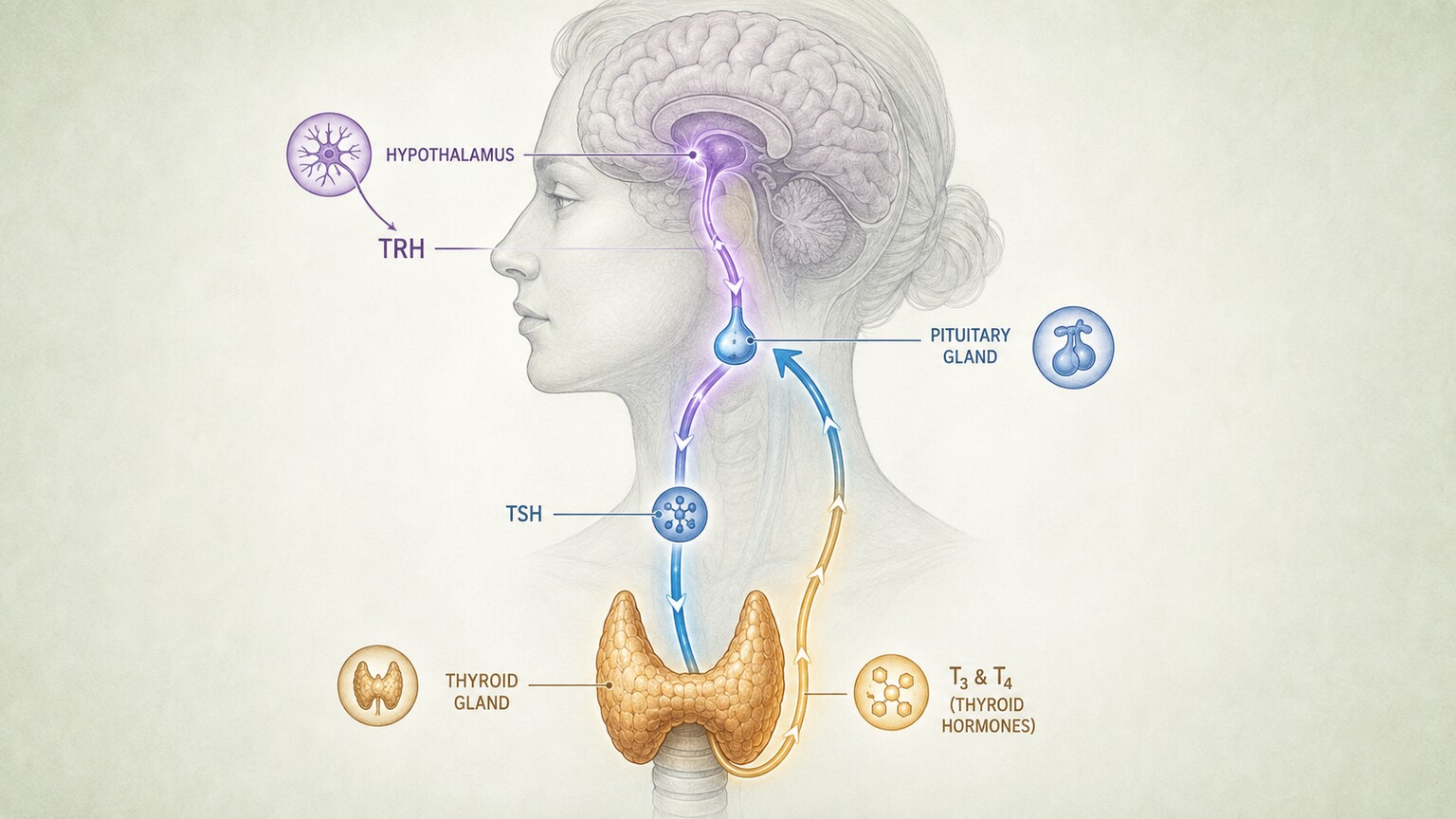
Figure 1. The hypothalamic-pituitary-thyroid axis, the feedback loop that normally keeps TSH and thyroid hormone levels moving together.
How Your Thyroid Actually Talks to Your Brain
To understand why T3 and TSH can drift apart, it helps to picture the relationship between them the way you'd picture a thermostat and a furnace, rather than as two separate readings on a lab report. Your brain runs the thermostat. A small structure called the hypothalamus, sitting deep in the brain, constantly monitors how much thyroid hormone is circulating in your blood. When it senses that levels are running low, it releases a signal called TRH (thyrotropin-releasing hormone) to the pituitary gland, a pea-sized gland just beneath the brain. The pituitary responds by releasing TSH — thyroid-stimulating hormone — into the bloodstream. TSH travels down to the thyroid gland in your neck and tells it, in effect, "produce more." The thyroid responds by making and releasing more T4 (thyroxine) and a smaller amount of T3 (triiodothyronine), the two hormones that actually do the work of speeding up metabolism throughout the body.
Here's the part that makes this system self-correcting: once thyroid hormone levels rise enough, that same rise is detected by the hypothalamus and pituitary, which then dial TSH back down — the way a thermostat cuts power to a furnace once a room reaches the target temperature. This is called negative feedback, and it's the reason TSH and thyroid hormone levels are almost mirror images of each other under normal circumstances: when thyroid hormone is high, TSH is suppressed low, and when thyroid hormone is low, TSH climbs high trying to compensate. Under this simple model, a high T3 should always come with a low TSH, not a normal one. The fact that your TSH is printed as normal means one of two things is happening: either your pituitary hasn't caught up yet to a T3 rise that just started, or the reason your T3 is high doesn't actually involve your pituitary and thyroid gland working together at all. Both of those possibilities are explored in detail below, because they point toward very different next steps.
It also helps to know just how sensitive this feedback loop actually is, because it's easy to assume TSH is a blunt instrument when in fact it's closer to a finely tuned amplifier. A relatively small change in circulating free thyroid hormone — often too small to feel as symptoms, and sometimes too small to even push T3 or T4 outside their own reference ranges — can produce a proportionally much larger swing in TSH. This is exactly why doctors so often lean on TSH as the primary screening test for thyroid problems: under normal conditions it moves first, and it moves the most, long before T3 or T4 wander outside their own boundaries. That amplification effect is also what makes a normal TSH sitting next to a clearly abnormal T3 stand out as unusual enough to investigate rather than ignore — in the vast majority of thyroid conditions, TSH is the value expected to show the earliest and largest deviation, not the one expected to stay put while a downstream hormone moves on its own.
What "T3" on Your Report Actually Measures
Before going further, it's worth being precise about what number you're actually looking at, because "T3" isn't a single, uniform measurement — labs report it in more than one way, and which version is elevated changes how seriously to take the result. Triiodothyronine, T3's full name, is called that because its molecule carries three iodine atoms attached to a backbone derived from the amino acid tyrosine; its slower-acting cousin, T4 (thyroxine), carries four. That single missing iodine atom is the entire chemical difference between the "off" form your thyroid mostly produces and the "on" form your cells actually use — nearly all of your T4 gets converted into T3 inside your tissues, in organs like the liver and kidneys, where an enzyme clips away one iodine atom to activate it.
Once in your blood, over 99% of T3 travels bound to carrier proteins — mainly one called thyroxine-binding globulin — which act like a delivery truck, holding the hormone inactive and in reserve until it's needed. Only the small, unbound fraction, called Free T3, is actually available to enter cells and exert an effect. Total T3 measures both the bound and free portions together, while Free T3 measures only the active sliver. This distinction matters enormously for your specific question, because several of the most common explanations for a high T3 with normal TSH — pregnancy, oral estrogen, liver disease — work by changing how much carrier protein is circulating, which pushes Total T3 up or down without ever touching Free T3, the fraction your cells actually respond to and the fraction your pituitary is actually monitoring. If your report says "Total T3" is high but doesn't mention Free T3, that's often the very first branch point in figuring out what's actually going on.
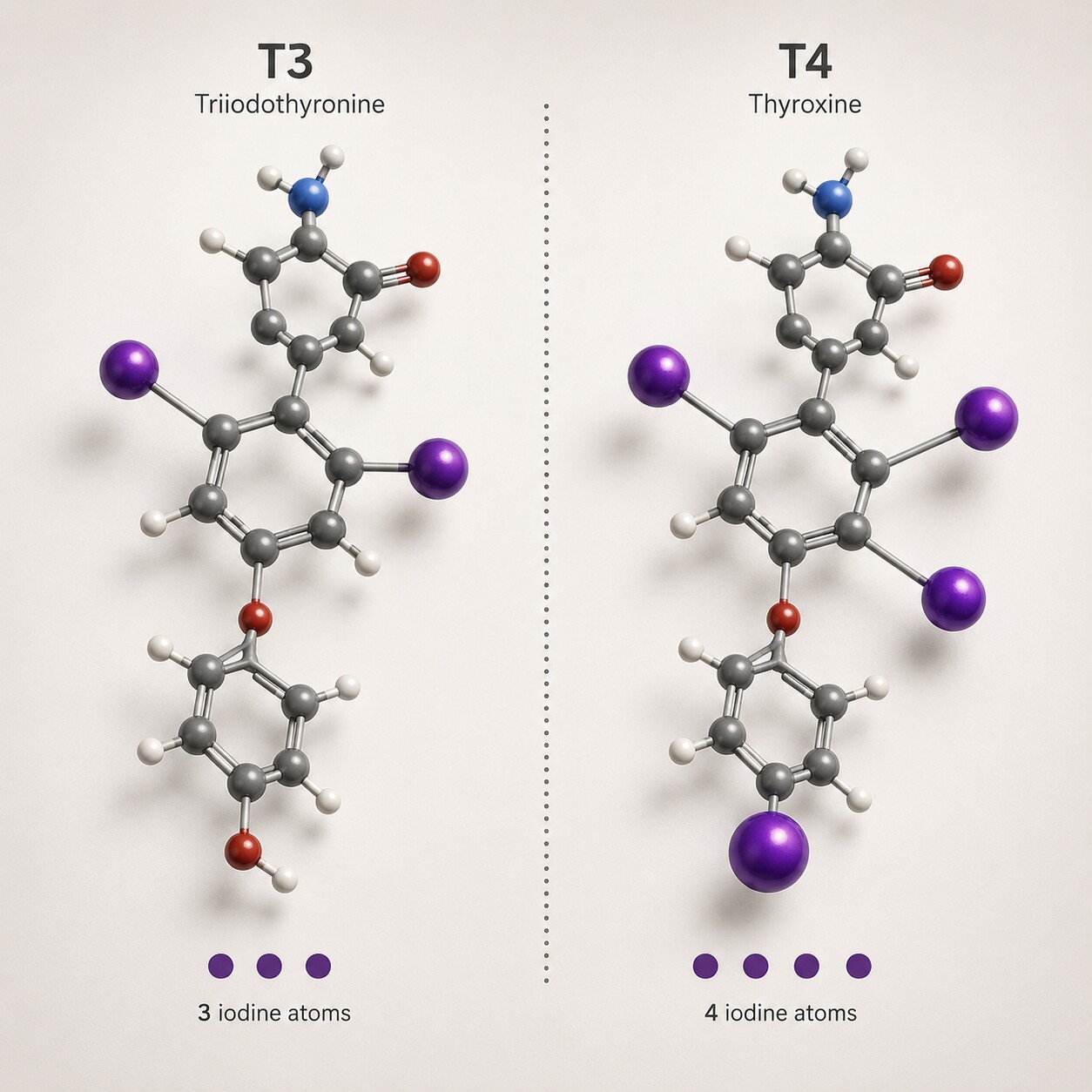
Figure 2. Triiodothyronine (T3) carries three iodine atoms, one fewer than thyroxine (T4) — the single difference that activates the hormone.
A rise in Free T3 specifically, then, is a much more direct signal that your tissues are being exposed to more active thyroid hormone than usual, since it isn't diluted or exaggerated by carrier-protein changes the way Total T3 can be. It's also worth knowing that T3 tends to be the more volatile of the two thyroid hormones on any given day — because so little of it is stored and it's cleared from the blood faster than T4, isolated Free T3 measurements can be more sensitive to short-term factors like recent illness, fasting status, or intense exercise than T4 or TSH are. That volatility is one more reason a single high T3 reading, on its own, is rarely enough to draw a firm conclusion, and why your provider will usually want to see the full panel and often a repeat test before deciding what's driving it.
Because T4 is the raw material and T3 is the activated product, some conditions raise both together in the expected proportion, while others raise T3 out of proportion to T4 — a pattern with its own specific name and its own specific causes, covered further down. Keeping the T3-versus-T4-versus-TSH triangle in mind, rather than fixating on the single flagged number, is the single most useful shift in how to read a thyroid panel that doesn't add up at first glance.
It's also worth understanding roughly how the reference range on your report was built in the first place, because that context changes how much weight a single "high" flag deserves. Reference ranges are statistical, not absolute — they're typically built from measuring thyroid hormone levels in a large group of people believed to be free of thyroid disease, then defining "normal" as the middle 95% of what was actually measured in that healthy population. By definition, that leaves roughly one in twenty healthy people with a result outside the printed range purely by chance, with no underlying disease at all. A T3 value sitting just barely above the top line of the range, especially on a single test, carries far less weight than one running two or three times higher than the upper limit — and this is part of why your provider will often care as much about how far outside the range a number sits, and whether it's confirmed on a second test, as about the fact that it's flagged at all.
Why TSH Doesn't Always Move the Instant T3 Rises
Even in a textbook case where the thyroid gland itself is the problem, TSH doesn't necessarily fall the moment T3 starts to climb. The pituitary gland is sensitive, but it isn't instantaneous — it takes time, typically weeks, for a sustained change in circulating thyroid hormone to fully register and for TSH to settle at its new, suppressed level. Some research also indicates that TSH responds more sluggishly to a rising Free T3 than it does to a rising Free T4, meaning a thyroid gland that starts by releasing disproportionately more T3 than T4 can produce a window where T3 is clearly elevated while TSH is still catching up, sitting anywhere from low-normal to genuinely normal on the report.
This lag is exactly why endocrinologists think of thyroid disease less as a single moment and more as a timeline, with early or "subclinical" stages that a lab panel can catch mid-transition. If your TSH is normal today, it doesn't rule out a thyroid gland that only recently started overproducing — it may simply mean the feedback loop hasn't finished recalibrating yet. This is one of the most common, and most benign to investigate, reasons this exact combination shows up on a report: not a broken system, but a system caught in the middle of correcting itself, which is precisely why a repeat panel a few weeks later is one of the most useful next steps a provider can order.
Curious what your own thyroid panel is really telling you? Upload your results and get a complete, plain-language breakdown in under 15 minutes.
Analyze My ResultsEarly or Mild Hyperthyroidism — A Thyroid That's Starting to Run Hot

Figure 3. A racing heartbeat and fine hand tremor are among the earliest physical signs of rising thyroid hormone, often appearing before lab values fully shift.
The single most common reason for a genuinely elevated T3 is straightforward overactivity of the thyroid gland itself — hyperthyroidism — and in its earliest phase, this can absolutely present with a normal TSH, for the pituitary-lag reasons described above. Graves' disease, an autoimmune condition where the immune system produces an antibody that mimics TSH and directly stimulates the thyroid to overproduce, is the leading cause of hyperthyroidism in adults and often produces a disproportionate rise in T3 relative to T4 early on. Toxic multinodular goiter and a single toxic adenoma — a nodule within the thyroid that has become functionally independent of pituitary control and secretes hormone on its own schedule — are two other common structural causes, more frequent in older adults and in people with a longstanding, previously unremarkable goiter.
Symptoms of an overactive thyroid tend to build gradually and can be easy to attribute to something else at first: a heart rate that feels persistently faster than usual, even at rest; a fine, barely visible tremor in outstretched hands; unintentional weight loss despite a normal or increased appetite; heat intolerance and excess sweating; anxiety or a wired, jittery feeling; and looser, more frequent bowel movements. Many people describe the early sensation as feeling like they've had too much coffee, all day, for no reason. Because these symptoms overlap heavily with everyday stress, it's common for a mildly elevated T3 discovered on a routine panel to be the very first concrete clue that something physiological, not psychological, is underway — and it's exactly the kind of finding that prompts a doctor to add a Free T4 and thyroid antibody panel to the next round of testing, since those results help distinguish Graves' disease from other causes and confirm the trend seen on the first test.
T3 Toxicosis — When T3 Rises Ahead of Everything Else
There's a specific, well-recognized clinical pattern that matches your exact combination of results almost word for word: T3 toxicosis. This term describes cases of hyperthyroidism where Free T3 is elevated while Free T4 remains within the normal range — and, particularly in early or mild disease, TSH can still be normal or only borderline low rather than fully suppressed. It happens because an overactive thyroid gland doesn't always release T4 and T3 in the same fixed ratio; in some forms of hyperthyroidism, especially early Graves' disease and some toxic nodules, the gland preferentially secretes more T3 relative to T4, and peripheral conversion of T4 into T3 can also increase, amplifying the imbalance further.
T3 toxicosis is important to recognize by name rather than dismiss as a lab oddity, because it isn't a lesser or "partial" form of hyperthyroidism — people with T3 toxicosis experience the same symptoms as anyone else with an overactive thyroid, and if left untreated, most cases eventually progress to also involve a rise in T4 and a fully suppressed TSH, following the more classic textbook pattern. Recognizing it early, while T3 is the only value clearly out of range, gives a provider the chance to confirm the diagnosis with additional testing — often a TSH-receptor antibody test to check for Graves' disease, or a thyroid ultrasound to look for a nodule — before the picture becomes more advanced. It's also relevant in the recovery phase of subacute thyroiditis, an inflammatory condition where a damaged thyroid gland leaks pre-formed hormone into the bloodstream in an uneven pattern, sometimes producing exactly this T3-predominant profile during one stage of its multi-week course.
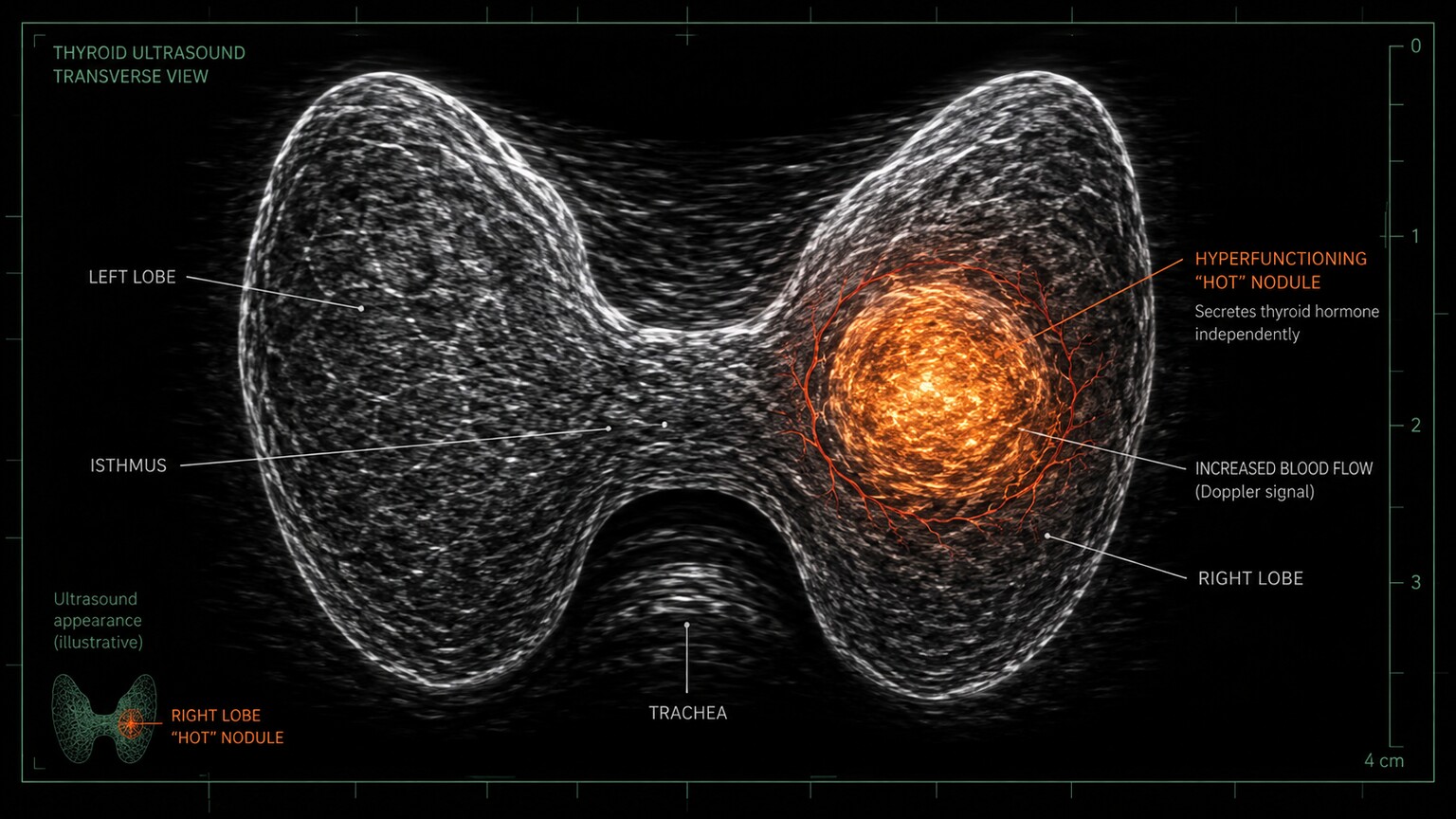
Figure 4. A hyperfunctioning "hot" nodule within the thyroid gland can secrete hormone independently of TSH control, producing a disproportionate rise in T3.
Because T3 toxicosis specifically involves the gland producing hormone somewhat autonomously, it typically doesn't resolve on its own without a clear underlying trigger being identified — which is why an elevated T3 with a normal TSH is a finding most providers want to actively track over the following weeks, rather than one to file away without a follow-up plan.
It also helps to understand why T3 toxicosis tends to show up more often in certain situations than others. Iodine-deficient regions and older adults with longstanding, previously silent multinodular goiters are disproportionately represented in reported cases, because a nodule that has slowly become autonomous over years tends to secrete a T3-rich hormone mix compared to a gland stimulated more uniformly by Graves' antibodies. Some clinicians also see a T3-predominant pattern more often in people who have recently increased their iodine intake substantially, for instance through a new iodine-containing supplement, a contrast dye used during a CT scan, or a diet that changed significantly — since feeding a mildly autonomous gland more raw material can unmask overproduction that wasn't obvious before. None of this changes the practical next step, which remains confirmatory testing, but it's part of why your provider may ask pointed questions about recent scans, supplements, or dietary shifts alongside the standard workup.
Biotin and Other Everyday Things That Can Fake an Elevated Result
Not every unexpected T3 result reflects your actual biology — some reflect the lab test itself being fooled. Most thyroid hormone assays use a laboratory technique built on biotin, a B vitamin, as a chemical bridge that helps the test detect and measure the hormone. If you happen to have a lot of extra biotin circulating in your blood — most commonly from a daily hair, skin, and nail supplement, or a high-dose multivitamin, both of which have become extremely popular in recent years — that excess biotin can interfere with the assay itself and distort the result. Depending on the specific test format a lab uses, biotin interference tends to falsely raise T3 and T4 while falsely lowering TSH, producing a pattern on paper that can look exactly like genuine hyperthyroidism in someone whose thyroid gland is working completely normally.

Figure 5. High-dose biotin supplements can interfere with common thyroid assays, producing a falsely elevated T3 result unrelated to actual thyroid function.
This isn't a rare edge case. Biotin supplements are sold over the counter at doses far higher than the amount your body needs from diet alone, and many people don't think to mention a daily gummy vitamin when a lab draws blood, simply because it doesn't feel like "medication." The general guidance from endocrine and laboratory professional societies is to stop biotin supplementation for at least two days, and ideally closer to a full week for very high-dose products, before any thyroid blood draw, since biotin clears from the bloodstream fairly quickly once supplementation stops. If your provider suspects interference based on a mismatch between your results and how you actually feel, the most direct way to confirm it is simply to stop the supplement and repeat the panel — a genuinely elevated T3 will still be elevated on the repeat test, while an artifact caused by biotin typically normalizes completely.
Beyond biotin, a handful of less common assay-interference sources exist too, including certain heterophile antibodies — antibodies your immune system can produce that interfere with lab test chemistry itself, unrelated to thyroid disease — which is one more reason labs sometimes ask for a repeat sample using a different testing method entirely when a result looks inconsistent with a person's overall clinical picture.
What makes biotin interference particularly worth ruling out first, before considering any of the other explanations in this article, is how quickly and cheaply it can be excluded. Unlike an autoimmune workup or an ultrasound, checking for biotin interference costs nothing beyond a short conversation: has anything changed in your supplement routine in the weeks before the blood draw, and are you willing to pause it and repeat the test? Because high-dose biotin has become a common ingredient not just in dedicated hair-growth supplements but also in some multivitamins, prenatal vitamins, and even certain protein powders and energy drinks marketed around "beauty" or "energy" benefits, it's worth checking ingredient labels rather than assuming a product is biotin-free just because it isn't sold specifically as a biotin supplement. This single question, asked early, has spared plenty of people an unnecessary and anxiety-inducing workup for a thyroid problem they never actually had.
Medications, Pregnancy, and Other Reasons T3 Can Run High Without Thyroid Disease
Several everyday medications and physiological states can push T3 upward through mechanisms that have nothing to do with your thyroid gland malfunctioning. The clearest example is taking thyroid hormone medication itself: liothyronine, sold under the brand name Cytomel and also compounded into some "natural desiccated thyroid" products, is a synthetic form of T3 taken directly, and even a dose that's only slightly too high for your body's needs can push measured T3 above range while TSH — responding appropriately to the extra hormone you're taking — drops toward the low end of normal or below it, rather than staying elevated. Anyone currently on thyroid replacement therapy who sees this exact pattern should treat it as a signal to discuss their dose with the prescribing provider rather than a mystery to investigate from scratch.
Pregnancy and oral estrogen — whether from combined birth control pills or hormone replacement therapy — both raise the amount of thyroid-binding globulin, the carrier protein described earlier, circulating in the blood. More carrier protein means more Total T3 (and Total T4) can be transported, even though the actual free, active hormone level and TSH often remain completely normal. This is a textbook cause of an elevated Total T3 in an otherwise healthy person, and it's precisely the scenario where checking Free T3 instead of Total T3 usually resolves the apparent contradiction immediately. Liver disease can produce a similar carrier-protein effect through a different mechanism, since the liver is where thyroxine-binding globulin is manufactured in the first place.
Acute illness, significant physical stress, and recent surgery can transiently affect thyroid hormone levels and their conversion in the body as well, sometimes in the opposite direction (a pattern called non-thyroidal illness syndrome, or "sick euthyroid syndrome," most often lowers T3 rather than raising it, but the recovery phase after a serious illness can produce a temporary rebound where T3 and even TSH run higher than usual as the body's normal regulation resumes). Amiodarone, a heart-rhythm medication that contains a very high iodine content, is well known for disrupting thyroid hormone levels in complex, sometimes contradictory ways and deserves a specific conversation with a cardiologist or endocrinologist if you're taking it and see an unexpected thyroid panel.
Even something as simple as the timing of your blood draw relative to your last dose of thyroid medication can matter more than most people realize. If you take levothyroxine or liothyronine in the morning and then had blood drawn just an hour or two later, your T3 (and sometimes T4) can appear temporarily elevated simply because the lab caught the peak absorption of that morning's dose still circulating, rather than your true, steady baseline level. This is exactly why standard guidance for anyone on thyroid medication is to have blood drawn before that day's dose, or at least three to four hours after it, and to keep the timing consistent between tests so results are actually comparable to one another over time. A single mistimed draw, unrelated to anything wrong with the thyroid gland itself, is a surprisingly common and easily overlooked explanation for a T3 that looks unexpectedly high on one occasion and normal on the next.
Age and sex-related patterns are worth a brief mention too, since reference ranges are usually built from a broad adult population rather than tailored to every individual circumstance. Thyroid hormone levels, including T3, can run mildly higher earlier in the menstrual cycle for some people and can shift again during perimenopause as estrogen levels fluctuate, all without representing thyroid disease. None of these everyday variables need to be memorized — the practical takeaway is simply that a provider reviewing a mismatched panel is trained to ask about exactly this kind of context (medication timing, menstrual cycle, recent illness, supplements) before assuming the thyroid gland itself has become the problem.
What Your Doctor Will Likely Do Next
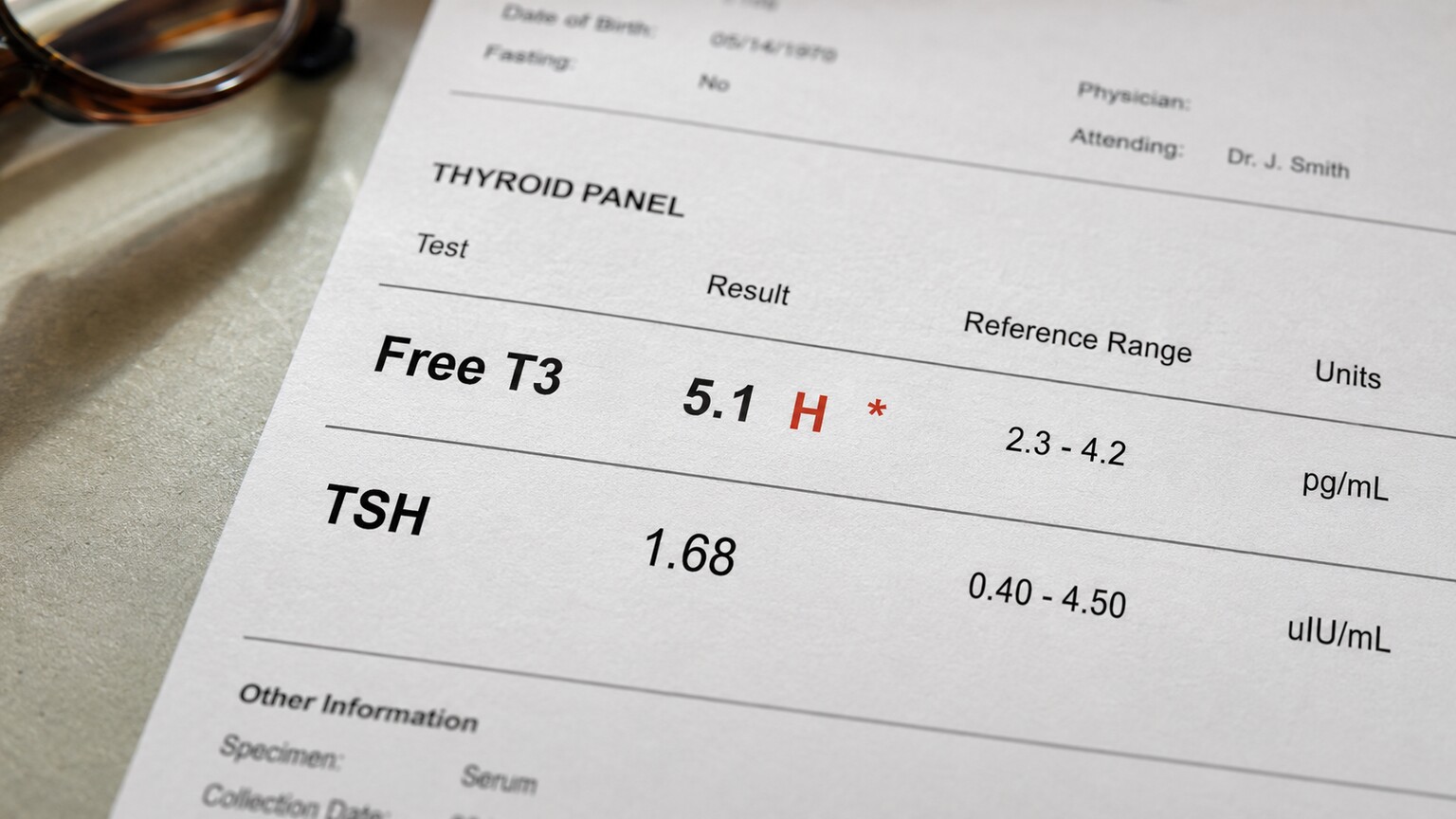
Figure 6. On a real thyroid panel, an elevated T3 sitting beside a normal TSH is the specific pattern that prompts additional, more targeted testing.
Given how many different explanations can produce this exact pattern, a single flagged T3 value is rarely treated as a final answer by an experienced clinician — it's treated as the start of a short, fairly predictable workup. The most common first step is simply repeating the panel, this time explicitly requesting Free T3 and Free T4 rather than Total T3, to see whether the elevation persists and whether it's actually the active hormone fraction that's high. Your provider will also want a careful medication and supplement history, specifically asking about biotin, thyroid hormone products, and estrogen-containing medications, since each of those can be resolved simply by adjusting or temporarily pausing them rather than treating a "thyroid problem" that isn't really there.
If the repeat panel confirms a genuine, persistent elevation in Free T3, the next tests typically ordered are TSH-receptor antibodies (TRAb) or thyroid peroxidase antibodies (TPOAb), which help identify or rule out Graves' disease and other autoimmune thyroid conditions, along with a thyroid ultrasound if a nodule is suspected on physical exam. In some cases, a radioactive iodine uptake scan is used to distinguish between a gland that's producing too much hormone itself versus one that's leaking pre-formed hormone due to inflammation — since those two situations, despite looking similar on a basic panel, are treated in completely different ways. None of this workup needs to happen the same week; thyroid hormone changes unfold over a timescale of weeks, not hours, which is exactly why "repeat the test in four to six weeks" is such a common and reasonable first instruction rather than a brush-off.
Where "Subclinical" Hyperthyroidism Fits Into This Picture
There's a specific clinical category worth knowing by name, because it describes a slightly different — and in some ways more common — version of a thyroid panel that doesn't line up the way people expect: subclinical hyperthyroidism. This term is normally used to describe a suppressed or low TSH paired with Free T4 and Free T3 that are both still within their normal ranges, which is almost the mirror image of the pattern this article has focused on. It's worth understanding anyway, because the two patterns sit on the same timeline and the same feedback loop, and providers often use similar language and a similar monitoring approach for both. In subclinical hyperthyroidism, the thyroid gland has started producing enough extra hormone to suppress the pituitary's TSH output, but not yet enough to push T3 or T4 themselves above the normal range — a gland that's revved up, in other words, before the downstream hormones have caught up to show it.
Your situation — a clearly high T3 with a TSH still sitting in the normal range — usually reflects an earlier or different point on that same continuum, one where the change started at the gland itself and simply hasn't fully registered with the pituitary yet, rather than a case where the pituitary has already responded but the hormones haven't moved. Providers evaluating either pattern tend to reach for the same tools: a repeat panel a few weeks out to see which direction things are trending, a check of TSH-receptor or thyroid peroxidase antibodies to look for an autoimmune cause, and a physical exam of the neck to feel for an enlarged gland or a discrete nodule. The shared lesson from both patterns is the same one worth carrying away from this whole discussion: the thyroid feedback loop doesn't move as one synchronized unit, and a single mismatched value is a normal, expected feature of a system that changes gradually — not proof that something has already gone seriously wrong.
Frequently Asked Questions
Should I be worried if only my T3 is high and everything else looks normal?
It's worth following up on, but not an emergency on its own. An isolated high T3 with a normal TSH and normal Free T4 is a recognized pattern with several explanations, ranging from a supplement interference to early hyperthyroidism. The appropriate next step is almost always a repeat test rather than immediate treatment, since a single value can't distinguish between these causes.
Can stress or a recent illness cause this pattern on its own?
Acute illness more commonly lowers T3 rather than raising it, but the recovery period after a significant illness or surgery can produce a temporary rebound where thyroid values run higher than baseline as the body's normal hormone regulation resumes. If you were sick or recovering around the time of your blood draw, mentioning that timeline to your provider is genuinely useful context.
How long should I stop taking biotin before getting my thyroid retested?
Most laboratory guidance recommends stopping biotin supplements for at least two days before a blood draw, and up to a week if you're taking a very high-dose hair, skin, and nail formula. Biotin clears from the bloodstream fairly quickly, so a short pause is usually enough to remove its effect on the test.
Does an elevated T3 with normal TSH always mean I'll need thyroid medication?
No. Several of the most common causes — a biotin supplement, pregnancy, oral estrogen, or a pituitary lag during an early stage of illness recovery — don't require any thyroid-specific treatment at all, only correcting or waiting out the underlying cause. Medication only becomes relevant once a genuine, persistent thyroid disorder like Graves' disease or a toxic nodule has actually been confirmed with follow-up testing.
Is Total T3 or Free T3 the more reliable number to focus on?
Free T3 is generally the more meaningful value when TSH is normal, since it measures only the active, unbound hormone rather than the total pool, which includes hormone still attached to carrier proteins. Conditions like pregnancy or oral estrogen use can raise Total T3 substantially through carrier-protein changes alone, without ever affecting Free T3 or how your cells actually respond to thyroid hormone.
How soon should a T3 result be repeated if TSH is normal?
There's no universal rule, but many providers repeat a mismatched thyroid panel somewhere between four and eight weeks later, giving the feedback loop enough time to either confirm the trend or settle back to baseline. If symptoms like a racing heartbeat, tremor, or unexplained weight loss are present, your provider may reasonably choose to move faster and add antibody testing right away rather than waiting.
Conclusion
An elevated T3 sitting beside a normal TSH isn't a broken lab result or a sign that something has gone catastrophically wrong — it's a snapshot of a feedback loop that hasn't finished settling, caught mid-transition by a blood draw. Sometimes that transition reflects a thyroid gland genuinely starting to overproduce hormone, as in early Graves' disease, a toxic nodule, or the specific and well-documented pattern called T3 toxicosis. Just as often, it reflects something far more mundane and far more fixable: a daily biotin gummy interfering with the lab assay itself, a birth control pill raising carrier proteins without touching your actual hormone levels, or a pituitary gland that simply hasn't caught up yet to a change that started only weeks ago. The only way to tell these apart is with a bit more information — a Free T3 and Free T4 recheck, a careful look at your supplements and medications, and sometimes a repeat panel a month down the line — which is exactly the kind of follow-up worth having with your provider rather than guessing from one number in isolation.
Still Not Sure What Your Results Mean?
Upload your labs and get a complete, visual, plain-language interpretation of every biomarker — delivered to your inbox in under 15 minutes.
Get My ReportThis article is for educational purposes only and does not constitute medical advice. Always consult your healthcare provider regarding your specific lab results.