
What's the Link Between Drug Screening and Chain of Custody?
A drug test's chemistry can be flawless, and its result can still be worthless if nobody can prove the sample tested is genuinely the sample that was collected from a specific person, untouched and unswapped, the whole way from bathroom to laboratory bench. That documented proof has a name: chain of custody. It's the specific reason a workplace drug test, a court-ordered test, or a federally regulated safety test looks and feels so procedurally different from an ordinary medical lab draw — extra paperwork, sealed bags, initials on tape, a witness in some cases — none of it is bureaucratic overkill. Every one of those steps exists to answer a single question a court, an employer, or a regulator might eventually ask: how do we know this result actually belongs to this person? This article walks through exactly what chain of custody means, how it's built and maintained step by step, and what actually happens when that chain breaks.
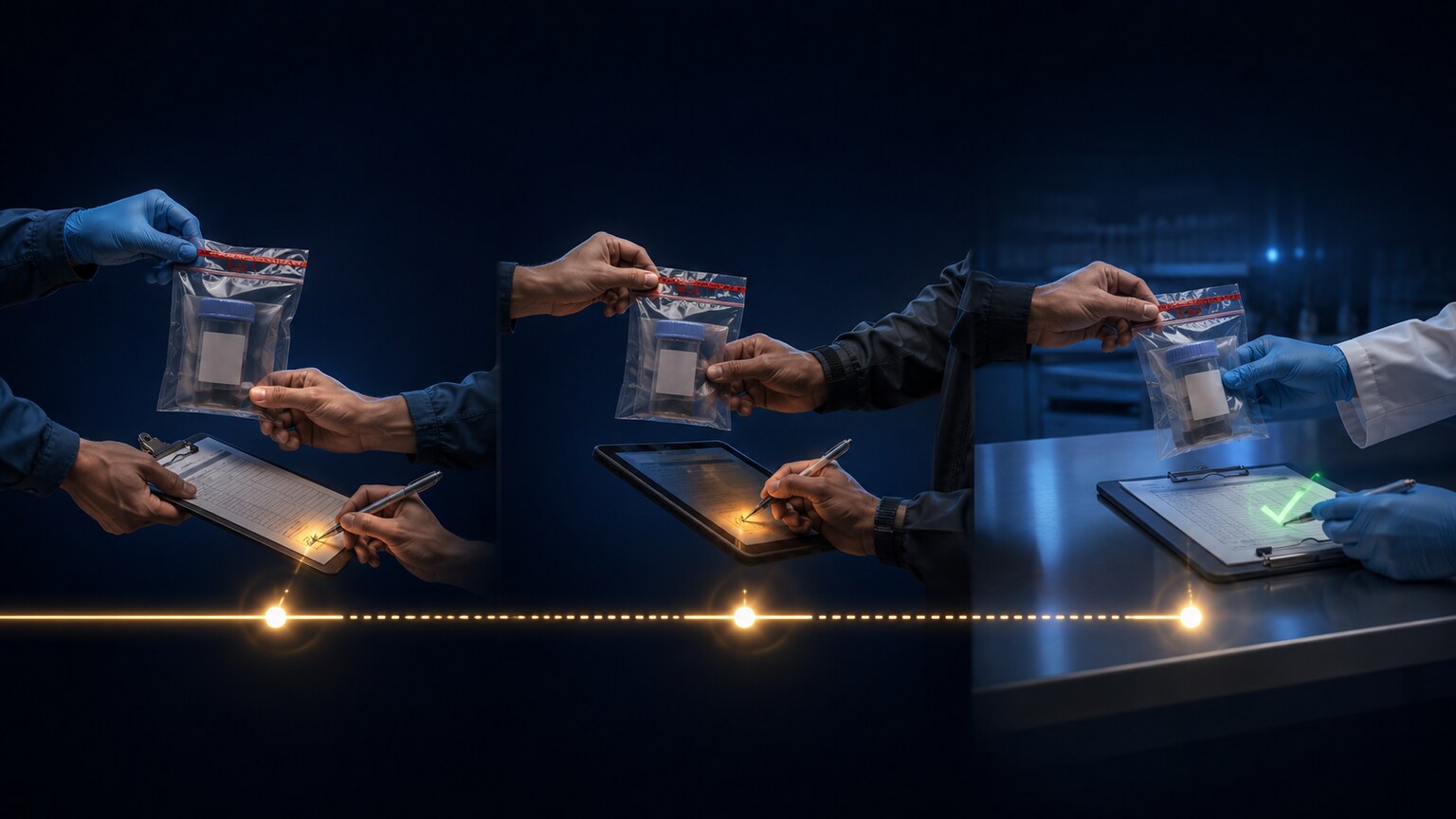
Figure 1. Chain of custody is the unbroken, signed record of every single person who physically possessed a specimen from the moment of collection through final laboratory analysis, with no gap in that documented handoff sequence.
Why Legal Systems Care So Much About How Evidence Is Handled
Chain of custody isn't a concept unique to drug testing — it's a foundational principle borrowed directly from forensic and legal evidence handling more broadly, applied here to a biological specimen instead of a physical object like a weapon or a document. The underlying legal logic is the same in every context it appears: any piece of evidence, no matter how compelling it looks on its own, is only as trustworthy as the documented certainty that it hasn't been altered, contaminated, or substituted between the moment it was collected and the moment it was analyzed or presented.
This principle exists because the alternative — simply trusting that everyone involved handled a specimen correctly, with no independent way to verify it — creates an obvious vulnerability. Evidence could be mishandled by accident, or in rarer cases, deliberately tampered with, and without a documented chain proving otherwise, there would be no reliable way to distinguish an honest, uncorrupted result from a compromised one after the fact. Drug testing inherited this same evidentiary standard specifically because its results are so often used to make consequential legal and employment decisions, decisions that deserve the same procedural rigor courts already demand of any other kind of physical evidence.
What Chain of Custody Actually Means
Chain of custody, in the context of drug testing, refers to the complete, documented, signature-verified record of every person who physically handled a urine, blood, hair, or oral fluid specimen from the moment it left the donor's body until the moment a laboratory reported a final result on it. Every single handoff — collector to courier, courier to laboratory receiving clerk, receiving clerk to testing technician — has to be documented and signed for, with no unexplained gap in that record at any point along the way.
The core idea is straightforward: if you can't prove exactly who had physical possession of a sample at every single moment between collection and testing, you can't fully rule out the possibility that the sample was tampered with, mixed up with someone else's, or substituted entirely, whether by accident or on purpose. Chain of custody exists specifically to close that gap, turning "trust us, this is the right sample" into a documented, independently verifiable paper trail.
It's worth being specific about what "documented" actually requires here, since the standard is higher than simply having a general sense of who was involved. Each transfer of custody needs to record who released the specimen, who received it, and the exact date and time of that exchange, typically captured through a physical or electronic signature at each step. A verbal confirmation or an informal note isn't sufficient — the documentation has to be specific, contemporaneous (recorded at the time of the event, not reconstructed afterward from memory), and tied to an identifiable individual who can, if ever necessary, be asked to testify or otherwise confirm their role in the chain.
This contemporaneous requirement is worth dwelling on for a moment, since it's one of the more legally significant details of the whole system. A record created after the fact, even by an honest person accurately recalling what happened, simply doesn't carry the same evidentiary weight as a record created at the actual moment of the event itself — memory can be mistaken, and a reconstructed timeline is inherently more vulnerable to challenge than one documented in real time. This is exactly why every custody transfer form is designed to be filled out on the spot, not compiled retroactively from memory once a dispute has already arisen.
Curious what the rest of your lab results are telling you? Upload your results and get a complete, plain-language breakdown in under 15 minutes.
Analyze My ResultsWhy This Matters So Much More for Some Drug Tests Than Others
Not every drug test needs this level of documented rigor, and understanding why highlights exactly what chain of custody is protecting against. A drug test ordered by your own doctor purely to guide your medical care — checking whether a pain management patient's urine shows their prescribed medication and nothing unexpected, for instance — doesn't typically need a full forensic chain of custody, because the result isn't being used to make a legal or employment decision that could be formally challenged. If something about that result seems off, the doctor and patient can simply discuss it and retest.
A drug test ordered for a federally regulated safety-sensitive job, a legal proceeding, or a formal workplace policy violation is a completely different situation. That result can end someone's employment, affect custody arrangements, or become evidence in a criminal or civil case — decisions serious enough that the person affected has a right to challenge the result, and a chain-of-custody gap is one of the most common, legally recognized grounds for exactly that kind of challenge. This is why forensic, or "chain of custody," testing follows a much stricter, standardized collection and documentation protocol than routine clinical testing, even when the underlying laboratory chemistry identifying the drug itself is identical in both cases.
Certain industries and job categories are specifically required, by federal regulation, to use this forensic chain-of-custody standard rather than a simpler clinical testing approach — commercial transportation, aviation, and other safety-sensitive federally regulated positions are common examples, precisely because a testing error or a successfully disputed result in these fields carries public safety implications well beyond the individual being tested. Employers in these regulated industries don't have discretion to use a simplified, non-forensic testing process for these specific positions; the stricter standard is a compliance requirement, not merely a best practice they've chosen to adopt.
Outside of these federally mandated categories, many private employers voluntarily choose to use forensic, chain-of-custody testing for their own workplace drug testing programs, even when not strictly required to by federal regulation, specifically because it gives any resulting employment decision a much stronger legal foundation if it's ever challenged. A positive result obtained through a documented chain of custody is considerably harder for a terminated employee to successfully dispute than a positive result from a simpler, non-forensic testing process, which is a major practical reason many employers consider the additional cost and complexity worthwhile.
The Custody and Control Form: The Paper Trail's Backbone
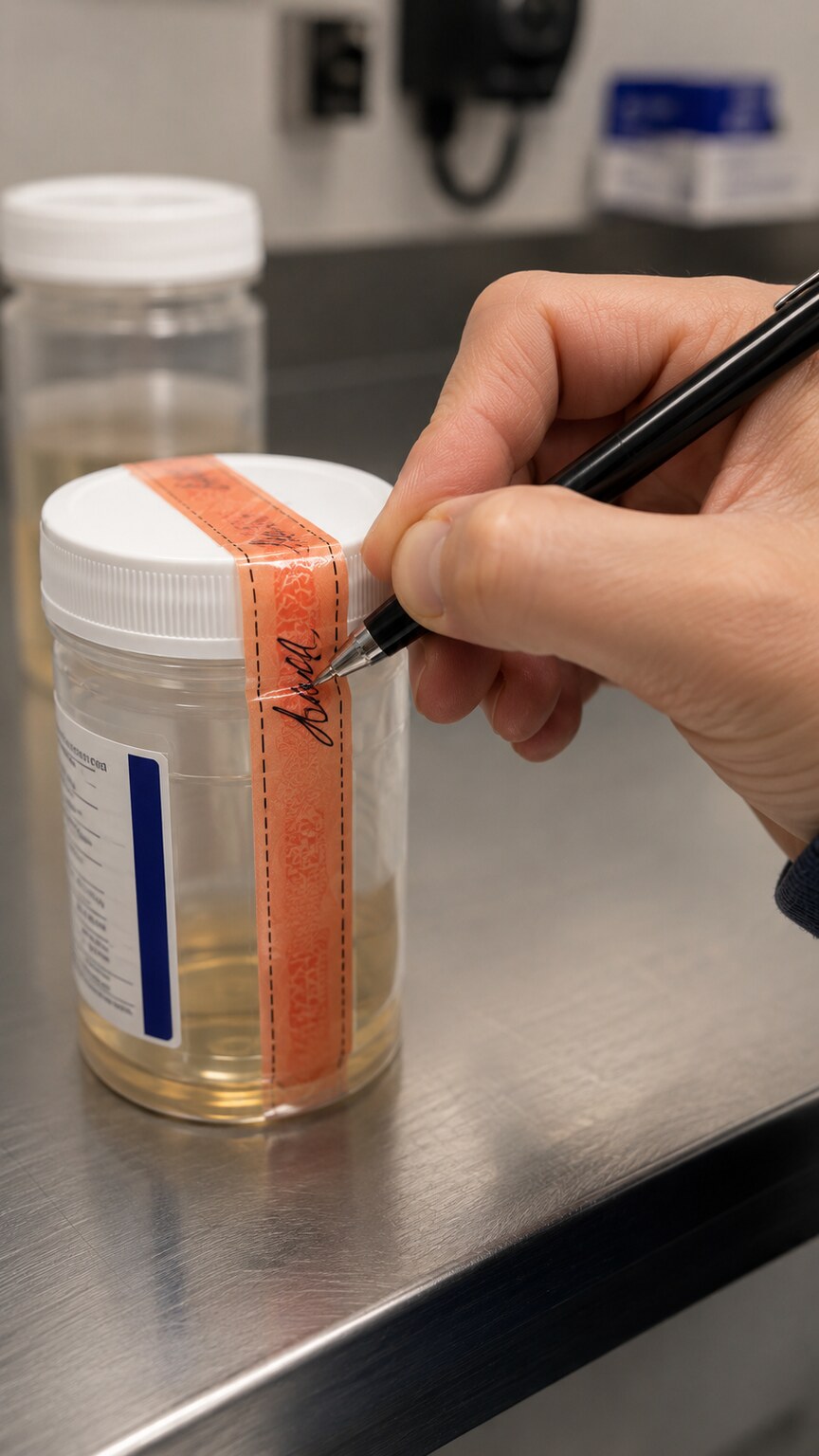
Figure 2. The donor initials the tamper-evident seal directly across the bottle cap and the bottle itself at the moment of collection, creating a physical signature that would visibly tear or misalign if the seal were ever removed and reapplied.
At the center of every forensic drug collection sits a document called the custody and control form, often abbreviated CCF. This form travels with the specimen for its entire journey and accumulates a signature or initial at every single step: the donor confirming the specimen is theirs, the collector confirming the collection procedure was followed correctly, the courier or shipping service confirming custody during transport, and the laboratory confirming the sealed specimen arrived intact and matching the form's details.
Immediately after a specimen is collected, the donor and collector both apply their initials or signature directly across a tamper-evident seal that's placed over the specimen bottle's cap and down onto the bottle itself. This seal is specifically designed so that removing it, even carefully, visibly damages or misaligns the writing on it — meaning anyone examining the sample later can tell at a glance whether it was ever opened after this sealing step, without needing anything more sophisticated than their own eyes.
The custody and control form itself is typically a multi-copy carbonless form, meaning writing on the top copy transfers through to identical copies underneath, so every party involved in the process — the donor, the collector, the laboratory, and often the employer or requesting agency — walks away with their own identical, simultaneously created copy of the exact same information. This carbonless design specifically prevents any single party from later altering their own copy of the form without that alteration being detectable by comparing it against everyone else's simultaneously created copy, since a genuine after-the-fact change would show up as a mismatch across copies that were all created at the same moment.
The form also captures a surprising amount of specific detail beyond just signatures: the donor's identification method (typically checked against a photo ID at the time of collection), the specific specimen type being collected, the collection date and time, the specific tests being requested, and, for federally regulated testing, a specific identification number unique to that collection event that ties every subsequent piece of paperwork and every laboratory result back to this one specific specimen, and no other. This unique identifier is what allows a laboratory processing potentially hundreds of specimens on a given day to keep every single one distinctly and unambiguously tracked through its entire testing process.
The Collection Process Itself: Where the Chain First Begins
The chain of custody doesn't begin at the laboratory — it begins the moment a donor arrives at a collection site, and several specific procedural steps exist at this earliest stage precisely to prevent problems before they can happen, rather than trying to detect them afterward. Collection sites for forensic testing are specifically designed and operated to minimize opportunities for a donor to substitute, dilute, or otherwise adulterate a specimen before it's ever sealed. Common measures include securing or disabling water sources in the collection restroom, adding a coloring agent to any standing water in the toilet to make dilution with tap water immediately obvious, and having the collector remain just outside the collection stall, close enough to hear normal sounds of urination.
In situations where there's a specific, documented reason to suspect a heightened risk of substitution or tampering — a previous specimen from the same donor that came back suspicious, for instance — some forensic collection protocols call for a directly observed collection, where a same-gender collector is physically present in the room and directly witnesses the collection itself. This is the most rigorous version of the collection procedure specifically because it eliminates essentially the entire opportunity window for substitution that exists in an unwitnessed collection, though it's reserved for specific, defined circumstances precisely because of its more invasive nature, rather than being the default procedure for every routine collection.
Immediately following the void itself, the collector checks the specimen's temperature using a strip built into or wrapped around the collection container, typically requiring a reading within a narrow window (commonly around 90 to 100 degrees Fahrenheit) within about four minutes of collection. This temperature check happens before the specimen is ever sealed, specifically so that an out-of-range reading can be caught and addressed — potentially triggering an immediate, freshly observed recollection — rather than being discovered only later at the laboratory, by which point the original collection opportunity has already passed.
Split-Specimen Collection: Building in a Second Chance
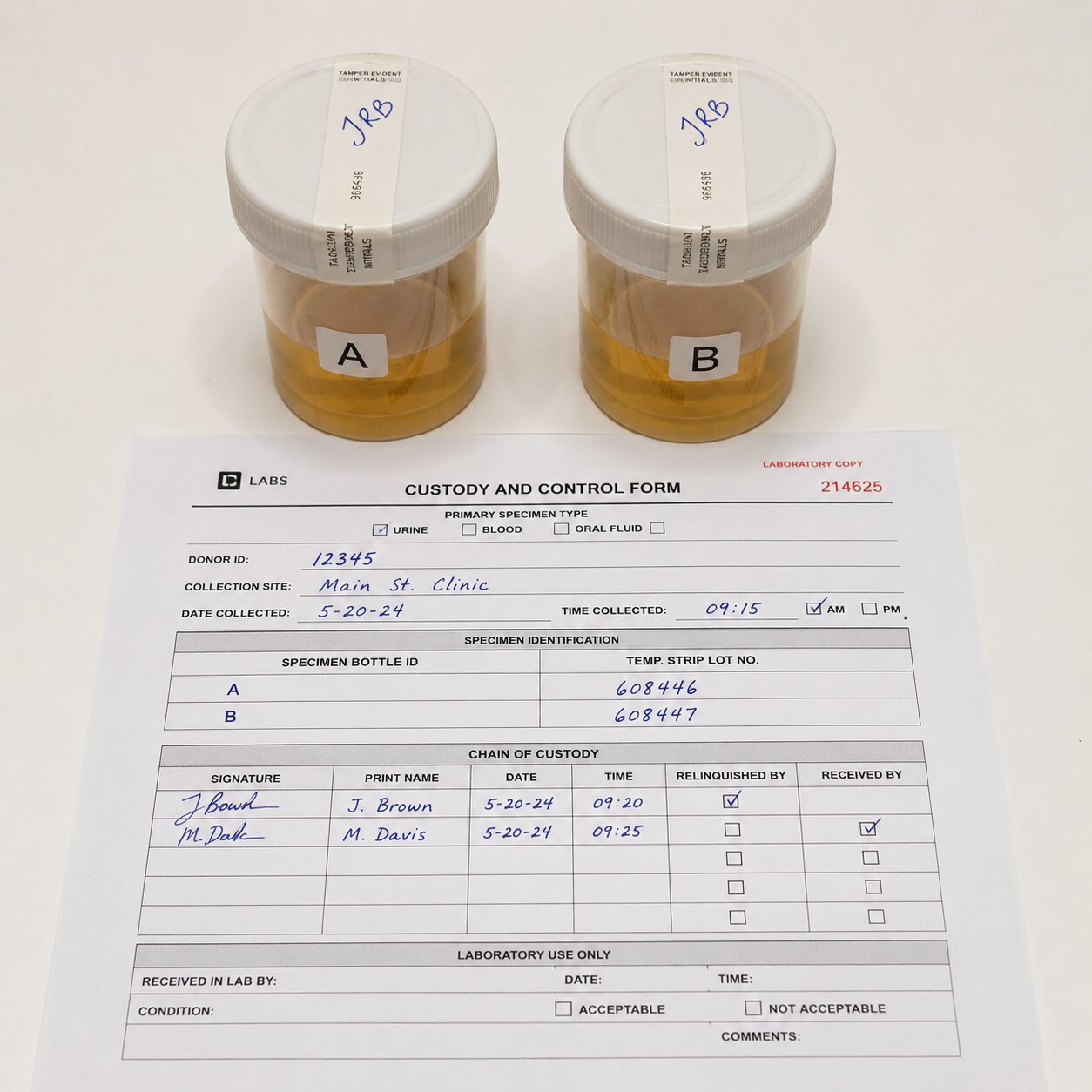
Figure 3. A split-specimen collection divides a single void into two independently sealed bottles — one tested immediately, and one held in reserve specifically so a donor can request independent retesting at a different laboratory if they dispute the first result.
Many forensic drug testing protocols use what's called a split-specimen collection, where a single urine void is divided into two separate containers immediately after collection, each individually sealed with its own tamper-evident seal and initialed by the donor. One bottle, typically labeled "A," is sent forward for standard testing right away. The second bottle, labeled "B," is retained in secure, documented storage, untouched, specifically as a safeguard.
If a donor disputes a positive result on the "A" bottle, they can formally request that the "B" bottle be sent to a separate, independent laboratory for confirmatory retesting — a laboratory that never had access to the original result and is testing the reserved sample cold. This split-specimen system exists specifically to give a donor a genuine, physically independent way to challenge a result, rather than asking them to simply trust a single laboratory's single analysis of a single container with no way to verify it.
The "B" bottle's own chain of custody is maintained just as rigorously as the "A" bottle's throughout this entire storage and eventual retesting process, since its entire evidentiary value depends on being able to prove it's genuinely the same untouched split of the original void, stored securely and continuously since the moment of collection. If the "B" bottle's own custody chain were ever allowed to lapse, the whole point of having a reserved, independently retestable sample would be defeated, since the retest could no longer be confidently tied back to the original collection event either.
There's typically a defined window during which a donor must request this "B" bottle retest, often a set number of days from being notified of the original positive result, since specimens can't be preserved indefinitely and laboratories need a reasonable, predictable timeline for managing their reserved specimen storage. This is one of several procedural details a donor disputing a result needs to move on relatively promptly, rather than assuming the retest option remains available indefinitely after the fact.
Why the Retest Almost Always Confirms the Original Result
It's worth noting directly, since it's a common point of confusion, that split-specimen retesting overwhelmingly confirms the original laboratory's finding rather than overturning it. This makes sense once you separate what the retest is actually checking from what people sometimes assume it's checking: the "B" bottle retest verifies that the same drug or drug metabolite genuinely was present in the specimen, using an independent laboratory and independent equipment, addressing concerns about laboratory error or specimen mix-up specifically. It does not, and isn't intended to, address a separate question like how that substance came to be present in the donor's body, which is a completely different issue from whether the laboratory correctly identified what was actually in the sample.
This distinction matters because donors sometimes request a retest hoping it will somehow explain away a result caused by, say, an over-the-counter medication or a specific food, when in fact both laboratories are simply confirming that the same chemical compound was present in the specimen either way — the retest's job is to rule out laboratory-side error, not to investigate every possible external explanation for a substance's presence, which is instead the kind of question addressed separately during the medical review officer's evaluation described later in this article.
How the Laboratory Maintains Custody Once the Sample Arrives
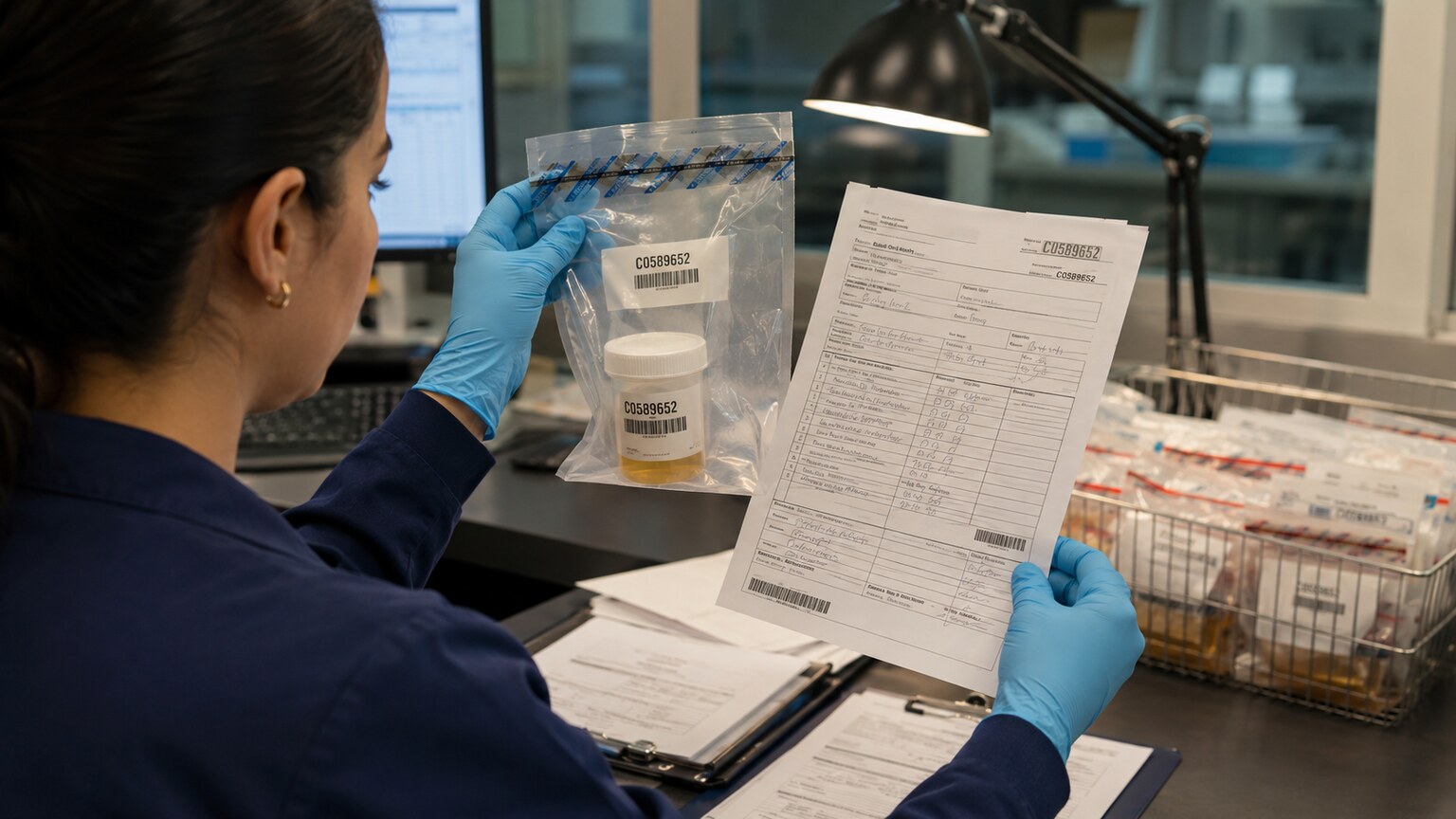
Figure 4. Before a laboratory accepts a specimen into testing, a receiving clerk verifies the tamper-evident seal is intact and that every detail on the container matches the accompanying custody and control form exactly — any mismatch halts the process before testing ever begins.
When a sealed specimen arrives at an accredited laboratory, a receiving clerk's first job is verification, not testing. They check that the tamper-evident seal is fully intact and undisturbed, confirm the specimen identification number on the bottle matches the number on the accompanying custody and control form exactly, and log the exact date and time of receipt. Only once every one of these details checks out does the specimen move into internal laboratory custody, where its own internal chain-of-custody logging begins, tracking every internal transfer between departments, technicians, and storage locations within the lab itself.
Laboratories performing this kind of forensic testing typically operate under a specific accreditation, most notably certification from the U.S. Substance Abuse and Mental Health Services Administration for federal workplace testing programs, which requires the laboratory to maintain and be able to produce, on request, this complete internal chain-of-custody record for any specimen it has processed. This accreditation is periodically audited specifically to confirm the laboratory's documentation practices genuinely meet the required standard, not just on paper but in actual day-to-day practice.
Within the laboratory itself, a specimen typically moves through several distinct internal stages, each requiring its own logged transfer: initial accessioning (the formal entry of the specimen into the lab's tracking system), screening (a fast, sensitive initial test used to flag specimens that appear positive for further review), and, for any specimen that screens positive, a separate, more specific confirmatory test using a different analytical method entirely, typically a technique called mass spectrometry, which can identify the exact chemical structure of whatever substance triggered the initial screening result. Every one of these internal stages generates its own logged custody entry, meaning a single specimen's complete internal laboratory record can include a dozen or more individually documented steps by the time a final result is issued.
This internal confirmatory testing step is itself a meaningful safeguard worth understanding on its own terms, separate from the chain-of-custody discussion. Initial screening tests are designed to be highly sensitive, which means they're deliberately built to catch every possible true positive, at the cost of occasionally flagging a specimen that doesn't actually contain the specific substance being screened for, due to cross-reactivity with an unrelated, chemically similar compound. Confirmatory testing exists specifically to catch and correct exactly this kind of false screening result before it's ever reported as a final positive, which is why a properly conducted forensic drug test never reports a positive result based on the initial screen alone.
Storage, Retention, and the Long Tail of Custody
Chain of custody doesn't end the moment a laboratory issues its final result — specimens and their associated documentation are typically retained in secure, documented storage for a defined period afterward, precisely to preserve the possibility of a challenge, an appeal, or a legal proceeding that might arise well after the original result was reported. Retention periods vary depending on the type of testing program and the specific regulations governing it, but positive specimens in particular are often kept considerably longer than negative ones, given their greater likelihood of being relevant to a future dispute.
During this retention period, the specimen's chain of custody continues to be actively maintained, meaning any subsequent access to a stored specimen — whether for a formal retest request, an audit, or a legal proceeding — still needs its own documented, signed handoff, exactly like every earlier step in the process. A specimen sitting in long-term storage isn't exempt from custody requirements just because active testing has already concluded; if anything, a specimen's value as potential future evidence makes maintaining its documented custody during storage just as important as during the original collection and testing process.
What Actually Breaks a Chain of Custody
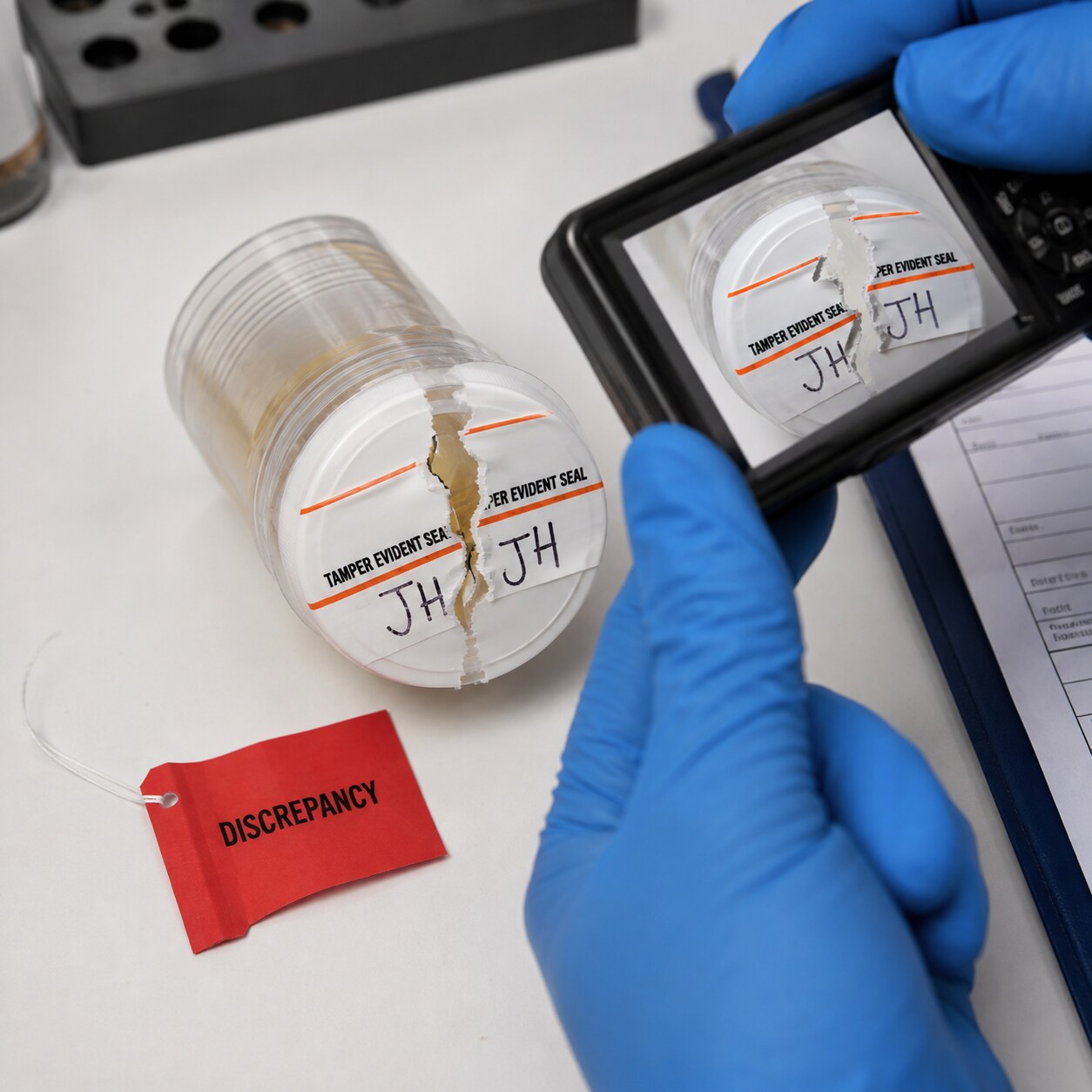
Figure 5. A torn or misaligned tamper-evident seal, a missing signature, or an unexplained gap in the documented timeline are the most common ways a chain of custody breaks — any one of them is grounds to flag the specimen as compromised before testing proceeds.
A chain of custody can break in a handful of well-recognized ways, and laboratory and collection staff are specifically trained to watch for each one. A tamper-evident seal that arrives torn, misaligned, or otherwise showing signs it was opened after the donor's initial sealing step is one of the most serious and immediately disqualifying issues. A missing signature or initial at any single handoff point — even if everything else about the specimen looks perfectly normal — creates a documented gap that technically means custody can't be fully accounted for during that window. An unexplained delay between when a specimen was supposedly collected and when it was logged as received, without a documented explanation (a courier delay note, for instance), can also raise a legitimate custody question.
Temperature is another specific, well-documented checkpoint: a fresh urine specimen has a predictable temperature range shortly after collection, and collection staff check this using a temperature strip on the collection container within a few minutes of the void. A specimen that falls outside the expected temperature range is flagged immediately as a potential substitution concern, since a substituted sample (brought in from outside the collection setting rather than produced on the spot) would very often fail to fall within this expected range.
Beyond temperature, laboratories also routinely check a specimen's basic physical and chemical characteristics — creatinine concentration and specific gravity, both markers that reflect how dilute or concentrated the urine genuinely is — specifically to catch attempts at diluting a sample with water to lower the concentration of any drug present below a detectable threshold. A specimen with an unusually low creatinine level and unusually low specific gravity, even if its temperature checked out fine, can still be flagged as "dilute" or, in more extreme cases, "substituted," triggering its own separate documentation and, often, a requirement for immediate recollection under more closely observed conditions.
These validity checks are conceptually distinct from chain-of-custody documentation itself, since they're testing the specimen's own physical properties rather than tracking who handled it, but they're closely related in purpose: both exist to protect the same underlying goal of ensuring the reported result genuinely reflects that specific donor's actual physiological state at the time of collection, rather than a manipulated or substituted stand-in for it.
What Happens When a Chain of Custody Is Actually Broken
When a genuine chain-of-custody break is identified, the laboratory result is not simply thrown away as if the test never happened — but it is treated very differently from a clean result. Depending on the specific nature of the break, a specimen may be reported as "rejected for testing," meaning the lab explicitly declines to report a definitive result at all because the specimen's integrity can't be verified, rather than reporting a positive or negative result that a compromised chain would make legally indefensible either way.
In an employment or legal context, a documented chain-of-custody break is one of the most common and most successful grounds an affected person's representative can raise to challenge an otherwise damaging result. This doesn't necessarily mean the underlying test was wrong about what was actually in the sample — it means nobody can fully prove, to the standard the situation requires, that the sample tested was genuinely the untampered specimen collected from that specific person. That distinction, between "the chemistry might have been accurate" and "the custody can't be proven," is exactly why chain of custody carries so much legal weight independent of the actual toxicology result itself.
This is also why laboratories and collection sites treat every custody documentation step with the same seriousness regardless of how the underlying result eventually turns out — a lab technician has no way of knowing, at the moment they're logging a routine internal transfer, whether that specific specimen will ever end up being disputed months later. Consistent, disciplined documentation on every single specimen, not just the ones that later turn out to matter, is what makes the whole system credible in the first place.
Reviewing a Disputed Result: Who Actually Makes This Determination

Figure 6. A trained medical review officer, not the testing laboratory itself, makes the final determination on a forensic drug test result, specifically weighing the chain-of-custody documentation alongside the toxicology findings before a result is reported to the requesting employer or agency.
For federally regulated workplace testing specifically, the laboratory doesn't have the final word on a result at all — that responsibility belongs to a specifically trained physician called a medical review officer, who independently reviews the complete custody and control form alongside the laboratory's findings before any result is reported to the employer or agency that requested the test. Part of this review explicitly includes checking that the chain-of-custody documentation is complete and consistent, and the medical review officer has the authority to challenge or reject a result specifically on custody grounds, independent of whatever the underlying toxicology showed.
This additional review layer exists precisely because the stakes of a forensic result are high enough that no single link in the process — not the collector, not the laboratory, not even the toxicology finding itself — is allowed to be the sole, unchecked authority on a final determination. The medical review officer's job is specifically to catch exactly the kind of custody problem this article has been describing, before a flawed result ever reaches the person or organization that requested the test.
As part of this review, the donor is also given a confidential opportunity to speak directly with the medical review officer about a positive result before it's finalized and reported, specifically to disclose any legitimate medical explanation, such as a current prescription, that might account for the finding. This conversation is separate from, and doesn't substitute for, chain-of-custody verification — the medical review officer still confirms the documentation is complete and consistent regardless of what the donor discloses — but it's a meaningful additional safeguard built into the overall process, ensuring a result isn't finalized without the donor having had a genuine chance to provide relevant context first.
Only after this full review — custody documentation confirmed complete, laboratory findings verified, and the donor given their opportunity to provide context — does the medical review officer issue a final, reportable determination, closing out the last remaining link in a chain that began the moment the donor first walked into the collection site, days or sometimes weeks earlier, and involved every collector, courier, laboratory technician, and reviewer in between.
Frequently Asked Questions
Does my doctor's routine drug test at a medical appointment need chain of custody?
Usually not. A drug test ordered purely for your own medical care, like monitoring a pain management prescription, typically doesn't require a full forensic chain of custody, since the result isn't being used for a legal or employment decision that could be formally disputed.
What is a split-specimen collection, and why does it matter?
It's when a single urine sample is divided into two separately sealed bottles at the time of collection. One is tested immediately, and the other is held in reserve so the donor can request independent retesting at a different lab if they dispute the first result.
Can a positive drug test be thrown out just because of a paperwork issue?
Yes, in some cases. A documented gap in the chain of custody, such as a missing signature or a broken tamper-evident seal, can make a result legally indefensible regardless of what the underlying toxicology showed, since the sample's integrity can no longer be fully verified.
Who actually decides whether a workplace drug test result is valid?
For federally regulated testing, a specifically trained physician called a medical review officer makes the final determination, reviewing both the chain-of-custody documentation and the laboratory's toxicology findings before reporting a result to the employer or agency.
What's the difference between a screening test and a confirmatory test?
A screening test is fast and highly sensitive, designed to catch every possible true positive, but it can occasionally flag a substance due to cross-reactivity with an unrelated compound. A confirmatory test uses a more specific method, typically mass spectrometry, to verify the exact substance before any positive result is finalized.
Does retesting the reserved "B" specimen usually overturn the original result?
No, it overwhelmingly confirms the original finding. The retest verifies that the same substance was genuinely present using an independent lab, addressing concerns about lab error rather than investigating how the substance came to be present, which is a separate question handled during medical review.
Conclusion
Chain of custody is what turns a drug test's raw chemistry into a result that can actually hold up under legal or employment scrutiny. Every seal, signature, and logged handoff along the way exists to answer one specific question: can everyone involved prove, without any gap, exactly who had this sample at every moment between collection and final analysis? When that documented chain stays unbroken, a laboratory's toxicology finding carries real evidentiary weight. When it breaks, even a technically accurate chemical result can become legally indefensible, which is exactly why forensic drug testing looks so much more procedurally rigorous than an ordinary medical lab draw — the extra steps aren't bureaucracy for its own sake, they're the entire foundation the result's credibility rests on.
The next time a drug test involves what feels like an unusual amount of paperwork, sealed bags, or an extra signature, that added friction is a visible sign of the same underlying principle running through every layer of this process: a result is only as trustworthy as the documented, unbroken proof behind it — and that proof, not the chemistry alone, is ultimately what makes a forensic drug test result something a court, an employer, or a regulator can actually rely on.
Still Not Sure What Your Results Mean?
Upload your labs and get a complete, visual, plain-language interpretation of every biomarker — delivered to your inbox in under 15 minutes.
Get My ReportThis article is for educational purposes only and does not constitute medical advice. Always consult your healthcare provider regarding your specific lab results.