
What Does an Elevated Arsenic Level Indicate?
Seeing the word "arsenic" flagged as elevated on a lab report is genuinely one of the more alarming moments a person can experience while reading through their own bloodwork or urine test results at home — the word itself carries centuries of cultural association with deliberate poisoning, murder mysteries, and villains, none of which reflects the actual, far more mundane clinical reality behind most real-world results. But the actual clinical reality is far less dramatic in the overwhelming majority of real-world cases: most elevated arsenic results turn out to be explained by something entirely ordinary that was eaten within the past two days, not by any genuine form of contamination, industrial exposure, or deliberate poisoning at all. The critical piece of information almost never explained clearly to patients at the point of care is that "arsenic" listed on a lab report isn't actually one single, uniform substance at all — it's a broader family of chemically related compounds, some of which are essentially harmless and pass cleanly through the body within a matter of days, and others which are genuinely toxic and can meaningfully accumulate with repeated or sustained exposure over time. This article walks through the crucial distinction between organic and inorganic arsenic, exactly where real inorganic exposure actually comes from, how arsenic testing is performed and why the specific type of test matters enormously, what a mildly elevated total result usually means versus a genuinely concerning inorganic result, the different picture painted by acute poisoning versus chronic low-level exposure, how children factor into this picture differently than adults, and how doctors typically follow up on a result that genuinely needs a closer, more careful look.
The Single Most Important Distinction: Organic vs. Inorganic Arsenic
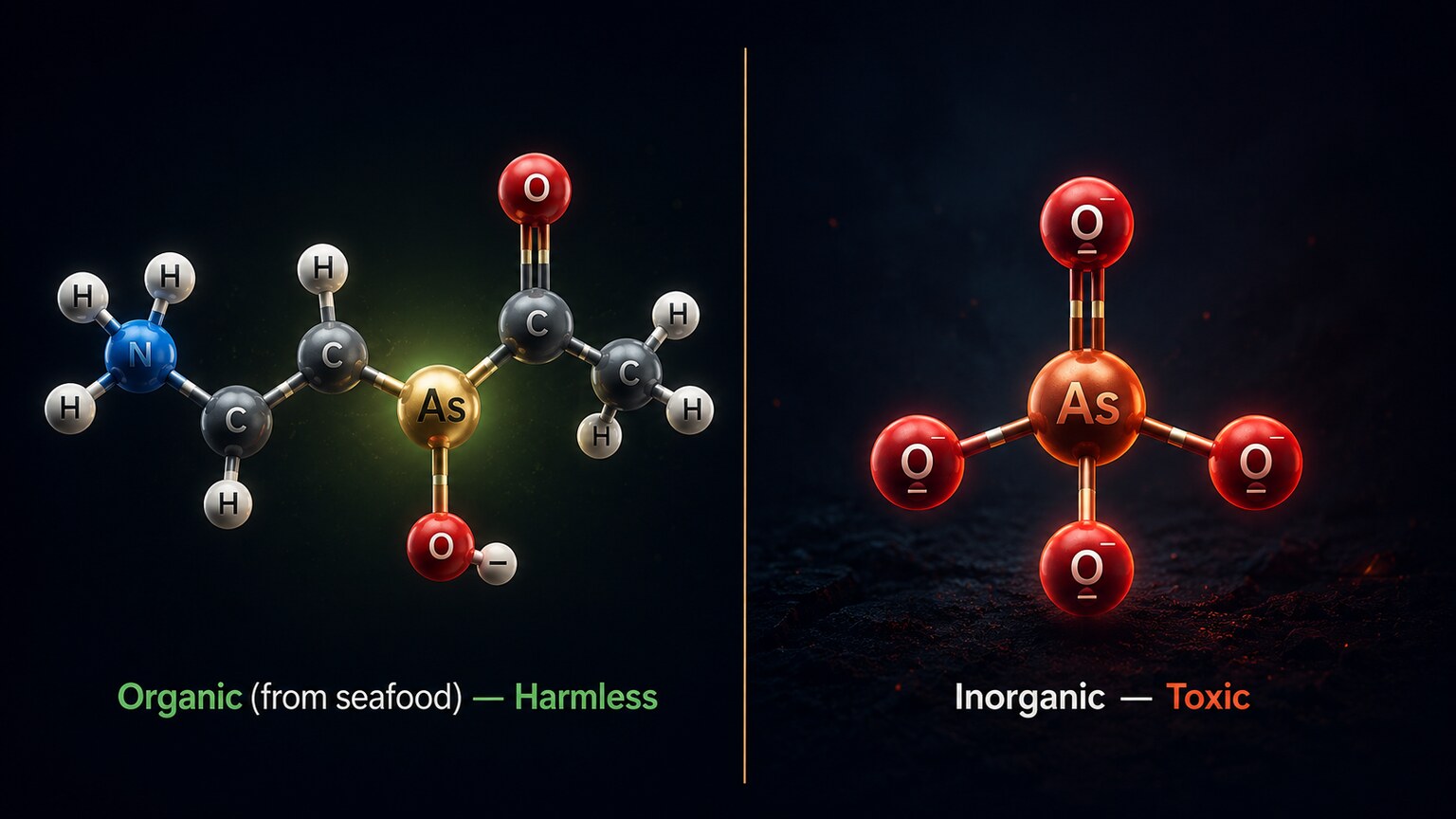
Figure 1. Organic arsenic compounds like arsenobetaine, found naturally in seafood, are chemically bound to carbon and pass through the body largely unchanged and harmlessly — a fundamentally different substance from toxic inorganic arsenic.
Arsenic occurs naturally in two broad chemical families, and the difference between them is the single most important fact for understanding any arsenic test result. Inorganic arsenic is the toxic form most people picture when they hear the word — it's found in contaminated groundwater, certain industrial processes, and some pesticides, and it's the form associated with genuine poisoning and long-term health risk. Organic arsenic, by contrast, refers to arsenic that has bonded with carbon-based molecules, and the most common organic form, called arsenobetaine, occurs naturally and abundantly in fish and shellfish. Arsenobetaine is considered essentially non-toxic: the body absorbs it readily through normal digestion, and within roughly one to three days following a meal, excretes it largely unchanged through urine, without the cellular accumulation or tissue damage that characterizes genuine exposure to the inorganic form specifically.
This distinction matters enormously because a standard "total arsenic" test — the most common, least expensive, and most frequently ordered type of arsenic testing available — measures both chemical forms together, lumped into a single combined number on the report, with no way for that number alone to distinguish which portion came from a harmless recent seafood meal and which portion, if any, came from a genuinely concerning inorganic source. This single fact explains the large majority of "elevated arsenic" results that alarm patients unnecessarily, and it's the very first thing worth understanding before interpreting any arsenic result at all.
Where Inorganic Arsenic Exposure Actually Comes From

Figure 2. Private well water is the most common real-world source of ongoing inorganic arsenic exposure in the United States, since arsenic can occur naturally in certain bedrock and isn't regulated the way municipal water supplies are.
Genuine, meaningful inorganic arsenic exposure traces back to a handful of well-documented, well-studied sources genuinely worth knowing about specifically, rather than a vague, undefined sense of environmental risk. Private well water is by far the single most significant, most commonly cited source for most people living in the United States, since arsenic occurs entirely naturally in certain types of underlying bedrock and soil formations, and can gradually leach into groundwater supplies at levels that vary considerably from one region to the next, entirely independent of any industrial contamination or nearby human activity whatsoever. Unlike municipal water systems, which are required to test for and limit arsenic content under enforced regulatory standards, private wells fall entirely under the responsibility of the individual homeowner to test on their own initiative, and many private well owners have simply never had their water checked for this specific contaminant, sometimes for the entire time they've lived on the property.
Rice and various rice-based products represent a second significant, though generally smaller, source of dietary inorganic arsenic exposure, since rice plants absorb arsenic from surrounding soil and irrigation water considerably more readily than most other common food crops, particularly rice grown in specific regions with naturally arsenic-rich soil composition. Certain traditional or imported remedies, some pesticides used in older agricultural or industrial settings, and specific occupational exposures (smelting, wood treatment involving older arsenic-based preservatives, semiconductor manufacturing) round out the remaining, less common sources of meaningful inorganic exposure for most people, and are covered in more detail in their own dedicated section further down this article.
Certain imported foods and specific regional agricultural practices have also been documented in published research as occasional, comparatively less common sources genuinely worth being aware of, particularly for households regularly consuming food products sourced from regions with known soil or irrigation-water arsenic contamination — though for the average person eating a typical, reasonably varied diet, this represents a genuinely minor contributor overall compared to well water and rice consumption specifically.
Curious what your own heavy metals panel actually means for your specific situation? Upload your results and get a complete, plain-language breakdown in under 15 minutes.
Analyze My ResultsOccupational and Industrial Sources Worth Knowing About

Figure 7. Certain occupational settings — wood treatment, metal smelting, and some semiconductor manufacturing processes — carry a recognized risk of inorganic arsenic exposure, which is why workplace safety monitoring exists in these specific industries.
Beyond well water and diet, certain occupations carry a specifically elevated, well-documented risk of inorganic arsenic exposure, and knowing whether your own work history includes any of these is a genuinely useful piece of context when interpreting an elevated result. Historically, many wood treatment facilities routinely used arsenic-based chemical preservatives (specifically chromated copper arsenate) to protect processed lumber from rot, decay, and insect damage over time, and while this specific compound has been largely phased out of new residential use, workers at older, legacy facilities, or those directly handling older treated lumber during demolition or renovation work, can still encounter genuinely meaningful exposure today. Metal smelting and mining operations, particularly those specifically processing ores that naturally contain arsenic as an incidental byproduct, represent yet another well-recognized occupational exposure category worth mentioning here.
Semiconductor and electronics manufacturing, somewhat less intuitively than the other sources listed here, also involves arsenic directly in certain specialized manufacturing processes, since a compound called gallium arsenide is used specifically in certain high-performance electronic components. Workers in any of these industries typically undergo routine occupational health monitoring specifically because of this recognized risk, meaning an elevated arsenic result discovered through workplace screening carries a different, more targeted follow-up pathway than one discovered incidentally through a routine personal physical, since the likely source is already strongly suggested by the job itself rather than needing to be identified from scratch through a broader, less directed investigation.
How Arsenic Is Actually Tested, and Why the Test Type Changes Everything

Figure 3. A speciated urine arsenic test, run on more sophisticated laboratory equipment, can separately report organic and inorganic arsenic — the only way to know whether an elevated total result reflects seafood or a genuine toxic exposure.
Arsenic is most commonly measured through a urine test rather than through a standard blood draw, since arsenic clears from active circulation in the bloodstream relatively quickly after exposure but continues being steadily excreted in urine for several days afterward, making urine testing a considerably more sensitive and practically useful window into recent exposure than blood alone. The standard, less expensive "total arsenic" urine test reports one combined number, unable to distinguish source. A more sophisticated test, called speciated arsenic testing, uses specialized laboratory equipment (typically a technique combining chromatographic separation with mass spectrometry) capable of separating and individually reporting each specific arsenic compound present in the sample — critically, separating harmless organic forms like arsenobetaine from genuinely concerning inorganic arsenic and its downstream metabolic breakdown products.
This distinction in testing methodology is precisely why a doctor who sees an elevated total arsenic result will very often order a follow-up speciated test before drawing any conclusion, rather than treating the initial elevated number as meaningful on its own. If speciated testing shows the elevation is overwhelmingly organic, the result requires no further action beyond noting the recent seafood consumption. If it instead shows a meaningfully elevated inorganic component specifically, that's the particular scenario that actually warrants the kind of focused source investigation and structured follow-up described in greater detail later in this article.
What a Mildly Elevated Total Arsenic Level Usually Means
In the overwhelming majority of cases where someone sees a modestly elevated total arsenic result, particularly one drawn within 48 hours of eating fish, shellfish, or seaweed, the explanation is simply recent dietary intake of harmless organic arsenic. Shellfish in particular — shrimp, crab, and various mollusks — tend to contain the highest concentrations of arsenobetaine among commonly eaten foods, and a single generous seafood meal can meaningfully elevate a total arsenic urine result for a day or two afterward, entirely independent of any actual toxic exposure. Seaweed and certain algae-based food products similarly tend to concentrate organic arsenic compounds, meaning a diet rich in these foods, even without any direct fish or shellfish consumption, can produce the same kind of temporary, harmless elevation on a total arsenic result.
This is such a well-recognized, well-documented pattern in laboratory medicine that many labs will proactively note this consideration directly on the printed report itself, or a doctor will simply ask as a routine, standard part of interpreting the result, whether the patient consumed seafood in the days leading up to the test being drawn. A mild elevation with a clear recent seafood history, and no accompanying symptoms or known risk factors for inorganic exposure, generally warrants nothing more than this brief clarifying conversation — not further testing, not treatment, and certainly not alarm.
Why Testing for Arsenic in the First Place Even Comes Up
It's worth briefly covering why a doctor orders arsenic testing at all, since this context helps explain how seriously to take any given result. Arsenic is typically included as part of a broader heavy metals panel rather than ordered entirely on its own, and that broader panel gets ordered for a range of reasons: unexplained symptoms that could plausibly relate to heavy metal exposure, a known well water source that's never been tested, an occupational history in one of the industries described later in this article, or sometimes simply as part of a comprehensive wellness workup requested by a patient with no specific concern at all.
The reason behind the original order matters for interpreting the result, in much the same way understanding why any lab test was ordered shapes how its result should be read. A heavy metals panel ordered because of a specific, well-founded concern (known well water use, relevant occupational history) carries a meaningfully different prior likelihood of a true positive finding than the same panel ordered as part of a general wellness check with no specific risk factors present — a distinction worth keeping in mind, since an unexpected result is statistically more likely to reflect a false alarm (like recent seafood) the less likely a genuine exposure source was to begin with.
What a Genuinely Elevated Inorganic Arsenic Result Can Indicate

Figure 4. When a speciated test confirms genuinely elevated inorganic arsenic, testing the household's actual water source is usually the first, most direct step toward identifying where the exposure is coming from.
When speciated testing confirms a genuinely elevated inorganic arsenic level — meaning the concerning form specifically, not the harmless dietary form — it points toward an actual ongoing or recent exposure source that warrants investigation. This is the scenario where the sources discussed earlier in this article become directly relevant: private well water that has never been tested, rice consumed in unusually large quantities as a dietary staple, an occupational exposure, or in rare cases, a contaminated traditional remedy or supplement.
A genuinely elevated inorganic result doesn't automatically mean poisoning in the dramatic sense — chronic, low-level inorganic exposure from an untested well, for instance, can accumulate gradually over months or years without producing any acute symptoms at all, which is exactly why identifying and eliminating the ongoing source matters more than any single number on a single test. This gradual, symptom-free accumulation pattern is precisely what makes chronic inorganic exposure genuinely different from, and in some ways more insidious than, the dramatic, obvious presentation of acute poisoning covered later in this article. The goal at this stage shifts meaningfully away from "how alarmed should I be about this specific number" and toward the more productive, actionable question of "where is this exposure actually coming from, and what needs to happen to stop it going forward."
Acute Arsenic Poisoning: A Distinct, More Severe Clinical Picture

Figure 5. Acute arsenic poisoning, involving a single large exposure, produces a rapid, severe clinical picture requiring emergency treatment — a fundamentally different scenario from the chronic, low-level exposure most elevated lab results reflect.
It's worth clearly distinguishing the scenario covered throughout most of this article — an unexpected lab finding, usually asymptomatic — from true acute arsenic poisoning, which is a genuinely different, rare, and medically severe emergency almost never discovered incidentally through routine bloodwork. Acute poisoning typically follows a single large exposure and produces a rapid, dramatic symptom pattern: severe abdominal pain, vomiting, watery diarrhea often beginning within hours, followed in more severe cases by cardiovascular instability and, over subsequent days to weeks, nerve damage causing numbness, tingling, and weakness in the hands and feet.
This presentation is clinically obvious and drives a patient to emergency care based on symptoms alone, long before any lab result would prompt the diagnosis — meaning if you're reading this article because of an unexpected, asymptomatic lab finding rather than because of a dramatic acute illness, you are almost certainly not dealing with this acute poisoning scenario at all, and can set aside this specific worry entirely while focusing on the far more common, far less severe explanations covered throughout the rest of this article. Acute poisoning, when it does occur, is treated with specific chelation medications designed to bind arsenic and accelerate its removal from the body, administered under close medical supervision in a hospital setting, alongside supportive care addressing the specific organ systems affected — intravenous fluids for the severe gastrointestinal losses, and cardiac monitoring given the potential for serious heart rhythm disturbances in severe cases. Recovery from the acute phase can take days to weeks depending on severity, while any nerve damage that developed may take considerably longer, sometimes several months, to meaningfully improve.
Arsenic and Children: Why the Same Exposure Matters More
Children exposed to the same absolute amount of inorganic arsenic as an adult generally face proportionally greater risk, for reasons that apply broadly across heavy metal exposure but are worth stating specifically here. A child's smaller body size means the same quantity of arsenic represents a larger dose relative to body weight, and children's developing nervous systems and other organ systems are generally more vulnerable to toxic insult during active growth and development than a fully matured adult system.
Children in households relying on private well water face this consideration directly, since they typically consume more water relative to their body weight than adults do, and any household-level well contamination affects every family member drinking from that same source, regardless of age. This is part of why pediatric guidance around well water testing tends to be more conservative than general adult guidance, and why a family with young children relying on an untested private well has a somewhat stronger practical argument for prioritizing that testing sooner rather than later, even in the complete absence of any specific symptom or concern prompting it.
Chronic Low-Level Exposure: A Slower, Different Kind of Concern

Figure 6. Years of chronic, low-level inorganic arsenic exposure — most often from untested well water — can eventually produce subtle skin changes, a recognized clinical sign that develops gradually rather than suddenly.
Chronic exposure, most often resulting from years of unknowingly drinking contaminated well water, produces a completely different, considerably slower clinical picture than the dramatic presentation of acute poisoning described above. Rather than sudden, dramatic symptoms, chronic low-level exposure can gradually produce a set of characteristic skin changes — patches of darkened pigmentation, particularly across the trunk, alongside thickened, rough patches developing on the palms and soles — that emerge slowly over a period of years, easily mistaken for unrelated, entirely benign skin conditions if the underlying exposure history isn't specifically asked about and considered.
Beyond these visible skin changes, sustained inorganic arsenic exposure over many years has been associated in research with an increased long-term risk of certain cancers and cardiovascular effects, which is precisely why public health authorities and environmental agencies continue treating well water testing as a genuine ongoing priority, even in the complete absence of any current symptoms in a given household. Population studies conducted in regions with historically high natural groundwater arsenic levels have provided much of the evidence base for these long-term associations, since these populations experienced sustained exposure over decades in a way that's difficult to study through shorter-term or lower-exposure research alone.
This long time horizon is exactly why identifying and correcting an ongoing low-level source — rather than focusing narrowly on a single test result — is the more clinically meaningful goal once genuine inorganic exposure has been confirmed.
Rice Preparation: A Practical Detail Worth Knowing
Since rice consumption is one of the more commonly discussed dietary sources of inorganic arsenic intake, a few practical, well-documented preparation details are worth mentioning for anyone specifically concerned about minimizing this exposure. Thoroughly rinsing raw rice grains before cooking, and cooking rice in a considerably larger volume of water than the traditional absorption method (roughly a 6-to-1 water-to-rice ratio, then draining the excess water afterward, similar to how pasta is typically cooked) has been shown in published research to meaningfully reduce the arsenic content of the final cooked rice compared to the standard absorption method, where all the cooking water — and whatever arsenic it picked up from the raw grain — remains in the finished dish.
The specific rice variety chosen also plays a measurable role in overall exposure: brown rice generally contains somewhat more arsenic than white rice, since arsenic tends to concentrate in the outer bran layer that's removed during the milling process that produces white rice, and rice grown in certain specific growing regions has been well-documented to contain meaningfully different average arsenic levels compared to rice grown in other regions entirely. None of this practical information suggests rice needs to be avoided entirely or eliminated from a normal diet — for the average person eating a varied diet, rice is not a significant source of concern — but for anyone eating rice regularly as a dietary staple multiple times daily, particularly when feeding young children, these preparation details represent a genuinely evidence-based, practical way to meaningfully reduce exposure without needing to eliminate a nutritionally important dietary staple entirely from the household.
What Treatment Actually Looks Like When It's Needed
For the rare cases involving acute poisoning or a confirmed, significant inorganic exposure, treatment centers on two distinct goals: removing the ongoing source and, where medically indicated, accelerating removal of arsenic already in the body. Source removal is always the first and most important step, regardless of severity — continuing to drink from a contaminated well while pursuing any other treatment undermines everything else, since ongoing exposure simply replaces whatever arsenic burden treatment removes.
Chelation therapy, a treatment using medications specifically designed to bind arsenic and other heavy metals and accelerate their elimination through urine, is reserved for acute poisoning or clearly significant, symptomatic inorganic exposure — it is not appropriate or beneficial for a mild total-arsenic elevation explained by recent seafood, and using it in that scenario would expose a patient to real medication side effects for no genuine benefit. For chronic, lower-level inorganic exposure without acute symptoms, the standard approach is simply source elimination followed by monitoring, allowing the body's own natural excretion processes to gradually clear the accumulated burden over time without additional medical intervention.
How Arsenic Compares to Other Heavy Metals Testing Might Catch
It's worth situating arsenic within the broader context of heavy metals testing generally, since arsenic is typically ordered alongside lead, mercury, and cadmium as part of the same panel, and the organic-versus-inorganic distinction covered throughout this article is, notably, unique to arsenic among this group. Lead and cadmium don't have a meaningfully "harmless dietary form" the way arsenic does through arsenobetaine, meaning an elevated lead or cadmium result carries a somewhat different, generally more directly concerning interpretation than an elevated total arsenic result does on its own.
Mercury shares some conceptual similarity to arsenic's dietary complexity, since fish consumption is also the dominant source of mercury exposure for most people, though mercury's forms (primarily methylmercury from fish) don't split into a clearly "harmless" versus "toxic" category the same clean way arsenic's organic and inorganic forms do — methylmercury itself carries genuine health considerations even at the levels typically obtained through diet, particularly for pregnant women, which is a meaningfully different risk profile than arsenobetaine's essentially negligible risk. Understanding that each metal on a combined heavy metals panel has its own distinct interpretation logic — rather than treating every elevated result on the panel as equally concerning — is a genuinely useful piece of context when reviewing a full panel rather than a single isolated arsenic value.
How Doctors Typically Follow Up an Elevated Result
When a total arsenic result comes back elevated on a report, the typical, genuinely sensible next step is fairly straightforward: first comes a brief conversation about recent diet, specifically covering seafood and rice intake over the preceding several days, since this dietary explanation alone accounts for the large majority of cases seen in routine practice. If that dietary history turns out to be unremarkable, or if the initial elevation is substantial enough to genuinely warrant more diagnostic certainty either way, a speciated urine test gets ordered specifically to separate organic from inorganic arsenic with real confidence, rather than relying on dietary history alone as a guess.
If speciated testing confirms a genuinely elevated inorganic component, the investigation shifts toward identifying the specific source — testing home water supply if a private well is in use, reviewing occupational exposure history in detail, reviewing any supplements or traditional remedies currently being taken, and, where relevant, a more thorough dietary history covering rice consumption patterns specifically over recent weeks and months. Repeat testing after eliminating a suspected source (switching to bottled or filtered water, for instance) helps confirm whether the identified source was, in fact, the cause, closing the loop on what started as an unexplained lab finding.
The timeline for this repeat testing typically allows enough time for the body to fully clear its existing arsenic burden and reflect only the current, post-intervention exposure level — usually several weeks to a couple of months after the source is eliminated, rather than checking again within days, which would still reflect residual arsenic from before the change was made and could misleadingly suggest the intervention hadn't worked yet.
Reading the Actual Numbers: What Reference Ranges Look Like
Understanding roughly how arsenic results are reported helps make sense of a printed lab report rather than just the general concepts discussed so far. Total urine arsenic is typically reported in micrograms per liter, with most reference ranges placing "normal" somewhere under approximately 35 micrograms per liter for someone with no recent seafood intake at all — though this specific threshold varies somewhat from one lab to another, entirely consistent with the general cross-lab variability that affects nearly every lab test in existence, not something at all unique to arsenic testing specifically. A result meaningfully above this threshold, particularly without a clear dietary explanation, is what prompts the speciated follow-up testing described earlier.
Speciated results break the total number down into its individual components, typically reporting arsenobetaine (the harmless seafood-derived form) separately from the sum of inorganic arsenic and its metabolic breakdown products (monomethylarsonic acid and dimethylarsinic acid, both downstream products the body creates while processing inorganic arsenic). A result where arsenobetaine accounts for the overwhelming majority of the reported total, with the inorganic-related components sitting comfortably within their own separate, much lower and well-defined reference range, represents the classic, reassuring pattern confirming a straightforward dietary explanation. A result where the inorganic-related components themselves are meaningfully elevated, regardless of how much harmless arsenobetaine also happens to be present alongside them, represents the specific pattern that genuinely warrants the source-investigation conversation described in greater detail later in this article.
Common Misconceptions Worth Clearing Up Directly
A handful of persistent misconceptions tend to make arsenic results feel more frightening than the underlying situation actually warrants, and addressing them directly is worth doing explicitly. The first is assuming that "arsenic" appearing anywhere on a lab report automatically implies deliberate poisoning or dangerous contamination — as this article has covered at length, the overwhelming majority of elevated total arsenic results reflect completely ordinary, harmless dietary intake, not any form of toxic exposure requiring concern.
A second common misconception involves assuming that any level of arsenic detected at all, even a small, clearly explainable amount, represents an unacceptable finding that must be brought to zero. In reality, extremely low levels of arsenic, including some inorganic arsenic, can be detected in nearly everyone through sufficiently sensitive modern testing, simply because arsenic exists at trace levels throughout the natural environment; the clinically meaningful threshold is a level significant enough to indicate an ongoing exposure worth investigating, not the mere detectability of the element at all. A third misconception assumes that once a source is identified and removed, some permanent, irreversible harm has necessarily already occurred — while this can be true for severe or prolonged exposures, most cases of mild to moderate chronic exposure identified and addressed promptly show meaningful improvement without permanent, lasting effects.
Frequently Asked Questions
Should I avoid seafood before an arsenic test?
Many labs and providers recommend avoiding seafood for 48 to 72 hours before testing specifically to prevent a harmless dietary elevation from complicating interpretation of the result, though this isn't universally required — ask your specific provider for their preference.
Does rice consumption alone typically cause a meaningfully elevated result?
Usually not to the same degree as seafood, though very high, regular rice consumption (as a dietary staple eaten multiple times daily over years) can contribute to inorganic arsenic intake worth discussing with a provider, particularly alongside other risk factors.
How do I know if my well water has been tested for arsenic?
Check with the well's original installer, prior homeowner, or local health department for existing records; if none exist, a water testing kit or local environmental lab can test a sample directly, which is a reasonable step for any private well owner regardless of current symptoms.
Is a blood arsenic test as useful as a urine test?
Generally no for routine screening, since arsenic clears from blood relatively quickly; urine testing offers a more sensitive window into recent exposure and is the standard first-line test in most clinical situations.
Can arsenic exposure be reversed once identified?
The body naturally clears arsenic once the exposure source is removed, and most people with chronic low-level exposure show improvement on repeat testing once the source is eliminated, though any skin changes or other established effects may take longer to resolve, if they resolve fully at all.
Do all private well owners need arsenic testing, even without symptoms?
Testing an untested private well is a reasonable, low-cost precaution regardless of current symptoms, since chronic low-level exposure often produces no noticeable symptoms for years, and confirming safe levels provides genuine peace of mind either way.
Conclusion
An elevated arsenic result looks alarming on paper, but the actual clinical reality hinges almost entirely on one distinction most patients are never clearly told about: organic arsenic from seafood, which is essentially harmless and genuinely temporary, versus inorganic arsenic, which is the specific, genuinely toxic form actually worth investigating further. A mild elevation shortly after a seafood meal rarely needs anything beyond a clarifying conversation, while a confirmed elevated inorganic result — usually identified through speciated testing — warrants a focused investigation into real sources like untested well water. Understanding this distinction turns an intimidating, unfamiliar lab finding into a manageable, well-defined next step rather than a lingering, open-ended source of worry.
The broader lesson extends beyond arsenic specifically: many lab values that sound frightening on their own become considerably more manageable once the specific chemical form, the timing of the test relative to diet or exposure, and the actual clinical significance of the number are properly understood, rather than reacting to a single flagged word on a printed report. Arsenic testing is, in many ways, a particularly clear example of why context transforms an intimidating result into an actionable, well-defined next step — a principle worth carrying forward to nearly any unfamiliar lab finding in the future.
Still Not Sure What Your Results Mean?
Upload your labs and get a complete, visual, plain-language interpretation of every biomarker — delivered to your inbox in under 15 minutes.
Get My ReportThis article is for educational purposes only and does not constitute medical advice. Always consult your healthcare provider regarding your specific lab results.