
Why Did My Doctor Order a Heavy Metals Panel?
A heavy metals panel is a set of blood or urine tests that measures the amount of lead, mercury, arsenic, and cadmium circulating in your body — four metals that serve no biological purpose whatsoever and become toxic even at levels the body would treat as trivial for something like sodium or calcium. Your doctor didn't reach for this test at random. In almost every case, it comes down to one of five specific triggers: you work with or around metals in your job or a hobby, you're showing a pattern of symptoms — fatigue, abdominal pain, numbness and tingling, cognitive fog — that doesn't add up under a routine workup, you're a young child or pregnant and fall under a standard screening recommendation, you live in a home or eat a diet with a plausible exposure source your doctor picked up on during your visit, or you're being monitored after a known spill, renovation, or contamination event. This article walks through all five reasons in plain language, explains exactly what's in the tube or cup when you get tested, and clarifies what a high result actually means for what happens next.

Figure 1. A heavy metals panel is typically drawn into a royal-blue "trace-element-free" tube, manufactured without the trace metal residue found in standard collection tubes.
What Exactly Does a "Heavy Metals Panel" Test For?
The phrase "heavy metals panel" is really a shorthand for a bundle of individual tests ordered together, and the exact bundle can shift slightly depending on the lab and the clinical question. The core four — the ones almost every version of the panel includes — are lead, mercury, arsenic, and cadmium. Some expanded panels add aluminum, thallium, or antimony depending on what a doctor is worried about, but lead, mercury, arsenic, and cadmium make up the standard, and they're grouped together for a good reason: all four are naturally occurring elements that the human body has no metabolic use for, all four accumulate in tissue rather than being efficiently cleared, and all four produce overlapping symptoms — fatigue, gut trouble, nerve problems — that make it genuinely hard to tell them apart from the outside. Testing for all four at once, rather than guessing which single metal is the culprit, is simply more efficient medicine.
Where the sample comes from depends on which metal matters most for your situation. Lead and mercury are measured almost exclusively from a blood draw, since both bind tightly to red blood cells and circulate there for weeks; a blood level gives a reasonably accurate snapshot of recent exposure. Arsenic behaves differently — it clears the bloodstream within hours to a couple of days, so a blood test can already look falsely reassuring by the time you make it to an appointment. For arsenic specifically, urine testing is the more reliable window, and it's sometimes collected as a full 24-hour sample rather than a single random cup, since urinary arsenic concentration can swing significantly depending on how much water you drank and how recently you ate seafood (a source of a harmless, non-toxic organic arsenic compound that can otherwise produce a falsely alarming number). Cadmium can be measured in either blood or urine depending on whether a doctor is more interested in recent exposure or the metal's slow accumulation in the kidneys over years, which is where cadmium tends to settle for the long term.
Curious what the rest of your lab results actually mean? Upload your results and get a complete, plain-language breakdown in under 15 minutes.
Analyze My ResultsReason 1: Occupational or Hobby Exposure

Figure 2. Solder used in jewelry-making, stained glass, and electronics repair commonly contains lead, and inhaling the fumes it produces when heated is a well-documented occupational exposure route.
This is the single most common reason an otherwise healthy adult with no dramatic symptoms ends up getting tested. Certain jobs and hobbies put people in regular, sometimes daily, contact with lead, mercury, arsenic, or cadmium, often through routes that aren't obvious unless you already know to look for them. Battery manufacturing and recycling, radiator repair, firing-range instruction (from primer dust in ammunition), plumbing work on older pipe systems, and construction or demolition on pre-1978 buildings all carry meaningful lead exposure risk. Jewelry-making, stained-glass work, and electronics soldering expose hobbyists and tradespeople to lead-containing solder fumes, often in a home workshop with none of the ventilation controls a commercial facility would be required to have. Dental technicians working with certain amalgams, thermometer and fluorescent-bulb repair, and some fishing-industry and chlor-alkali plant jobs carry mercury exposure risk. Mining, smelting, and certain pesticide-manufacturing jobs are classic arsenic exposure routes, while cadmium shows up heavily in battery production, electroplating, and welding on cadmium-coated metal.
Many workplaces with recognized exposure risk are required under OSHA regulations to offer periodic biological monitoring — meaning your employer's occupational health program may be the one prompting the test, not a symptom at all. Under OSHA's lead standard, for example, workers in certain industries must be offered blood lead testing at set intervals, with more frequent testing triggered automatically once a result crosses a defined action level, and mandatory removal from the exposure source if levels climb high enough — a structured, almost automatic system that exists specifically because relying on symptoms alone would mean waiting until real harm had already occurred. But plenty of hobbyists never get that structured monitoring, which is exactly why a doctor who hears "I've been doing a lot of stained glass in the garage this year" or "I refinish old furniture with lead paint on it" during a routine visit will often order the panel proactively, well before any symptom shows up, simply because the exposure history alone is enough to justify checking.
It's also worth noting how exposure actually gets into the body in these settings, since the route matters for how preventable it is. Lead dust and fumes are typically inhaled rather than swallowed — heating solder, sanding old paint, or firing a kiln with lead-glazed ceramics all generate fine particles small enough to reach deep into the lungs, where they're absorbed efficiently into the bloodstream. Hand-to-mouth contact adds a second pathway: eating, drinking, or smoking with lead dust still on the hands after a shift in a home workshop, without washing first, is a well-documented way exposure sneaks past even people who are otherwise careful about ventilation. This is part of why occupational health guidance for these hobbies emphasizes not just masks and fume extraction, but also a strict habit of washing hands and changing clothes before eating — small steps that measurably reduce how much ends up in a follow-up blood test.
Reason 2: Unexplained Symptoms That Don't Add Up
Heavy metal toxicity has a frustrating habit of mimicking dozens of other, far more common conditions, which means it's frequently considered only after a standard workup for something else has come back inconclusive. Lead toxicity classically produces abdominal pain (sometimes severe enough to be mistaken for a surgical emergency), constipation, fatigue, irritability, joint pain, and — at higher levels — peripheral neuropathy, the numbness, tingling, or weakness that starts in the hands and feet. It can also cause a specific type of anemia that looks unusual under a microscope, with red blood cells showing a stippled, dotted pattern that an experienced lab technologist may flag even before anyone thought to ask about metal exposure. Mercury toxicity leans more toward neurological and psychiatric symptoms: tremor, memory trouble, irritability, and in more severe cases a distinctive gait disturbance and sensory changes concentrated at the edges of the visual field. Arsenic toxicity often announces itself through the gut — nausea, watery diarrhea, and abdominal cramping — and, with longer-term lower-level exposure, through skin changes: patchy darkening of the skin and a thickening of the skin on the palms and soles called hyperkeratosis. Cadmium tends to be quieter for longer, working slowly on the kidneys and, over years, on bone density, without a dramatic acute presentation at all.
What pushes a doctor toward ordering the panel specifically is usually a pattern that resists a simpler explanation: unexplained anemia that doesn't fit an iron-deficiency picture, peripheral neuropathy in someone without diabetes or a clear alternative cause, abdominal pain that's been worked up for gallbladder and ulcer disease with nothing found, or a cluster of neurological complaints alongside a relevant hobby or occupational history that only comes out once the conversation turns specifically toward exposures rather than symptoms alone.
Reason 3: Pediatric Screening and Pregnancy

Figure 3. Routine blood lead screening is recommended for children around 12 and 24 months of age, timed to when hand-to-mouth behavior and rapid brain development overlap.
Unlike the other four reasons on this list, pediatric lead screening often isn't triggered by a symptom or a suspicion at all — it's simply built into the standard schedule of well-child visits in many states and insurance programs, especially for children enrolled in Medicaid, where testing at 12 and 24 months of age is federally required regardless of any individual risk factor. The reasoning is straightforward and sobering: children absorb a far higher percentage of the lead they ingest than adults do, their brains are still undergoing the rapid wiring that lead is especially good at disrupting, and toddlers in particular put their hands — and whatever dust or paint chips are on them — directly into their mouths as a normal part of exploring the world. Housing built before 1978, when lead-based residential paint was banned in the United States, is the single biggest risk factor a pediatrician screens for, since deteriorating old paint sheds a fine dust that settles on windowsills, floors, and toys in a way that's often invisible to the eye.
Pregnancy adds a second, related screening trigger. Lead crosses the placenta freely, and if a pregnant woman has any accumulated lead stored in her bones — often from exposure decades earlier, since lead can sit in bone for years — normal pregnancy-related bone turnover can release some of it back into her bloodstream and, from there, to the developing fetus. Doctors will often order a panel during pregnancy for women with a known history of lead exposure, women who recently immigrated from a region with less stringent environmental controls, or women who report using imported cosmetics, spices, or traditional remedies that carry a documented risk of metal contamination — a category that comes up often enough in prenatal care that many obstetric practices ask about it directly at intake.
Reason 4: Suspected Environmental or Dietary Exposure

Figure 4. Private wells are not regulated or routinely tested the way municipal water supplies are, and arsenic occurs naturally in the groundwater of certain regions at levels that can accumulate with daily use.
A fourth path into testing runs through a person's home, water, and diet rather than their job or age. Private well water is the most significant hidden source: unlike municipal water systems, which are regulated and routinely tested for arsenic under the Safe Drinking Water Act, private wells are the homeowner's own responsibility, and arsenic occurs naturally in groundwater at meaningfully elevated levels in parts of the country, including sections of New England, the upper Midwest, and the Southwest. A doctor who learns a patient's household drinks exclusively from an untested private well, particularly in one of these regions, has good reason to check. The EPA recommends private well owners test their water annually for a range of contaminants, but survey data consistently shows a large share of well owners have never tested for arsenic specifically, often because it produces no taste, odor, or color change that would otherwise prompt someone to investigate — a genuinely invisible risk in a way that, say, a strange smell from the tap would not be.
Diet contributes in quieter, more surprising ways. Certain fish — swordfish, shark, king mackerel, and to a lesser degree tuna — accumulate mercury as they feed on smaller fish over their lifespan, and someone eating several servings a week for months can build up a measurably elevated level even without any obvious occupational exposure. Rice absorbs arsenic from soil and irrigation water more readily than most other grain crops, making rice-heavy diets — including rice-based baby cereals and rice milk — a recognized, if modest, dietary arsenic source that pediatricians increasingly ask about. Imported cosmetics, particularly kohl and surma eyeliners traditional in parts of South Asia and the Middle East, and imported ceramics with lead-based glazes used for cooking or food storage, are both documented, repeatedly-flagged sources of lead exposure that a careful history can uncover. Certain imported spices — turmeric in particular has been repeatedly identified in FDA and international testing as sometimes adulterated with a lead-chromate compound used to enhance its color — and some Ayurvedic and traditional remedies manufactured without Western quality controls have also been linked to significant lead exposure in case reports. None of this means these products or practices are inherently dangerous across the board; it means a thoughtful doctor, hearing any of these details in a routine conversation about diet and home life, has a specific, evidence-based reason to check rather than guess.
Reason 5: Monitoring After a Known Exposure or Environmental Event
The fifth reason is the most straightforward: someone already knows, or strongly suspects, that an exposure happened, and the panel is being used to measure it rather than to search for it. This covers a wide range of situations — a water main break or contamination event reported by a local utility, a workplace spill or ventilation failure, a home renovation that disturbed old lead paint without proper containment, or a child found eating paint chips or soil near a known contamination site. In all of these cases, testing usually isn't a one-time event. A baseline test establishes how much exposure actually occurred, and follow-up testing over subsequent weeks or months tracks whether the level is falling as expected on its own, which most mild-to-moderate cases do once the exposure source is removed, or whether it's staying elevated in a way that suggests either ongoing exposure that hasn't been fully eliminated or a level high enough to need active treatment. This same monitoring pattern applies to workers in regulated industries under OSHA's mandatory biological monitoring programs, where testing happens on a fixed schedule specifically to catch a rising trend long before it becomes symptomatic.
How the Test Actually Works, From Draw to Result
For lead, mercury, and cadmium, the process starts with a standard venous blood draw from the arm — but the tube matters more here than it does for most blood tests. Because trace amounts of metal can leach out of the rubber stoppers and glass used in ordinary collection tubes, labs use a specially manufactured "trace-element-free" tube, usually with a royal blue top, to avoid contaminating the sample with metal that was never actually in the patient's body. Using the wrong tube is one of the more common, avoidable sources of a falsely elevated result, which is part of why this test is typically drawn by a lab experienced with trace-metal collection rather than treated as routine.
For arsenic, a urine sample is usually preferred over blood, given how quickly arsenic clears the bloodstream. Depending on what your doctor is trying to determine, this might be a simple random urine sample or a full 24-hour collection, where every void over a full day is saved in a large container and then combined, giving a more complete and less variable picture than any single random sample could. Patients are typically asked to avoid seafood for a few days beforehand, since the harmless organic arsenic compound in fish and shellfish gets measured by the same basic test and can otherwise produce a temporarily elevated number that has nothing to do with toxic exposure.
Once the sample reaches the lab, the actual measurement is done using a highly sensitive analytical technique — most commonly inductively coupled plasma mass spectrometry, which can detect metal concentrations down to fractions of a microgram per liter, far below what any older method could reliably measure. In broad terms, the instrument works by turning the liquid sample into an extremely hot, ionized gas (a plasma, reaching temperatures around 10,000 Kelvin, hotter than the surface of the sun), which strips electrons from every atom present and allows a mass spectrometer downstream to sort and count ions by their exact atomic weight — lead atoms are heavier than mercury atoms, which are heavier than cadmium, and the instrument distinguishes between them with enough precision to report a result down to a fraction of a part per billion. Results generally take anywhere from a few days to about a week, depending on the lab and how many metals are being run.
Hair and nail testing for metals also exist and are sometimes marketed directly to consumers, often bundled with broader "toxin" panels sold outside a standard medical relationship. Most major medical and toxicology organizations consider them unreliable for diagnosing toxicity for a specific, well-documented reason: external contamination from shampoo, water, dyes, and environmental dust settles onto the outside of a hair or nail sample and is very difficult to wash away completely before testing, which means a lab often can't tell how much of what it measures ever passed through the bloodstream at all versus simply sitting on the surface. Because treatment decisions — removing a child from a home, starting chelation, pulling a worker off a job site — can follow directly from these results, blood and urine remain the standard for any decision that actually affects your care, while hair testing is generally regarded as, at best, a very rough screening tool and, at worst, a source of confusing or misleading numbers.
Why These Metals Are Toxic Even in Tiny Amounts
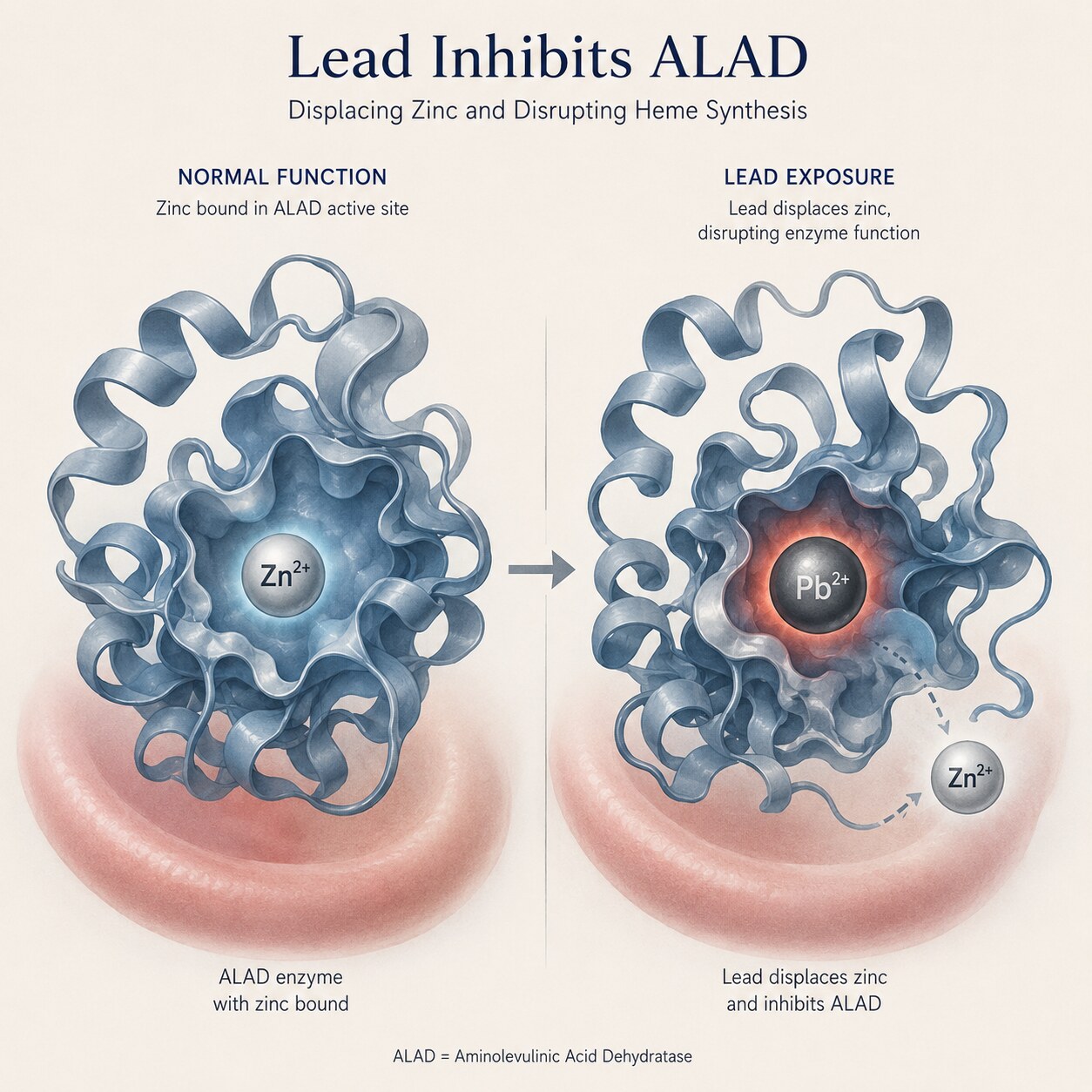
Figure 5. Lead's toxicity stems partly from its ability to mimic and displace zinc and calcium inside enzymes and bone, allowing it to slip past the body's usual defenses against foreign substances.
It's a fair question why the human body treats a few micrograms of lead as a genuine threat while tolerating far larger quantities of other substances without issue. The answer lies in a kind of molecular disguise. Lead is roughly the same size and electrical charge as calcium and zinc, two minerals your body actively transports, stores, and uses in enzymes throughout nearly every system you have. Because of that resemblance, lead can slip into the exact same transport channels, storage sites in bone, and enzyme-binding pockets that calcium and zinc normally occupy — and once it's there, it doesn't do the job those minerals were supposed to do. One especially well-studied example is an enzyme called ALAD, a critical step in the assembly line your bone marrow uses to build heme, the oxygen-carrying core of hemoglobin. Lead binds to ALAD in place of the zinc it needs to function, jamming that step in the assembly line and contributing directly to the specific type of anemia seen in lead toxicity. This same mimicry lets lead cross the blood-brain barrier and the placenta far more easily than a "foreign" molecule normally would, which is exactly why the nervous system and a developing fetus are hit hardest.
Mercury and cadmium cause harm through related but distinct mechanisms — mercury has an unusually strong attraction to sulfur-containing structures found throughout proteins in nerve cells, disrupting their shape and function, while cadmium competes with calcium for reabsorption in the kidney's tubules and, over years, with calcium in bone, contributing to the reduced bone density sometimes seen with chronic exposure. Arsenic interferes with the mitochondria, the energy-producing structures inside nearly every cell, by disrupting a key enzyme step needed to generate cellular energy. Across all four metals, a recurring theme is bioaccumulation: because the kidneys and liver aren't well equipped to break these elements down or excrete them quickly, repeated small exposures add up over months or years in a way a single large exposure to something the body can process and clear simply wouldn't. This is also the biological basis for the position taken by the CDC and the American Academy of Pediatrics that no blood lead level in a child has been shown to be completely without risk — there isn't a threshold below which the mimicry described above simply stops happening.
The developing brain is especially vulnerable to this process for a reason distinct from the ALAD mechanism described above. During the first few years of life, the brain is rapidly building the physical connections between neurons that will underlie learning, attention, and behavior for the rest of that person's life, a process guided in part by calcium signaling. Because lead can substitute for calcium at some of the same points in that signaling process, it can subtly interfere with exactly the wiring being laid down at the moment it's most active — which is a large part of why the dose that produces a measurable drop in IQ or attention in a two-year-old is far lower than the dose that would produce a noticeable effect in an adult brain that finished this kind of active wiring years earlier. This same window of vulnerability is why pediatric screening (Reason 3, above) is timed so specifically around the toddler years rather than spread evenly across childhood.
Understanding Your Results — What Actually Counts as "Elevated"
Unlike a lot of routine bloodwork, heavy metal results don't come with a single, tidy "normal range" that applies the same way to everyone. For lead, the reference values have actually changed over time as research kept finding harm at levels once considered acceptable — the CDC's blood lead reference value for children was lowered from 5 to 3.5 micrograms per deciliter in 2021 specifically because evidence showed developmental effects even below the old cutoff. It's important to understand that this number is described by the CDC as a reference value used to identify children with higher exposure than most of their peers for follow-up and intervention — not a line that separates "safe" from "dangerous." For adults, occupational exposure limits set by OSHA allow for meaningfully higher blood lead levels before mandatory removal from an exposure source is triggered, which reflects a regulatory balance between workplace practicality and health risk rather than a claim that those higher levels carry no risk at all.
Mercury, arsenic, and cadmium each have their own reference ranges that vary somewhat by lab and by which specific test was run — total blood mercury versus a mercury level drawn specifically to assess methylmercury from fish, for instance, can be interpreted a little differently. This is one of the most important reasons to review these results with the ordering provider directly rather than comparing a number against a generic online chart: your doctor already knows which test was run, why it was ordered, and what your specific exposure history looks like, all of which shape whether a given number is reassuring, worth monitoring, or worth acting on. A mildly elevated cadmium level in someone with decades of smoking history (tobacco is itself a notable cadmium source) gets interpreted differently than the same number in a battery-plant worker with three years on the job, even though the lab report itself would look identical.
It's also worth understanding that a single result is a snapshot, not necessarily the full story. Because lead in particular can be stored in bone for years and slowly released back into the blood, a person's blood lead level can fluctuate somewhat even without any new exposure — a detail that sometimes confuses people who expect levels to only ever trend in one direction once a source has been removed. This is exactly why doctors lean on trends across repeat testing rather than reacting to any single number in isolation, and why a borderline result is often followed by a repeat test in a matter of weeks rather than an immediate treatment decision.
What Happens If Your Results Come Back High?

Figure 6. Chelation therapy uses a medication that binds directly to a metal ion in the bloodstream, forming a compound the kidneys can filter out and excrete in urine.
The very first step after any confirmed elevated result — before any medication is even discussed — is identifying and removing the source. In many mild-to-moderate cases, this alone is enough: once the ongoing exposure stops, the body's own kidneys and liver gradually clear what's already circulating, and a repeat test some weeks later shows a falling trend without any further intervention. This is why your doctor will usually ask detailed questions about your job, hobbies, home age, water source, and diet as soon as a result comes back elevated — pinpointing the source is the single most important next step, more so than the number on the report itself.
For levels high enough to cause symptoms, or that stay stubbornly elevated despite removing the obvious source, chelation therapy becomes the next consideration. Chelating agents are medications designed to bind tightly to a specific metal ion in the bloodstream, forming a stable compound the kidneys can then filter out and excrete in urine — essentially giving the metal a molecular escort out of the body. Different chelators work better for different metals: calcium disodium EDTA and succimer (DMSA) are commonly used for lead, dimercaprol and DMSA for arsenic, and DMSA or a related compound for mercury, though the choice depends heavily on which specific metal is elevated, how high, and the patient's overall health. Chelation is not without risk — it can also strip out beneficial minerals like zinc and calcium alongside the target metal, which is one of several reasons it's reserved for genuinely elevated levels and administered under medical supervision rather than used casually as a general "detox," a claim sometimes made by unregulated wellness clinics that isn't supported by evidence in people without confirmed toxic exposure. After treatment, or after source removal alone, follow-up testing on a set schedule — often weeks apart initially, then spacing out over months — confirms the level is actually trending down as expected and hasn't rebounded, which can happen if lead stored in bone gets slowly released back into the bloodstream over time.
Frequently Asked Questions
Does getting a heavy metals panel ordered mean my doctor suspects something serious?
Not necessarily. A large share of these panels are ordered as routine, proactive screening — pediatric well-child visits, occupational monitoring programs, or a doctor simply following up on something mentioned during a normal conversation about your hobbies or home. It's far more often a precaution than a sign that something alarming has already been found.
Can food or supplements throw off the results?
Yes, particularly for arsenic. Eating fish or shellfish in the days before a urine arsenic test can produce a temporarily elevated result from a harmless organic form of arsenic that has nothing to do with toxic exposure, which is why patients are often asked to avoid seafood beforehand. Certain supplements, particularly some kelp or seaweed-based products, can do the same.
Is hair analysis a reliable alternative to a blood or urine test?
Most major medical organizations don't consider commercial hair mineral testing reliable for diagnosing heavy metal toxicity. External contamination from shampoo, water, and environmental dust on the hair shaft is very difficult to distinguish from what the body actually absorbed internally, so blood and urine remain the clinical standard.
How quickly do heavy metal levels drop once the exposure source is removed?
It depends on the metal. Arsenic clears from the blood within hours to days and from urine within about a week. Lead and mercury take considerably longer, often weeks to months, since both bind to red blood cells and, in lead's case, can also be stored in bone and released back into circulation gradually over a much longer period.
Should I ask for a heavy metals panel even if my doctor hasn't brought it up?
It's a reasonable thing to raise if you have a genuine exposure history to describe — a hobby involving solder or old paint, a private well that's never been tested, an older home undergoing renovation, or regular consumption of imported cosmetics or remedies. Doctors generally welcome this kind of specific, exposure-based context, since it's exactly the information that turns a vague request into a clinically justified test rather than one ordered without a clear reason.
Conclusion
A heavy metals panel almost always traces back to one of five clear, evidence-based reasons: an occupational or hobby exposure history, a pattern of symptoms that hasn't been explained by anything more common, a routine pediatric or pregnancy screening trigger, a plausible source in your water, diet, or home, or active monitoring after a known event. None of these, on their own, mean something is seriously wrong — the test exists precisely so exposure can be caught and addressed before it reaches that point. If your own panel came back with an elevated number, the most useful next question isn't how worried to be, but where the exposure is actually coming from, since identifying and removing that source is the step that matters most for bringing your levels back down. Bring the specific circumstances of your own life — your job, your hobbies, the age of your home, your water source, your diet — into the conversation with whoever ordered the test; that context is very often what turns a single number on a lab report into an actual, actionable answer.
Still Not Sure What Your Results Mean?
Upload your labs and get a complete, visual, plain-language interpretation of every biomarker — delivered to your inbox in under 15 minutes.
Get My ReportThis article is for educational purposes only and does not constitute medical advice. Always consult your healthcare provider regarding your specific lab results.