
Why Do Heavy Metal Levels Matter More in Children?
A child isn't just a smaller adult, and nowhere is that more consequential than in how their body handles lead, mercury, arsenic, and cadmium. The same amount of lead dust that would barely register in an adult's bloodstream can produce a measurable, medically significant level in a toddler, and the damage it can do to a brain that's still being built is fundamentally different from the damage it does to a brain that's already finished developing. This isn't a matter of children being more "sensitive" in some vague sense — it comes down to specific, measurable differences in how much of a given metal a child's body actually absorbs, how easily it reaches their brain, and how much harm it can do once it's there. This article walks through the biology behind each of those differences, which metals matter most and why, how exposure actually happens in a child's daily life, and what a parent should know about testing, results, and next steps.
The Same Exposure, a Very Different Dose
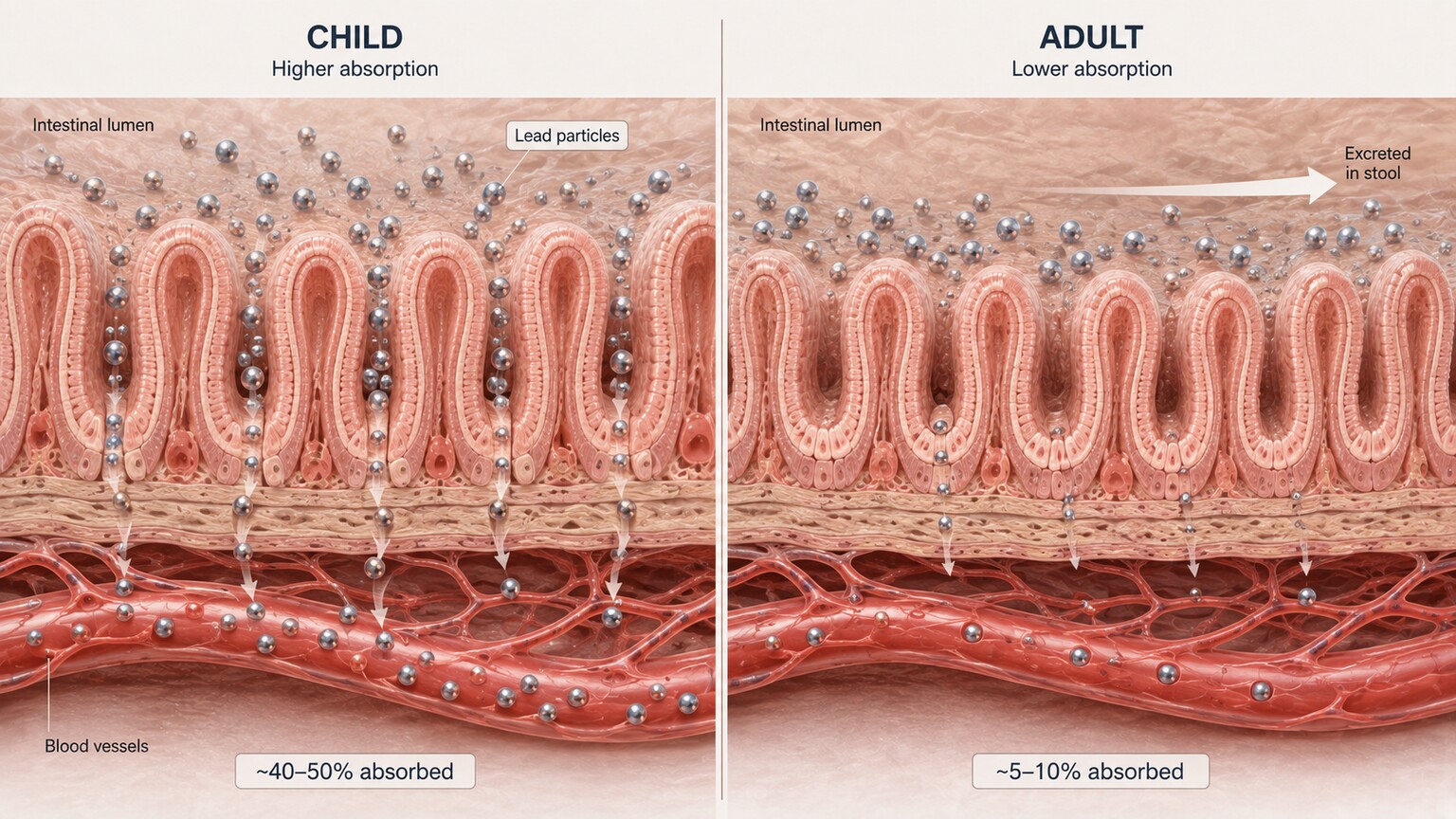
Figure 1. A child's small intestine absorbs roughly three to five times more of a given dose of ingested lead into the bloodstream than an adult's intestine absorbs from the same exposure.
Before getting into what a heavy metal does once it's inside the body, it helps to understand why the same environment produces a much bigger internal dose in a child in the first place. Pound for pound, children eat more food, drink more water, and breathe more air relative to their body weight than adults do, simply because growth demands it — a one-year-old's metabolism is working overtime compared to an adult's, and that means proportionally more of whatever is in their food, water, and air gets taken in. On top of that basic math, young children explore the world with their hands and mouths in a way adults have long since grown out of. This hand-to-mouth behavior, completely normal and developmentally important for learning about the world, becomes a direct pathway for dust, dirt, paint chips, and soil to enter the body in a way that simply doesn't happen for most adults going about a normal day.
Then there's absorption itself — the process of a substance actually crossing from the gut into the bloodstream rather than passing through and leaving the body in stool. This is where the numbers get striking. An adult who swallows a given amount of lead absorbs roughly 10% to 15% of it into their bloodstream; a young child absorbing that same amount from the same exposure takes in closer to 40% to 50% of it — three to five times more of it actually gets into circulation from an identical dose. Iron deficiency and calcium deficiency, both common in young children, make this worse, because lead is absorbed through some of the same gut pathways the body uses for iron and calcium, and when those minerals are in short supply, the gut ends up absorbing more lead than it otherwise would as it tries to compensate.
Absorption Is Only Half the Story — Getting Past the Blood-Brain Barrier

Figure 2. Lead ions are similar enough in size and charge to calcium ions that they can slip into the NMDA receptors synapses use to strengthen connections during learning.
Once a metal is in the bloodstream, the next question is whether it can reach the brain — and this is where the second major difference between children and adults comes in. The brain is normally protected by a structure called the blood-brain barrier, a tightly sealed layer of cells lining the brain's blood vessels that acts like a security checkpoint, letting in nutrients the brain needs while blocking out most things that could cause harm. In a newborn and young child, this barrier is still under construction — it isn't fully sealed and mature until sometime after the first few years of life. That gap in the barrier gives lead, methylmercury, and other neurotoxic metals a much easier path into brain tissue in a young child than they would ever have in an adult with a fully developed barrier.
Lead's ability to cause harm once it reaches brain tissue comes down to a kind of molecular mistaken identity. Calcium is one of the most important signaling molecules in the nervous system, used constantly by neurons to communicate with each other and to strengthen or weaken connections during learning. Lead ions are close enough in size and electrical charge to calcium ions that the brain's own transport systems and receptors — including a class called NMDA receptors, central to how the brain forms new connections during learning and memory formation — can't reliably tell them apart. Lead ends up substituting for calcium in places calcium is supposed to be, disrupting the release of neurotransmitters (the chemical messengers neurons use to talk to each other) and interfering with the very process by which the young brain wires itself. This isn't a vague, general "toxicity" — it's a specific molecular mechanism that explains why lead's effects concentrate so heavily on learning, attention, and behavior rather than causing more generalized illness in most low-level exposures.
Why Timing Matters as Much as the Amount
A developing brain isn't built all at once — it moves through specific, time-limited windows where enormous amounts of construction happen in a short period: neurons migrating to their correct final positions, connections forming between them (a process called synaptogenesis), and insulating layers called myelin wrapping around nerve fibers to speed up signal transmission. These windows open and close on a schedule, largely finished by early childhood for many foundational structures, and a metal that interferes with one of these processes during its narrow window of activity can produce an effect that a later, even larger exposure — after that window has closed — would not produce in the same way. This is part of why the same blood lead level found in a two-year-old and in a ten-year-old doesn't necessarily carry the same risk; the age at which the exposure happens can matter as much as how high the number is.
Prenatal exposure deserves its own mention here, since a fetus depends entirely on this same principle. Lead and methylmercury both cross the placenta, meaning a pregnant person's own exposure becomes the fetus's exposure as well, at a developmental stage where essentially the entire brain is under construction at once. This is a major reason pregnant women are specifically advised on which fish to limit because of mercury, and why lead exposure during pregnancy is treated as a two-patient problem rather than a concern for the mother alone.
Curious what the rest of your child's lab results are telling you? Upload them and get a complete, plain-language breakdown in under 15 minutes.
Analyze My ResultsNo Safe Threshold — Why "Normal" Doesn't Mean "Fine" for Lead
For most substances doctors test for, there's a reference range with a lower and upper bound, and a result inside that range is considered normal and unremarkable. Lead doesn't work that way, and this is one of the most important and most frequently misunderstood facts in this entire topic. Major health authorities, including the CDC and the American Academy of Pediatrics, state plainly that no blood lead level has been identified as safe for children — there is no floor below which the science shows zero effect. What exists instead is a "reference value," a statistical threshold (currently 3.5 micrograms per deciliter in the United States) that identifies children whose exposure is high compared to their peers and who warrant follow-up, not a line that separates "safe" from "unsafe." This reference value has been revised downward repeatedly over the decades — it stood at 10, then 5, before reaching its current level — not because lead became more dangerous, but because better research kept finding measurable effects at levels previously assumed to be harmless.
This matters practically because a parent who hears their child's lead level is "low" or "below the reference value" can reasonably still ask their pediatrician what that specific number means for their child, rather than assuming a number under the threshold is automatically a non-issue. Research has found associations between blood lead levels and small reductions in measured IQ even at levels below 5 micrograms per deciliter, with some of the steepest drops in IQ occurring at the lowest end of the exposure range rather than the highest — meaning the very first bit of exposure appears to do proportionally more damage than the same increment does at already-elevated levels. This is a genuinely unusual dose-response pattern, and it's a big part of why "no safe level" isn't an exaggeration for effect, even if it can sound that way at first.
Different Metals, Different Vulnerabilities

Figure 3. Methylmercury becomes more concentrated at each step up a marine food chain, a process called biomagnification, which is why large predatory fish carry the highest levels.
Lead gets the most attention, but it isn't the only metal that behaves differently in a child's body, and each of the metals commonly tested for causes harm through its own distinct route. Methylmercury, the organic form of mercury found in seafood, follows a process called biomagnification: it becomes more concentrated at each step up the marine food chain, so a large, long-lived predatory fish like swordfish, shark, or king mackerel carries far more mercury than a small fish lower on the chain ever would. Once ingested, methylmercury crosses the same underdeveloped blood-brain barrier described earlier and specifically interferes with the migration of developing neurons to their correct positions in the brain, an effect that is most pronounced during prenatal development and the first years of life — which is precisely why fish guidance for pregnant women and young children singles out specific high-mercury species rather than advising against fish in general.
Arsenic exposure in children most often traces back to contaminated drinking water — particularly private wells that haven't been tested, since municipal water systems are more consistently monitored — and to rice-based foods, since rice plants absorb arsenic from soil and irrigation water more efficiently than most other crops. Chronic arsenic exposure in children has been associated with effects on cognitive development and, notably, on the immune system, an effect profile distinct from lead's more attention- and behavior-focused pattern. Cadmium, less commonly discussed but still relevant, accumulates primarily in the kidneys over a lifetime and is absorbed more efficiently by anyone with low iron stores — a category that includes a large share of toddlers, given how common mild iron deficiency is at that age. Understanding that these metals don't all cause the same kind of harm is important context for interpreting a heavy metals panel that tests for several of them at once: an elevated result for one metal doesn't imply the same risk profile as an elevated result for another.
What a Heavy Metals Panel Actually Measures
When a pediatrician orders a "heavy metals panel," it helps to know what's actually happening in the lab rather than picturing a single all-purpose test. Most panels measure lead, mercury, arsenic, and cadmium from a single blood sample using a technique that essentially counts individual metal atoms with extreme precision, sensitive enough to detect concentrations measured in parts per billion. Blood is the standard sample for lead and for the inorganic and organic forms of mercury most relevant to children, since it reflects relatively recent exposure — generally the past few months for lead, and closer to the past several weeks for methylmercury, since the body clears mercury from blood faster than it clears lead. Arsenic is sometimes measured in blood but is often better assessed through a 24-hour urine collection, since arsenic clears the bloodstream quickly and urine testing captures a more complete picture of recent intake, particularly from water or food sources.
Hair and nail testing for heavy metals deserves a specific caution here, since it's marketed directly to worried parents online but isn't considered reliable by mainstream pediatric or toxicology guidelines. These tests are highly susceptible to external contamination — shampoo, hair dye, or simply metals sitting on the surface of a hair strand from the environment — and results can vary dramatically between labs testing the exact same sample, which is part of why professional medical societies generally advise against using hair or nail analysis to make decisions about a child's heavy metal exposure or treatment. Blood and urine testing through a certified clinical laboratory remain the standard a pediatrician will actually act on.
Occupational and Take-Home Exposure Parents Often Don't Consider
A meaningful share of childhood heavy metal exposure doesn't come from anything in the child's own environment at all — it comes home on a parent. Certain jobs and hobbies generate fine metal dust or residue that clings to clothing, hair, and skin, and gets carried into the family car and home at the end of the day long before anyone thinks to change clothes or shower. Battery manufacturing and recycling, auto body and radiator repair, construction and renovation work in older buildings, firing range work or frequent recreational shooting, stained glass and pottery glazing, and certain smelting or metal-fabrication jobs are among the most commonly documented sources of this kind of take-home exposure. A parent in one of these lines of work showering and changing clothes before significant contact with young children, and laundering work clothes separately from the rest of the household's laundry, are simple, well-supported ways to interrupt this specific pathway.
It's worth being clear that this isn't a concern limited to any single income level or type of housing. Older homes with deteriorating lead paint exist across price ranges, private wells with untested arsenic levels are common in many rural areas regardless of household income, and imported goods, cosmetics, and traditional remedies containing lead are purchased by families across the economic spectrum, often specifically because they're culturally familiar or trusted. Assuming this is only a risk for one type of family is itself a risk, since it can lead higher-income or suburban families to skip a screening test their child would otherwise have benefited from.
How Exposure Actually Happens in a Child's Daily Life

Figure 4. A 2021 congressional investigation found measurable levels of lead, arsenic, cadmium, and mercury in a range of commercial baby foods, particularly those containing rice and root vegetables.
Most childhood heavy metal exposure in the United States today doesn't come from a single dramatic event — it comes from ordinary, everyday sources that add up. Homes built before 1978, when lead-based residential paint was banned, remain a leading source: as that paint ages, chips and deteriorates into fine dust that settles on windowsills, floors, and soil around the foundation, exactly where a crawling infant's hands end up. Renovation or simple wear in these older homes can release this dust even when the paint itself looks intact. Contaminated soil, sometimes from historical use of leaded gasoline that settled along roadways decades ago, or from old industrial sites, is another common and often overlooked route, since outdoor play and gardening bring soil into regular contact with hands and, eventually, mouths.
Food is a more recent and more surprising source than many parents expect. A 2021 U.S. congressional subcommittee investigation found measurable levels of lead, arsenic, cadmium, and mercury in a range of popular commercial baby foods, with rice-based products and certain root vegetables like sweet potatoes and carrots showing the highest levels, since these crops draw more of these naturally occurring metals up from soil than others do. Imported ceramics and cookware, certain traditional or folk remedies, some imported cosmetics like kohl eyeliner, and some imported spices and candies have also been documented sources of high lead content, particularly ones not subject to the same regulatory oversight as domestically produced goods. None of this means a family needs to overhaul everything about how they feed or raise a child — it means being aware that "modern" and "safe from lead" aren't automatically the same thing, and that a handful of specific, identifiable categories carry disproportionate risk.
Why the Symptoms Are Often Invisible

Figure 5. Ordinary hand-to-mouth exploration near deteriorating lead paint in homes built before 1978 remains one of the most common routes of childhood lead exposure in the United States.
One of the most frustrating aspects of this topic for parents is that the levels of concern discussed above rarely produce symptoms a family would notice at home. Acute, high-level lead poisoning — abdominal pain, vomiting, severe fatigue, and in extreme cases seizures or loss of consciousness — is a real emergency, but it's also uncommon today and typically reflects an unusually intense, concentrated exposure. The much more common scenario, chronic low-to-moderate exposure, produces effects that are subtle, cumulative, and easy to attribute to something else entirely: slightly reduced attention span, mild behavioral difficulties, or small shifts in measured cognitive scores that only become apparent through formal developmental testing or, in some cases, not until a child struggles more than expected once they reach school.
This is precisely why screening matters more than symptom-watching for these exposures. A parent waiting for a child to "look sick" before raising a concern with their pediatrician is, in most real-world cases, waiting for something that was never going to happen even with a level worth addressing. This is also why blood testing, not observation, is the tool actually capable of catching this early — a child can have a genuinely elevated level and, in the moment, seem completely fine by every visible measure.
How Doctors Screen and Test for This
In the United States, the CDC and American Academy of Pediatrics recommend a blood lead test at both 12 and 24 months of age for children considered at higher risk — including those living in or regularly visiting homes built before 1978, especially with recent renovation, or in areas with known soil or water contamination — and many states and insurance programs, including Medicaid, require or strongly encourage universal testing at these ages regardless of individual risk factors, since risk factors aren't always known or disclosed. A first test is often done as a fingerstick capillary sample, a small drop of blood taken from the fingertip, since it's quicker and easier to collect in a young child than drawing from a vein; because capillary tests carry a modest risk of a falsely elevated result from surface contamination on the skin, any elevated capillary result is confirmed with a venous blood draw before further action is taken.
Testing for mercury, arsenic, and cadmium is far less routine and is typically reserved for children with a specific, identifiable reason for concern — a known high-fish diet during pregnancy or infancy, a private well never tested for arsenic, a suspected exposure to a specific contaminated product, or symptoms that don't have another clear explanation — rather than as universal, scheduled screening the way lead testing has become. A pediatrician deciding whether to test for these additional metals will typically walk through a family's specific water source, diet, home age, occupation-related exposures (certain jobs and hobbies, like battery recycling, stained glass work, or firearms range use, carry their own metal exposure risks that can be brought home on clothing and skin), and any imported products or remedies used in the household.
What Happens After an Elevated Result
The response to an elevated result is almost always centered on one priority above all others: finding and removing the source of exposure, since that single step does more to protect a child than almost anything a doctor can prescribe. For a confirmed elevated lead level, this typically means a home inspection — sometimes conducted by a local health department at low or no cost — to test paint, dust, water, and soil, followed by a specific remediation plan tailored to what's actually found rather than a generic recommendation. Nutritional support plays a genuinely useful supporting role here: since iron and calcium deficiency both increase how much lead the gut absorbs, ensuring a child gets adequate iron- and calcium-rich foods (or supplementation, if a doctor recommends it) is one of the more concretely actionable steps a family can take while the environmental source is being identified and addressed.
Chelation therapy — medication that binds to metal ions in the bloodstream and helps the body excrete them faster than it otherwise would — is reserved specifically for significantly elevated levels, generally starting around 45 micrograms per deciliter for lead in most clinical protocols, and is not used for the more common mild-to-moderate elevations discussed throughout most of this article. This distinction matters because chelation carries its own risks and isn't a routine or first-line response to an elevated screening result; for the large majority of elevated pediatric results, source removal, nutritional support, and monitoring — not medication — are the actual treatment.
Follow-Up Testing and Long-Term Outlook
Once a source is identified and addressed, follow-up blood testing at intervals set by the pediatrician (commonly every few months initially, spacing out as levels decline) tracks whether the level is actually falling as expected. Encouragingly, blood lead levels do decline over time once ongoing exposure stops, since the body gradually clears lead from blood and soft tissue, though a portion redistributes into bone, where it can remain for years and slowly re-release back into blood long after the original exposure ended — which is part of why some children show a slower decline than families expect, and why patience with the follow-up process matters.
The harder question families understandably ask is whether the developmental effects themselves are reversible. The honest answer from the current research is mixed and depends heavily on how early the exposure is caught and stopped: some studies suggest that removing the source and providing a supportive, enriched environment early can meaningfully improve outcomes, while higher, more prolonged exposures are more likely to leave some lasting effect on measures like IQ and attention, even after the exposure itself ends. This isn't meant to cause alarm for a family reading a single mildly elevated result — it's the underlying reason pediatricians treat early identification as so valuable: the earlier a source is found and removed, the more of the concern is addressed while the most can still be done about it.
Nutrition as a Modifiable Risk Factor

Figure 6. Because lead is absorbed through some of the same intestinal pathways used for iron and calcium, ensuring a child gets adequate iron and calcium intake measurably reduces how much lead the gut takes up.
Of everything discussed in this article, diet is one of the few factors a family can act on directly, starting immediately, without waiting on a home inspection or an environmental remediation timeline. Because lead competes with iron and calcium for the same absorption pathways in the small intestine, a child who is iron-deficient or calcium-deficient absorbs measurably more lead from a given exposure than a child whose iron and calcium levels are adequate — meaning good nutrition doesn't just support general health in the abstract, it directly and mechanically reduces how much of an existing environmental exposure actually makes it into the bloodstream. Iron-rich foods appropriate for toddlers include beans and lentils, fortified infant cereals, and lean meats, and pairing iron-rich foods with a source of vitamin C — citrus fruit, strawberries, or bell peppers — improves how efficiently the body absorbs that iron, which indirectly helps crowd out lead absorption at the same time.
Calcium-rich foods, including dairy products, fortified plant milks, and leafy greens, work through a similar competitive mechanism in the gut. Pediatricians will sometimes specifically check a child's iron studies alongside a lead level for exactly this reason — an elevated lead result found alongside iron deficiency is treated as two problems that reinforce each other, and correcting the iron deficiency is considered part of the response to the lead exposure itself, not a separate, unrelated recommendation. This is also a useful thing for families to know proactively, before any test comes back elevated: routine attention to iron and calcium intake in the toddler years is a genuinely protective habit on its own, independent of whether a specific exposure has been identified.
What This Means During Pregnancy and Breastfeeding
Because the placenta doesn't block lead or methylmercury, a pregnant person's own body burden of these metals becomes directly relevant to the fetus long before a baby's first pediatric visit. Lead stored in a mother's bones from exposure that happened years or even decades earlier — during her own childhood, for instance — can be released back into her bloodstream during pregnancy, since the body increases bone turnover to help meet the calcium demands of the growing fetus, meaning an old, long-resolved exposure can effectively resurface at exactly the developmental window where it matters most. This is one of the more counterintuitive facts in this entire topic: a mother who has had no recent lead exposure at all can still pass on a meaningful dose to her fetus, sourced from her own skeleton.
Breastfeeding is generally still recommended even for mothers with some degree of metal exposure, since the benefits of breast milk are well established and the transfer of most heavy metals into breast milk itself is considerably lower than transfer across the placenta during pregnancy — lead, in particular, partitions into breast milk at only a small fraction of the concentration found in the mother's blood. Methylmercury is somewhat more efficiently transferred into breast milk than lead is, which is part of why mercury-specific fish consumption guidance extends through the breastfeeding period and not just pregnancy. Any specific concerns about a known exposure during pregnancy or breastfeeding are worth raising directly with an obstetrician or pediatrician rather than stopping breastfeeding preemptively, since in most documented cases the calculus still favors continuing.
Frequently Asked Questions
Is there a lead level low enough to be considered completely safe for a child?
No. The CDC and American Academy of Pediatrics state that no blood lead level has been identified as safe for children. The current reference value of 3.5 micrograms per deciliter identifies children with higher-than-typical exposure for follow-up — it is not a line separating "safe" from "unsafe."
Why do children absorb more lead than adults from the exact same exposure?
A child's gut absorbs roughly 40% to 50% of ingested lead compared to about 10% to 15% in adults, partly because lead is taken up through some of the same pathways the body uses for calcium and iron, and mild deficiencies in those minerals — common in young children — increase how much lead gets absorbed.
Should every child be tested for heavy metals, or just lead?
Universal blood lead testing at 12 and 24 months is broadly recommended in the United States because of how common lead exposure sources are. Testing for mercury, arsenic, or cadmium is usually reserved for children with a specific identifiable risk, such as a high-fish diet, an untested private well, or a suspected contaminated product.
Can the effects of childhood lead exposure be reversed?
It depends on how early the exposure is caught and how high and prolonged it was. Removing the source early and providing a supportive environment can meaningfully improve outcomes, but higher or more prolonged exposures are more likely to leave some lasting effect, which is why early detection and source removal matter so much.
Do all elevated heavy metal results require medication?
No. Chelation therapy is reserved for significantly elevated levels, generally starting around 45 micrograms per deciliter for lead. Most elevated pediatric results are managed through identifying and removing the exposure source, nutritional support, and follow-up monitoring rather than medication.
Can a mother's old lead exposure from years ago still affect her baby during pregnancy?
Yes. Lead stored in bone from exposure that happened years or decades earlier can be released back into the bloodstream during pregnancy, since the body increases bone turnover to help meet the fetus's calcium demands. This means a mother with no recent exposure can still pass on a meaningful dose sourced from her own skeleton.
Conclusion
Children aren't simply smaller versions of adults when it comes to heavy metals — they absorb more of a given exposure, their blood-brain barrier lets more of it through, and their brains are moving through specific, time-limited construction windows that make certain kinds of interference especially consequential. On top of that biological vulnerability, exposure itself is more likely in the first place, simply because young children spend more time close to the floor, put more things in their mouths, and depend entirely on adults to have already identified and removed whatever risks exist in their environment before they ever encounter them. None of this means every trace exposure is a crisis; it means the margin for what counts as "not a concern" is genuinely narrower for a child than it would be for an adult facing the identical exposure, and that narrower margin is exactly why pediatric guidelines lean toward proactive screening rather than waiting for a reason to suspect a problem.
If your child has had a heavy metals panel run and you're looking at a result you don't fully understand, the most useful next step is a direct conversation with your pediatrician about what that specific number means for your child's specific age and situation — not a search for a universal cutoff, since for lead in particular, no such safe cutoff actually exists. Bringing a clear picture of your home's age, water source, diet, and any relevant occupational exposures to that conversation will generally get you a faster, more useful answer than the number on the lab report alone ever could.
Still Not Sure What Your Results Mean?
Upload your labs and get a complete, visual, plain-language interpretation of every biomarker — delivered to your inbox in under 15 minutes.
Get My ReportThis article is for educational purposes only and does not constitute medical advice. Always consult your healthcare provider regarding your specific lab results.