
What Causes Foamy or Bubbly Urine?
A thin layer of bubbles that forms when urine hits the toilet water and disappears within a few seconds is, for almost everyone, completely normal — it's simple physics, not biology. But foam that looks more like the head on a glass of beer, that lingers for several minutes, or that keeps rebuilding every time you go, is a genuinely different phenomenon with a genuinely different cause: protein where protein isn't supposed to be. The exact same physical principle — surface tension — explains both situations, which is exactly why understanding that one shared mechanism is the key to telling a completely harmless bathroom observation apart from one of the earliest visible warning signs of kidney damage. This article walks through the actual physics of why urine foams at all, the specific, testable way to tell ordinary foam from a warning sign, what's really happening at the molecular level when protein turns urine into something closer to soapy water, and the handful of distinct medical conditions — some common, some less discussed — that can be behind it.
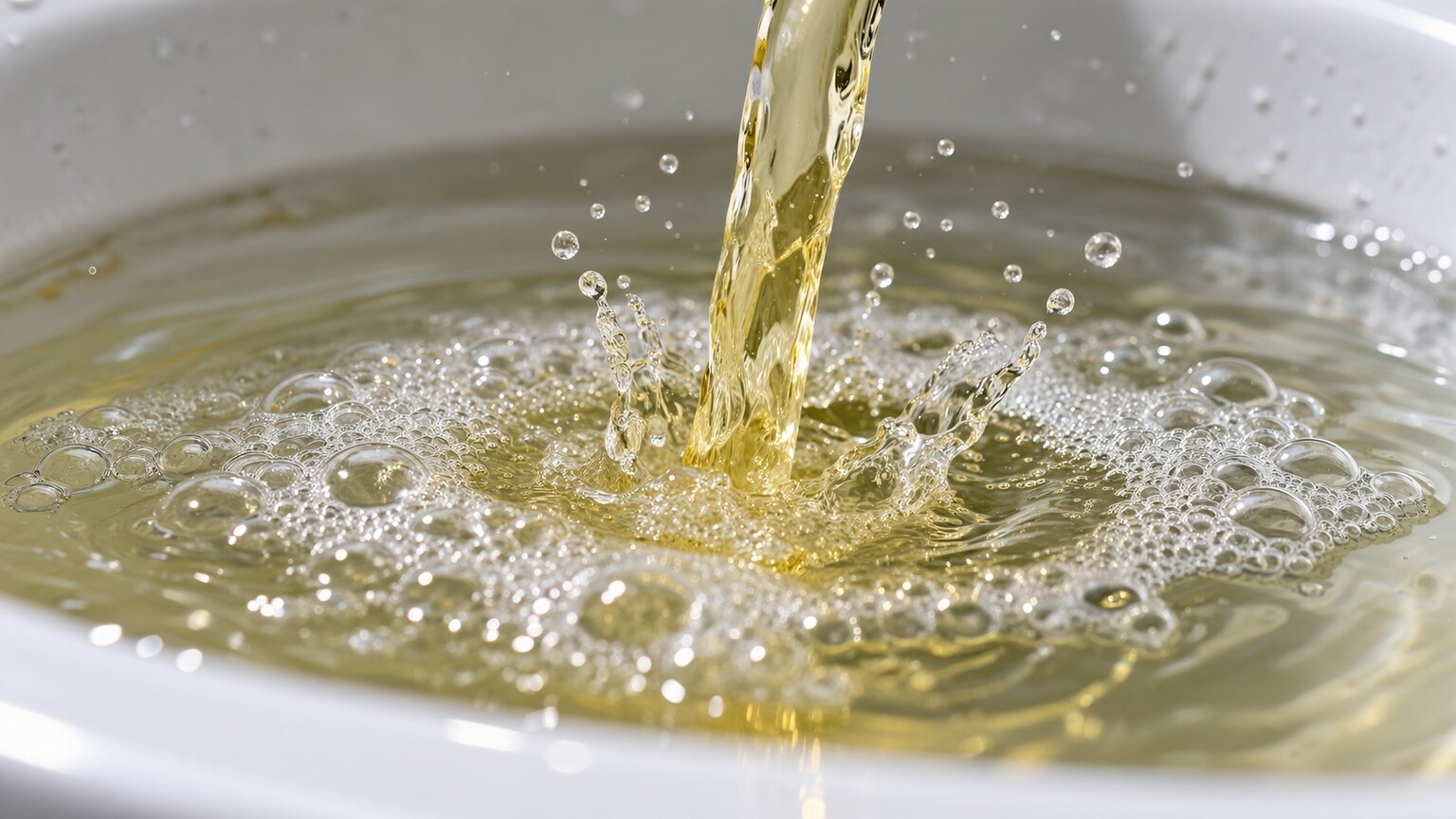
Figure 1. The impact of a urine stream traps air at the water's surface, forming a thin layer of bubbles through ordinary surface tension — the same mechanism behind foam in a shaken glass of water.
The Simple Physics Behind Ordinary Foam
Water molecules at the surface of any liquid are pulled inward by the molecules around and beneath them, creating a kind of invisible elastic skin called surface tension — it's the same property that lets a water strider insect walk across a pond, or that lets you very slightly overfill a glass of water before it spills. When a stream of urine hits the water in the toilet bowl with any real force, it drives air down into the liquid and traps small pockets of it right at that surface skin, momentarily as bubbles, before that skin's own tension pulls itself back together and pops them.
How much foam this ordinary process produces depends heavily on completely unremarkable factors that have nothing to do with your health: how far you're sitting or standing from the water, how forceful and fast the stream is, how full the toilet bowl already is, and even the specific mineral content of your home's water supply, since harder water with more dissolved minerals holds bubbles slightly differently than very soft water. None of these variables say anything at all about what's happening inside your body — they're purely mechanical, the same way the foam pattern in a poured glass of soda depends on how you pour it, not on what's in the soda.
Urine concentration plays a role here too, and it's the first genuinely useful clue this article will cover. First-thing-in-the-morning urine is naturally more concentrated than urine later in the day, since it's had all night to concentrate while you weren't drinking fluids, and that higher concentration of dissolved substances — mostly urea, the main waste product your kidneys filter out of your blood — slightly lowers the water's surface tension compared to more dilute urine. A slightly lower surface tension means bubbles that form are a little more stable and take a little longer to pop, which is a big part of why a lot of people notice more foam specifically on their first bathroom trip of the day, and why that same foam usually looks noticeably less prominent by afternoon once they've had coffee, water, or breakfast.
This same concentration effect explains a few other everyday patterns people notice without necessarily connecting them to the same underlying cause. Someone who's mildly dehydrated after a hot day, a long flight, or simply forgetting to drink much water will often notice more foam than usual for the same reason their urine also looks darker — both are downstream effects of the same more-concentrated urine, not two separate phenomena. Caffeine and alcohol both have a mild diuretic effect, meaning they push the kidneys to produce more urine relative to how much fluid was actually consumed, which paradoxically means a period of heavy coffee or alcohol intake can sometimes be followed by more concentrated urine once that diuretic effect wears off and the body is working to catch back up on hydration — one more entirely unremarkable, purely mechanical variable that can nudge foam levels up or down from one bathroom visit to the next without ever reflecting anything happening inside the kidneys themselves.
The Persistence Test — What Actually Separates Normal Foam From a Warning Sign
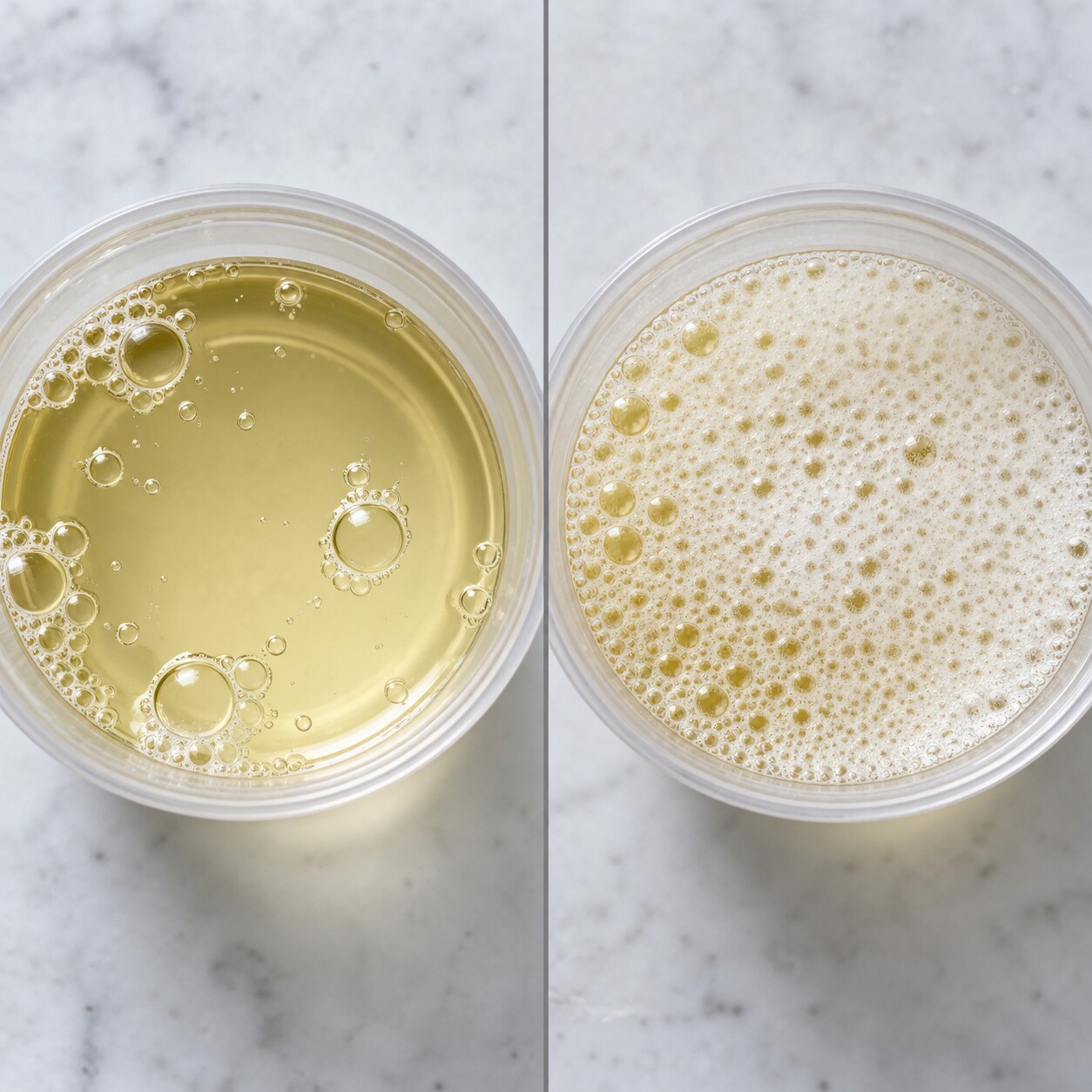
Figure 2. A useful, low-tech comparison: ordinary surface-tension foam (left) is thin, sparse, and gone within seconds, while protein-driven foam (right) is dense, tightly packed, and lingers well after flushing.
There is a genuinely simple, no-equipment-needed way to tell the difference between these two situations, and it's worth knowing because it's what most doctors will actually ask about first: how long does the foam actually last, and does it come back? Ordinary, physics-driven foam is made of relatively large, loosely packed bubbles that pop and disperse within roughly a few seconds to, at most, a minute, and flushing clears it completely, with no fresh layer rebuilding on its own afterward. Foam driven by excess protein behaves noticeably differently — it's made of much smaller, more tightly packed bubbles (because the protein is physically stabilizing each individual bubble wall, a mechanism covered in the next section), which makes the whole layer denser, sometimes visibly mounded up rather than flat, and considerably slower to break down, in some cases still partly visible ten or fifteen minutes later.
A second, related clue is consistency across multiple bathroom visits over the following days, not just a single occurrence. Nearly everyone produces noticeably foamier urine at least occasionally — after a big glass of water, after a particularly concentrated first-morning void, or simply due to how the stream happened to land that one time — and a single foamy episode that doesn't repeat is essentially never a meaningful medical signal on its own. What actually prompts a closer look is a pattern: foam that shows up consistently, void after void, day after day, especially when it's also unusually persistent by the test described above. This combination — persistent in duration and consistent in frequency — is precisely the pattern that separates a normal bathroom observation from something actually worth mentioning to a doctor.
A practical way to actually apply this at home, without needing any special equipment, is to run a simple few-day self-check rather than judging based on a single bathroom trip. Since ordinary variation (hydration, time of day, how forcefully the stream lands) can make any individual instance look more or less foamy than usual, watching the pattern across your first-morning urination specifically, on three or four consecutive days, gives a far more reliable read than reacting to one unusual-looking trip to the bathroom. If that same dense, slow-clearing foam shows up morning after morning across that short observation window, that consistency is exactly the kind of detail worth mentioning at your next appointment, or worth calling about sooner if it's a genuinely new pattern for you rather than something you've noticed on and off for years without any other symptoms.
Curious what your own urinalysis results actually show? Upload your results and get a complete, plain-language breakdown in under 15 minutes.
Analyze My ResultsProteinuria — Why Protein in Urine Acts Like Soap
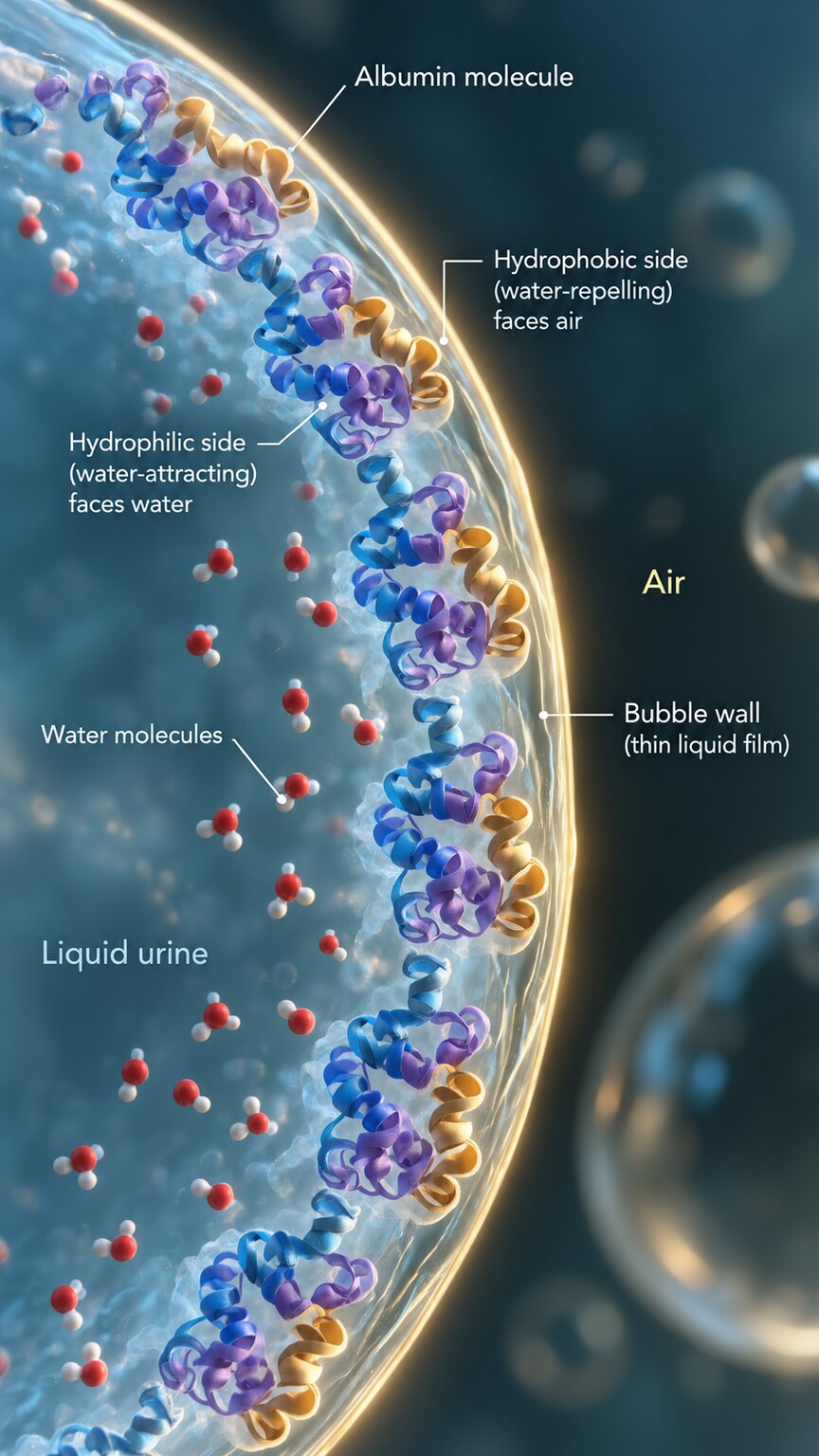
Figure 3. Albumin molecules behave like a natural surfactant, arranging themselves at the surface of each tiny bubble and physically reinforcing its wall so it resists popping — the same basic mechanism that makes soap create long-lasting foam.
The reason excess protein specifically produces such distinctive, stubborn foam comes down to molecular shape and behavior, and it genuinely helps to think about it through the most familiar comparison available: soap. A bar of soap is, chemically, a surfactant — a molecule with one end that's attracted to water and one end that repels it, which lets soap molecules line up at the surface of a bubble, water-loving end facing in and water-repelling end facing out, physically reinforcing that bubble's thin wall enough to make it resist popping for far longer than a plain water bubble ever could. This is precisely why soapy water foams so much more persistently than plain water in a sink.
Albumin, the specific protein that shows up in urine in the overwhelming majority of cases of clinically significant proteinuria, happens to have a very similar surfactant-like molecular structure — one that lets it behave, physically, almost exactly like a natural soap once it's dissolved in urine at a high enough concentration. Instead of a thin, unreinforced water bubble popping within a second or two, an albumin-stabilized bubble has a physically sturdier wall, made of folded protein molecules holding the surface together, and it takes considerably longer to break down. Multiply that single-bubble effect across an entire stream of urine, and the result is exactly the dense, long-lasting, mounded foam layer described in the previous section — not a different kind of bubble, but the same kind of bubble made mechanically more durable by a molecule that shouldn't be there in meaningful quantity in the first place.
Under completely normal, healthy conditions, the kidneys' filtering units — tiny structures called glomeruli, covered in more depth in the next section — are specifically built to hold large protein molecules like albumin back in the bloodstream, allowing only water, salts, and small waste products like urea through into the urine. A healthy adult does lose a very small, genuinely negligible trace amount of protein into urine every day, well below the threshold that would ever produce visible, persistent foam — it's only once that filtering barrier is compromised, letting a meaningfully larger amount of albumin through, that urine actually contains enough surfactant-like protein to change its foaming behavior in a way you can visibly notice with the naked eye.
What's Actually Damaged: The Kidney's Filtering Barrier
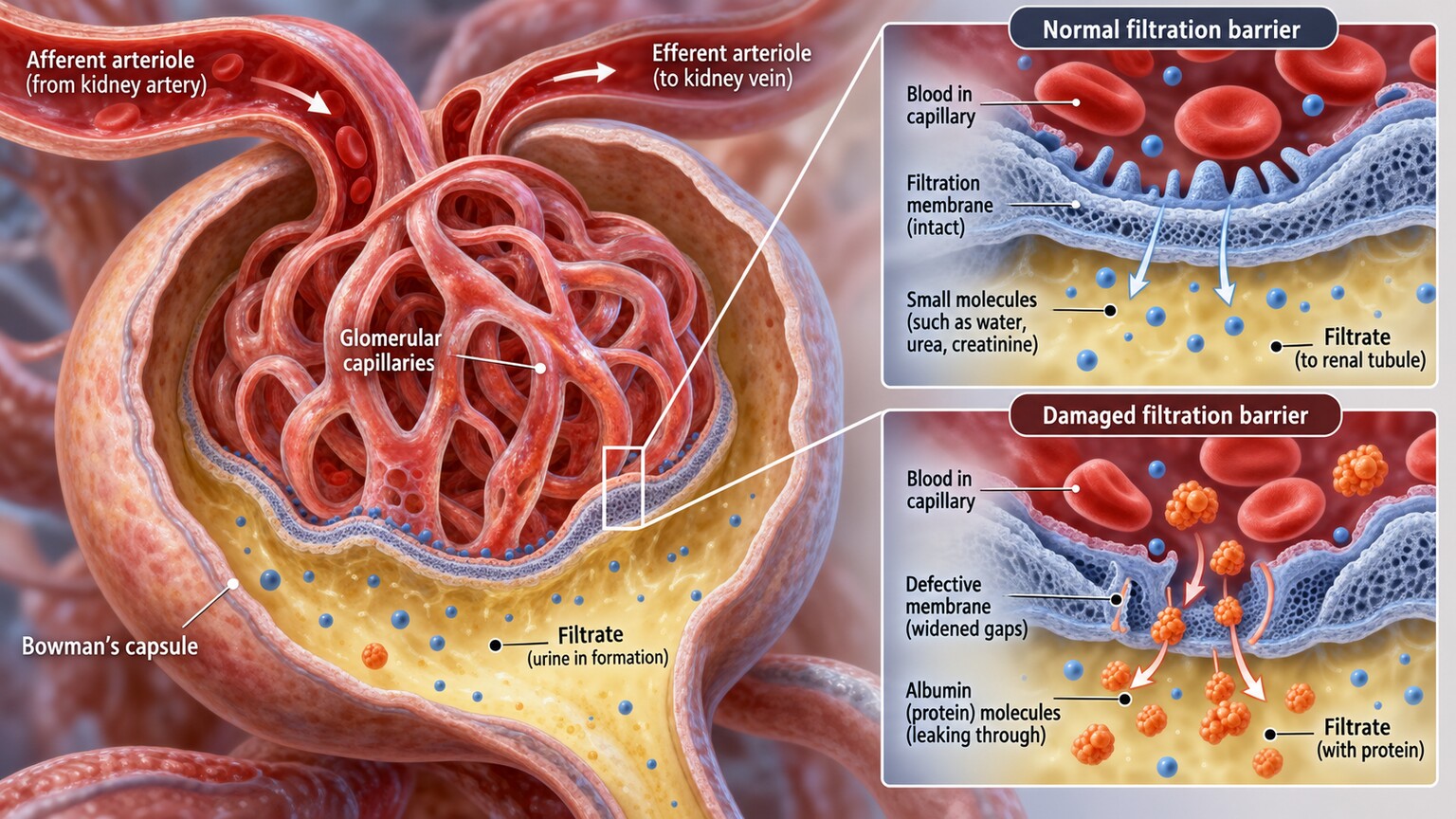
Figure 4. Each glomerulus contains a multi-layered filtration membrane fine enough to hold back albumin under normal conditions; damage to any layer of that membrane lets meaningfully more protein leak through into the urine.
Each of your two kidneys contains roughly a million tiny filtering units called glomeruli, each one a microscopic tangle of blood vessels wrapped in a specialized, multi-layered membrane engineered, essentially, to act like an extremely fine sieve. That membrane has to accomplish something genuinely difficult: let water and small dissolved waste products through freely while holding back albumin, a molecule that's large by comparison but still small enough that a damaged or overly porous membrane can let a meaningful amount of it slip through. When this filtration membrane is working properly, it accomplishes this through both physical pore size and an electrical charge barrier (albumin carries a negative charge that a healthy membrane also naturally repels), which is why a healthy person's urine protein level stays extremely low even though their blood is, at any given moment, carrying a large amount of albumin past those same glomeruli.
Damage to this filtration barrier — whether from long-term high blood sugar slowly stiffening and thickening it, from an autoimmune or inflammatory attack directly targeting it, or from sustained high blood pressure mechanically stressing it — widens those effective pores and weakens that charge barrier, letting progressively more albumin escape into the urine than the healthy design ever intended. This is precisely why persistent foamy urine is considered one of the more useful visible, at-home clues to kidney health: it's a direct, physical consequence of a specific, identifiable structure inside the kidney no longer doing its one central job as well as it used to.
It genuinely helps to picture the scale involved here, since "a little bit of protein leaking through" undersells just how selective this filtration barrier is designed to be under normal conditions. A healthy adult's kidneys filter roughly 180 liters of blood plasma every single day — an amount that would fill a large bathtub — and out of the substantial quantity of albumin circulating through that filtered plasma, a healthy filtration barrier normally allows less than about 30 milligrams of it into the final urine over an entire 24-hour period, an amount so small it produces no visible effect on foam at all. Clinically significant proteinuria typically means that number has climbed into the hundreds of milligrams or, in more severe cases like nephrotic syndrome, several grams per day — meaning the visible, persistent foam described earlier in this article reflects the filtration barrier's selectivity having been degraded by a genuinely substantial margin, not a trivial, marginal change.
The Specific Conditions Behind Persistent Foamy Urine
A handful of distinct medical conditions account for the overwhelming majority of cases where persistent, protein-driven foam turns out to have a genuine underlying cause, and they range from extremely common to comparatively rare.
Diabetic nephropathy is, by a wide margin, the single most common cause of clinically significant proteinuria worldwide, and it develops gradually: years of elevated blood sugar slowly damage the small blood vessels feeding each glomerulus, thickening and stiffening the filtration membrane described above until it starts letting meaningfully more albumin through. This is exactly why people with diabetes routinely have a specific urine protein test — checking for a smaller, earlier-stage protein leak called microalbuminuria — built into their regular annual screening, often years before foam would ever become visible to the naked eye, since the goal is catching this damage at its earliest, most reversible stage.
Glomerulonephritis, an umbrella term for a group of conditions where the immune system directly attacks or inflames the glomeruli themselves, produces a faster, sometimes more dramatic version of the same underlying problem — protein (and, in some forms, visible blood) leaking through a rapidly and directly damaged filtration membrane, sometimes over a period of weeks rather than years.
Nephrotic syndrome describes the specific, more severe endpoint some kidney conditions can reach: protein loss into the urine so significant (well above what's typically seen in early diabetic nephropathy) that blood protein levels themselves start dropping, which in turn causes fluid to leak out of blood vessels into surrounding tissue, producing swelling in the legs, feet, and around the eyes alongside the persistent, dramatic foam.
High blood pressure that's gone poorly controlled for years contributes through mechanical stress on the same filtration structures, often working in combination with diabetes rather than as a fully separate, standalone cause — the two conditions frequently damage the same kidney structures through overlapping pathways in the same person.
It's equally important to know that not every case of protein-driven foam points to ongoing kidney damage. Transient proteinuria — a temporary, harmless increase in urine protein — genuinely happens after intense physical exercise, during a fever, or from simple dehydration concentrating the urine, and it resolves entirely on its own within a day or two once the triggering factor (the workout, the fever, the dehydration) passes. This is precisely why a doctor evaluating persistent foam will typically ask about recent illness or unusually strenuous activity, and often recommends a simple repeat test on a different, more typical day, before treating a single elevated protein reading as evidence of a chronic problem.
A related, generally harmless pattern worth knowing by name is orthostatic proteinuria, seen mostly in children and younger adults under 30, where a meaningful amount of protein appears in urine collected while standing or moving around during the day, but not in a urine sample collected first thing in the morning after a full night lying flat. The leading explanation involves subtle, positional changes in blood flow through the kidneys that occur specifically while upright, which mildly and temporarily increase how much protein slips through the filtration barrier during the day, without reflecting any actual structural kidney damage. A doctor suspecting this specific pattern will often ask for two separate urine samples — one collected immediately upon waking, still lying down, and one collected later in the day while active — specifically to check whether the protein disappears in the first sample, which is the confirming feature of this otherwise benign condition. Unlike diabetic nephropathy or glomerulonephritis, orthostatic proteinuria generally doesn't require any treatment at all and, in most people who have it during adolescence, resolves entirely on its own by early adulthood.
How Doctors Actually Test For This
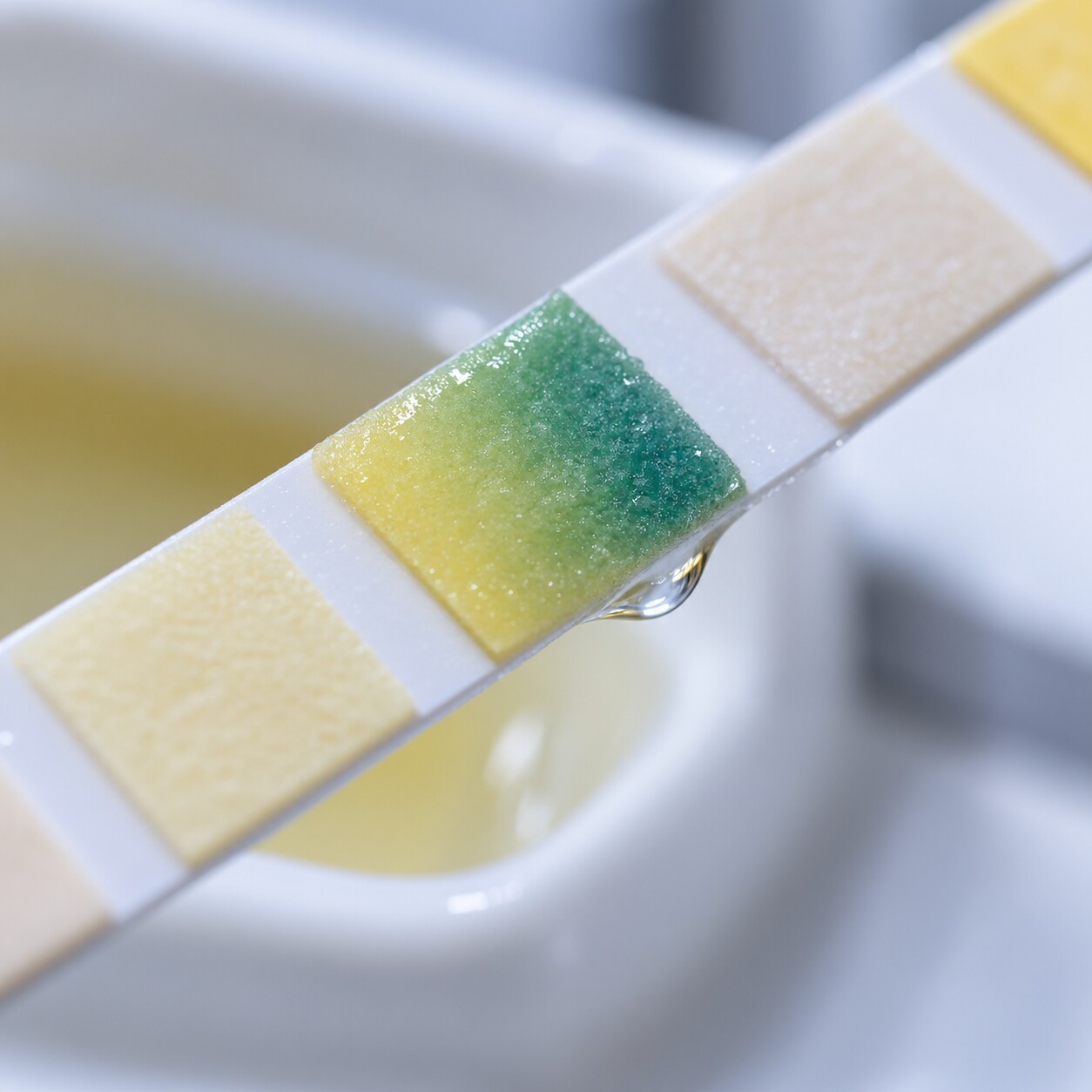
Figure 5. A standard urine dipstick uses a color-changing reagent pad to give a quick estimate of protein concentration, though it's typically followed by a more precise lab test if the result is positive.
The first, fastest test for suspected proteinuria is the same simple dipstick used in nearly every urinalysis: a chemically treated paper strip dipped briefly into a urine sample, where one specific reagent pad changes from pale yellow toward green or blue-green in the presence of albumin, with the depth of that color shift giving a rough, semi-quantitative estimate ranging from "trace" up through "3+" or higher. This test is fast and inexpensive, but it's also intentionally treated as a screening step rather than a final answer, since it's most sensitive specifically to albumin and can occasionally miss other, less common urine proteins, and its results can shift somewhat based on how concentrated or dilute that particular urine sample happens to be.
A positive or borderline dipstick result is typically followed by a more precise test: a urine protein-to-creatinine ratio, run on a single spot urine sample rather than requiring an inconvenient full 24-hour collection. Because creatinine is produced and excreted at a fairly steady, predictable rate, comparing the protein level against it in the same sample corrects for how concentrated or dilute that particular urine happens to be, giving a considerably more reliable number than the dipstick's rough color-based estimate alone. A ratio above a specific, well-established threshold confirms clinically significant proteinuria and typically prompts further workup — blood tests checking kidney function directly, blood pressure measurement, and blood sugar testing, since the specific pattern across all of these results is usually what actually points toward a specific underlying cause among the ones covered in the previous section.
For someone with diabetes specifically, doctors often go one step further and order a dedicated microalbumin test rather than relying on the standard dipstick alone, because standard dipsticks are calibrated to reliably detect only moderate-to-large amounts of protein and can miss the smaller, earlier-stage albumin leak that a microalbumin test is specifically built to catch. This distinction matters enormously in practice: by the time a standard dipstick turns clearly positive, the underlying kidney damage in diabetic nephropathy has often already been progressing for a meaningful stretch of time, whereas a positive microalbumin result can flag the very earliest, most reversible stage of that same damage, sometimes years before visible foam or a positive standard dipstick would ever appear. This is exactly why the American Diabetes Association and similar professional bodies recommend annual microalbumin screening for people with diabetes as a standard part of routine care, rather than waiting for a patient to bring up a symptom like foamy urine on their own.
Once significant proteinuria is confirmed through these tests, the workup that follows is designed to answer one central question: is this protein leak isolated, or is it part of a broader pattern of reduced kidney function? A blood test measuring creatinine and calculating estimated glomerular filtration rate (eGFR) — a number reflecting how efficiently the kidneys are filtering blood overall — is almost always ordered alongside the urine protein test, since a normal eGFR alongside proteinuria points toward earlier-stage damage still worth monitoring and treating proactively, while a reduced eGFR alongside proteinuria suggests kidney function has already been measurably affected and typically prompts a referral to a kidney specialist, called a nephrologist, for more detailed evaluation and ongoing management.
A Less Discussed Cause: Retrograde Ejaculation in Men

Figure 6. Semen contains its own naturally surfactant-like proteins, which is why foamy urine noticed specifically after sexual activity in men sometimes traces back to a harmless anatomical variation rather than kidney disease.
One specific, less commonly discussed cause deserves its own mention because it can otherwise cause unnecessary worry: foamy urine noticed by men specifically after sexual activity or ejaculation. Semen itself contains its own naturally surfactant-like proteins, structurally similar in their foam-producing effect to the albumin discussed earlier in this article, and in a condition called retrograde ejaculation, semen travels backward into the bladder during climax instead of exiting the body normally, mixing with urine and getting expelled the next time that person urinates. This produces genuinely foamy, sometimes cloudy urine that has nothing to do with kidney filtration at all.
Retrograde ejaculation itself is generally not dangerous, though it commonly causes reduced fertility and is worth mentioning to a doctor for that reason, and it can result from certain prostate surgeries, some medications (particularly certain blood pressure and prostate medications), nerve damage from long-standing diabetes, or occur with no identifiable cause at all. The specific, useful distinguishing clue here is timing and pattern: foam that shows up specifically and consistently tied to sexual activity, rather than appearing on ordinary, everyday urination throughout the day, points toward this specific, comparatively benign explanation rather than toward the kidney-related causes covered earlier — a distinction that can meaningfully ease unnecessary worry once it's understood.
Confirming this specific cause, when it's suspected, generally involves a straightforward urine test performed shortly after ejaculation rather than the protein-focused tests described in the previous section — a lab looking specifically for the presence of sperm in a post-ejaculation urine sample, which confirms the mechanism directly rather than relying on timing and pattern alone. This is a genuinely different diagnostic pathway from the one used to evaluate suspected kidney-related proteinuria, which is exactly why mentioning the specific timing pattern to a doctor upfront — foam tied to sexual activity specifically, rather than appearing throughout the day — helps steer the workup toward the right test from the start, rather than needlessly repeating a protein-focused evaluation that was never going to explain this particular pattern.
Why Foamy Urine in Pregnancy Gets Evaluated Faster

Figure 7. Because new-onset proteinuria combined with rising blood pressure can signal preeclampsia, urine protein screening is a standard, repeated part of every prenatal visit rather than a test ordered only when symptoms appear.
Persistent foamy urine noticed during pregnancy is handled with a distinctly faster sense of urgency than the same finding in a non-pregnant adult, and the reason is specific: new-onset protein in the urine, especially when it appears alongside a rise in blood pressure after the twentieth week of pregnancy, is one of the defining diagnostic features of preeclampsia, a serious pregnancy complication that can progress quickly and affects both the pregnant person and the baby if it isn't caught and managed. This is precisely why urine protein screening (usually a quick dipstick check) is a completely routine part of every single prenatal visit, checked repeatedly throughout pregnancy rather than only when someone happens to mention noticing foam.
A pregnant person who notices new, persistent foamy urine between scheduled visits — particularly alongside a new headache, visual changes, swelling beyond what's typical for pregnancy, or pain just under the ribs on the right side — is generally advised to contact their obstetric provider promptly rather than waiting for the next routine appointment, precisely because of how quickly preeclampsia can progress once it starts. This urgency doesn't apply to non-pregnant adults in the same way, which is exactly why pregnancy is treated as its own distinct category throughout this discussion rather than folded into the general causes covered earlier.
It's also worth understanding why preeclampsia produces proteinuria through a mechanism that's somewhat distinct from the chronic, slowly progressive damage described earlier in diabetic nephropathy. Rather than years of gradual structural wear on the filtration barrier, preeclampsia involves specific changes to blood vessel function throughout the body, including within the kidneys, that develop over a comparatively short window during pregnancy itself and, in the large majority of cases, resolve entirely after delivery once those pregnancy-specific vascular changes reverse. This is an important distinction for anyone who experiences it: proteinuria caused specifically by preeclampsia is generally not evidence of permanent kidney damage the way persistent proteinuria in a non-pregnant adult often is, though it still warrants the same close monitoring during pregnancy given how quickly the underlying condition itself can become dangerous if left unaddressed.
Common Misconceptions Worth Clearing Up
A few misunderstandings about foamy urine come up often enough to address directly. The first is assuming that any foam at all is abnormal — as this entire article has covered, a thin, quickly popping layer is expected, ordinary physics for the majority of people, especially with a concentrated first-morning sample, and doesn't warrant concern on its own.
The second is the reverse mistake: assuming that because foam is "just physics" in most cases, it can never be meaningful, and therefore never worth mentioning to a doctor. The specific combination described in this article — foam that's dense, slow to break down, and consistent across multiple days — is a genuinely useful, free, at-home clue that a formal urine protein test would actually be worth having, not something to dismiss reflexively in either direction.
A third misconception is assuming foamy urine, on its own, is painful or comes with other obvious symptoms. In its earlier, more treatable stages, proteinuria from any of the causes covered in this article frequently produces no other symptom at all — no pain, no visible swelling yet, nothing besides the foam itself — which is exactly why it's considered a valuable early clue rather than a redundant one; by the time swelling or other symptoms show up, the underlying kidney damage has often already progressed further than it would have if the foam alone had prompted testing sooner.
A fourth misconception is assuming that treating kidney-related proteinuria always requires dramatic intervention once it's identified. In its earlier stages — particularly diabetic nephropathy caught through routine microalbumin screening — management often centers on tightening control of the underlying driver (blood sugar and blood pressure specifically) alongside a category of medication that directly reduces pressure inside the glomeruli themselves, easing the mechanical stress on that filtration barrier and, in many people, meaningfully slowing or even partially reversing the protein leak over time. This is a large part of why routine screening matters as much as it does: catching this process early generally means more treatment options and a better long-term outlook than waiting until foam becomes obvious enough to notice without any testing at all.
Frequently Asked Questions
Is foamy urine always a sign of kidney problems?
No. A thin layer of bubbles that pops within seconds is normal physics, especially with concentrated morning urine. Persistent, dense foam that keeps rebuilding across multiple days is the pattern that's actually worth having checked.
How can I tell normal foam from concerning foam at home?
Watch how long it lasts and whether it comes back. Normal foam clears within about a minute and doesn't return after flushing. Protein-driven foam is denser, slower to break down, and tends to appear consistently over several days.
What test actually confirms protein in urine?
A dipstick gives a quick screening estimate. If it's positive, a urine protein-to-creatinine ratio on a single sample gives a more precise, reliable measurement without requiring a full 24-hour collection.
Can foamy urine be temporary and not related to kidney disease?
Yes. Intense exercise, fever, and dehydration can all cause temporary, harmless protein increases that resolve on their own within a day or two, which is why doctors often recommend a repeat test on a more typical day.
Why does foamy urine get checked so quickly during pregnancy?
New protein in the urine combined with rising blood pressure after 20 weeks can signal preeclampsia, a serious complication that can progress quickly, which is why urine protein is checked at every prenatal visit.
Conclusion
Foamy urine sits at an unusually clean intersection of basic physics and real clinical significance: the exact same surface-tension mechanism explains both a completely harmless morning observation and one of the more useful early, visible clues to kidney health available to an ordinary person with no equipment beyond their own eyes. What separates the two isn't the presence of foam itself, but its specific character — how long it lasts, how densely it's packed, and whether it keeps showing up day after day — and that distinction traces directly back to whether a specific molecule, albumin, is present in urine at a meaningfully higher concentration than a healthy kidney's filtration barrier should ever allow through.
None of this is meant to turn an occasional foamy bathroom trip into a source of anxiety — for the overwhelming majority of people, most of the time, it's genuinely nothing more than a concentrated morning sample meeting an ordinary toilet bowl. But a consistent, persistent pattern is exactly the kind of free, at-home signal worth mentioning at your next checkup, or worth checking sooner if it's new, since a simple urine protein test is one of the most inexpensive, non-invasive ways available to catch kidney-related damage at its earliest, most manageable stage — well before any other symptom would ever prompt the same conversation.
If there's one practical takeaway to carry forward from everything covered here, it's this: pay attention to the pattern, not the single occurrence. Run the simple few-day, first-morning check described earlier before drawing any conclusion either way, keep the specific distinguishing details in mind — duration, density, and consistency across multiple days — and use them as genuinely useful information the next time this topic comes up with a doctor, rather than either dismissing it reflexively or treating one unusual bathroom trip as cause for alarm. That's exactly the kind of informed, proportionate response this small, ordinary daily observation actually deserves.
Still Not Sure What Your Results Mean?
Upload your labs and get a complete, visual, plain-language interpretation of every biomarker — delivered to your inbox in under 15 minutes.
Get My ReportThis article is for educational purposes only and does not constitute medical advice. Always consult your healthcare provider regarding your specific lab results.