
Can Certain Medications Affect Your Calcium Test Results?
Yes — a number of common medications can meaningfully raise or lower the calcium level reported on your blood test, sometimes enough to flag a result as abnormal even when nothing is wrong with your bones, kidneys, or parathyroid glands. Drugs like thiazide diuretics, lithium, and high-dose vitamin D supplements tend to push calcium up, while bisphosphonates, loop diuretics, and long-term proton pump inhibitor use can pull it down. Because blood calcium sits at the center of a tightly regulated feedback loop involving your parathyroid glands, kidneys, and bones, even a modest medication effect can shift where your result lands on the lab report. Understanding which drugs interfere — and why — helps you and your healthcare provider interpret your results accurately instead of chasing a false alarm.

Curious what your own lab results are really telling you? Upload them and get a complete, plain-language breakdown in under 15 minutes.
Analyze My ResultsHow Your Body Regulates Blood Calcium
Calcium does far more than build strong bones — it's essential for muscle contraction, nerve signaling, blood clotting, and normal heart rhythm. Because these functions are so critical, the body keeps blood calcium within a remarkably narrow range using a feedback loop involving the parathyroid glands, the kidneys, the intestines, and the skeleton itself. When blood calcium dips slightly, the parathyroid glands release parathyroid hormone (PTH), which pulls calcium out of bone, tells the kidneys to reabsorb more calcium instead of excreting it, and activates vitamin D to increase calcium absorption from food. When calcium rises too high, this process reverses. Roughly 99% of the body's calcium is stored in bones and teeth, leaving only about 1% circulating in the blood. Of that circulating fraction, close to 40% is bound to the protein albumin, while the rest — the "ionized" or "free" calcium — is biologically active and unbound. Most routine lab panels report total calcium, which measures both the bound and free portions together. This distinction matters because several medications interfere with one part of this system without necessarily affecting the others, which is exactly why a drug can shift your calcium reading even when your bones and kidneys are perfectly healthy.
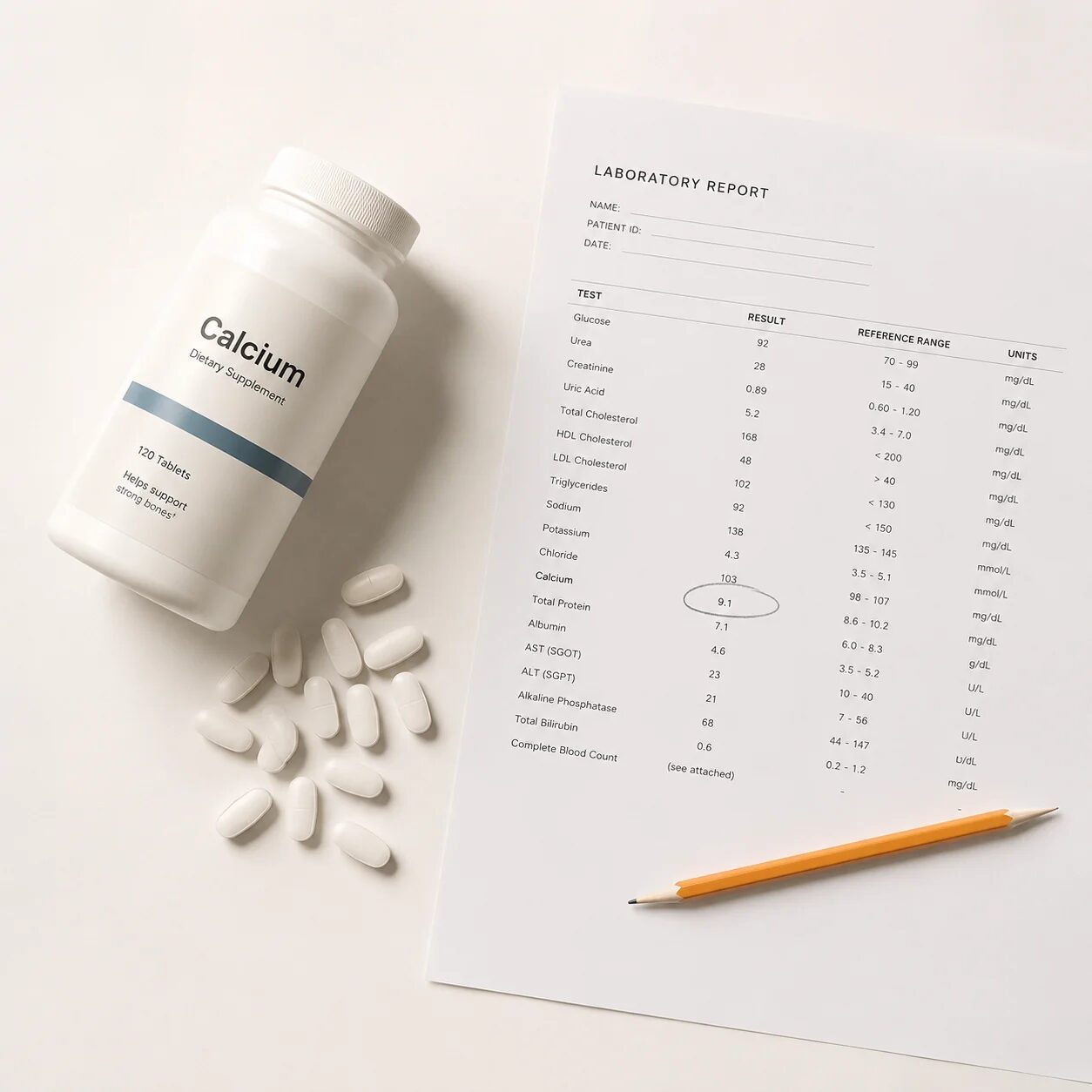
Medications That Can Raise Calcium Levels
Thiazide diuretics, commonly prescribed for high blood pressure (hydrochlorothiazide is the best-known example), reduce how much calcium the kidneys excrete in urine. Over time this can raise blood calcium, and in people with an underlying but previously undiagnosed overactive parathyroid gland, thiazides can unmask hyperparathyroidism that wasn't obvious before. Lithium, used to treat bipolar disorder, alters the parathyroid glands' internal "set point," causing them to release more PTH than they normally would at a given calcium level — this is why patients on long-term lithium therapy typically have their calcium checked periodically. Calcium-containing antacids and supplements are a more direct cause: taking large amounts of calcium carbonate, especially alongside vitamin D, can push blood levels up simply because more calcium is entering the bloodstream than usual. Vitamin D supplements themselves, particularly at high doses, increase how efficiently the intestines absorb dietary and supplemental calcium. Other, less commonly encountered medications — including teriparatide (used for osteoporosis), estrogen therapy, and tamoxifen — can also elevate calcium, sometimes through bone turnover effects. None of these medications are inherently dangerous, but each is worth mentioning to whoever orders your labs.
Medications That Can Lower Calcium Levels
Just as some drugs push calcium up, others pull it down. Bisphosphonates (such as alendronate and zoledronic acid) and the injectable medication denosumab are prescribed to slow bone loss in osteoporosis by blocking the cells that break down bone tissue — since less calcium is being released from bone into the bloodstream, these medications can occasionally cause blood calcium to dip, particularly with intravenous forms. Loop diuretics, such as furosemide, work in the opposite direction from thiazides: they increase how much calcium the kidneys excrete, which can gradually lower blood levels. Long-term corticosteroid use (prednisone and similar drugs) reduces how well the intestines absorb calcium and increases how much the kidneys excrete, while also interfering with vitamin D activity — a combination that can contribute to lower calcium and, over time, bone loss. Certain anticonvulsant medications, including phenytoin, carbamazepine, and phenobarbital, speed up how quickly the liver breaks down vitamin D, leaving less active vitamin D available to help absorb calcium from food. Proton pump inhibitors, widely used for acid reflux and taken long-term, reduce stomach acid needed to dissolve and absorb calcium carbonate — the effect is smaller with calcium citrate, which doesn't require as much stomach acid to be absorbed.

Why Low Albumin Can Make Calcium Look Abnormal
One of the most common reasons a calcium result looks off has nothing to do with medication at all — it's albumin. Because roughly 40% of blood calcium travels bound to the protein albumin, a standard total calcium test is directly affected by however much albumin is present. If albumin is low — which can happen with liver disease, malnutrition, chronic illness, or even pregnancy — total calcium will read lower than it truly is, even though the ionized, biologically active calcium your body is actually using may be completely normal. This is sometimes called a lab artifact rather than true hypocalcemia. To account for this, clinicians often calculate a "corrected calcium" value that adjusts the total calcium reading based on the albumin level, or they order a direct ionized calcium test, which isn't influenced by albumin at all. This distinction becomes especially relevant when interpreting results in people taking medications that also affect liver function or protein levels, since a low-albumin reading combined with a medication effect can otherwise be mistaken for a more serious calcium imbalance than actually exists.
What to Do Before Your Calcium Test
The single most useful thing you can do before a calcium blood test is give your provider a complete list of everything you're taking — prescription medications, over-the-counter antacids, and any calcium or vitamin D supplements, including the dose and how recently you took them. This context alone often explains an unexpected result without requiring additional testing. Never stop or adjust a medication on your own before a lab draw; if a specific drug is likely to interfere, your provider will tell you whether to pause it briefly or simply account for it when reviewing your results. Fasting generally isn't required for a calcium test on its own, though it's frequently drawn alongside a broader metabolic panel that may have its own preparation instructions. If your result comes back outside the reference range, don't panic — your provider will typically look at your full medication list, your albumin level, and sometimes a follow-up ionized calcium test before drawing any conclusions.

Frequently Asked Questions
Should I stop taking my medications before a calcium blood test?
No — never stop or adjust a medication before a lab test without your provider's guidance. If a specific drug is a concern, your provider may temporarily pause it or simply account for the interference when interpreting your results. Stopping medications like thiazides, lithium, or steroids on your own can create other health risks unrelated to the test itself.
Can vitamin D or calcium supplements affect my calcium blood test?
Yes. High-dose vitamin D increases how much calcium your intestines absorb from food and supplements, which can raise your blood calcium level. Calcium-containing antacids and supplements have a similar direct effect. If you take either regularly, mention the dose and timing to your provider — that context is often enough to correctly interpret an elevated result.
What's the difference between total calcium and ionized calcium tests?
Total calcium measures every form of calcium in your blood, including the portion bound to the protein albumin. Ionized calcium measures only the "free" calcium your body actually uses for muscle, nerve, and clotting function, and it isn't affected by albumin levels. Total calcium is used for routine screening because it's simpler and cheaper, but when albumin is abnormal or results are borderline, an ionized calcium test gives a clearer picture.

Conclusion
An unexpected calcium result isn't always a sign that something is wrong with your bones or organs — it's often a reflection of a medication you're already taking as prescribed. Thiazide diuretics, lithium, and vitamin D or calcium supplements tend to push levels up, while bisphosphonates, loop diuretics, corticosteroids, anticonvulsants, and long-term PPI use can pull them down, and low albumin can distort the reading further still. The best way to make sense of your own numbers is to share your complete medication list with whoever orders your labs, and to ask questions about anything that looks unexpected rather than assuming the worst.
Still Not Sure What Your Results Mean?
Upload your labs and get a complete, visual, plain-language interpretation of every biomarker — delivered to your inbox in under 15 minutes.
Get My ReportThis article is for educational purposes only and does not constitute medical advice. Always consult your healthcare provider regarding your specific lab results.