
What's the Connection Between CA 19-9 and Pancreatitis?
Pancreatitis — inflammation of the pancreas — is one of the single most common reasons a CA 19-9 result comes back elevated with no cancer anywhere in sight. The connection is direct and mechanical: CA 19-9 is produced by the very cells that line the ducts of the pancreas, and inflammation disrupts those cells enough to push far more of the marker into the bloodstream than usual. During a single acute attack, roughly one in four people show a CA 19-9 above the normal cutoff of 37 U/mL. In chronic, long-standing pancreatitis, where scarring and duct damage accumulate over months or years, documented cases have shown levels reaching into the thousands, and in rare extremes, into the tens of thousands — numbers that, taken alone, would normally raise serious alarm. Understanding why pancreatitis does this, how the acute and chronic forms behave differently, and — critically — the one pattern doctors do watch closely within this relationship, can turn a frightening lab result into a much more manageable, and far less mysterious, piece of information about what your body is actually going through.
Curious what the rest of your lab panel is telling you? Upload your results and get a complete, plain-language breakdown in under 15 minutes.
Analyze My ResultsWhy an Inflamed Pancreas Raises a Cancer-Associated Blood Marker
To understand this connection, it helps to remember what CA 19-9 actually is: not a substance made exclusively by tumors, but a normal sugar-coated protein (a glycoprotein antigen) manufactured by the epithelial cells that line the pancreatic ducts, the bile ducts, and parts of the digestive tract, as a routine part of everyday cell activity. Under normal circumstances, a small amount is shed into the bloodstream and an even larger amount drains harmlessly into the digestive tract along with pancreatic secretions. Cancer doesn't invent this molecule — it simply causes far more of it to be produced and, more importantly, disrupts the normal channels that would otherwise clear it away.
Pancreatitis produces a strikingly similar effect through an entirely different, non-malignant route. When the pancreas becomes inflamed — whether from a blocked duct, alcohol, gallstones, or another trigger — the ductal cells lining it become irritated, swollen, and in more severe cases, injured or destroyed. Irritated ductal tissue behaves like irritated tissue anywhere else in the body: it becomes more permeable and more active, both of which increase how much CA 19-9 leaks sideways into the bloodstream and the surrounding lymphatic channels instead of following its normal path out through the digestive tract. On top of this direct leakage, inflammation frequently causes localized swelling that partially or fully blocks the pancreatic duct itself, the same narrow channel CA 19-9 would normally exit through — trapping the antigen with nowhere to go but into the blood supply. The result is a blood marker that was never designed to detect inflammation at all, responding to it anyway, simply because inflammation happens to disrupt the same tissue and the same drainage pathways that produce and clear the marker in the first place.
A useful way to picture this is to think of the pancreatic duct as a one-way service road that normally carries CA 19-9, along with digestive enzymes, out into the small intestine, while only a small, steady trickle spills over into the bloodstream as background traffic. Cancer and inflammation both do the same basic thing to this system, just for different reasons: they narrow or block the service road. When the road is blocked, the material that would have traveled down it has nowhere to go but sideways, into the surrounding blood vessels and lymphatic channels — which is exactly why obstruction, whether caused by a tumor, a gallstone, a stricture from scarring, or simple inflammatory swelling, is such a consistently powerful driver of CA 19-9 elevation across so many different conditions. The blood test cannot tell the difference between a road blocked by a tumor and a road blocked by inflammation; it only measures how much material ended up in the bloodstream instead of its intended destination. That single limitation is the root of nearly every confusing CA 19-9 result discussed anywhere in the medical literature, pancreatitis included.
Acute Pancreatitis: How Often, and How High

Acute pancreatitis is a sudden, intense inflammation of the pancreas, most commonly triggered by a gallstone temporarily blocking the shared opening where the bile duct and pancreatic duct meet, or by heavy alcohol use — with high triglycerides, certain medications, and other less common causes making up the rest. It typically announces itself with severe, steady upper-abdominal pain that often radiates to the back, frequently accompanied by nausea and vomiting, and it usually lands people in an emergency room rather than building gradually over weeks. The pain is often distinctive enough that people describe it as unlike any stomach or digestive discomfort they've experienced before — a deep, boring ache rather than cramping, frequently worse after eating and sometimes partially relieved by leaning forward. Diagnosis in the emergency setting typically combines this symptom pattern with blood tests showing elevated pancreatic enzymes and, often, imaging such as an ultrasound or CT scan to look for gallstones and assess the degree of pancreatic swelling. Research tracking CA 19-9 in patients hospitalized with acute pancreatitis has found that roughly 27% show a result above the standard 37 U/mL cutoff at some point during the attack — meaning the majority of acute cases do not raise the marker at all, but a meaningful minority clearly do, and it's worth remembering that percentage every time an elevated result shows up on a pancreatitis admission's lab panel.
How high the number climbs during an acute attack tends to track with how severe and how complicated the episode is. A mild, uncomplicated flare that resolves within a few days often produces only a modest elevation, if any. More severe attacks — particularly those involving pancreatic necrosis (tissue death within the gland itself) or the formation of a pseudocyst (a fluid-filled pocket that can develop as the pancreas heals) — tend to produce substantially higher readings, sometimes climbing into the hundreds or beyond, because both necrosis and pseudocyst formation intensify local tissue disruption and further obstruct normal drainage. Gallstone-triggered attacks carry an additional layer to this picture: because the gallstone is often also partially obstructing the bile duct on its way into the pancreas, the elevation seen in these cases can reflect two overlapping mechanisms at once — pancreatic inflammation and biliary obstruction — compounding the rise beyond what pancreatic inflammation alone would produce.
Doctors also lean on more than CA 19-9 alone when sizing up how serious an acute attack is. Standard severity scoring tools used at the bedside — measures that weigh factors like age, white blood cell count, blood glucose, and organ function in the first 48 hours — remain the primary way clinicians grade how severe an attack is and predict complications, and CA 19-9 is not one of their standard inputs. Two other pancreatic enzymes, amylase and lipase, are the actual first-line blood tests used to diagnose pancreatitis in the first place, since they rise and fall in a much more predictable, well-studied pattern tied specifically to acute pancreatic injury. CA 19-9, when it's drawn during a pancreatitis workup, is typically riding along as part of a broader panel or because a doctor is already thinking about the pancreas for other reasons — it plays a supporting, contextual role in this picture rather than being the test that diagnoses or grades the attack itself.
Chronic Pancreatitis: Why Levels Can Climb Into the Thousands
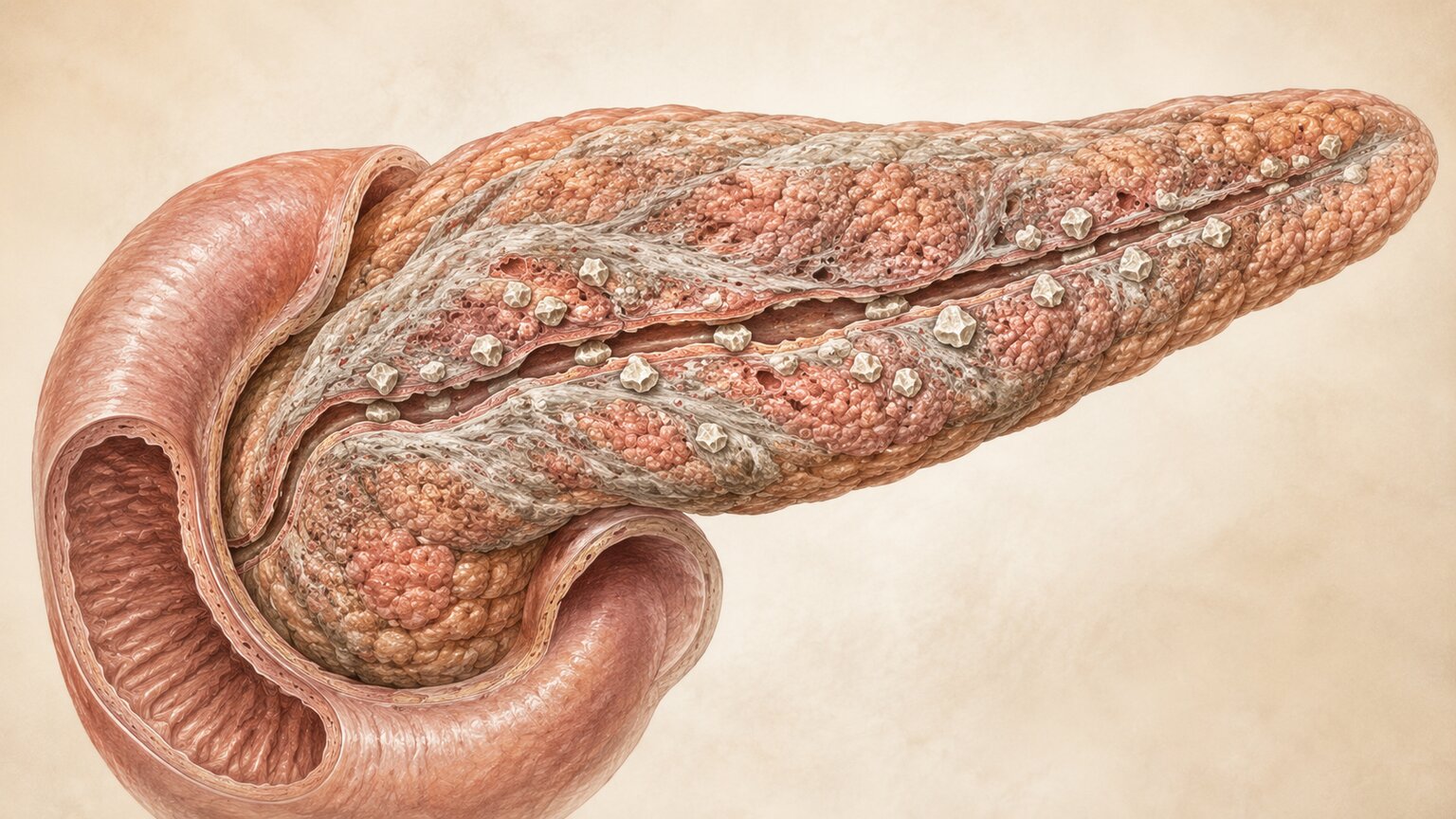
Chronic pancreatitis is a fundamentally different process from a single acute attack — it's the result of repeated or prolonged inflammation, most often from long-term heavy alcohol use, that gradually replaces healthy pancreatic tissue with scar tissue, narrows the ducts with strictures, and in many cases leaves behind visible calcium deposits (calcifications) scattered through the gland. Because this damage is persistent rather than a single resolving event, the CA 19-9 elevation it produces tends to be more sustained and, in some individuals, considerably more dramatic than what's typically seen in a single acute episode. Medical case literature has documented chronic pancreatitis patients with CA 19-9 levels as high as 2,350 U/mL, and in one extraordinary reported case, a reading of over 104,000 U/mL — a number that, divorced from context, looks unmistakably like advanced cancer, yet reflected purely benign, longstanding inflammatory damage.
The reason chronic disease can push levels this high comes down to the same two mechanisms seen in acute pancreatitis, but now operating continuously rather than during a single flare: ongoing irritation of ductal tissue keeps production elevated, while the strictures and scarring that build up over years create semi-permanent bottlenecks that trap the antigen and force more of it into the bloodstream instead of its normal drainage route. This is precisely why chronic pancreatitis is singled out in the medical literature as one of the trickiest benign conditions to interpret CA 19-9 results in — the baseline elevation can persist indefinitely, making a single very high number far less alarming on its own than it would be in someone with an otherwise healthy pancreas, but also making genuine new changes harder to spot against an already-elevated backdrop.
There's a second, longer-horizon layer to the chronic pancreatitis story that's worth understanding, separate from the immediate question of what a single elevated result means. Years of persistent inflammation and cell turnover in chronic pancreatitis are independently associated with a modestly increased lifetime risk of eventually developing pancreatic cancer, a risk that appears highest in hereditary and early-onset forms of the condition and generally builds gradually over decades rather than appearing suddenly. This is not the same claim as "chronic pancreatitis is likely to become cancer" — for the large majority of people with chronic pancreatitis, it never does — but it's the reason people with a long-standing diagnosis are sometimes enrolled in more structured, longer-term monitoring than someone who had a single resolved acute episode. In that monitoring context, a CA 19-9 that has climbed meaningfully above a person's own established baseline, rather than one that's simply elevated in the way it has always been, is treated as more noteworthy than the raw number alone would suggest, precisely because the comparison point is the individual's own history rather than the general population's reference range.
How Doctors Actually Tell the Two Apart
Given that both pancreatitis and pancreatic cancer can raise CA 19-9, sometimes to a similar magnitude, it's worth understanding what actually separates the two in clinical practice, since it's rarely the blood test working alone. The starting point is almost always the clinical story: a clear preceding trigger like documented gallstones, a well-established pattern of heavy alcohol use, or high triglycerides on the same admission strongly favors a straightforward pancreatitis explanation, while pancreatitis with no identifiable trigger prompts more scrutiny by default. From there, imaging does the heavy lifting that a blood marker never can. A CT scan, MRI, or in more detailed cases an endoscopic ultrasound (a small ultrasound probe passed down through the stomach to get an unusually close, high-resolution view of the pancreas) can directly visualize whether the gland shows the diffuse, generalized swelling typical of inflammation or a discrete, localized mass suggestive of a tumor — a distinction no blood test can make on its own, since both processes can produce an identical number on a lab report.
Trend over time is the other major piece of the puzzle, and it's part of why doctors are often reluctant to react strongly to a single CA 19-9 result in this setting. A level that rises during the acute phase of pancreatitis and then falls in step with clinical recovery over the following weeks behaves exactly the way an inflammation-driven elevation is expected to behave. A level that fails to fall as expected, or that continues climbing even as pain, nausea, and other acute symptoms resolve, breaks that expected pattern and is one of the more reliable signals that something other than simple, resolving inflammation may be at play. In practice, this combination — the story behind the attack, direct imaging of the gland, and the trajectory of repeat testing — carries far more diagnostic weight than any single CA 19-9 number viewed in isolation, which is exactly why an elevated result during a pancreatitis episode is a starting point for context-gathering rather than a conclusion in itself.
The One Pattern Doctors Do Watch Closely
All of this raises an important question: if pancreatitis so reliably explains an elevated CA 19-9, does that mean doctors can simply write off every high result in a pancreatitis patient as harmless? Not entirely — and this is the genuinely important nuance in this relationship. Research has found that among patients hospitalized with acute pancreatitis, those with significantly higher CA 19-9 levels during their attack were statistically more likely to be subsequently found to have an underlying pancreatic cancer as the actual root cause of their pancreatitis — meaning the tumor itself had been quietly obstructing the pancreatic duct, and the resulting blockage is what triggered the pancreatitis attack in the first place, rather than the more usual culprits of gallstones or alcohol.
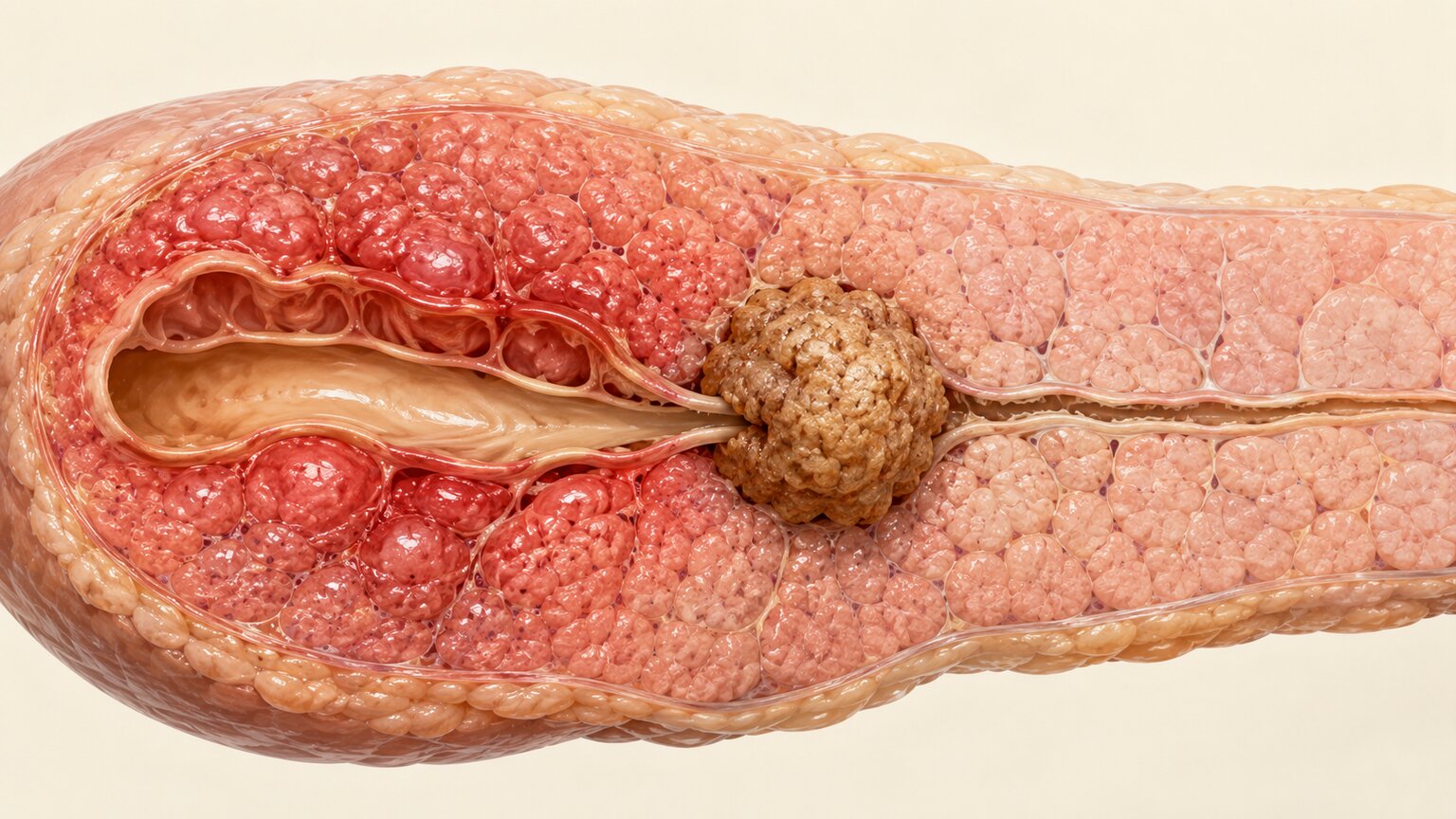
This is why a first episode of pancreatitis with no obvious cause — no gallstones seen on imaging, no history of heavy drinking, no elevated triglycerides — is treated somewhat differently than a textbook gallstone or alcohol-related attack. In these "unexplained" cases, especially in people over roughly 40 to 50, doctors are more inclined to pursue further imaging of the pancreas even after the acute inflammation settles down, specifically to rule out a mass sitting quietly behind the inflammation. A very high CA 19-9, particularly one that doesn't track proportionally with how mild the clinical picture otherwise looks, is one of the signals that can tip a doctor toward pursuing that extra imaging sooner rather than simply attributing the whole picture to a routine, self-limited flare. It's a genuinely useful distinction to hold onto: pancreatitis explaining a high CA 19-9 is the overwhelmingly common scenario, but in a small subset of unexplained cases, the causality runs the other direction, with a hidden mass explaining both the pancreatitis and the elevated marker at once.
Why Timing Matters: Half-Life, Resolution, and When to Retest
One detail that shapes how doctors interpret CA 19-9 around a pancreatitis episode is how quickly the marker actually clears from the bloodstream once its source of production or obstruction goes away. CA 19-9 has a biological half-life in circulation of roughly 12 to 14 hours, meaning that once the underlying inflammation calms down and normal drainage is restored, the body clears it out relatively quickly compared to how slowly some other markers behave. In practice, this means levels that were significantly elevated during the height of an acute attack often fall substantially within days, and typically approach or return to normal within two to four weeks after the inflammation has genuinely resolved.
This clearance timeline is exactly why testing CA 19-9 in the middle of an active pancreatitis flare, and treating that number as diagnostically meaningful in the moment, is generally considered premature. A result drawn during peak inflammation reflects the inflammation itself far more than it reflects anything else going on in the pancreas. The more informative approach — and the one most clinicians actually follow — is to let the acute episode fully settle, then repeat the CA 19-9 several weeks later. A level that has fallen back into the normal range on that follow-up test is a reassuring sign that the elevation was, as expected, driven by the inflammatory episode itself. A level that remains stubbornly elevated well after the pancreatitis has clinically resolved is a different story, and typically prompts closer follow-up, additional imaging, or both, precisely because it no longer fits the expected pattern of a transient, inflammation-driven spike.
What This Means If You've Just Been Diagnosed With Pancreatitis

If you've recently been hospitalized or treated for a gallstone attack, an alcohol-related flare, or any other cause of acute pancreatitis, and a CA 19-9 test came back elevated somewhere in that process, the single most useful piece of context is simply this: that result is exactly what would be expected, and on its own it is not a signal of cancer. Roughly a quarter of people with acute pancreatitis show this same pattern, and it typically resolves right alongside the pancreatitis itself. There is generally no need for alarm from an isolated elevated reading drawn during or shortly after an acute episode, particularly if there's a clear, identified cause like gallstones on imaging or a documented history of heavy alcohol use.
What's genuinely worth following up on is the trajectory afterward, not the single number from the hospitalization itself. If your doctor recommends a repeat CA 19-9 test some weeks after you've recovered, that's a normal and sensible part of closing the loop — confirming that the level has come back down as expected. If you have chronic pancreatitis rather than a single acute episode, ongoing elevation may simply be your baseline, and your care team will typically interpret any given reading in the context of your prior results and trend over time, rather than against the general population's normal range. And if your pancreatitis appeared without an obvious trigger, don't be surprised if your doctor recommends a bit more imaging than usual to look directly at the pancreas — that's a routine, sensible precaution given everything above, not an indication that something has already been found.
It's also worth understanding that treating the underlying cause of pancreatitis does more than just address the current episode — it directly affects what happens to your CA 19-9 going forward, too. If gallstones triggered the attack, having the gallbladder removed (a common and often recommended step after a first gallstone pancreatitis episode, since the risk of a repeat attack is otherwise significant) removes the recurring source of duct obstruction entirely. If heavy alcohol use was the trigger, reducing or stopping drinking lowers the risk of both a repeat acute episode and the slow progression toward chronic pancreatitis. In either case, addressing the root cause is what actually protects both your pancreas and your future lab results — a CA 19-9 that spikes with each new attack and normalizes between them is a very different pattern, and a very different conversation, than one that's sustained continuously because the underlying trigger was never addressed.
Frequently Asked Questions
If my CA 19-9 was high during a pancreatitis flare, will it definitely go back to normal?
In most cases, yes. Since CA 19-9 clears from the blood within roughly 12 to 14 hours once its source calms down, levels driven by acute inflammation typically fall substantially within days and normalize within two to four weeks of genuine recovery. Persistent elevation well after resolution is less common and is usually what prompts further follow-up.
Does chronic pancreatitis mean my CA 19-9 will always be elevated?
Not necessarily always, but ongoing elevation is common because the structural damage — scarring, duct strictures, calcifications — doesn't resolve the way a single acute flare does. Many people with chronic pancreatitis have a personal "new normal" baseline that's above the general population cutoff, which is why doctors often track your own trend over time rather than judging a single result against the standard range alone.
Should CA 19-9 be tested during an active pancreatitis attack at all?
It's often drawn as part of a broader lab panel during hospitalization, but most clinicians treat a result taken during active inflammation with caution, since it's expected to reflect the inflammation itself rather than anything else. The more diagnostically useful reading is typically a follow-up test after the attack has fully resolved.
Is gallstone pancreatitis more likely to raise CA 19-9 than alcohol-related pancreatitis?
Gallstone-triggered attacks can sometimes produce a larger elevation because the gallstone may also be partially obstructing the bile duct on its way into the pancreas, adding a biliary obstruction effect on top of the pancreatic inflammation itself. That said, both causes of acute pancreatitis can raise CA 19-9, and the degree of elevation varies considerably from person to person and attack to attack.
What would make a doctor look beyond pancreatitis as the explanation for a high CA 19-9?
The main flags are a first pancreatitis episode with no identified cause (no gallstones, no significant alcohol use, no elevated triglycerides), a CA 19-9 level that seems disproportionately high relative to how mild the clinical picture otherwise looks, or a level that stays persistently elevated well after the pancreatitis has clinically resolved. Any of these typically prompts additional imaging to look directly at the pancreas.
Does having chronic pancreatitis mean I'll eventually develop pancreatic cancer?
No — for the large majority of people with chronic pancreatitis, it never progresses to cancer. Long-standing inflammation is associated with a modestly increased lifetime risk, which is highest in hereditary and early-onset forms of the condition and builds gradually over decades, which is why some people with a long-standing diagnosis are enrolled in more structured monitoring rather than because cancer is expected.
Can amylase and lipase help explain whether a high CA 19-9 is from pancreatitis?
Indirectly, yes. Amylase and lipase are the actual first-line tests used to diagnose acute pancreatitis, and elevated levels of both alongside a high CA 19-9 support pancreatitis as the explanation. CA 19-9 itself isn't part of standard pancreatitis diagnosis or severity scoring — it's typically a secondary finding on a broader lab panel rather than a test ordered to evaluate the pancreatitis itself.
Conclusion
Pancreatitis and CA 19-9 are connected through simple biological proximity: the marker is made by the very ductal cells that inflammation attacks, and the same swelling that causes pancreatitis pain also disrupts the normal channels that marker would otherwise drain through, pushing extra amounts into the bloodstream instead. This explains why roughly a quarter of acute pancreatitis cases and a large share of chronic pancreatitis cases show an elevated result, sometimes dramatically so, without any cancer being involved at all. The one thread worth holding onto amid that reassurance is the unexplained case — a first pancreatitis episode with no clear trigger and a strikingly high CA 19-9 is one of the situations where doctors dig a little deeper, precisely because in rare instances the pancreatitis itself turns out to be the first visible sign of a mass quietly blocking the duct. Distinguishing the two in practice always comes down to more than the number alone — the story behind the attack, direct imaging of the gland, and how the level behaves over the following weeks together carry far more weight than a single elevated reading ever could. For the great majority of people recovering from a garden-variety gallstone or alcohol-related attack, an elevated CA 19-9 drawn during or shortly after that episode is simply the pancreas doing what inflamed tissue anywhere in the body does — and it's worth discussing the specific number, the suspected cause, and any recommended follow-up testing directly with the provider who ordered it. Addressing the root cause, whether that means gallbladder removal or a change in alcohol use, does more than treat the immediate episode; it also removes the recurring driver behind future CA 19-9 elevations, which is ultimately a more useful goal than fixating on any single number from a single hospital visit.
Still Not Sure What Your Results Mean?
Upload your labs and get a complete, visual, plain-language interpretation of every biomarker — delivered to your inbox in under 15 minutes.
Get My ReportThis article is for educational purposes only and does not constitute medical advice. Always consult your healthcare provider regarding your specific lab results.