
What Does a Low-Titer ANA Result Actually Mean?
An antinuclear antibody, or ANA, test is genuinely one of the most frequently ordered screening tests used broadly across autoimmune disease evaluation, and it's also, quite unfortunately, one of the most frequently misunderstood tests once an actual result finally comes back to the patient. A "positive" ANA result sounds genuinely alarming entirely on its own, but the actual titer attached to it — a specific measure of exactly how strongly positive the result truly is — changes the real meaning of that single word quite dramatically, and a low-titer positive is a genuinely different, considerably far less concerning finding than most people naturally assume the very first moment they see the word "positive" printed anywhere on their own report. This article walks through what "titer" actually means on this specific test, exactly how common a low-titer positive is in the general healthy population, the specific numeric cutoffs used and why the line separating positive from negative sits where it does, why age meaningfully raises the odds of a low-titer positive, whether the immunofluorescence staining pattern matters at low titer, the situations where even a low titer deserves a closer look, how symptoms shape what happens next, why repeating the test rarely clarifies anything at low titer, and how a low-titer result genuinely differs from a high-titer one.
What "Titer" Actually Means on This Test

Figure 1. A titer measures how many times a blood sample can be diluted while still testing positive; 1:40 means only mild dilution was needed to lose the reaction, while 1:320 means it persisted through much heavier dilution.
The traditional ANA test uses a technique called indirect immunofluorescence, where a lab technician takes a patient's blood sample and progressively dilutes it — first 1 part sample to 40 parts diluting solution, then 1 to 80, then 1 to 160, and so on — testing each dilution against a slide of cells to see whether antinuclear antibodies are still present in strong enough concentration to produce a visible glowing reaction under a fluorescence microscope. The titer reported on your result is the most dilute concentration that still produced a clearly visible positive reaction.
This is exactly why a higher titer number, counterintuitively, represents a stronger positive rather than a weaker one: a result of 1:320 means antibodies were still detectable even after the sample was diluted 320-fold, indicating a considerably higher original antibody concentration than a 1:40 result, where the reaction disappeared after only mild dilution. Understanding this specific inverse relationship clearly is genuinely the single most important piece of context needed for correctly and confidently reading any ANA titer result at all going forward.
How Common a Low-Titer Positive Actually Is

Figure 2. Population studies consistently find a meaningful share of entirely healthy people test positive for ANA at a low titer, with that proportion rising steadily as age increases.
Large population studies looking at ANA positivity in people with no autoimmune disease and no symptoms of one have consistently found that a genuinely meaningful percentage of healthy adults test positive at low titer, generally in the range of 1:40 to 1:80, when tested using the standard immunofluorescence method. This is genuinely not a laboratory error, nor is it any kind of flaw in the underlying test itself — it simply reflects the biological reality that the human immune system occasionally, naturally produces small quantities of these particular antibodies as part of ordinary biological variation, without this ever actually developing into any related autoimmune disease at all for the vast majority of people.
This particular background rate of low-titer positivity is exactly why professional guidelines specifically recommend ordering an ANA test only when there's a genuine, real clinical suspicion of autoimmune disease based on actual reported symptoms, rather than reaching for it as a general, catch-all screening test in someone with no relevant symptoms at all — testing a person with no genuinely suggestive symptoms meaningfully increases the overall odds of encountering one of these expected, entirely normal background-rate positives, one that then requires unnecessary explanation, follow-up conversation, and reassurance that could have been avoided entirely by simply not ordering the test in that specific context to begin with.
Curious what your own lab results are actually telling you? Upload your results and get a complete, plain-language breakdown in under 15 minutes.
Analyze My ResultsWhy the ANA Cutoff Line Was Deliberately Chosen, Not Arbitrary
The specific choice to set a laboratory's cutoff at 1:80 rather than 1:40, or at some other titer entirely, reflects a genuine, deliberate statistical tradeoff between two competing goals: setting the threshold too low captures more true cases of disease but also flags far more healthy people unnecessarily, while setting it too high misses genuine cases in exchange for fewer false alarms. Laboratories and professional organizations arrive at their specific cutoffs by studying large groups of both healthy people and confirmed autoimmune patients, choosing the threshold that best balances catching real disease against generating an unmanageable volume of incidental, ultimately meaningless positives.
Understanding that this specific number wasn't chosen arbitrarily, but represents a genuine, carefully considered statistical compromise, helps explain why the cutoff can differ modestly between laboratories and organizations without any of them being simply wrong — they're each making a reasonable, defensible choice along the same fundamental tradeoff, based on their own specific patient population and testing method.
The Specific Cutoffs, and Why the Line Sits Where It Does
Most laboratories consider a titer of 1:80 or higher to be a genuinely positive result, with 1:40 sometimes reported as positive by some labs and as a borderline or negative finding by others, depending on that specific laboratory's own established cutoff. This variability between labs isn't arbitrary — each laboratory determines its own cutoff by testing a large sample of healthy people and setting the threshold at a level that captures a reasonable balance between catching genuine disease and avoiding excessive false positives from the normal background rate already discussed.
This is exactly why comparing an ANA titer from one laboratory directly against a titer from a different laboratory can be misleading without accounting for each lab's own specific cutoff and testing method — the safest, most meaningful comparison is one made using the same laboratory and the same testing method over time, which matters considerably if your titer is ever being tracked across more than one test.
Why Age Meaningfully Raises the Odds of a Low-Titer Positive
The background rate of low-titer ANA positivity in healthy people isn't evenly distributed across every age group — it rises steadily as age increases, with older adults showing meaningfully higher rates of incidental low-titer positivity than younger adults, even in the complete absence of any autoimmune disease. The exact underlying biological reason for this age-related rise isn't yet fully settled or completely understood, but it's generally thought to relate to gradual, cumulative changes in overall immune regulation that naturally accumulate over the course of a long lifetime, entirely separate from and unrelated to any actual underlying disease process taking place.
This particular age-related pattern is exactly why an incidental low-titer ANA discovered in an older adult, found during testing ordered for a completely unrelated reason, is generally interpreted even more conservatively and reassuringly than that exact same numeric result would be in a considerably younger person, since the baseline expected background rate of this specific finding is already meaningfully higher within that older age group to begin with, well before any individual testing even occurs.
Why Some Healthy People Have a Genetic Tendency Toward Low-Titer Positivity
Beyond age and sex, researchers have identified that ANA positivity, including at low titer, tends to run somewhat in families, suggesting a genetic component to how readily a given person's immune system produces these antibodies at baseline, entirely separate from developing any autoimmune condition. Having a close relative with a known autoimmune disease modestly raises the background likelihood of testing positive yourself, though it's important to be clear that this raised likelihood applies mainly to testing positive on this particular screening test, not to actually developing the disease itself, which remains a considerably less common outcome even in that context.
This genetic tendency toward antibody production existing on something of a spectrum, rather than as a strict binary between "will develop autoimmune disease" and "never will," helps explain why a family history of autoimmune disease is one of the pieces of context a doctor reasonably asks about when interpreting an unexpected low-titer result, without that family history alone being treated as a reason for alarm on its own.
Does the Staining Pattern Matter at Low Titer?
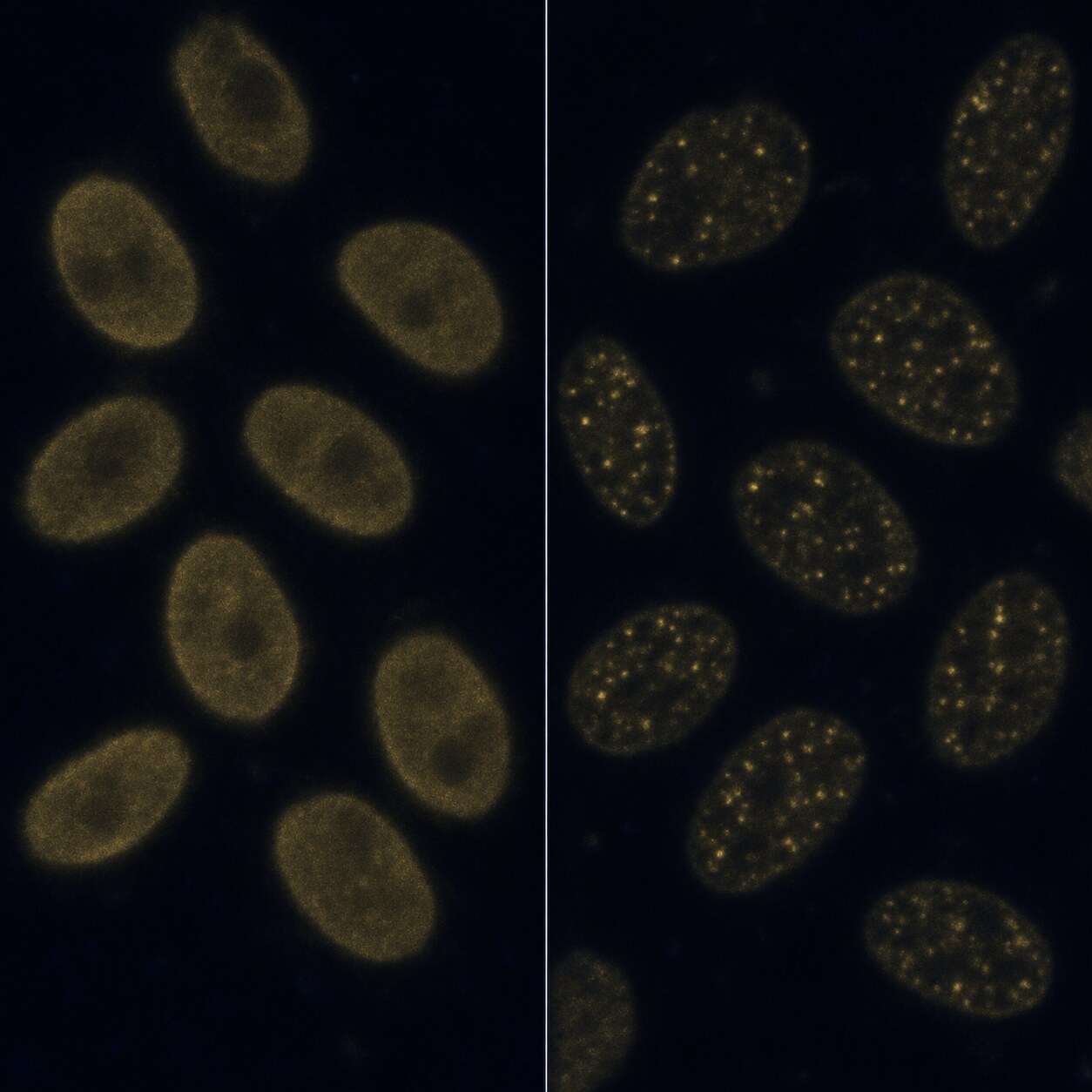
Figure 3. The immunofluorescence staining pattern offers a modest additional clue at any titer, but at low titer specifically, it rarely changes the overall interpretation on its own.
Beyond the numeric titer itself, an immunofluorescence ANA test also reports a staining pattern, describing the specific visual appearance of how the antibodies bind to different structures within the cell nucleus — homogeneous, speckled, nucleolar, and centromere patterns are among the most common. Certain specific patterns are more strongly and specifically associated with particular autoimmune conditions than others when they're found at a genuinely high titer, offering a genuinely useful additional clue that helps a clinician narrow down exactly which further, more specific tests are actually worth pursuing next.
At a genuinely low titer specifically, though, the staining pattern carries considerably less real diagnostic weight overall, since the underlying antibody concentration present is simply too low for that particular pattern to reliably or confidently indicate anything specific about a genuinely evolving disease process taking place beneath the surface. A homogeneous or speckled pattern reported alongside a 1:40 or 1:80 titer generally doesn't meaningfully change the overall interpretation of an otherwise genuinely reassuring result in any significant way, quite unlike how that exact same pattern would be weighed and interpreted differently at a considerably higher, more clinically concerning titer level.
When a Low Titer Still Deserves a Closer Look

Figure 4. A low-titer result appearing alongside genuine, specific symptoms like joint swelling, a distinctive rash, or unexplained fatigue is weighed very differently than the exact same titer found with no symptoms at all.
Despite everything covered so far, a low-titer ANA isn't automatically dismissed in every situation. When a low titer appears alongside genuinely specific, suggestive symptoms — persistent joint swelling rather than vague aches, a distinctive facial rash, unexplained hair loss, or other findings consistent with a specific autoimmune condition — a doctor generally proceeds with a fuller evaluation rather than reassuring dismissal, since the symptom pattern itself, not the titer number alone, is what's actually driving concern in that specific scenario.
This is a genuinely important, easy-to-overlook nuance worth internalizing clearly: the specific titer number and the surrounding full clinical picture are always meant to be read carefully together as one combined whole, never in true isolation from each other, no matter how tempting it might feel to focus on the number alone. A low titer with a compelling, specific symptom pattern still warrants real investigation, while the exact same low titer found incidentally in someone with no relevant symptoms at all is interpreted far more conservatively, precisely because the titer number by itself was never designed to carry the full diagnostic weight on its own.
Why Fibromyalgia and Chronic Fatigue Are Often Discussed Alongside This Test
Fibromyalgia and chronic fatigue syndrome deserve a specific mention here, since both conditions produce genuinely real, often significant symptoms — widespread pain, profound fatigue — that can understandably prompt a doctor to order an ANA test as part of ruling out an underlying autoimmune cause. Because these conditions are common, and because a low-titer ANA is also common in the general population as this article has established, the two findings frequently coexist in the same person without one actually causing the other.
This coincidental overlap is worth being aware of specifically because it can create genuine confusion: a person with fibromyalgia who also happens to have an incidental low-titer ANA might reasonably wonder whether an underlying autoimmune condition explains their symptoms, when in most such cases, the two findings are simply occurring in the same person by coincidence rather than one genuinely causing the other. Recognizing this distinction is part of why a doctor evaluating this specific combination looks carefully for the more specific, autoimmune-suggestive symptoms already discussed throughout this article, rather than treating the low-titer ANA itself as the explanation for the fatigue or pain.
Why Repeating the Test Rarely Clarifies a Low Titer
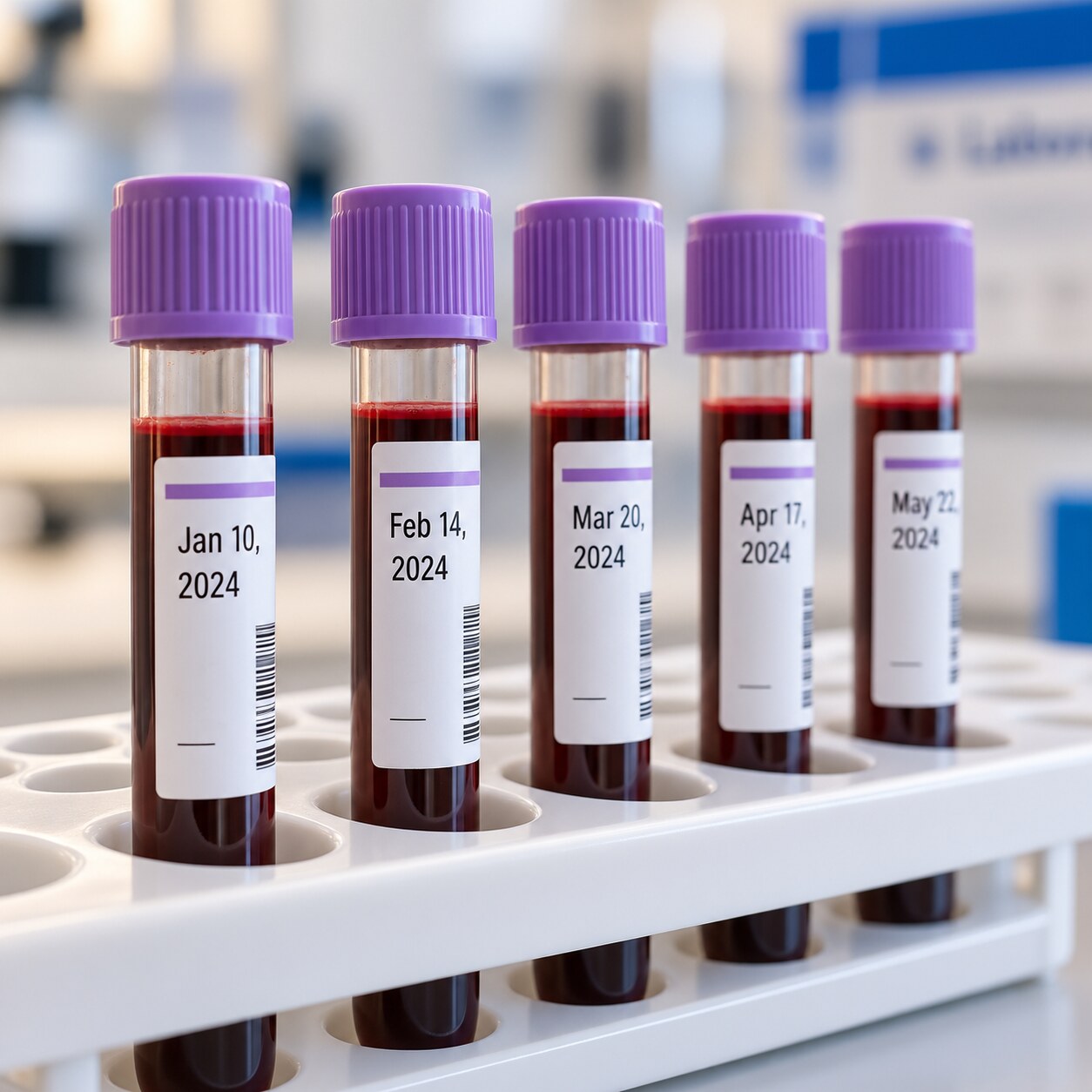
Figure 5. Because a low-titer ANA has meaningful natural variability between individual tests, repeating the test soon after usually adds more confusion than clarity rather than settling the question.
Unlike some lab values where repeating a test soon after an unexpected result reliably clarifies the picture, a low-titer ANA has genuine test-to-test variability, meaning a repeat test drawn just weeks later can reasonably come back negative, unchanged, or even modestly higher without any of these outcomes necessarily meaning anything clinically significant has changed. This inherent variability is part of why doctors generally don't recommend immediately repeating a low-titer ANA simply to double-check it, since the added result often creates more confusion than clarity.
When repeat testing genuinely turns out to be useful in a specific case, it's typically spaced out deliberately over a period of several months rather than just a few weeks, and interpreted carefully alongside whether any genuinely new symptoms have developed in that interim period, rather than being treated as a simple, standalone confirm-or-deny check performed in complete isolation shortly after the original result came back.
How Children's ANA Results Get Interpreted Differently
ANA testing in children raises some additional considerations worth understanding separately, since the specific autoimmune conditions relevant in pediatric populations, and the diseases most commonly screened for using this test, differ somewhat from the adult population. Juvenile idiopathic arthritis, one of the more common autoimmune conditions in children, is specifically associated with ANA positivity in a meaningful share of affected children, and in this particular context, ANA positivity carries additional practical relevance beyond diagnosis alone — it's also used to help guide decisions about how frequently a child needs specific eye screening, since ANA-positive juvenile idiopathic arthritis carries a higher risk of an associated eye inflammation that can develop with minimal early symptoms.
This pediatric-specific use of the ANA titer, feeding directly into a screening schedule rather than only into diagnosis, is a good example of how the same basic test can serve a genuinely different, additional practical purpose depending on the specific clinical context and population being tested, beyond simply determining whether autoimmune disease is present in the first place.
How a Low-Titer Result Genuinely Differs From a High-Titer One

Figure 6. A high-titer ANA, particularly 1:320 or above, carries a meaningfully stronger association with genuine autoimmune disease than a low-titer result, and is followed up correspondingly more assertively.
Higher ANA titers, particularly at 1:320 and beyond, carry a genuinely stronger, considerably better-established statistical association with confirmed, real autoimmune disease compared to titers sitting in the lower 1:40 to 1:80 range already discussed at length, and this meaningfully stronger association is exactly what directly shapes how aggressively and quickly a given positive result actually gets pursued clinically. A genuinely high-titer positive, especially when it appears alongside real, suggestive symptoms, typically prompts a considerably more thorough diagnostic workup relatively promptly and without much delay, including several more specific follow-up antibody tests each targeting one particular autoimmune condition directly.
This titer-dependent, graduated approach genuinely reflects the real, measurable, well-documented difference in disease association found at different points along the full titer scale, rather than crudely treating the single word "positive" as one uniform, entirely undifferentiated category that means the exact same thing regardless of the actual number attached to it. Understanding precisely where your own specific individual result actually falls along this fuller scale, rather than fixating narrowly on whether it's simply labeled positive or negative on the page, is genuinely the single most useful piece of information available for correctly and appropriately gauging exactly how seriously to weigh that particular result in the first place.
Reading Your Own Report: What to Actually Look At
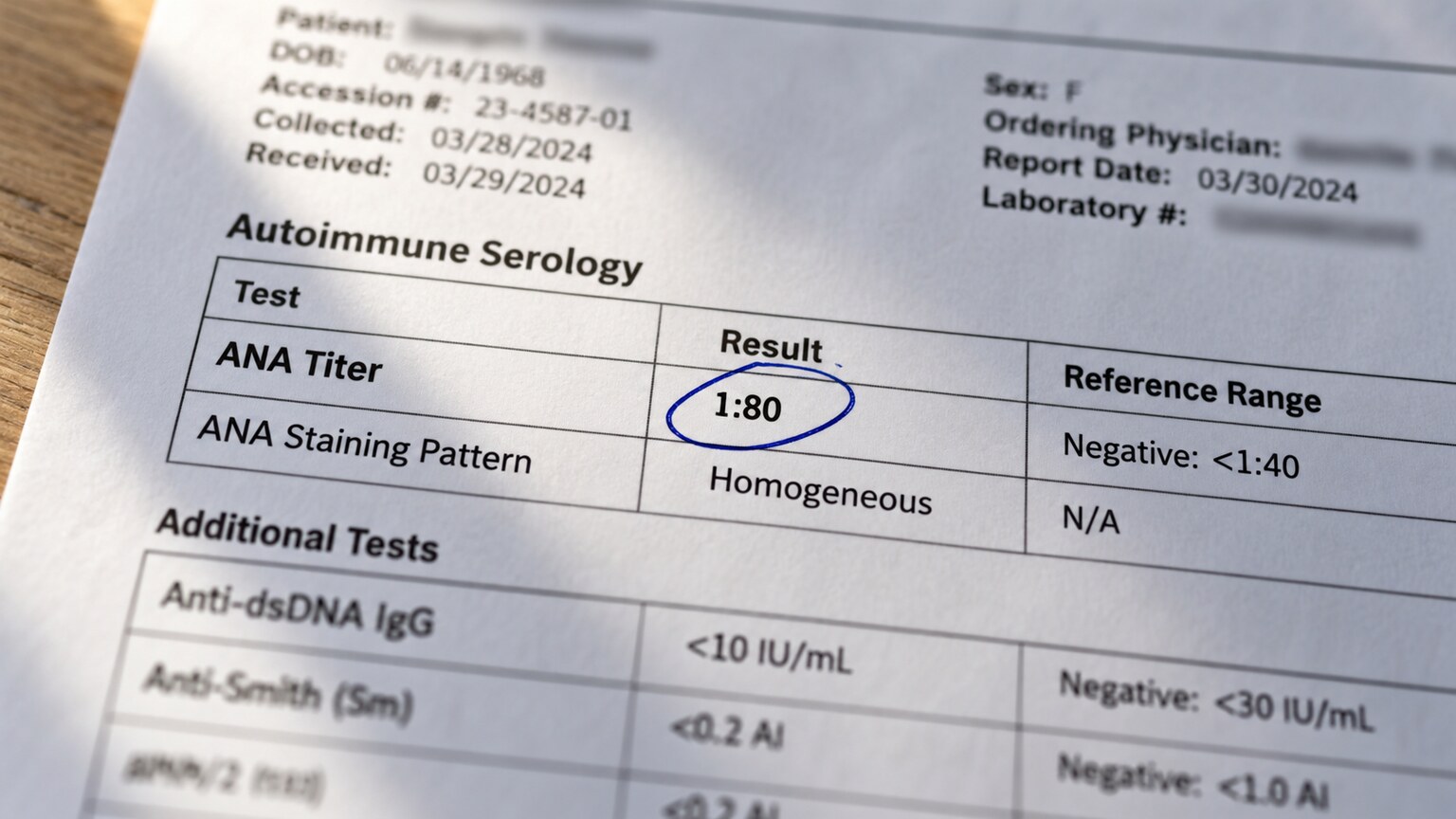
Figure 7. A complete ANA report lists both the titer and the specific staining pattern together; reading them side by side, rather than focusing on the word "positive" alone, is what actually matters.
When you're looking at your own ANA report, the two pieces of information worth focusing on are the titer itself, expressed as a ratio like 1:80, and the staining pattern listed beside it, rather than simply the word "positive" or "negative" printed at the top. The specific laboratory's own reference range, printed directly on the report, tells you exactly where that lab's cutoff sits, which matters given the lab-to-lab variability already discussed earlier in this article.
If your own specific result sits comfortably at 1:40 or 1:80, with a staining pattern that isn't accompanied by any of the more specific, concerning symptoms already discussed earlier in this article, the most genuinely useful next step is generally a calm, unhurried conversation with whoever originally ordered the test about your own personal symptom history, rather than treating the single printed word "positive" as some kind of standalone diagnosis in and of itself. That specific conversation, genuinely informed by everything already covered in careful detail throughout this article, is really what actually turns a confusing, unfamiliar lab value into a clear, appropriately and thoughtfully weighted piece of usable information going forward.
Common Misconceptions About a Low-Titer ANA
One common, quite understandable misconception is that any positive ANA result at all automatically means genuine autoimmune disease is currently present or is otherwise imminent and inevitable. As covered in real depth throughout this article, a genuinely low-titer positive is actually quite common in otherwise perfectly healthy people, especially with steadily increasing age, and by itself carries a meaningfully, measurably lower overall disease association than a genuinely high-titer result found under the same circumstances.
A second closely related misconception is that a subsequently negative repeat test somehow definitively rules out a prior low-titer positive as having been entirely meaningless, or that, conversely, a subsequently positive repeat test definitively confirms that something clinically important has genuinely changed since the original test. Given the genuinely real, well-documented test-to-test variability already discussed at length earlier in this article, a single isolated repeat result drawn soon after the original one is rarely, entirely on its own, the truly definitive answer in either direction, positive or negative.
A third common misconception worth addressing directly is that the specific staining pattern always adds genuinely meaningful, reliable diagnostic information no matter what the actual titer happens to be. At low titer specifically, the pattern carries considerably less weight than the same pattern would at a genuinely high titer, since the underlying antibody concentration is too low to reliably indicate anything pattern-specific.
A Practical Comparison Across the Titer Scale
1:40 sits right at the border many labs consider negative to borderline, genuinely common in healthy people and rarely pursued further without specific symptoms. 1:80 is considered positive by most labs, still common enough as a background finding that it's interpreted primarily through the lens of accompanying symptoms rather than alarm on its own. 1:160 begins to carry a somewhat stronger association with genuine autoimmune disease, more often prompting at least a basic symptom review even without dramatic complaints. 1:320 and above carries the strongest, best-established association with confirmed autoimmune disease among these categories, typically prompting a more thorough workup including specific follow-up antibody testing. Seeing these categories laid out side by side helps explain why two people, both technically "ANA positive," can receive genuinely different levels of follow-up depending on exactly where their own specific titer falls along this scale.
Why the ANA Test Uses This Older Technique Instead of a Simple Number
It's worth understanding why the ANA test still relies on this dilution-based titer method rather than reporting a single, simple numeric value the way many other blood tests do. Indirect immunofluorescence, the technique underlying the traditional ANA test, was developed decades ago and remains the recommended reference method specifically because it allows a trained technologist to directly visualize both the presence and the specific staining pattern of the antibodies, information a purely numeric assay can't fully replicate on its own.
Newer, automated ANA testing methods do exist, reporting results in a more conventional numeric format, and some laboratories have shifted toward these newer methods for speed and consistency. However, these automated methods don't always correlate perfectly with the traditional titer-based approach, which is part of why professional guidelines still recommend the traditional immunofluorescence method, especially for confirming an initial positive result from a newer automated screening test, before that result is treated as fully reliable.
How Sex Differences Factor Into ANA Positivity
Beyond age, biological sex is another well-documented factor influencing the background rate of ANA positivity, with women showing meaningfully higher rates of both low-titer and high-titer ANA positivity than men across most studied populations. This pattern mirrors the broader, well-established sex difference seen across autoimmune disease generally, where most autoimmune conditions occur several times more frequently in women than in men, for reasons connected to hormonal and genetic factors that researchers continue to study actively.
This sex-related pattern is one more piece of context that factors into how a given titer gets interpreted in practice — a low-titer positive in a woman, while still generally reassuring on its own without accompanying symptoms, is being read against a population baseline that already runs somewhat higher than the equivalent baseline for men, which is part of why the symptom picture, rather than sex alone, remains the deciding factor in any individual case.
Frequently Asked Questions
Is a low-titer ANA result something to worry about?
Generally not, especially with no suggestive symptoms. Low-titer ANA positivity, typically 1:40 to 1:80, is genuinely common in healthy people and increases with age, without necessarily indicating autoimmune disease.
Why does a higher titer number mean a stronger positive?
The titer represents how many times a sample could be diluted while still testing positive. A higher number, like 1:320, means the antibodies remained detectable even after much heavier dilution, indicating a higher original concentration.
Should I get my ANA rechecked if it comes back low-titer positive?
Not usually right away. Low-titer ANA has genuine test-to-test variability, so repeating it soon after can add confusion rather than clarity. If retesting is useful, it's typically spaced months apart and paired with symptom tracking.
Does the staining pattern matter if my titer is low?
Less than it would at a high titer. At low titer, the antibody concentration is generally too low for the specific staining pattern to reliably point toward any particular condition.
Why would my doctor still investigate a low-titer ANA further?
If it appears alongside genuinely specific symptoms, like persistent joint swelling or a distinctive rash, the symptom pattern itself, not the titer number alone, drives the decision to investigate further.
Can medications cause a positive ANA result?
Yes. Certain medications are well-documented to cause ANA positivity, sometimes at low titer, entirely separate from any underlying autoimmune process, which is why a medication review is a standard early step in interpreting an unexpected result.
Does a negative ANA result completely rule out autoimmune disease?
Not entirely, but a clearly negative result carries strong negative predictive value for lupus specifically, since the large majority of genuine cases test positive. A few specific conditions can occur with ANA negativity.
Why are women more likely to have a positive ANA than men?
Women show meaningfully higher background rates of ANA positivity than men, mirroring the broader pattern seen across autoimmune disease generally, where most autoimmune conditions occur more frequently in women.
Why Certain Medications Can Also Produce a Low-Titer Positive
Beyond age, sex, and simple normal biological variation, certain medications are well-documented to trigger ANA positivity as a side effect, sometimes at low titer and sometimes considerably higher. This medication-associated positivity is distinct from full drug-induced lupus, a more specific and considerably rarer syndrome discussed in more depth in a related article, but it illustrates the same broader principle: an ANA result can't be fully interpreted without knowing what medications a person is currently taking, since certain drugs are recognized, expected causes of a positive result entirely separate from any underlying autoimmune process.
This is exactly why a thorough medication review is one of the standard, routine first steps whenever an unexpected ANA positivity comes up for discussion, regardless of the specific titer involved — ruling out a known medication-associated cause is often one of the fastest, most straightforward explanations available, and pursuing it early can save a person from unnecessary additional testing when a simpler, medication-related explanation genuinely accounts for the finding.
Why an Incidental Finding Differs From a Test Ordered for Symptoms
The context in which an ANA test was originally ordered meaningfully shapes how any resulting titer should be interpreted, a distinction worth making explicit. An ANA ordered specifically because of genuine, suggestive symptoms — persistent joint swelling, an unexplained rash, ongoing unexplained fatigue alongside other findings — carries a different baseline likelihood of representing genuine disease than the same titer discovered incidentally, perhaps as part of a broader panel ordered for an entirely unrelated reason, in someone with no relevant symptoms at all.
This is exactly why the same numeric result, say 1:80 with a speckled pattern, can reasonably lead to two different next steps depending entirely on why the test was ordered in the first place: continued investigation in the symptomatic case, and simple reassurance with no further action in the incidental case. Understanding which of these two scenarios actually applies to your own situation is often more informative than the titer number itself in predicting what happens next.
What a Genuinely Negative ANA Result Tells You
It's worth briefly addressing the opposite scenario for context: a genuinely negative ANA result, meaning no detectable positivity even at the lowest tested dilution, carries real, meaningful negative predictive value for several of the autoimmune conditions this test is used to screen for, particularly systemic lupus erythematosus, where the large majority of genuine cases test ANA positive at some point. A negative result doesn't rule out every possible autoimmune condition, since some specific conditions are associated with ANA negativity even when genuinely present, but for the conditions most commonly screened for with this test, a clearly negative result is a genuinely reassuring finding.
Seeing both ends of this spectrum together — a clearly negative result on one end, a low-titer positive in the genuinely common, largely reassuring middle, and a high-titer positive with a much stronger disease association on the other end — helps place any individual result within the full range of what this test is actually capable of showing, rather than viewing a single number in isolation from the broader scale it sits on.
How This Test Fits Into a Broader Autoimmune Workup
An ANA test is rarely, on its own, either the first or the last test in a genuine autoimmune workup — it functions more as a broad screening step that, when positive at a meaningful titer alongside suggestive symptoms, leads toward more specific follow-up testing targeting particular conditions, such as the anti-dsDNA and anti-Smith antibody tests covered in related articles on this site. A low-titer ANA with no suggestive symptoms typically doesn't proceed to this next layer of more specific testing at all, precisely because the initial screening result didn't clear the bar that would justify it.
Understanding this layered structure — broad screening test first, specific confirmatory tests only when warranted — helps explain why a low-titer ANA alone rarely triggers an extensive battery of additional autoimmune testing, while a high-titer result alongside suggestive symptoms reasonably does. The test was designed from the outset to function this way, as an entry point into a broader diagnostic process rather than a single, standalone verdict.
Putting the Full Picture Together
Across every angle covered in this article, one consistent theme holds: the raw label "ANA positive" tells you almost nothing useful on its own, while the actual titer, the staining pattern, your age and sex, your medication list, and above all your actual symptoms together build the fuller picture this test was always designed to be read within. A low titer sitting at 1:40 or 1:80, with no accompanying symptoms, sits comfortably within the range of ordinary, expected human biological variation for a meaningful share of the healthy population.
For anyone holding a recent low-titer ANA result and feeling uncertain about what it means, working back through the specific factors covered in this piece — your age, whether any genuinely suggestive symptoms are present, your current medications, and how the specific titer compares to your own lab's stated reference range — is a far more productive use of that uncertainty than assuming the worst from the word "positive" printed at the top of the page.
Conclusion
A low-titer ANA result looks alarming printed on a page next to the word "positive," but understanding what titer actually measures, how common a low-titer finding genuinely is in healthy people, and how age and staining pattern factor into the interpretation turns an intimidating result into a considerably clearer, more manageable one. The number by itself was genuinely never meant to stand entirely alone — read carefully alongside your own actual symptoms, medication history, age, and family background, a low-titer ANA is, for the overwhelming majority of people who ever encounter one, a genuinely reassuring, largely unremarkable finding rather than an early warning sign of something serious to come.
Still Not Sure What Your Results Mean?
Upload your labs and get a complete, visual, plain-language interpretation of every biomarker — delivered to your inbox in under 15 minutes.
Get My ReportThis article is for educational purposes only and does not constitute medical advice. Always consult your healthcare provider regarding your specific lab results.